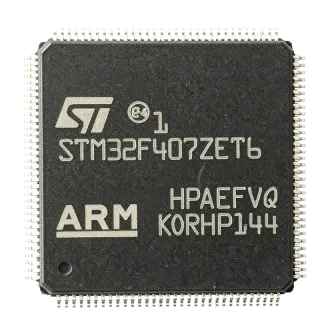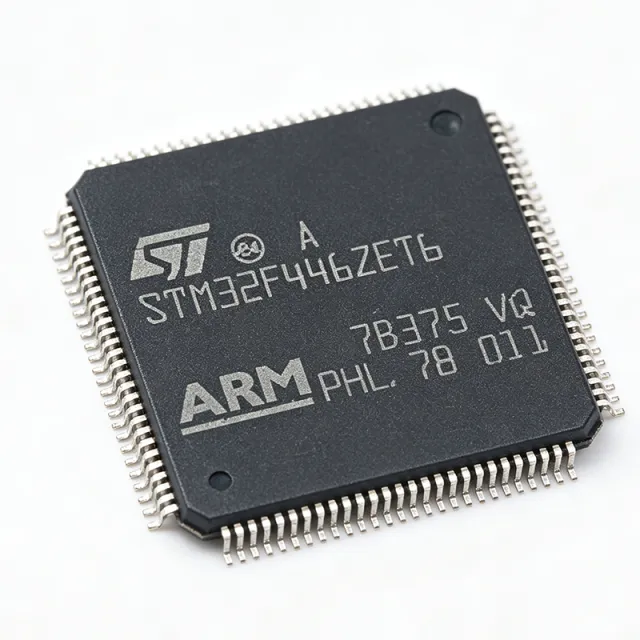
STM32F446ZET6 - 180MHz ARM Cortex-M4F MCU | STMicroelectronics
Артикул: STM32F446ZET6 ✓ Активен| Кол-во | Цена за ед. | Итого |
|---|---|---|
| 1 | $10.3636 | $10,36 |
| 10 | $7.4848 | $74,85 |
| 100 | $6.6212 | $662,12 |
| 500 | $6.3333 | $3.166,65 |
| 1.000 | $6.0455 | $6.045,50 |
STM32F446ZET6 Обзор
What is a microcontroller? A microcontroller (MCU) is a compact integrated circuit designed to govern a specific operation in an embedded system. It integrates a processor core, memory (flash and SRAM), and programmable input/output peripherals on a single chip. Microcontrollers are the backbone of embedded systems, enabling control, monitoring, and communication in devices ranging from automotive engine control units to smart home sensors. The STM32F446ZET6 is a high-end MCU within the STM32 family, positioned above entry-level Cortex-M0/M3 parts and offering superior performance and peripheral integration.
Key features of the STM32F446ZET6 include a 180 MHz ARM Cortex-M4F core with FPU, 512 KB flash memory, 128 KB SRAM, and a comprehensive set of peripherals: multiple 12-bit ADCs, DACs, timers, USARTs, SPIs, I2Cs, USB OTG, CAN, and an FMC (Flexible Memory Controller) for external memory expansion. The device supports a wide supply voltage range of 1.8V to 3.6V and operates over a temperature range of -40°C to +85°C. It also features a true random number generator (RNG), a cryptographic acceleration cell, and a real-time clock (RTC).
The STM32F446ZET6 is built on ST's advanced 90nm process technology, delivering a balance of performance and power efficiency. The Cortex-M4F core with FPU accelerates mathematical computations, making it ideal for DSP and control algorithms. The device includes a memory protection unit (MPU) and a nested vectored interrupt controller (NVIC) for robust real-time operation. The FMC supports external SDRAM, NOR, and NAND flash, enabling large data buffers and code expansion.
Typical applications include motor control (e.g., field-oriented control of brushless DC motors), industrial automation (PLCs, robotics), medical devices (patient monitors, infusion pumps), and consumer electronics (smart appliances, audio systems). The rich connectivity options (USB, CAN, UART, SPI, I2C) make it a versatile choice for IoT gateways and human-machine interfaces (HMI).
When designing with the STM32F446ZET6, ensure proper decoupling of the power supply pins with 100nF capacitors placed close to each VDD pin, and a 4.7uF bulk capacitor. The VDDA pin should be filtered with a ferrite bead and capacitor to reduce analog noise. The device supports multiple low-power modes (Sleep, Stop, Standby) to optimize battery life in portable applications.
Аналоги без доработки для STM32F446ZET6 — тот же корпус, pin-to-pin совместимость. Компоненты в других корпусах, требующие переработки PCB, исключены.
Инструмент быстрого сравнения — выберите альтернативные компоненты для сравнения бок о бок:
STM32F446ZET6TR
📋 Справочный аналог (нет в каталоге)
STM32F446ZET6Q
📋 Справочный аналог (нет в каталоге)
STM32F446ZET7
✓ В наличии
Уточнить цену
Открыть даташит →STM32F446ZET6 Максимальные параметры и электрические характеристики
| Core | ARM Cortex-M4F with FPU |
| Maximum Clock Speed | 180 MHz |
| Flash Memory | 512 KB |
| SRAM | 128 KB |
| Supply Voltage Range | 1.8 V to 3.6 V |
| Диапазон рабочих температур | -40°C to +85°C |
| Корпус | LQFP144 (20x20 mm) |
| Number of I/O Pins | 114 |
| ADC | 3x 12-bit, up to 24 channels |
| DAC | 2x 12-bit |
| Timers | 12x 16-bit, 2x 32-bit |
| USART | 4x |
| SPI | 4x |
| I2C | 4x |
| USB | USB OTG FS/HS |
| CAN | 2x |
| FMC | Yes (external memory interface) |
| RNG | Yes (true random number generator) |
| RTC | Yes (with calendar) |
| DMA | 16 channels |
| Статус RoHS | Compliant |
Конфигурация выводов STM32F446ZET6
| Контакт 1 | PE2 — GPIO / alternate functions |
| Контакт 2 | PE3 — GPIO / alternate functions |
| Контакт 3 | PE4 — GPIO / alternate functions |
| Контакт 4 | PE5 — GPIO / alternate functions |
| Контакт 5 | PE6 — GPIO / alternate functions |
| Контакт 6 | VBAT — Backup battery supply |
| Контакт 7 | PC13 — GPIO / RTC tamper |
| Контакт 8 | PC14 — GPIO / OSC32_IN |
| Контакт 9 | PC15 — GPIO / OSC32_OUT |
| Контакт 10 | PF0 — GPIO / FMC_A0 |
| Контакт 11 | PF1 — GPIO / FMC_A1 |
| Контакт 12 | PF2 — GPIO / FMC_A2 |
| Контакт 13 | PF3 — GPIO / FMC_A3 |
| Контакт 14 | PF4 — GPIO / FMC_A4 |
| Контакт 15 | PF5 — GPIO / FMC_A5 |
| Контакт 16 | VSS — Ground |
| Контакт 17 | VDD — Power supply |
| Контакт 18 | PF6 — GPIO / FMC_NWAIT |
| Контакт 19 | PF7 — GPIO / FMC_NE1 |
| Контакт 20 | PF8 — GPIO / FMC_NCE2 |
| Контакт 21 | PF9 — GPIO / FMC_NCE3 |
| Контакт 22 | PF10 — GPIO / FMC_NE2 |
| Контакт 23 | PF11 — GPIO / FMC_NCE4 |
| Контакт 24 | PF12 — GPIO / FMC_A6 |
| Контакт 25 | PF13 — GPIO / FMC_A7 |
| Контакт 26 | PF14 — GPIO / FMC_A8 |
| Контакт 27 | PF15 — GPIO / FMC_A9 |
| Контакт 28 | PG0 — GPIO / FMC_A10 |
| Контакт 29 | PG1 — GPIO / FMC_A11 |
| Контакт 30 | PG2 — GPIO / FMC_A12 |
| Контакт 31 | PG3 — GPIO / FMC_A13 |
| Контакт 32 | PG4 — GPIO / FMC_A14 |
| Контакт 33 | PG5 — GPIO / FMC_A15 |
| Контакт 34 | VSS — Ground |
| Контакт 35 | VDD — Power supply |
| Контакт 36 | PG6 — GPIO / FMC_NE1 |
| Контакт 37 | PG7 — GPIO / FMC_INT |
| Контакт 38 | PG8 — GPIO / FMC_NCE2 |
| Контакт 39 | PG9 — GPIO / FMC_NE2 |
| Контакт 40 | PG10 — GPIO / FMC_NE3 |
| Контакт 41 | PG11 — GPIO / FMC_NE4 |
| Контакт 42 | PG12 — GPIO / FMC_NE4 |
| Контакт 43 | PG13 — GPIO / FMC_A24 |
| Контакт 44 | PG14 — GPIO / FMC_A25 |
| Контакт 45 | PG15 — GPIO / FMC_SDNCAS |
| Контакт 46 | PD0 — GPIO / FMC_D2 |
| Контакт 47 | PD1 — GPIO / FMC_D3 |
| Контакт 48 | PD2 — GPIO / FMC_D4 |
| Контакт 49 | PD3 — GPIO / FMC_D5 |
| Контакт 50 | PD4 — GPIO / FMC_D6 |
| Контакт 51 | PD5 — GPIO / FMC_D7 |
| Контакт 52 | PD6 — GPIO / FMC_D8 |
| Контакт 53 | PD7 — GPIO / FMC_D9 |
| Контакт 54 | VSS — Ground |
| Контакт 55 | VDD — Power supply |
| Контакт 56 | PD8 — GPIO / USART3_TX |
| Контакт 57 | PD9 — GPIO / USART3_RX |
| Контакт 58 | PD10 — GPIO / USART3_CK |
| Контакт 59 | PD11 — GPIO / USART3_CTS |
| Контакт 60 | PD12 — GPIO / USART3_RTS |
| Контакт 61 | PD13 — GPIO / TIM4_CH2 |
| Контакт 62 | PD14 — GPIO / TIM4_CH3 |
| Контакт 63 | PD15 — GPIO / TIM4_CH4 |
| Контакт 64 | PC0 — GPIO / ADC123_IN10 |
| Контакт 65 | PC1 — GPIO / ADC123_IN11 |
| Контакт 66 | PC2 — GPIO / ADC123_IN12 |
| Контакт 67 | PC3 — GPIO / ADC123_IN13 |
| Контакт 68 | PC4 — GPIO / ADC12_IN14 |
| Контакт 69 | PC5 — GPIO / ADC12_IN15 |
| Контакт 70 | VSS — Ground |
| Контакт 71 | VDD — Power supply |
| Контакт 72 | PB2 — GPIO / BOOT1 |
| Контакт 73 | PE7 — GPIO / TIM1_ETR |
| Контакт 74 | PE8 — GPIO / TIM1_CH1 |
| Контакт 75 | PE9 — GPIO / TIM1_CH1N |
| Контакт 76 | PE10 — GPIO / TIM1_CH2 |
| Контакт 77 | PE11 — GPIO / TIM1_CH2N |
| Контакт 78 | PE12 — GPIO / TIM1_CH3 |
| Контакт 79 | PE13 — GPIO / TIM1_CH3N |
| Контакт 80 | PE14 — GPIO / TIM1_CH4 |
| Контакт 81 | PE15 — GPIO / TIM1_CH4N |
| Контакт 82 | PB10 — GPIO / I2C2_SCL |
| Контакт 83 | PB11 — GPIO / I2C2_SDA |
| Контакт 84 | VSS — Ground |
| Контакт 85 | VDD — Power supply |
| Контакт 86 | PB12 — GPIO / SPI2_NSS |
| Контакт 87 | PB13 — GPIO / SPI2_SCK |
| Контакт 88 | PB14 — GPIO / SPI2_MISO |
| Контакт 89 | PB15 — GPIO / SPI2_MOSI |
| Контакт 90 | PD8 — GPIO / USART3_TX |
| Контакт 91 | PD9 — GPIO / USART3_RX |
| Контакт 92 | PD10 — GPIO / USART3_CK |
| Контакт 93 | PD11 — GPIO / USART3_CTS |
| Контакт 94 | PD12 — GPIO / USART3_RTS |
| Контакт 95 | PD13 — GPIO / TIM4_CH2 |
| Контакт 96 | PD14 — GPIO / TIM4_CH3 |
| Контакт 97 | PD15 — GPIO / TIM4_CH4 |
| Контакт 98 | PC6 — GPIO / TIM3_CH1 |
| Контакт 99 | PC7 — GPIO / TIM3_CH2 |
| Контакт 100 | PC8 — GPIO / TIM3_CH3 |
| Контакт 101 | PC9 — GPIO / TIM3_CH4 |
| Контакт 102 | PA0 — GPIO / ADC123_IN0 / WKUP |
| Контакт 103 | PA1 — GPIO / ADC123_IN1 |
| Контакт 104 | PA2 — GPIO / ADC123_IN2 / USART2_TX |
| Контакт 105 | PA3 — GPIO / ADC123_IN3 / USART2_RX |
| Контакт 106 | VSS — Ground |
| Контакт 107 | VDD — Power supply |
| Контакт 108 | PA4 — GPIO / ADC12_IN4 / DAC_OUT1 |
| Контакт 109 | PA5 — GPIO / ADC12_IN5 / DAC_OUT2 |
| Контакт 110 | PA6 — GPIO / ADC12_IN6 / TIM3_CH1 |
| Контакт 111 | PA7 — GPIO / ADC12_IN7 / TIM3_CH2 |
| Контакт 112 | PC4 — GPIO / ADC12_IN14 |
| Контакт 113 | PC5 — GPIO / ADC12_IN15 |
| Контакт 114 | PB0 — GPIO / ADC12_IN8 / TIM3_CH3 |
| Контакт 115 | PB1 — GPIO / ADC12_IN9 / TIM3_CH4 |
| Контакт 116 | PB2 — GPIO / BOOT1 |
| Контакт 117 | PE7 — GPIO / TIM1_ETR |
| Контакт 118 | PE8 — GPIO / TIM1_CH1 |
| Контакт 119 | PE9 — GPIO / TIM1_CH1N |
| Контакт 120 | PE10 — GPIO / TIM1_CH2 |
| Контакт 121 | PE11 — GPIO / TIM1_CH2N |
| Контакт 122 | PE12 — GPIO / TIM1_CH3 |
| Контакт 123 | PE13 — GPIO / TIM1_CH3N |
| Контакт 124 | PE14 — GPIO / TIM1_CH4 |
| Контакт 125 | PE15 — GPIO / TIM1_CH4N |
| Контакт 126 | PB10 — GPIO / I2C2_SCL |
| Контакт 127 | PB11 — GPIO / I2C2_SDA |
| Контакт 128 | VSS — Ground |
| Контакт 129 | VDD — Power supply |
| Контакт 130 | PB12 — GPIO / SPI2_NSS |
| Контакт 131 | PB13 — GPIO / SPI2_SCK |
| Контакт 132 | PB14 — GPIO / SPI2_MISO |
| Контакт 133 | PB15 — GPIO / SPI2_MOSI |
| Контакт 134 | PD8 — GPIO / USART3_TX |
| Контакт 135 | PD9 — GPIO / USART3_RX |
| Контакт 136 | PD10 — GPIO / USART3_CK |
| Контакт 137 | PD11 — GPIO / USART3_CTS |
| Контакт 138 | PD12 — GPIO / USART3_RTS |
| Контакт 139 | PD13 — GPIO / TIM4_CH2 |
| Контакт 140 | PD14 — GPIO / TIM4_CH3 |
| Контакт 141 | PD15 — GPIO / TIM4_CH4 |
| Контакт 142 | PC6 — GPIO / TIM3_CH1 |
| Контакт 143 | PC7 — GPIO / TIM3_CH2 |
| Контакт 144 | PC8 — GPIO / TIM3_CH3 |
Типичное применение
STM32F446ZET6 подходит для 6 применениеs: Motor Control, Industrial Automation, Medical Devices, Consumer Electronics, IoT Gateways, Audio Processing.
Motor Control
The STM32F446ZET6 is ideal for motor control applications due to its 180 MHz Cortex-M4F core with FPU, advanced timers with complementary PWM outputs, and high-speed ADCs. It supports field-oriented control (FOC) for BLDC, PMSM, and AC induction motors. The FPU accelerates complex mathematical computations, enabling real-time control loops. The device's rich peripheral set includes multiple timers for encoder feedback and PWM generation, and the ADC can sample current and voltage signals with high precision. In a typical motor control system, the STM32F446ZET6 reads current sensors via ADC, executes the FOC algorithm, and generates PWM signals to drive the inverter. The dead-time generation and break features ensure safe operation. Compared to lower-performance MCUs, the F446 provides higher control loop frequency and better dynamic response, reducing torque ripple and improving efficiency. Designers should ensure proper isolation and filtering of analog signals to maintain ADC accuracy.
Рекомендуется
Industrial Automation
The STM32F446ZET6 is well-suited for industrial automation, including PLCs, robotics, and process control. Its 180 MHz core and extensive connectivity (CAN, UART, SPI, I2C) enable communication with sensors, actuators, and higher-level controllers. The FMC interface allows external memory expansion for data logging or large control programs. The device's robust design, with a wide temperature range and low-power modes, makes it reliable in harsh industrial environments. In a PLC, the STM32F446ZET6 can handle multiple I/O points, execute ladder logic, and communicate via Modbus or EtherCAT. The FPU accelerates PID control algorithms, improving response time. The RNG and cryptographic acceleration enhance security for industrial IoT applications. Designers should consider using the STM32F446ZET6's DMA to offload data transfer from the CPU, ensuring real-time performance. The device's 5V-tolerant I/O pins simplify interfacing with industrial sensors and actuators.
Рекомендуется
Medical Devices
The STM32F446ZET6 is used in medical devices such as patient monitors, infusion pumps, and diagnostic equipment. Its high performance enables real-time signal processing, while its low-power modes extend battery life in portable devices. The device's multiple ADCs and DACs allow precise analog signal acquisition and generation. In a patient monitor, the STM32F446ZET6 can process ECG, SpO2, and blood pressure signals, displaying waveforms on an LCD via the FMC interface. The FPU accelerates digital filtering algorithms, improving signal quality. The device's security features (RNG, crypto) protect patient data. Designers must ensure compliance with medical standards (IEC 60601) and implement proper isolation for patient-connected circuits. The STM32F446ZET6's wide supply voltage range (1.8V-3.6V) allows operation from a single lithium-ion battery. The RTC enables timestamping of patient data.
Рекомендуется
Consumer Electronics
The STM32F446ZET6 is used in consumer electronics such as smart appliances, audio systems, and gaming peripherals. Its high clock speed and rich peripherals enable advanced user interfaces, audio processing, and connectivity. In a smart speaker, the STM32F446ZET6 can handle voice recognition, audio playback, and Wi-Fi communication via an external module. The I2S interface supports high-quality audio codecs, and the FPU accelerates audio effects. The device's USB OTG allows direct connection to smartphones for firmware updates or data transfer. The FMC can drive TFT-LCD displays for touch interfaces. Designers can leverage the STM32F446ZET6's low-power modes to meet energy efficiency standards. The device's small form factor (LQFP144) and wide temperature range make it suitable for consumer products. The RNG and crypto acceleration enhance security for smart home applications.
Рекомендуется
IoT Gateways
The STM32F446ZET6 is an excellent choice for IoT gateways that aggregate data from multiple sensors and communicate with the cloud. Its multiple UARTs, SPIs, and I2Cs allow connection to various sensors and communication modules (e.g., LoRa, Zigbee, Wi-Fi). The 180 MHz core can handle protocol stacks and data processing. The FMC interface can expand memory for buffering data. In a typical IoT gateway, the STM32F446ZET6 collects sensor data via UART or SPI, processes it, and forwards it to the cloud via Ethernet or Wi-Fi. The device's security features (RNG, crypto) ensure secure communication. The low-power modes enable battery-powered gateways. Designers should consider using the STM32F446ZET6's DMA to handle high data rates without CPU intervention. The device's wide supply voltage range and temperature range make it suitable for outdoor deployments.
Рекомендуется
Audio Processing
The STM32F446ZET6 is well-suited for audio processing applications such as audio interfaces, effects processors, and voice-controlled devices. Its 180 MHz Cortex-M4F core with FPU accelerates DSP algorithms like filtering, FFT, and audio effects. The device features a dedicated audio PLL and multiple I2S interfaces with full-duplex support, enabling high-quality audio streaming. In an audio interface, the STM32F446ZET6 can handle multiple channels of audio input/output, apply effects, and communicate with a host via USB. The FPU enables real-time processing of audio signals with low latency. The device's DACs can generate analog audio output directly. Designers should use the audio PLL to generate precise clock frequencies for I2S, reducing jitter. The STM32F446ZET6's large SRAM (128 KB) allows buffering of audio data. The device's low-power modes are beneficial for portable audio devices.
Рекомендуется
Сводка рекомендуемых товаров
Справочные инженерные данные для STM32F446ZET6 — сравнение, рекомендации по проектированию и информация о соответствии.
Руководство по выбору
Сравнение с аналогами
| Параметр | Этот товар | STM32F446ZET6TR | STM32F446ZET6Q | STM32F446ZET7 |
|---|---|---|---|---|
| Package | LQFP144 | LQFP144 | LQFP144 | LQFP144 |
| Brand | STMicroelectronics | STMicroelectronics | STMicroelectronics | STMicroelectronics |
| Core | ARM Cortex-M4F | ARM Cortex-M4F | ARM Cortex-M4F | ARM Cortex-M4F |
| Maximum Clock Speed | 180 MHz | 180 MHz | 180 MHz | 180 MHz |
| Flash Memory | 512 KB | 512 KB | 512 KB | 512 KB |
| SRAM | 128 KB | 128 KB | 128 KB | 128 KB |
| Operating Temperature Range | -40°C to +85°C | -40°C to +85°C | -40°C to +105°C | -40°C to +85°C |
| Number of I/O Pins | 114 | 114 | 114 | 114 |
Ключевые отличия
- Higher clock speed (180 MHz) than many competitors (против STM32F407ZET6 (168 MHz))
- Dedicated audio PLL (против STM32F407ZET6)
- More SRAM (128 KB) than some alternatives (против STM32F446RET6 (128 KB SRAM))
Заметки по проектированию
The STM32F446ZET6 requires a stable power supply. Decouple each VDD pin with a 100nF ceramic capacitor placed as close as possible to the pin, and add a 4.7uF bulk capacitor per power domain. The VDDA pin should be connected to a filtered analog supply using a ferrite bead and a 1uF capacitor to reduce noise for ADC accuracy. Ensure VSS and VSSA are connected to a solid ground plane.
For the LQFP144 package, use a 4-layer PCB with a dedicated ground plane and power plane. Place the crystal oscillator (HSE) and load capacitors close to the OSC_IN/OSC_OUT pins, with a ground guard ring to minimize noise. Keep high-speed signals (e.g., FMC, USB) away from analog pins to reduce crosstalk. Use via stitching around the ground plane to reduce EMI.
A common mistake is forgetting to configure the BOOT0 and BOOT1 pins correctly. BOOT0 must be pulled low for normal boot from flash. Also, ensure the NRST pin has a 100nF capacitor to ground for reliable reset. When using the FMC, verify the timing parameters for external memory to avoid data corruption. For USB HS, an external PHY is required; do not connect the USB DP/DM directly to the MCU without a PHY.
Информация о соответствии
RoHS and REACH compliant per STMicroelectronics product page. Not AEC-Q100 qualified; for automotive, consider STM32F446ZET6Q (extended temp) but still not AEC-Q100.