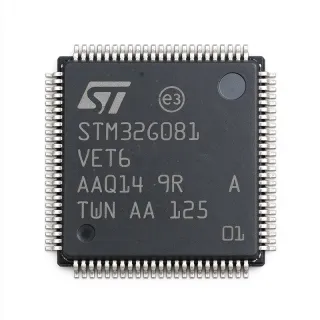
STM32L476VGT3 - 80MHz Cortex-M4 MCU | STMicroelectronics
Артикул: STM32L476VGT3 ✓ АктивенSTM32L476VGT3 Обзор
A microcontroller such as the STM32L476VGT3 integrates a processor core, memory, communication peripherals, timers, analog inputs, and GPIO into one compact component. Within the embedded-control hierarchy, it belongs to the ARM Cortex-M microcontroller class and the STM32L4 ultra-low-power family. This broad integration reduces the number of supporting components required for industrial control, data acquisition, communications, and embedded user-interface systems.
Key features include an Arm Cortex-M4 core operating at up to 80 MHz, 1 MB of Flash organized as 1M x 8, and a 100-LQFP package. The STM32L476VG family also supports USB OTG, LCD interfaces, and DFSD according to the manufacturer product information. These capabilities make the device suitable for designs requiring a balance of processing performance, serial connectivity, display control, and compact embedded packaging.
The Cortex-M4 architecture provides efficient 32-bit instruction execution while retaining a low-power design profile suited to embedded systems. The integrated 1 MB of Flash provides substantially more program storage than many small microcontroller designs, while the 80 MHz operating frequency supports responsive control loops and interrupt-driven peripheral handling. Engineers should account for the input-voltage options of 1.8 V, 2.5 V, and 3.3 V when designing power rails and external interfaces.
Typical applications include industrial monitoring equipment, USB-connected data loggers, LCD-based human-interface panels, digital storage systems using DFSD, and low-power embedded controllers. The combination of USB OTG, substantial Flash, and a high-pin-count LQFP package is especially useful when a board must combine device connectivity, firmware storage, external memory, and numerous peripheral signals on one component.
PCB design should preserve the package outline, exposed thermal considerations, and recommended decoupling arrangement from the manufacturer documentation. Signal routing should separate sensitive analog inputs from fast-switching digital nets, while firmware should enable clocks and peripherals only after the associated power rails are stable. Verify all I/O operating limits against the selected supply voltage.
This product page combines the manufacturer device description with distributor package, memory, frequency, voltage, USB, LCD, and DFSD details. It also adds practical design guidance, structured comparisons, and same-package replacement considerations for engineers evaluating the STM32L476VGT3.
Аналоги без доработки для STM32L476VGT3 — тот же корпус, pin-to-pin совместимость. Компоненты в других корпусах, требующие переработки PCB, исключены.
Варианты в этой серии
Модели той же серии, совместимые без доработки с STM32L476VGT3 (тот же форм-фактор и посадочное место) — отличается по Core, Package, USB Interface.
STM32L476VGT6
✅ Прямая замена ⚠️ Характеристики не провереныУточнить цену
Открыть даташит →STM32L476VGT7
✅ Прямая замена ⚠️ Характеристики не проверены📋 Справочный аналог (нет в каталоге)
STM32L476VGT6U
✅ Прямая замена ⚠️ Характеристики не проверены📋 Справочный аналог (нет в каталоге)
STM32L476VGT3 Максимальные параметры и электрические характеристики
| Product Type | 32-bit ARM Cortex-M4 microcontroller |
| Manufacturer | STMicroelectronics |
| Core | Arm Cortex-M4 |
| Maximum CPU Frequency | 80 MHz |
| Flash Memory | 1 MB (1M x 8) |
| Program Memory Architecture | 32-bit |
| Supply Voltage Options | 1.8 V, 2.5 V, or 3.3 V |
| Корпус | 100-pin LQFP |
| Package Body Size | 14 x 14 mm |
| Package Height | 1.4 mm maximum |
| Тип монтажа | Surface mount |
| USB Interface | USB OTG |
| Display Support | LCD interface |
| Storage Interface | DFSD |
Руководство по цоколевке STM32L476VGT3 в корпусе 1.4 mm maximum
Цоколевка для STM32L476VGT3 (корпус 1.4 mm maximum). Эта цифровая ИС включает выводы GPIO, интерфейсы связи (UART, SPI, I2C) и выводы питания. Обратитесь к техническому описанию производителя для альтернативных функций выводов и вариантов конфигурации. Необходимо для проектирования встраиваемых систем и трассировки печатных плат.

Нет подробных данных о распиновке для STM32L476VGT3.
Обратитесь к даташиту для полной конфигурации выводов.
Типичное применение
STM32L476VGT3 подходит для 6 применениеs: Industrial Monitoring and Control, USB Connected Data Logger, LCD Human Interface Panel, Digital Flash Storage System, Low-Power Embedded Control Node, Multi-Protocol Communications Gateway.
Industrial Monitoring and Control
STM32L476VGT3 fits industrial monitoring equipment that combines periodic sensor acquisition with responsive local control. Its Arm Cortex-M4 core operates at up to 80 MHz, while 1 MB of Flash provides room for filtering, calibration, diagnostics, communications, and data logging. The 100-pin LQFP package exposes enough I/O for digital inputs, sensor interfaces, status indicators, and actuator outputs. Use the manufacturer pin and electrical tables to assign every signal, and validate the chosen suffix against the enclosure temperature. A practical benefit is consolidation: a single MCU can execute control logic, supervise the power system, and manage communication without a separate supervisory controller.
Рекомендуется
USB Connected Data Logger
STM32L476VGT3 is appropriate for a USB-connected data logger because the STM32L476VG family supports USB OTG alongside an 80 MHz Cortex-M4 core and 1 MB of Flash. The MCU can timestamp sensor events, maintain calibration parameters, format records, and transfer them through USB while managing the associated low-power states. The 100-LQFP package also supports peripheral integration without forcing a larger board. Designers should reserve the correct USB data lines, provide the required bus voltage and signal conditioning, and confirm enumeration behavior on the selected development platform. The result is a compact logger with substantial firmware and connectivity capability in one device.
Рекомендуется
LCD Human Interface Panel
STM32L476VGT3 can serve as the controller for an LCD-based human interface because the device combines LCD interface support with an 80 MHz Cortex-M4 processor and 1 MB of Flash. The processing headroom supports menu logic, touch or keypad scanning, status formatting, and communication with remote equipment. Its 100-pin LQFP package offers a practical balance between display connections and general-purpose GPIO for controls and indicators. Use the manufacturer alternate-function and pin-assignment guidance to avoid conflicts among the LCD interface and other peripherals. Firmware should also manage display update intervals and backlight control to maintain low power when the panel is idle.
Рекомендуется
Digital Flash Storage System
STM32L476VGT3 suits embedded storage systems using the family's DFSD capability, particularly when local nonvolatile storage is needed alongside control processing. The 80 MHz Cortex-M4 core can manage filesystem operations, buffer transfers, error handling, and status reporting, while 1 MB of internal Flash holds application firmware. The 100-pin LQFP package provides connections for a memory bus and supporting control signals in a compact controller board. Layout must follow the manufacturer's interface timing and routing guidance, with attention to clock edge requirements and signal integrity. Firmware should include recovery behavior for interrupted writes and verification of data blocks after power loss.
Рекомендуется
Low-Power Embedded Control Node
STM32L476VGT3 fits low-power embedded control nodes where a higher-performance core must coexist with strict energy-conscious operation. Its STM32L4-family positioning supports power-aware design, and the 1 MB of Flash permits local algorithms, protocol stacks, and diagnostic logic to be consolidated into one MCU. The 80 MHz performance allows short, deterministic bursts of processing between low-power states rather than requiring a continuously active processor. Use the manufacturer power-mode and current-consumption tables to select regulator modes, disable unused peripherals, and configure wake-up sources. The 100-pin LQFP package also supports direct sensing and actuation connections without a separate interface controller.
Рекомендуется
Multi-Protocol Communications Gateway
STM32L476VGT3 can act as the central controller in a compact communications gateway that must coordinate USB, serial peripherals, local processing, and data storage. The 80 MHz Cortex-M4 core provides capacity for protocol conversion, buffering, and routing, while 1 MB of Flash supports firmware, configuration tables, and update logic. Its 100-pin LQFP package offers a broad pin budget for communication interfaces, indicators, and configuration controls. Designers should partition tasks through the manufacturer interrupt architecture and use appropriate peripheral instances to avoid contention. Firmware should include watchdog handling, buffer limits, and fault isolation so one communication path cannot prevent the gateway from restarting or reporting an unhealthy state.
Рекомендуется
Сводка рекомендуемых товаров
Справочные инженерные данные для STM32L476VGT3 — сравнение, рекомендации по проектированию и информация о соответствии.
Руководство по выбору
Сравнение с аналогами
| Параметр | Этот товар | STM32L476VGT6 | STM32L476VGT7 | STM32L476VGT6U |
|---|---|---|---|---|
| Brand | STMicroelectronics | STMicroelectronics | STMicroelectronics | STMicroelectronics |
| Package | 100-LQFP | 100-LQFP | 100-LQFP | 100-LQFP |
| CPU Core | Arm Cortex-M4 | Arm Cortex-M4 | Arm Cortex-M4 | Arm Cortex-M4 |
| Maximum CPU Frequency | 80 MHz | 80 MHz | 80 MHz | 80 MHz |
| Flash Memory | 1 MB (1M x 8) | 1 MB (1M x 8) | 1 MB (1M x 8) | 1 MB (1M x 8) |
| Architecture | 32-bit ARM RISC | 32-bit ARM RISC | 32-bit ARM RISC | 32-bit ARM RISC |
Ключевые отличия
- Substantial integrated program storage (против STM32L476VGT6)
- Connected and storage-capable peripheral mix (против STM32L476VGT7)
- Consistent core and memory ratings across same-family alternatives (против STM32L476VGT6U)
Заметки по проектированию
Design the supply rails for the STM32L476VGT3's 1.8 V, 2.5 V, or 3.3 V operating options and confirm that every connected peripheral uses a compatible voltage domain. Place the device's decoupling capacitors close to the corresponding supply pins, with the smallest effective capacitance nearest the package. Use the manufacturer power-mode and current-consumption tables to calculate the regulator budget, including startup, active processing, communications, and sleep-state leakage.
Route high-speed and high-current peripherals according to the manufacturer pin and board-layout guidance. Keep USB, display, and DFSD signals away from analog inputs where practical, preserve continuous return paths, and place termination or protection components at the connector or transceiver interface. The 100-pin LQFP footprint has closely spaced leads, so verify courtyard clearance, solder mask definition, and paste stencil apertures against the official package drawing.
Do not treat a matching package outline as proof that every alternate STM32L476VGT suffix is qualified for the same application. Review the ordering information, temperature grade, supply limits, pin definitions, and product-status conditions for the exact replacement MPN. Likewise, do not infer USB, LCD, or DFSD behavior from peripheral names alone: confirm the required pins, alternate-function settings, clock trees, and firmware driver support for the selected board configuration.
Информация о соответствии
The manufacturer and distributor product information reviewed does not explicitly state RoHS, REACH, AEC-Q100, lead-free, halogen-free, or conflict-minerals status. Confirm these requirements with STMicroelectronics using the exact STM32L476VGT3 ordering code.