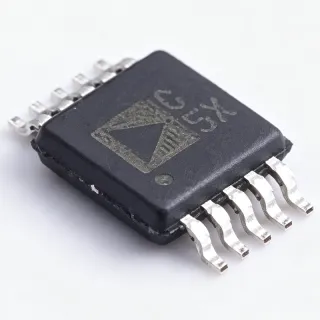
AK5354VT - 20-Bit Low-Power ADC with PGA | AKM Semiconductor
MPN: AK5354VT ✗ Tapus ng BuhayAK5354VT Ulas
An audio ADC is a specialized data-converter IC that converts continuous analog microphone or line-level voltages into sequential digital samples for processing by a codec, DSP, or microprocessor. The AK5354VT belongs to the delta-sigma ADC family within the broader analog-to-digital converter, signal-conversion, and semiconductor hierarchies. Its integrated PGA allows a microphone signal to be amplified before conversion without requiring a separate analog gain stage.
The principal feature set includes 20-bit conversion resolution, an integrated analog input PGA, single-ended analog input, and a 1.8 V digital supply connection. The single-ended input architecture can simplify source wiring and reduce the number of external input filters required by the device. These functions make the converter suitable for digital-audio recording, microphone capture, and compact audio input modules.
Technically, the AK5354VT uses a low-voltage delta-sigma conversion architecture intended to balance conversion resolution with low power consumption. The digital interface can operate from 1.8 V, supporting systems built around low-voltage processors and digital audio engines. The PGA is placed in the analog signal path ahead of the converter, so microphone sensitivity and signal headroom should be considered together when selecting the gain configuration.
Typical applications include digital microphones, microphone preamplifier modules, portable audio recorders, USB audio interfaces, and embedded audio capture systems. In these systems, the converter can accept a single-ended analog microphone source, provide adjustable analog gain, and present digital conversion data to a downstream DSP or audio codec.
Design attention should focus on analog input conditioning, decoupling, digital-interface compatibility, and conversion-clock implementation. The input network must limit out-of-band energy, while power and ground arrangements should prevent switching activity from contaminating the low-level microphone signal.
This page combines the manufacturer datasheet, verified product listings, application-focused engineering guidance, lifecycle observations, and family comparisons for engineers evaluating the AK5354VT. It also distinguishes documented drop-in replacements from related converters whose package and pin compatibility have not been established.
Mga alternatibo na pwedeng ilagay na AK5354VT — parehas na package, pin-to-pin na katugmang. Hindi kasama ang mga bahagi ng iba't-ibang package na nangangailangan ng pagpapaayos ng PCB.
Wala ng magagamit na drop-in alternatibo para sa produkto na ito.
Hilingin ang AlternatiboAK5354VT Mga Pinakamataas na Rating at Electrical Characteristics
| Converter Type | Delta-sigma ADC |
| Pangangasiwaan | 20 bit |
| Application | Digital audio |
| Digital Supply Voltage | 1.8 V |
| Analog Input Configuration | Single-ended |
| Analog Input PGA | Integrated |
| Supply Type | Low-voltage |
| Power Class | Low power |
| Package Shipping Format | Tape & Reel (TR) |
| Input Signal Polarity | Single-ended |
| Digital Interface Supply | 1.8 V |
Gabay sa Pin Configuration ng AK5354VT tape & reel (tr)
Pin configuration para sa AK5354VT (tape & reel (tr) package). Ang analog component na ito ay may input, output, at power supply pins. Sumangguni sa datasheet ng manufacturer para sa offset null, compensation, at enable pin configurations. Perpekto para sa signal conditioning at amplifier circuits.

Wala ng detalyadong pinout data na magagamit para sa AK5354VT.
Sumangguni sa datasheet para sa buong pin configuration.
Tipikal na mga Gamit
AK5354VT ay nararapat para sa 6 aplikasyons: Digital Microphone Capture, USB Audio Interface, Portable Voice Recorder, Digital Audio Microphone Module, Embedded Audio Sensor Node, Audio Interface for Audio DSP.
Digital Microphone Capture
The AK5354VT fits single-ended digital microphone capture because it combines a 20-bit delta-sigma converter with an integrated analog input PGA. The PGA can condition a low-level microphone voltage before conversion without adding a separate gain stage. Place the microphone input and analog filtering close to the converter, maintain the documented 1.8 V digital supply, and verify the analog input range against the selected microphone sensitivity and gain. This architecture is especially useful when compact area, low voltage, and direct digital conversion are more important than supporting multiple analog inputs.
USB Audio Interface
The AK5354VT can serve as the analog capture stage of a USB audio interface when the downstream controller accepts the converter's digital output and clocking arrangement. Its 20-bit resolution supports high-resolution audio capture, while the integrated PGA simplifies the microphone input path. The implementation should keep high-gain analog traces short, provide clean supply decoupling, and isolate switching regulators and USB data activity from the single-ended microphone node. Confirm the exact digital format and conversion-rate limits against the host controller before schematic capture.
Portable Voice Recorder
The low-voltage architecture of the AK5354VT is suitable for battery-powered portable voice recorders where microphone amplification and conversion must fit into a compact signal chain. The integrated analog input PGA reduces the component count around a single-ended microphone source, and the 20-bit converter supports detailed audio capture. Battery designs must still account for microphone biasing, idle current, clock implementation, and the converter's analog and digital supply requirements. Validate the selected gain against the microphone output so that speech peaks do not exceed the allowed analog input range.
Digital Audio Microphone Module
The AK5354VT is appropriate for a dedicated digital-audio microphone module requiring more signal gain ahead of conversion than a fixed input stage can provide. Its integrated PGA and single-ended input can simplify conditioning of one microphone channel, while the 20-bit delta-sigma architecture targets high-resolution audio. The module designer should define the microphone sensitivity, mechanical noise environment, grounding strategy, and digital clock source before fixing the gain setting. Short analog traces, stable reference-free operation, and separate clean analog and digital supply routing are central to preserving microphone signal quality.
Embedded Audio Sensor Node
The AK5354VT can convert a conditioned single-ended acoustic or vibration signal in an embedded sensing node that outputs digital audio data to a DSP. Its 20-bit resolution and integrated PGA make it useful when the sensor output is small and variable. For machine-condition monitoring or acoustic event detection, the analog filter and PGA gain must be selected together so that the expected signal occupies the converter's useful range without clipping. Keep sensor excitation switching and digital processing away from the input node, and use controlled clocking to prevent modulation from appearing in the captured audio.
Audio Interface for Audio DSP
The AK5354VT is suitable for a dedicated analog-input channel feeding an audio DSP in equipment with separated capture and processing sections. A 20-bit delta-sigma ADC with an integrated PGA can provide a low-noise conversion stage before filtering, mixing, storage, or communication. The designer should confirm whether the DSP accepts the converter's serial format and clock polarity, then isolate analog and digital return paths in the layout. If the source is not a microphone, an external attenuator or gain stage may still be needed to place the signal correctly within the converter's analog range.
Impormasyon ng Talumpati sa Engineering for AK5354VT — ikabit, gabay sa disenyo, at impormasyon ng pagsunod sa kautusan.
Paunawang Hanapin
Ikabit sa Mga Alternatibo
| Parametro | Ito ang Producto | AK5355 | AK5356 | AK5357 |
|---|---|---|---|---|
| Brand | Asahi Kasei Microdevices/AKM | Asahi Kasei Microdevices/AKM | Asahi Kasei Microdevices/AKM | Asahi Kasei Microdevices/AKM |
| Drop-In Status | Target device | Not established | Not established | Not established |
Pangunahing mga Pagkakaiba
- Integrated microphone-signal gain stage (kumpara saAK5355)
- Low-voltage digital integration (kumpara saAK5356)
- Single-ended analog input architecture (kumpara saAK5357)
Talaan ng Disenyo
Route the single-ended microphone input as a short, quiet analog trace directly toward the converter and its recommended input network. Keep digital clocks, serial data, switching-node connections, and high-current return paths away from the input node. Use a continuous ground reference beneath the analog section, and place analog decoupling capacitors at the pins specified by the manufacturer reference circuit. The 20-bit conversion capability can capture low-level detail, but PCB-induced pickup and ground coupling can still dominate the usable noise floor.
Do not select the PGA gain from resolution alone. First determine the microphone or source sensitivity, maximum expected signal amplitude, and permitted analog input range. Select a gain that leaves sufficient headroom for peaks, then confirm whether the source requires attenuation, biasing, or an external filter. Excessive gain can cause clipping, while insufficient gain reduces the effective dynamic range of the 20-bit converter. The manufacturer's analog characteristics and typical microphone circuit should govern the final value.
Plan the analog and digital supplies around the 1.8 V digital supply requirement and the device's documented operating states. Decouple each supply group at the IC, maintain the recommended component values and placement, and avoid routing converter return current through the microphone ground path. Validate startup, shutdown, and clock-stop behavior with the intended processor because digital-audio converters can have mode-dependent supply-current changes. Exact current limits and capacitor values should be taken from the manufacturer datasheet.
Impormasyon ng Pagsunod sa Kautusan
The available product information does not explicitly state RoHS, REACH, lead-free, halogen-free, or conflict-minerals status. AEC-Q100 is not applicable to the documented general digital audio ADC use.