Microchip Technology

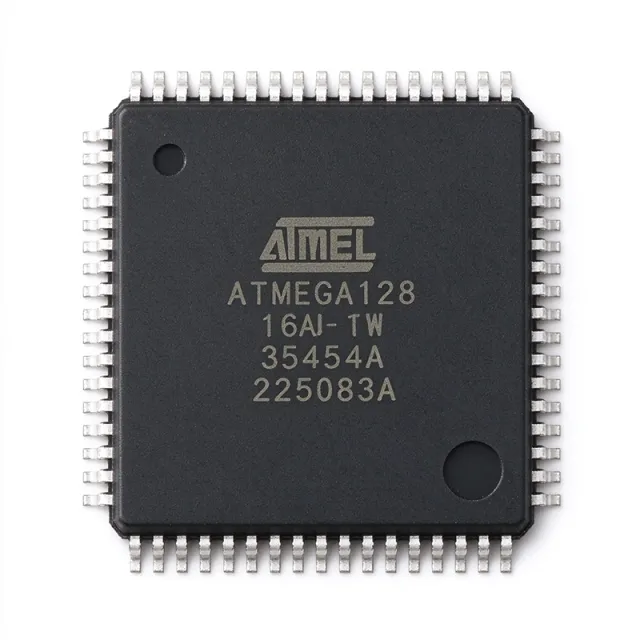
ATMEGA128-16AUR - 8-Bit AVR MCU, 128KB Flash, 16MHz | Microchip (Tape & Reel)

MPN: ATMEGA128-16AUR ✓ Nakahanda
4.5 V to 5.5 V (16 MHz speed grade) Vdss 64-TQFP (14x14 mm) Package 16 MHz Speed 128 KB (64K x 16) In-System Programmable Memory
MOQ: 1 |

ATMEGA128-16AUR Ulas

The Microchip Technology ATMEGA128-16AUR is a high-performance, low-power 8-bit AVR RISC microcontroller with 128KB of In-System Programmable Flash, 4KB SRAM, 4KB EEPROM, an 8-channel 10-bit ADC, and a JTAG interface for on-chip debugging, delivered in a 64-pin TQFP (14x14 mm) package operating at up to 16 MHz.

An 8-bit AVR microcontroller is a single-chip processor built on the AVR enhanced RISC architecture, in which most instructions execute in a single clock cycle. Within the power-management and embedded-control hierarchy, it functions as the central computing element of a system, replacing discrete logic and analog control circuitry while offering flash-based field reprogrammability.

Key features include 128KB self-programmable Flash with a boot section for in-application programming, 4KB internal SRAM, 4KB EEPROM for non-volatile parameter storage, and throughput approaching 16 MIPS at 16 MHz, allowing designers to optimize power consumption versus processing speed.

Technically, the ATmega128 combines an 8-channel 10-bit A/D converter with an external-memory interface (up to 64KB external data space via PORTA/PORTC multiplexed addressing), two 8-bit and two 16-bit timers with PWM outputs, two USARTs, SPI, and a Two-Wire Interface, plus a JTAG boundary-scan and debug port. The AVR Harvard architecture with 32 general-purpose registers enables efficient C-compiled code execution.

Typical applications include industrial control and automation nodes, general embedded systems, data loggers, and legacy ATmega103 upgrades, since the ATmega128 is 100% pin compatible with ATmega103 and can replace it on existing PCBs.

A key design consideration is supply voltage: the 16 MHz -16AU speed grade requires 4.5V to 5.5V operation; the ATmega128L variant is needed for 2.7V-5.5V low-voltage designs. Provide decoupling capacitors on all VCC/AVCC pins and use the internal RC or external crystal clock option accordingly.

This page synthesizes distributor pricing, verified drop-in alternatives, and practical design notes not found in the manufacturer datasheet.

Mga alternatibo na pwedeng ilagay na ATMEGA128-16AUR — parehas na package, pin-to-pin na katugmang. Hindi kasama ang mga bahagi ng iba't-ibang package na nangangailangan ng pagpapaayos ng PCB.

Variante sa Seri na ito

Katulad na modelo sa serye na katugma sa pagpasok ATMEGA128-16AUR (parehas na form factor at footprint) — pagkakaiba sa Operating Temperature, Package, Core Architecture, RoHS Status, Program Memory Size.

Microchip Technology
Operating Temperature: 0C to +70C (commercial, AC suffix)
Package: 64-TQFP (14 x 14 mm)
Core Architecture: AVR Enhanced RISC, 8-bit
Ikabit sa ATMEGA128-16AUR →
Microchip Technology
Operating Temperature: -40C to +85C
Ikabit sa ATMEGA128-16AUR →
Microchip Technology
Operating Temperature: 0C to +70C (commercial grade)
Core Architecture: AVR 8-bit enhanced RISC
Program Memory Size: 128 KB (64K x 16) Flash
Ikabit sa ATMEGA128-16AUR →
Microchip Technology
Operating Temperature: -40C to +85C
RoHS Status: unknown
Ikabit sa ATMEGA128-16AUR →
Microchip Technology
Operating Temperature: -40C to +85C
RoHS Status: unknown
Ikabit sa ATMEGA128-16AUR →
Microchip Technology
Operating Temperature: -40 C to +85 C
Package: 64-TQFP (14x14 mm, 0.8 mm pitch)
RoHS Status: Compliant (GREEN)
Ikabit sa ATMEGA128-16AUR →

ATMEGA128A-AU

Microchip Technology
AVR · 8-Bit · Enhanced RISC, 133 instructions · 16 MHz · 128 KB (64K x 16), In-System Programmable, read-while-write · 4 KB · 4 KB · 2.7 V to 5.5 V

Magkontak para sa presyo

Tingnan ang Datasheet →

ATMEGA128-16AN

Microchip Technology
8-bit AVR RISC · 8-bit · 16 MHz · 16 MIPS at 16 MHz · 128 KB (64K x 16) · 4 KB · 4 KB · 4.5 V to 5.5 V

Magkontak para sa presyo

Tingnan ang Datasheet →

ATMEGA128-16AI

Microchip Technology
AVR 8-bit RISC · 16 MHz · 128 KB (64K x 16) In-System Programmable · 4 KB · 4 KB · 4.5 V to 5.5 V · 16 MIPS at 16 MHz · 8-channel 10-bit

Magkontak para sa presyo

Tingnan ang Datasheet →

ATMEGA1281-16MUR

Microchip Technology
AVR 8-bit RISC · 16 MHz · 128 KB (64K x 16) Flash · 8 KB · 4 KB · 2.7 V to 5.5 V · 54 · 32

Magkontak para sa presyo

Tingnan ang Datasheet →

AT90CAN128-16AUR

adds CAN 2.0A/B controller, otherwise near-identical AVR core with 128KB Flash at 16MHz in 64-TQFP

📋 Alternatibo na Reference (hindi sa katalogo)

ATMEGA128-16AUR Mga Pinakamataas na Rating at Electrical Characteristics

Core Architecture 8-bit AVR RISC
Flash Memory 128 KB (64K x 16) In-System Programmable
SRAM 4 KB
EEPROM 4 KB
Maksimum na Taktiko ng Oras 16 MHz
Throughput 16 MIPS at 16 MHz (approx. 1 MIPS per MHz)
Supply Voltage Range 4.5 V to 5.5 V (16 MHz speed grade)
ADC 8-channel 10-bit
Debug Interface JTAG for on-chip debugging
Packhaging 64-TQFP (14x14 mm)
Uri ng Pagpapasok Surface Mount
Temperature Grade Industrial (IND TEMP)
External Memory Interface Supported (up to 64 KB external data memory)
Serial Interfaces 2x USART, SPI, Two-Wire Interface (I2C-compatible)
Tindminan RoHS Compliant (RoHS Y)

Gabay sa Pin Configuration ng ATMEGA128-16AUR 64-tqfp (14x14 mm)

Pin configuration para sa ATMEGA128-16AUR (64-tqfp (14x14 mm) package). Kasama sa digital IC na ito ang GPIO, mga communication interface (UART, SPI, I2C), at mga power pin. Sumangguni sa datasheet ng manufacturer para sa mga alternatibong function ng pin at mga opsyon sa configuration. Mahalaga para sa disenyo ng embedded system at PCB layout.

Pinout diagram ng 64-tqfp (14x14 mm) package para sa ATMEGA128-16AUR

Wala ng detalyadong pinout data na magagamit para sa ATMEGA128-16AUR.

Sumangguni sa datasheet para sa buong pin configuration.

Tipikal na mga Gamit

ATMEGA128-16AUR ay nararapat para sa 6 aplikasyons: Industrial Control and Automation, Data Acquisition and Logging Systems, General Purpose Embedded Systems, Legacy ATmega103 Board Upgrade, Motor Control and Actuation, Instrumentation Front Panels and HMI.

🏭

Industrial Control and Automation

The ATMEGA128-16AUR fits industrial control nodes where deterministic 8-bit control, moderate code size, and rugged I/O matter. Its 128KB Flash accommodates state machines, communication stacks, and bootloaders, while the industrial temperature grade and 4.5V-5.5V supply suit noisy 5V plant environments. Two USARTs handle Modbus RTU links and diagnostics simultaneously, and the external memory interface extends RAM for buffering. With throughput of 16 MIPS at 16 MHz, closed-loop control at kilohertz rates is practical, and JTAG enables in-circuit debugging during commissioning of automated machinery.

📚

Data Acquisition and Logging Systems

In data loggers, the ATmega128's 8-channel 10-bit ADC multiplexes multiple analog sensors without external front ends, and 4KB EEPROM retains calibration and configuration across power cycles. The 128KB Flash supports substantial logging firmware and file-system code, while the external memory interface addresses external SRAM when 4KB internal SRAM is insufficient for long sample buffers. Two USARTs allow simultaneous sensor-network capture and telemetry output. The 16 MHz clock provides 16 MIPS for real-time filtering, and the ADC interrupt-driven sampling keeps CPU load low during continuous acquisition campaigns.

🔧

General Purpose Embedded Systems

For general embedded products such as controllers, meters, and interface converters, the ATMEGA128-16AUR offers a balanced feature set: 32 general-purpose registers, rich timer/PWM resources, SPI and Two-Wire Interface for peripherals, and a JTAG port that simplifies production debugging. The AVR architecture executes most instructions in a single cycle, delivering approximately 1 MIPS per MHz, so a 16 MHz system behaves like far slower-cycle-count competitors. Long-term availability and extensive community code make it low-risk for products with multi-year service lives, and the boot-section Flash supports field firmware updates.

⚙️

Legacy ATmega103 Board Upgrade

The ATmega128 is 100% pin compatible with the ATmega103 and can replace it on existing printed circuit boards, as stated in the Microchip datasheet. Designs built around the ATmega103's 4MHz-era performance gain a 16 MHz clock, 128KB self-programmable Flash with boot section, JTAG debugging, and revised peripherals without PCB respin. Microchip's application note 'Replacing ATmega103 by ATmega128' documents the register-level and fuse differences engineers must address in firmware. This makes the ATMEGA128-16AUR the sanctioned drop-in path for sustaining legacy 5V industrial and telecom hardware.

⚡

Motor Control and Actuation

With two 8-bit and two 16-bit timers providing multiple PWM channels, the ATMEGA128-16AUR drives DC and stepper motors with modest gate-driver overhead. The 16 MHz clock yields PWM resolutions in the kilohertz carrier range appropriate for motor control, while external interrupt pins INT0-INT7 accept quadrature or Hall-feedback signals. The 10-bit ADC reads current-sense amplifiers for closed-loop torque control. Because all PWM and feedback functions are on-chip, the surrounding BOM stays small, and the 5V industrial supply range simplifies interfacing with standard driver ICs in actuator assemblies.

💺

Instrumentation Front Panels and HMI

Human-machine interface boards benefit from the ATmega128's combination of ADC inputs for keypads and potentiometers, TWI for driving character LCD controllers, and ample Flash for menu systems and multilingual strings. The JTAG interface enables boundary-scan testing of assembled display boards, improving production quality. External memory expansion supports graphics buffers for small displays beyond what 4KB SRAM allows, and the dual USART bridges an RS-485 supervisory link with a local RS-232 service port. The 14x14 mm TQFP fits compact panel controllers while remaining hand-solderable and reworkable.

Buod ng mga Inirekomendang Produkto

ATMEGA128A-AU Microchip Technology Ginagamit sa: Industrial Control and Automation, Legacy ATmega103 Board Upgrade AT90CAN128-16AUR Same footprint with integrated CAN for fieldbus networks Ginagamit sa: Industrial Control and Automation AT45DB161E SPI data flash for logged-sample storage Ginagamit sa: Data Acquisition and Logging Systems MCP9808 Precision temperature sensor on TWI bus Ginagamit sa: Data Acquisition and Logging Systems ATMEGA64A-AU Microchip Technology Ginagamit sa: General Purpose Embedded Systems AT25DF081A SPI configuration/code storage Ginagamit sa: General Purpose Embedded Systems ATMEGA128-16AI Microchip Technology Ginagamit sa: Legacy ATmega103 Board Upgrade L6203 DMOS full-bridge motor driver Ginagamit sa: Motor Control and Actuation ACS712 Allegro MicroSystems Ginagamit sa: Motor Control and Actuation MCP23017 TWI GPIO expander for keys/LEDs Ginagamit sa: Instrumentation Front Panels and HMI MAX232 RS-232 level translator for service port Ginagamit sa: Instrumentation Front Panels and HMI
What are the key specifications of ATMEGA128-16AUR that engineers should know?
The ATMEGA128-16AUR is an 8-bit AVR RISC microcontroller with 128KB In-System Programmable Flash, 4KB SRAM, 4KB EEPROM, an 8-channel 10-bit ADC, and a JTAG on-chip debug interface. It runs at up to 16 MHz (about 16 MIPS), requires a 4.5V to 5.5V supply, and comes in a 64-pin TQFP (14x14 mm) surface-mount package for industrial temperature ranges. According to the Microchip ATmega128 datasheet, it also offers two USARTs, SPI, and a Two-Wire Interface.
What is the price of ATMEGA128-16AUR?
The ATMEGA128-16AUR is listed at approximately $17.04 per unit in single-piece quantity per the Heisener distributor listing, with volume discounts typically applying at 10, 100, and 1000 pieces as of 2026-09-15. Octopart aggregates pricing from 11 distributors, so comparing several sources is recommended. Prices vary with market conditions; always confirm current stock and pricing with the distributor before ordering.
Where can I buy ATMEGA128-16AUR online?
The ATMEGA128-16AUR can be purchased from major authorized distributors including DigiKey (product page for Microchip Technology microcontrollers) and Mouser, both of which list the part with pricing and availability, as well as via Octopart's 11-distributor price comparison. XAIPART also offers this part. Because stock moves quickly on legacy AVR parts, verify in-stock status at DigiKey or Mouser before committing to a production schedule.
Is ATMEGA128-16AUR in stock and what is the lead time?
Availability changes daily, but the part is actively stocked: the Heisener listing reports roughly 1.1 million pieces available with immediate-ship status, and DigiKey's page indicates ships-today availability as of the last verification on 2026-09-15. Because the ATMEGA128 family is mature, some distributors carry deeper stock than others; Octopart's inventory aggregation across 11 distributors gives the most current consolidated view.
What is the difference between ATMEGA128-16AUR and ATMEGA128A-AU?
The ATMEGA128A-AU is Microchip's refreshed die of the original ATMEGA128-16AUR. Both are 8-bit AVR MCUs with 128KB Flash, 4KB SRAM, 4KB EEPROM, a 10-bit ADC, and JTAG in the same 64-TQFP package, and the A-version is fully software compatible. Differences are minor and mostly relate to internal die revision, DC characteristics refinements, and manufacturing process; the ATMEGA128A is the recommended choice for new designs, while the original remains in supply for maintenance programs.
ATMEGA128-16AUR vs ATMEGA1281-16AU - which is better for industrial control?
For most industrial control tasks the ATMEGA128-16AUR is sufficient and more widely documented; it provides 128KB Flash, 4KB SRAM, two USARTs, SPI, TWI, and JTAG at 16 MHz. The ATMEGA1281 adds peripherals such as additional USARTs and a real-time-calendar-friendly timer set and slightly different SRAM sizing, suiting designs needing more serial channels. Both use 64-pin TQFP packages with closely related pinouts. Choose the ATMEGA128-16AUR for legacy continuity and lowest design risk; choose the ATMEGA1281 only if its extra peripherals are required.
When should I choose ATMEGA128-16AUR over ATMEGA64A-AU?
Choose the ATMEGA128-16AUR when your firmware needs more than 64KB of Flash code space or full external memory expansion: the ATmega128 offers 128KB Flash versus the ATmega64A's 64KB, plus the external memory interface with multiplexed address bus. Both share AVR architecture, a 10-bit ADC, and similar peripherals. If your code fits in 64KB and cost or board area matters more, the ATmega64A is a lighter option. Note the two are not pin-compatible replacements on the same PCB layout without redesign.
What is the best drop-in replacement for ATMEGA128-16AUR?
The best drop-in replacement is the ATMEGA128A-AU: it is Microchip's pin-compatible successor in the identical 64-TQFP (14x14 mm) package with the same 128KB Flash, 4KB SRAM, 4KB EEPROM, ADC, and JTAG set, requiring no PCB or firmware changes for the vast majority of designs. Same-family variants such as ATMEGA128-16AN and ATMEGA128-16AI are also drop-in. Verify the A-version errata and DC-characteristic deltas against your design before switching.
Can ATMEGA128-16AUR replace ATmega103 on an existing PCB?
Yes. According to the Microchip ATmega128 datasheet, the ATmega128 is 100% pin compatible with the ATmega103 and can replace it on current printed circuit boards. Microchip also publishes the application note 'Replacing ATmega103 by ATmega128' describing the firmware and fuse differences to be aware of, since the instruction set, MCU control registers, and memory mapping evolved between the two devices. Hardware is drop-in; software review is required.
Where to download ATMEGA128-16AUR datasheet PDF?
The official ATmega128 datasheet PDF is available free from the Microchip product page at microchip.com/en-us/product/ATMEGA128, which links the complete document describing the 128KB Flash, 4KB SRAM, 4KB EEPROM, 10-bit ADC, and JTAG interface. Mirror copies are hosted on Octopart and Datasheets.com, but the Microchip site guarantees the latest revision. Avoid third-party PDF aggregators for design-critical values, as they may host outdated revisions.
Where to find the ATMEGA128-16AUR pinout for the 64-TQFP package?
The complete 64-pin TQFP pinout for the ATMEGA128-16AUR is in the pinout diagram section of the official Microchip ATmega128 datasheet, showing the four 8-bit I/O ports (PA-PD), PORT E, F, G, VCC/AVCC/GND/AREF/AGND assignments, and JTAG pins (TCK/TMS/TDO/TDI on PF4-PF7). Because per-pin accuracy is design-critical, we recommend referencing the datasheet pin diagram directly rather than any secondary summary. JTAG uses PF7-PF4 in IEEE 1149.1 style operation per the datasheet.
Is ATMEGA128-16AUR the same as ATMEGA128A-AU?
Functionally yes, electrically nearly identical, but not the same die revision. The ATMEGA128A is Microchip's later die revision of the original ATmega128, in the same 64-TQFP (14x14 mm) package with the same pinout, 128KB Flash, 4KB SRAM, 4KB EEPROM, and 16 MHz maximum speed. Firmware written for one runs on the other in typical applications. Check the device errata sheets for revision-specific corrections before relying on either in safety-critical designs.
Is ATMEGA128-16AUR suitable for motor control and data logging applications?
Yes. The ATMEGA128-16AUR provides four timers (two 8-bit, two 16-bit) with PWM outputs suitable for motor control at 16 MHz, and its 8-channel 10-bit ADC supports multi-sensor data logging. The 4KB EEPROM stores calibration parameters through power cycles, while 128KB Flash accommodates substantial logging firmware. The external memory interface allows adding RAM or parallel peripherals when 4KB SRAM is insufficient. For high-resolution control loops, remember the ADC is 10-bit, not 12-bit or higher.
Is ATMEGA128-16AUR RoHS compliant and lead-free?
Yes, the ATMEGA128-16AUR is RoHS compliant: the 'U' package suffix designates Microchip's lead-free, green (RoHS-compliant) packaging, and distributor compliance data (e.g., PartGenie compliance notes) marks RoHS as Y for this part. It is a surface-mount 64-TQFP industrial-temperature device intended for modern lead-free reflow assembly. For exact REACH, halogen-free, and conflict-minerals declarations, consult the official Microchip product compliance documentation, as those statuses were not fully specified in the source listings.

Impormasyon ng Talumpati sa Engineering for ATMEGA128-16AUR — ikabit, gabay sa disenyo, at impormasyon ng pagsunod sa kautusan.

Paunawang Hanapin

Choose the ATMEGA128-16AUR when you need a proven 5V, 16 MHz 8-bit MCU with 128KB Flash, external memory expansion, JTAG debugging, and industrial temperature rating - especially for sustaining legacy ATmega103 boards, since the ATmega128 is 100% pin compatible with ATmega103 per the Microchip datasheet. For new designs, prefer the ATMEGA128A-AU: it is the pin-compatible refreshed die with identical functionality and a longer forward roadmap. Choose ATMEGA1281-16MUR if your application needs the successor family's added serial peripherals. Choose AT90CAN128-16AUR when CAN bus is required, keeping the same footprint. If firmware fits in 64KB and cost is primary, consider the smaller ATMEGA64A-AU instead, accepting the loss of external memory expansion and a different pinout. Trade-off summary: the -16AU prioritizes supply continuity and 5V legacy compatibility over lowest cost or lowest power.

Ikabit sa Mga Alternatibo

Parametro Ito ang Producto ATMEGA128A-AU ATMEGA1281-16MUR AT90CAN128-16AUR
Package 64-TQFP (14x14 mm) 64-TQFP (14x14 mm) - same 64-TQFP - same footprint 64-TQFP - same footprint
Brand Microchip Technology Microchip Technology Microchip Technology Microchip Technology
Flash Memory 128 KB 128 KB 128 KB 128 KB
Max Clock Frequency 16 MHz 16 MHz 16 MHz 16 MHz
Special Peripherals JTAG, 2x USART, SPI, TWI, ext. memory interface Same set (refreshed die) Added USARTs / revised peripheral set Adds CAN 2.0A/B controller
RoHS Compliant ('U' suffix, green) Compliant Compliant ('R' reel, green) Compliant

Pangunahing mga Pagkakaiba

  • External memory expansion interface (kumpara saATMEGA64A-AU)
  • Refreshed-die continuity option (kumpara saATMEGA128A-AU)
  • CAN-fieldbus-ready pin-compatible path (kumpara saAT90CAN128-16AUR)

Talaan ng Disenyo

The -16AU speed grade requires a 4.5V to 5.5V supply; do not power it from a 3.3V rail expecting 16 MHz operation. Decouple every VCC pin and AVCC with 100 nF ceramics placed within a few millimeters of the pins, plus bulk 10 uF per board. Tie AVCC to VCC through an LC filter when ADC accuracy matters, and keep AGND/AREF routing quiet. Estimated: at 16 MHz with I/O loaded, active current is typically in the tens of milliamps per the datasheet current-consumption tables.

The 64-TQFP (14x14 mm) exposes JTAG on PF7-PF4 (TDI/TDO/TMS/TCK). Reserve the 10-pin JTAG header footprint even if unused, because JTAG is enabled by default fuse settings and doubles as boundary-scan for production test. Route the external memory bus (PORTA multiplexed address/data, PORTC high address, PG2 ALE, PG0/PG1 WR/RD) with matched-ish lengths and series termination on ALE if long. Keep the crystal within 10 mm of XTAL pins with appropriate load capacitors.

Migrating from ATmega103: the ATmega128 changes several register locations and default fuse behavior; follow Microchip's 'Replacing ATmega103 by ATmega103/128' guidance and re-check WDTCR, MCUCR, and interrupt vector mapping. Also note the boot-loader section requires correct BOOTRST fusing, and EEPROM operation has a timed write sequence that must not be interrupted by power loss - add brown-out detection. Verify the exact operating temperature limits against the full datasheet before qualification.

Impormasyon ng Pagsunod sa Kautusan

RoHS
Compliant
REACH
Unknown
AEC-Q100
Walang Lead
Walang Halogen
Unknown
Mga Conflict Mineral
Unknown

RoHS Y and green packaging indicated by the 'U' suffix and distributor compliance data (PartGenie: RoHS Y). REACH, halogen-free, and conflict-minerals statuses were not specified in the provided data - consult Microchip's official product compliance documentation.

Data napatotohanan sa: 2026-10-30 — impormasyon na pinatunayan at pinapatakbo ng pangkat ng engineering ng XAIPART's component engineering team

Kaugnay na Hanapin

ATMEGA128-16AUR datasheet ATMEGA128-16AUR pinout 64-TQFP Microchip ATMEGA128-16AUR price ATMEGA128-16AUR buy in stock ATMEGA128-16AUR vs ATMEGA128A-AU ATMEGA128-16AUR drop-in replacement 128KB flash 16MHz AVR microcontroller ATMEGA128-16AUR industrial control application ATmega128 pin compatible ATmega103 replacement what can replace ATMEGA128-16AUR ATMEGA128-16AUR JTAG on-chip debugging ATMEGA128-16AUR RoHS compliant lead free

Mga kaugnay na Mga Komponente at mga Tuntunin

Microchip Technology Atmel ATMEGA128-16AUR ATMEGA128A-AU ATMEGA1281-16MUR AT90CAN128-16AUR ATMEGA64A-AU ATmega103 AVR 8-bit microcontroller RISC architecture JTAG 64-TQFP TQFP package family surface mount RoHS 10-bit ADC In-System Programmable Flash industrial control Two-Wire Interface USART external memory interface 16 MIPS boot loader
Mabilis na Tanggap na RFQ
Ihanda ang buong detalye — ang aming pangkalakal na koponan ay tutugon sa loob ng 24 oras
Numero ng Parte Mga Tagagawa Pakete QTY Target na Halaga Pinalawak
✓
Quote na inilabas!

Ating tumugon sa iyong email sa loob ng 24 oras

1
RFQ Naisumite
2
Received na ang Kwaliksik
3
Nai-order
4
Pagbabayad
5
Inihanda
6
Naihanda
Tingnan ang Detalye ng RFQ