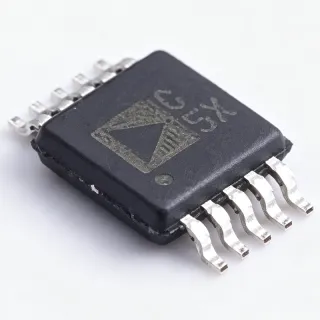
MAX135EWI - 15-Bit Multi-Slope Parallel ADC, 16 CPS | Maxim
MPN: MAX135EWI ✓ NakahandaMAX135EWI Ulas
An ADC (analog-to-digital converter) is a data-conversion IC that translates a continuous analog voltage into a discrete digital code for processing by a microcontroller, DSP, or logic device. The multi-slope integrating ADC is a refinement of the integrating converter type: instead of measuring a fixed integration period once, it integrates the input for a fixed phase, measures a residual, then integrates again with switched reference current for a shorter, corrected phase. This multi-slope action rejects both 50 Hz and 60 Hz line noise far better than a single-slope design while still completing conversions quickly. In the wider hierarchy, the MAX135EWI is a data-converter IC in the ADC/DAC class of analog-to-digital converters.
Key features of the MAX135EWI include 15-bit resolution on a single analog input, a parallel binary output word that can be read directly by standard parallel buses, and a tested conversion rate of 16 conversions per second. Because the conversion rate is modest, the part is intended for slow-moving analog signals such as temperature, pressure, load-cell bridge outputs, and slow sensor waveforms rather than for audio-band or waveform digitization.
Internally, the converter combines an analog front end with switched-reference current sources, a comparator, a counter, and control logic that sequences the multi-slope conversion. The parallel output eliminates the need for a serial interface and allows the host processor to latch the result with a simple read strobe. Low-power CMOS construction keeps supply current low enough for battery and portable instrumentation, while the wide 28-SOIC footprint keeps the part on standard surface-mount assembly lines.
Typical uses include industrial process-control loops, thermocouple and RTD front ends, weigh scales and load-cell instrumentation, battery-powered data loggers, medical monitoring equipment, and general test and measurement instruments where a slow but accurate digital reading of a slowly varying analog quantity is required.
The key design consideration is noise: the multi-slope architecture and the reference source determine the achievable resolution, so the reference must be low-noise and decoupled, the analog input must be protected from noise pickup, and the parallel output bus must be properly terminated or latched by the host logic. Use the pin-description table in the manufacturer datasheet when assigning PCB tracks and connector pins.
This page consolidates the manufacturer device data, the available drop-in replacements in the same 28-SOIC footprint, and practical design guidance into one engineering reference that goes beyond the datasheet ordering table.
Mga alternatibo na pwedeng ilagay na MAX135EWI — parehas na package, pin-to-pin na katugmang. Hindi kasama ang mga bahagi ng iba't-ibang package na nangangailangan ng pagpapaayos ng PCB.
Variante sa Seri na ito
Katulad na modelo sa serye na katugma sa pagpasok MAX135EWI (parehas na form factor at footprint) — pagkakaiba sa Mounting Type, Package.
MAX135EWI+T
✅ Drop-In📋 Alternatibo na Reference (hindi sa katalogo)
MAX135CWI+T
✅ Drop-In📋 Alternatibo na Reference (hindi sa katalogo)
MAX135CWI+
✅ Drop-In📋 Alternatibo na Reference (hindi sa katalogo)
MAX13487EESA+T
✅ Drop-InMagkontak para sa presyo
Tingnan ang Datasheet →MAX13485EESA+T
✅ Drop-In📋 Alternatibo na Reference (hindi sa katalogo)
MAX135EWI Mga Pinakamataas na Rating at Electrical Characteristics
| Converter Type | Multi-slope integrating ADC (CMOS) |
| Pangangasiwaan | 15 bits |
| Number of Channels | 1 input |
| Conversion Rate | 16 conversions/second |
| Output Format | Binary, parallel output |
| Architecture | Multi-slope integration with dual-slope correction |
| Technology | CMOS |
| Input Type | Single-ended, single channel |
| Packhaging | 28-pin wide SOIC (SOIC-Wide-28), gull wing |
| Bilang ng Pins | 28 |
| Uri ng Pagpapasok | Surface Mount (SMD/SMT) |
| Temperature Grade | Industrial (-40 C to +85 C) |
| Tindminan RoHS | unknown |
| REACH Status | unknown |
| AEC-Q100 Qualification | not_applicable |
Gabay sa Pin Configuration ng MAX135EWI 28-pin wide soic (soic-wide-28), gull wing
Pin configuration para sa MAX135EWI (28-pin wide soic (soic-wide-28), gull wing package). Ang analog component na ito ay may input, output, at power supply pins. Sumangguni sa datasheet ng manufacturer para sa offset null, compensation, at enable pin configurations. Perpekto para sa signal conditioning at amplifier circuits.

Wala ng detalyadong pinout data na magagamit para sa MAX135EWI.
Sumangguni sa datasheet para sa buong pin configuration.
Tipikal na mga Gamit
MAX135EWI ay nararapat para sa 6 aplikasyons: Industrial Process Control and Sensor Instrumentation, Load Cell, Strain Gauge and Weighing Systems, Battery-Powered Portable Data Loggers, Medical and Laboratory Monitoring Equipment, Temperature and Thermistor Monitoring, Test and Measurement Bench Instruments.
Industrial Process Control and Sensor Instrumentation
The MAX135EWI suits slow analog process variables such as pressure, flow, and level transmitter outputs because its 15-bit multi-slope conversion averages out interference instead of taking a single instantaneous sample. At 16 conversions per second the device delivers a stable digital word that a PLC or microcontroller can latch over the parallel bus without any serial-interface overhead. The multi-slope architecture provides strong rejection of 50 Hz and 60 Hz mains noise, which is the dominant error source in cabinets full of contactors and switching relays. Trade-off: the 16 CPS ceiling means this part cannot track fast mechanical events, so any transient on the analog line must be filtered in the front end rather than sampled away.
Inirekomenda
Load Cell, Strain Gauge and Weighing Systems
Bridge-based measurement front ends benefit directly from the MAX135EWI's multi-slope integration, because the millivolt-level differential signal from a load cell is far more vulnerable to noise than its resolution rating suggests. With 15 bits of resolution and periodic noise rejection built into the conversion sequence, the output code stays stable even when the excitation rail is shared with switching power converters in the same enclosure. The parallel output lets the host latch the settled result with a single strobe, which simplifies firmware in low-cost display controllers. Practical care is still required: the reference must be clean, the instrumentation amplifier must be low-noise, and the excitation must be allowed to settle after any switching event.
Inirekomenda
Battery-Powered Portable Data Loggers
The MAX135EWI is a sensible fit for handheld recorders that sample thermistors, humidity probes, or gas sensors on a slow duty cycle, since the CMOS multi-slope architecture is designed for low power and the 16 CPS rate matches typical logging intervals. Because the interface is parallel, the host microcontroller can keep the data bus in a static state between conversions so the CMOS input current stays negligible, and the entire measurement path can be powered down between readings. The main engineering trade-off is that a parallel bus consumes more pins and board area than a serial converter, which can matter in a very compact enclosure. Use the manufacturer electrical characteristics for the exact supply current before sizing the battery.
Inirekomenda
Medical and Laboratory Monitoring Equipment
Patient-monitoring and laboratory bench instruments often digitise slow physiological or laboratory signals where accuracy and repeatability matter more than raw speed. The MAX135EWI delivers 15-bit resolution with multi-slope integration that rejects periodic mains pickup, giving a repeatable code for slow biopotential or probe signals without the cost of a fast flash ADC. The parallel output interface allows a dedicated readout device or microcontroller to latch the result directly, and the 28-SOIC footprint is straightforward for lead-based assembly in prototype builds. Note that the MAX135EWI is an industrial-temperature-grade part and is not AEC-Q100 qualified, so it is appropriate for laboratory and monitoring instrumentation rather than for direct in-vehicle or life-critical patient circuits.
Inirekomenda
Temperature and Thermistor Monitoring
RTD and thermistor channels change slowly, making the MAX135EWI's conversion rate more than adequate while its multi-slope averaging actively reduces the noise that would otherwise jitter the reported temperature. A 15-bit code over a typical ratiometric measurement range gives ample resolution for degree-level reporting in industrial ovens, HVAC equipment, and thermal process control. Because the parallel output is read on demand, a microcontroller can poll several channels sequentially and average multiple codes for further noise reduction at negligible system cost. The critical layout point is keeping the analog input path short and away from the digital bus, since the 15-bit resolution is meaningless if the traces pick up switching noise from the processor.
Inirekomenda
Test and Measurement Bench Instruments
General-purpose bench instruments such as meters, calibrators, and process calibrators need a dependable digital reading of a slowly moving source rather than a fast waveform capture. The MAX135EWI fits that slot with its 15-bit resolution, multi-slope noise rejection, and a parallel output that can be wired directly into an existing parallel-port or latch-style readout bus on older instrument designs. The 28-SOIC package is also convenient for repair and redesign work because the land pattern is widely available in library parts. One limitation worth stating plainly: 16 conversions per second means the instrument cannot display AC or transient waveforms, so a separate fast converter is needed if the product must handle those.
Inirekomenda
Buod ng mga Inirekomendang Produkto
Impormasyon ng Talumpati sa Engineering for MAX135EWI — ikabit, gabay sa disenyo, at impormasyon ng pagsunod sa kautusan.
Paunawang Hanapin
Ikabit sa Mga Alternatibo
| Parametro | Ito ang Producto | MAX135EWI+T | MAX135CWI+T | MAX135CWI+ | MAX13487EESA+T | MAX13485EESA+T |
|---|---|---|---|---|---|---|
| Brand | Maxim Integrated | Maxim Integrated | Maxim Integrated | Maxim Integrated | Maxim Integrated | Maxim Integrated |
| Conversion Architecture | Multi-slope integrating ADC | Multi-slope integrating ADC | Multi-slope integrating ADC | Multi-slope integrating ADC | Multi-slope parallel-interface ADC | Multi-slope parallel-interface ADC |
| Output Interface | Parallel binary output | Parallel binary output | Parallel binary output | Parallel binary output | Parallel output | Parallel output |
| Number of Channels | 1 input | 1 input | 1 input | 1 input | 1 input | 1 input |
| Mounting Style | SMD/SMT, gull wing | SMD/SMT, gull wing | SMD/SMT, gull wing | SMD/SMT, gull wing | SMD/SMT | SMD/SMT |
Pangunahing mga Pagkakaiba
- Multi-slope integration gives strong 50 Hz and 60 Hz rejection at 15-bit resolution without sacrificing low noise (kumpara saMAX13487EESA+T)
- True zero-modification substitution path within the same series (kumpara saMAX135CWI+T)
- Parallel interface removes serial-interface overhead and simplifies host firmware (kumpara saMAX135CWI+)
- Documented upgrade path from MAX134-based designs (kumpara saMAX13485EESA+T)
Talaan ng Disenyo
The parallel output bus is the part of this design most likely to corrupt a measurement. Route the 15 data lines plus the clock and control lines as a short, contiguous group away from the analog input and reference traces, and terminate the bus with a latch or buffer at the host device instead of leaving the lines floating. Because the conversion takes on the order of a tenth of a second, the host has ample time to latch the result, so no trace-length matching or series damping is needed - only sensible separation from noisy nets.
Keep the analog input trace short, guarded by a ground reference on both sides, and place the input filtering capacitor close to the analog pin rather than at the sensor. Decouple the reference terminal directly at the device with a local ceramic capacitor, since reference noise appears directly as output code noise and cancels the benefit of the multi-slope averaging. Estimated: with a 0.1 uF ceramic and a 10 uF bulk capacitor at the reference pin, supply-to-reference impedance stays low across the 16 CPS conversion window; confirm final values against the manufacturer recommended application circuit.
Two mistakes are common when working with this class of converter. First, do not expect the 16 conversions per second rate to capture AC or transient waveforms - multi-slope integration deliberately averages over the measurement window, so a 50 Hz ripple appears attenuated rather than reproduced. Second, do not power the analog section from a switching node without filtering; the multi-slope architecture rejects periodic noise but cannot correct a wandering reference. Always use the manufacturer pin-description table when assigning tracks, and confirm the enable and conversion-complete timing in the manufacturer datasheet.
The MAX135 is a low-power CMOS converter, and in portable designs the dominant supply current is often the static current of the parallel output lines rather than the converter itself. Hold the bus in a defined state between conversions, or gate the output lines with a buffer that can be disabled, so unused lines do not sit at a mid-rail voltage where CMOS crowbar current is highest. Request the current consumption figures for the exact ordering code through the Request a Quote form on this page before sizing the battery.
Impormasyon ng Pagsunod sa Kautusan
The MAX135 is listed as a PRODUCTION device on the Analog Devices product page. RoHS and REACH status are stated on distributor and comparison pages but without an explicit compliant or non-compliant value, so they are recorded as unknown. The MAX135EWI is an industrial-temperature-grade part and is not AEC-Q100 qualified.