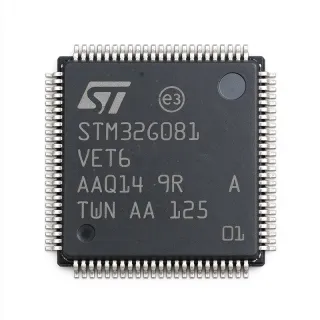
STM32L471VET6 - 80MHz Cortex-M4 512KB MCU | STMicroelectronics
MPN: STM32L471VET6 ✓ AktifSTM32L471VET6 Genel Bakış
A microcontroller is a programmable semiconductor that combines a processor core, memory, and peripherals on one integrated circuit. The STM32L471VET6 belongs to the STM32L4 family of 32-bit Arm Cortex-M4 microcontrollers, combining low-power operation with substantial processing performance. Its architecture supports connected industrial, sensor, metering, and equipment-control applications where energy efficiency, real-time response, and a broad peripheral set are important.
Principal device attributes include an 80 MHz maximum clock, 512 KB Flash, 128 KB SRAM, a 32-bit Arm Cortex-M4 core, and single-precision floating-point support. The 100-pin LQFP package exposes substantially more I/O than smaller MCU packages, making it suitable for systems requiring several communication peripherals, analog inputs, timers, and external memory interfaces. Digital signal processing benefits from the Cortex-M4 FPU while retaining deterministic embedded-control operation.
The STM32L4 architecture balances processing capability with low-power modes for battery-operated and industrial systems. Its 512 KB Flash provides room for application firmware, boot code, configuration data, and protocol libraries, while 128 KB of SRAM supports working buffers and real-time control tasks. The exact supported operating voltage, clock tree, peripheral configuration, current consumption, and temperature limits must be selected from the manufacturer datasheet and device option-byte configuration.
Typical applications include industrial sensor nodes, low-energy wireless equipment, building automation, portable instrumentation, motor and motion control, and connected measurement systems. The combination of 80 MHz processing, hardware floating-point capability, 512 KB Flash, and 100-pin I/O capacity supports complex control algorithms, local data processing, and communication protocol stacks while maintaining a compact surface-mount footprint.
PCB design should preserve the pin assignment and decoupling requirements defined in the manufacturer datasheet. Place the required input and output capacitors close to their associated supply pins, route high-current and sensitive analog nets away from fast-switching nodes, and use a continuous ground plane. Confirm the exact pin names, alternate functions, oscillator requirements, and programming interface before releasing the PCB.
This product page combines the manufacturer specifications, package information, sourcing references, drop-in alternatives, application guidance, and design considerations needed to evaluate the STM32L471VET6. It also distinguishes directly pin-compatible STM32L4 options from broader functional alternatives so engineers can assess replacement decisions against memory, peripheral, and firmware requirements.
Drop-in alternatifler için STM32L471VET6 — aynı paket, pin-başına uyumlu. PCB yeniden montajı gerektiren farklı paket bileşenleri dışlanmıştır.
Bu Serideki Variantlar
Yedek parça uyumlu olan aynı serideki modeller STM32L471VET6 (aynı form faktörü ve ayağa oturma) — farklı olan ADC Resolution, Flash Organization, Package, Processor Core.
STM32L475VET6
✅ Yerleştirme📋 Katalogda Olmayan Referans Alternatifi
STM32L476VET6
✅ Yerleştirme📋 Katalogda Olmayan Referans Alternatifi
STM32L452VET6
✅ Yerleştirme ⚠️ Onaylanmamış Özellikler📋 Katalogda Olmayan Referans Alternatifi
STM32L496VET6
✅ Yerleştirme ⚠️ Onaylanmamış ÖzelliklerFiyat için iletişime geçin
Veri Şablonunu Görüntüle →STM32L432VET6
✅ Yerleştirme ⚠️ Onaylanmamış Özellikler📋 Katalogda Olmayan Referans Alternatifi
STM32L471VET6 Maksimum Değerlendirmeler & Elektriksel Özellikler
| Product Type | 32-bit ultra-low-power microcontroller |
| Processor Core | Arm Cortex-M4 |
| Architecture | 32-bit RISC |
| Azami Saat Hızı | 80 MHz |
| Flash Memory | 512 KB |
| Flash Organization | 512K x 8 |
| SRAM | 128 KB |
| Floating-Point Unit | Integrated single-precision FPU |
| Paket | 100-pin LQFP |
| Package Body Size | 14 x 14 mm |
| Montaj Türü | Surface mount |
| Power Class | Ultra-low-power |
| ADC Resolution | 12 bit |
STM32L471VET6 14 x 14 mm Pin Yapısı Kılavuzu
STM32L471VET6 (14 x 14 mm paket) için pin yapısı. Bu dijital IC, GPIO, iletişim arayüzleri (UART, SPI, I2C) ve güç pinleri içerir. Alternatif pin işlevleri ve yapılandırma seçenekleri için üretici veri kitapçığını referans alın. Tünel sistem tasarımı ve PCB yerleşimi için temel bir bileşendir.

Ayrıntılı pin çıkış verisi mevcut değil: STM32L471VET6.
Aşağıdaki veri sayfası tam pin konfigürasyonu için.
Tipik Uygulamalar
STM32L471VET6 için uygundur 6 uygulamas: Industrial Sensor and Condition Monitoring, Low-Energy Wireless Sensor Node, Building Automation Controller, Portable Test and Measurement Instrument, Motor and Motion Control, Connected Industrial Equipment.
Industrial Sensor and Condition Monitoring
The STM32L471VET6 fits industrial sensor nodes that need local signal processing, configurable I/O, and low-power operation. Its 80 MHz Arm Cortex-M4 core can combine sensor filtering, control logic, and protocol handling without a separate host processor, while the integrated floating-point unit accelerates calculations involving temperature, pressure, vibration, or power measurements. The 512 KB Flash provides room for application code and data-processing routines, and 128 KB of SRAM supports working buffers. Its 100-pin LQFP format is particularly useful when the system needs multiple digital inputs, outputs, analog channels, and communication peripherals. Engineers should confirm the required ADC channels, timer assignments, sensor interfaces, and low-power mode transitions in the manufacturer pin and electrical tables before schematic release.
Low-Energy Wireless Sensor Node
The STM32L471VET6 is suitable for a battery-powered wireless sensor node because it combines an 80 MHz Cortex-M4 processor with the STM32L4 family's ultra-low-power positioning. The MCU can remain responsible for local measurement, filtering, event detection, and payload preparation while a connected radio handles communications. Its 512 KB Flash is useful for a lightweight protocol stack and application firmware, and 128 KB of SRAM reduces pressure on external memory. The large 100-pin package also offers more peripheral routing options than a small-outline MCU. A production design should select the radio interface pins early, verify whether the STM32L471VET6 supports the required low-power sleep mode and wake-up source, and budget decoupling capacitors and antenna keepout accordingly.
Building Automation Controller
The STM32L471VET6 can serve as the control hub for a building-automation subsystem containing environmental sensors, relays, digital inputs, and serial-network devices. Its 80 MHz Cortex-M4 core provides enough performance for scheduling, debouncing, state machines, and data conversion, while the floating-point unit assists with calculations used in occupancy and energy management. The 100-pin LQFP package provides a practical pin count for multiple peripheral interfaces and substantially greater I/O flexibility than compact packages. Its STM32L4 low-power architecture is also valuable in equipment that spends long periods idle. Firmware should define explicit power states, configure unused pins safely, and validate communications timing under the selected clock tree. Exact available timers, serial interfaces, and low-power wake-up options require confirmation from the manufacturer documentation.
Portable Test and Measurement Instrument
The STM32L471VET6 is appropriate for portable measurement equipment where a compact MCU must acquire data, process results, and present a local user interface. The 80 MHz Cortex-M4F core can execute filtering, calibration, and numerical routines efficiently, while 512 KB of Flash supports firmware for measurement algorithms and communications. The 128 KB SRAM is useful for waveform buffers and communication framing, and the 100-pin LQFP package exposes enough pins for displays, buttons, ADC inputs, and debug functions. The STM32L4 family's low-power emphasis supports longer battery operation between measurement cycles. Designers should verify analog front-end requirements separately, use the datasheet pin table to avoid conflicts with high-speed or sensitive signals, and ensure the reference design power arrangement and external component values are followed.
Motor and Motion Control
The STM32L471VET6 can support compact motor-control or motion-control subsystems that require deterministic timers, real-time interrupt handling, and moderate processing bandwidth. The 80 MHz Cortex-M4 core provides headroom for control-law execution and diagnostics, and its floating-point unit simplifies many common motor-control calculations. The 100-pin LQFP package provides enough pin count for encoder inputs, control signals, communication links, and protection inputs, reducing the need for external logic. A production design must match timer channels to PWM and capture requirements, confirm pin alternate-function mappings, and coordinate analog current sensing with the device's ADC resources. The low-power architecture is helpful between motion events, although continuous regulation, switching losses, and thermal performance of external power stages determine the overall efficiency.
Connected Industrial Equipment
The STM32L471VET6 fits connected industrial equipment that combines real-time control with diagnostics and field communications. Its 80 MHz Cortex-M4 processor and integrated floating-point unit can execute motor, process, or sequencing logic while also maintaining a communication stack, and 512 KB of Flash accommodates application, boot, and configuration software. The 100-pin LQFP package offers extensive routing options for serial interfaces, digital I/O, timers, and analog channels. Its ultra-low-power family positioning supports efficient sleep and wake behavior in intermittently connected machines. Engineering teams should use the manufacturer documentation to map the intended serial interface, confirm bootloader and in-system-programming requirements, and avoid assigning pins that are needed for high-speed signals or debug access. Production validation should include clock tolerance, brownout behavior, and peripheral interrupt timing.
Mühendislik referans verileri: STM32L471VET6 — karşılaştırma, tasarım rehberi ve uyumluluk bilgileri.
Seçim Kılavuzu
Alternatiflerle Karşılaştırma
| Parametre | Bu Ürün | STM32L475VET6 | STM32L476VET6 | STM32L452VET6 | STM32L496VET6 | STM32L432VET6 |
|---|---|---|---|---|---|---|
| Brand | STMicroelectronics | STMicroelectronics | STMicroelectronics | STMicroelectronics | STMicroelectronics | STMicroelectronics |
| Package | 100-pin LQFP (14 x 14 mm) | 100-pin LQFP (14 x 14 mm) | 100-pin LQFP (14 x 14 mm) | 100-pin LQFP (14 x 14 mm) | 100-pin LQFP (14 x 14 mm) | 100-pin LQFP (14 x 14 mm) |
| Processor Core | Arm Cortex-M4 with FPU | Arm Cortex-M4 with FPU | Arm Cortex-M4 with FPU | Arm Cortex-M4 with FPU | Arm Cortex-M4 with FPU | Arm Cortex-M4 with FPU |
| Maximum Clock Frequency | 80 MHz | 80 MHz | 80 MHz | 80 MHz | 80 MHz | 80 MHz |
| Flash Memory | 512 KB | 512 KB | 1 MB | 512 KB | 1 MB | 256 KB |
| SRAM | 128 KB | 128 KB | 128 KB | 128 KB | 128 KB | 64 KB |
| Word Length | 32-bit | 32-bit | 32-bit | 32-bit | 32-bit | 32-bit |
| Power Class | Ultra-low-power | Ultra-low-power | Ultra-low-power | Ultra-low-power | Ultra-low-power | Ultra-low-power |
| ADC Resolution | 12 bit | 12 bit | 12 bit | 12 bit | 12 bit | 12 bit |
Ana Farklılayıcılar
- Balanced memory configuration for the 100-pin STM32L4 platform (karşılaştırma:STM32L432VET6)
- Lower flash capacity than the STM32L476VET6 (karşılaştırma:STM32L476VET6)
- Same package and CPU platform support direct board reuse (karşılaştırma:STM32L475VET6)
- Lower nominal flash capacity than the STM32L496VET6 (karşılaştırma:STM32L496VET6)
Tasarım Notları
Use the manufacturer pin table and package drawing as the authoritative PCB assignment. Place all required bypass capacitors adjacent to their supply pins, provide a continuous ground plane, and route programming, reset, and debug signals away from noisy analog and switching sections. The 100-pin LQFP footprint requires careful fan-out review because incorrect pin numbering can produce a board that powers up but cannot boot or communicate.
Decouple each applicable supply domain and verify voltage limits, sequencing, and startup behavior against the manufacturer electrical tables before connecting external loads. The STM32L471VET6 is an ultra-low-power MCU, but average system power depends on the selected clock, peripheral activity, and sleep duration. Measure current in the operating modes that matter and calculate battery life from those measured values rather than from the processor frequency alone.
Keep analog sensing paths short and isolate them from oscillator, debug, and digital switching nets. If the design uses a high-frequency clock or external communication interface, follow the recommended impedance and return-path practices in the manufacturer reference material. ADC accuracy is affected by source impedance, sampling time, reference stability, and grounding, so the analog front end must be designed together with the firmware sampling strategy.
Do not assume that every STM32L4 MCU with the same LQFP package is register- and firmware-compatible. Before replacing the STM32L471VET6, verify alternate-function mapping, timer channels, communication peripherals, interrupt vectors, clock sources, low-power modes, package dimensions, and device identification in the actual firmware startup code. This is particularly important when an alternative provides more Flash, different SRAM, or additional connectivity features.
Uyumluluk Bilgisi
The available product references do not provide an unambiguous compliance declaration. RoHS, REACH, lead-free, halogen-free, and conflict-minerals status remain unknown. AEC-Q100 qualification is not claimed for this commercial-temperature STM32L471VET6 ordering code.