مصنوعات (49,000+)

TUSB2551PWR - USB 2.0 Half Transceiver | Texas Instruments (Tape & Reel)
TUSB2551PWR

TUSB2551PWR - USB 2.0 Half Transceiver | Texas Instruments (Tape & Reel)

Texas Instruments TUSB2551PWR is a single USB 2.0 half-rate transceiver supporting full-speed operation up to 12 Mbit/s and low-speed operation up to 1.5 Mbit/s in a 14-pin TSSOP package. The device operates from a 1.65 V to 3.6 V supply, making it suitable for low-voltage USB connectivity and embedded systems. Its integrated transceiver architecture supports bidirectional USB data signaling while reducing the external circuitry required for a host, device, or interface application. A USB transceiver is an interface IC that converts digital controller signals into USB-compatible physical-layer signals and receives the corresponding bus signals from a USB connection. The TUSB2551 belongs to the USB interface transceiver hierarchy, alongside USB interface controllers, USB hubs, and USB power-management devices. Unlike a USB controller, it does not implement protocol or enumerate bus devices; it provides the physical-layer path between a USB-capable controller and a connector or cable. The TUSB2551 supports both full-speed and low-speed USB 2.0 operation. Texas Instruments identifies superior edge-rate control as a means of producing crisper eye diagrams, which can simplify USB compliance testing. Dual-supply operation allows the digital and analog portions of the device to use separate supply rails. The 1.65 V to 3.6 V operating range supports common 1.8 V and 3.3 V system environments while accommodating lower-voltage interface requirements. Typical uses include USB-to-serial bridges, embedded USB peripherals, industrial data acquisition, portable diagnostic equipment, and USB connectivity for microcontrollers that require an external physical-layer transceiver. Its 14-pin TSSOP format also supports PCB layouts that prioritize a small, widely available package rather than a leadless land pattern. System designers should still verify signal integrity, termination, cable routing, and supply sequencing against the manufacturer datasheet. For USB applications, the transceiver is used between the host or device controller and the connector. Differential pair routing should be short and impedance controlled, while supply and ground connections should provide low-impedance return paths. The device's low-voltage supply range makes it useful for portable equipment, but total system power, connector-current capability, and USB specification compliance remain separate design considerations. This page combines the verified Texas Instruments product information, distributor listings, package details, available cross-reference evidence, and practical guidance for evaluating the TUSB2551PWR. It also distinguishes confirmed pin-compatible options from unreported electrical parameters so engineers can identify which data must be checked before approving a replacement.

RFQ رابطہ
TUSB2551RGTR - USB 2.0 Transceiver | Texas Instruments
TUSB2551RGTR

TUSB2551RGTR - USB 2.0 Transceiver | Texas Instruments

The Texas Instruments TUSB2551RGTR is a USB 2.0 physical-layer transceiver supporting full-speed operation up to 12 Mbit/s and low-speed operation up to 1.5 Mbit/s, housed in a 16-pin VQFN package measuring 3 mm by 3 mm. It is a single-chip transceiver designed for systems that require USB host, device, or transceiver-port connectivity with controlled signal-edge performance. A universal serial bus transceiver is an interface IC that converts digital data between a controller or peripheral and the physical USB D+ and D- differential pair. The TUSB2551 belongs to the broader hierarchy of interface IC, USB interface, transceiver, and physical-layer semiconductor. Its USB 2.0 compliance provides a standardized implementation for full-speed and low-speed USB links found in portable equipment, industrial controls, test systems, and USB peripherals. The device supports dual supply-voltage operation, allowing system-side I/O signaling from a supply as low as 1.6 V while the transceiver is independently powered from USB VCC at 5.0 V. This separation is useful when the logic interface voltage differs from the USB bus supply voltage. Controlled edge rates produce clearer eye diagrams and can simplify USB compliance testing by reducing excessive transition spread. Technically, the TUSB2551 integrates the USB physical-layer functions required for bidirectional communication over the differential data pair. The 16-pin VQFN-16 (RGT) package provides a compact surface-mount footprint suitable for portable and embedded equipment. Its small 3 mm by 3 mm body, exposed-pad-style thermal connection, and high pin density make careful PCB layout essential for reliable signal integrity and heat transfer. Typical uses include USB-to-serial adapters, portable instrumentation, industrial control panels, laboratory equipment, external accessories, and embedded systems that connect a low-voltage controller to a full-speed or low-speed USB port. The 1.6 V system-interface capability can simplify integration with modern low-voltage digital controllers while retaining compatibility with the 5.0 V USB supply domain. Design the high-speed differential path with a controlled 90-ohm differential impedance, short traces, and uninterrupted reference planes. Place input and output decoupling capacitors close to their associated supply pins, and verify the exposed thermal pad connection under the highest expected bus activity. USB compliance testing should cover rise and fall times, eye diagrams, impedance, and both full-speed and low-speed operating modes. This product page combines USB capability, package details, application guidance, drop-in candidate analysis, and practical layout considerations to help engineers evaluate the TUSB2551RGTR beyond a basic manufacturer feature list.

RFQ رابطہ
TUSB3200CPAH USB Streaming Controller | Texas Instruments
TUSB3200CPAH

TUSB3200CPAH USB Streaming Controller | Texas Instruments

Texas Instruments TUSB3200CPAH is a USB streaming controller with a standard 8052 microcontroller core, 4 KB of ROM program memory, and full compatibility with USB Specification Version 1.1 and the USB Audio Class Specification. The device is packaged in a 52-pin TQFP and is intended for USB audio interface designs that require dedicated USB streaming control. A USB streaming controller is a specialized application-specific microcontroller that manages the transfer of audio or other streaming data between a USB host and an audio codec or peripheral. Within the product hierarchy, it combines an 8052 microcontroller, USB device control, firmware handling, and streaming interfaces. This integration reduces the need for a separate general-purpose controller when a USB audio product requires deterministic enumeration, control, and data-routing behavior. Key characteristics include the 8052 MCU architecture, 4 KB ROM containing a bootloader program, USB 1.1 compatibility, and USB Audio Class support. The dedicated streaming architecture allows a product to handle USB host enumeration and audio data transfer while presenting the external audio circuitry with a controlled interface. The 52-pin TQFP also provides separate connections for digital audio, USB, clocking, control, and power functions. The controller's internal organization is centered on on-chip memory and an 8052-compatible processing core. Its ROM-based program memory contains a bootloader, while USB and audio-class firmware establish enumeration and streaming behavior. This makes the device suitable for compact USB audio equipment where a dedicated streaming interface is preferable to implementing the complete USB audio stack in a larger application processor. Typical applications include USB headphones, active speakers, USB speakerphones, docking stations, USB audio adapters, and compact consumer audio accessories. In these systems, the TUSB3200CPAH can manage USB streaming control while an external codec converts the digital stream into an analog or headphone-driver-compatible signal. Its dedicated function also supports multi-function USB products that combine audio with control or status interfaces. PCB design should preserve the USB differential pair as a short, continuous, impedance-controlled route and place the required support components close to the device. Audio and USB clock domains require careful grounding and return-path planning to prevent data corruption and audible artifacts. Designers should use the manufacturer pin-description and layout guidance when assigning every TQFP signal and programming the on-chip firmware. This product page combines the exact TUSB3200CPAH identification, USB streaming architecture, verified package details, sourcing guidance, related 52-TQFP options, and practical implementation considerations. It is designed to help engineers determine whether the controller matches a USB audio design before beginning PCB layout and firmware integration.

RFQ رابطہ
TUSB320HAIRWBR - USB Type-C CC Logic, X2QFN-12 | TI
TUSB320HAIRWBR

TUSB320HAIRWBR - USB Type-C CC Logic, X2QFN-12 | TI

The Texas Instruments TUSB320HAIRWBR is a USB Type-C Configuration Channel (CC) logic and port controller in an industrial-grade (I-temp) active-high enable variant, packaged in a 12-pin X2QFN (RWB) measuring 1.6 mm × 1.6 mm. The device operates from a single 3.3 V supply and supports USB Type-C Specification 1.1 while remaining interoperable with 1.0 systems. It advertises and detects up to 3 A of VBUS current per Type-C current-mode rules and supports DFP (Source), UFP (Sink), and DRP (Dual Role) port roles selected through MODE pins. A USB Type-C Configuration Channel Logic IC is a state-machine controller that sits between a USB Type-C receptacle and the application processor or USB controller. Its job is to negotiate attach/detach events, cable orientation (CC1/CC2 polarity), role (host vs device), and current advertisement (default 500 mA, 1.5 A, or 3 A) through the CC1/CC2 pull-up and pull-down signalling defined by the USB-IF Type-C specification. Higher up the hierarchy it is an Interface IC > USB Interface IC; below it is the CC PHY layer. Key features include: integrated 5.1 kΩ CC pull-up resistors that can be toggled for DRP toggle, hardware MODE pin configuration (no firmware needed), active-high enable (EN) pin for power sequencing, low standby current with a dedicated low-power mode, and HBM ESD protection on CC pins. The X2QFN-12 RWB package keeps the device under 3 mm² footprint, ideal for compact dongles, hubs, and embedded platforms. Typical applications are any 5 V / 3 A USB Type-C ports that need a low-BOM CC controller: travel chargers, USB Type-C dongles, adapters, hubs, docking stations, smartphones, tablets, and notebooks. Because it operates as a standalone state machine with no MCU required, it is well-suited to cost- and board-area-sensitive designs. Design consideration: place the 100 nF decoupling capacitor within 2 mm of VCC and keep the CC traces short, matched, and away from switching nodes to preserve signal integrity. A 0 Ω or ferrite series resistor on VBUS is optional but recommended to limit inrush current at attach. This page synthesizes distributor pricing, drop-in alternatives, application pairings, and design notes not found in the manufacturer datasheet, optimized for engineers sourcing USB Type-C port controllers.

RFQ رابطہ
TUSB320LAIRWBR - USB Type-C CC Logic & Port Controller | TI
TUSB320LAIRWBR

TUSB320LAIRWBR - USB Type-C CC Logic & Port Controller | TI

The Texas Instruments TUSB320LAIRWBR is a USB Type-C configuration channel (CC) logic and port controller housed in a 12-pin X2QFN (RWB) package measuring 1.6 mm x 1.6 mm. It supports USB Type-C Specification 1.1, is backward compatible with 1.0, advertises and detects up to 3 A of VBUS current, and operates from a 2.7 V to 5 V supply. Configuration modes include Host Only (DFP/Source), Device Only (UFP/Sink), and Dual Role Port (DRP) for accessories, hubs, smartphones, and laptops. The "L" variant removes I2C and adds GPIO-controlled mode selection for ultra-low-power BOMs. What is a USB Type-C port controller? A USB Type-C port controller is an interface IC that sits between a USB 2.0 data path and the Type-C receptacle, managing the Configuration Channel (CC) pins that detect cable attach/detach, determine plug orientation (CC1 vs CC2), advertise the source/sink current capability through Rp/Rd pull-up/pull-down resistors, and negotiate power-role swap for USB Power Delivery. It belongs to the broader hierarchy of interface ICs -> USB interface ICs -> Type-C controllers -> USB Power Delivery controllers, occupying the link layer just above the physical connector. Key differentiating features include integrated CC logic, automatic DRP toggle, support for audio and debug accessory modes, an active-high ENABLE pin, and an open-drain INT output for interrupt-driven host polling. The device is offered in both I2C-configurable (TUSB320I) and pin-strapped/GPIO (TUSB320L) variants within the same X2QFN-12 footprint, allowing PCB reuse between firmware-driven and BOM-optimized designs. Operating temperature is -40 C to +85 C (industrial). The TUSB320L architecture is a pure hardware state machine that samples the CC1/CC2 pins, drives the appropriate Rp current source or Rd pull-down, and reports attach/orientation events to the application processor through dedicated GPIO flags. This eliminates the firmware overhead of I2C register polling and reduces quiescent current for battery-powered devices. Compared to discrete USB-C implementations using comparators and FETs, the TUSB320L integrates Rp/Rd biasing and accessory detection in a single 1.6 mm x 1.6 mm chip. Typical applications include USB Type-C wall adapters, smartphone charging cradles, accessory-mode audio adapters, USB-C hubs and docks, notebook and tablet Type-C ports, and USB-C debug ports for embedded development. It is widely used wherever a 5 V / up to 3 A Type-C source or sink is needed without USB PD negotiation. A key design tip - because the TUSB320L has no I2C, role selection and current-mode advertisement must be hard-wired through MODE pin resistors at power-up. Layout the CC1/CC2 traces as a 90 ohm differential pair with the connector ground return, and decouple VDD with a 0.1 uF X7R ceramic placed within 2 mm of pin 12. This page synthesizes TI datasheet parameters, distributor pricing, drop-in alternatives (same-brand first, cross-brand verified), and PCB design notes not duplicated in the manufacturer datasheet, giving procurement and design engineers a one-stop reference for the TUSB320LAIRWBR.

RFQ رابطہ
TUSB320RWBR - USB Type-C CC Controller | Texas Instruments
TUSB320RWBR

TUSB320RWBR - USB Type-C CC Controller | Texas Instruments

Texas Instruments TUSB320RWBR is a USB Type-C configuration channel logic and port-control IC supporting USB Type-C specification 1.1, backward compatibility with specification 1.0, and current advertisement and detection up to 3 A. The device is offered in a 12-X2QFN surface-mount package measuring 1.6 mm by 1.6 mm. It handles configuration-channel attachment, cable-orientation detection, port-role detection, and Type-C current-mode selection. A USB Type-C configuration channel controller is an interface IC within the USB Type-C port ecosystem. USB Type-C uses dedicated CC pins to negotiate cable attachment, orientation, port roles, and the available current level. This controller connects that negotiation to the port-management circuitry, allowing a USB-C port to operate as a source, sink, or dual-role port without implementing the entire USB Type-C protocol in system firmware. The TUSB320 supports host-only DFP, device-only UFP, and dual-role DRP operating modes. It advertises default, medium, and high Type-C current modes, with support for current advertisement and detection up to 3 A. Backward compatibility with USB Type-C specification 1.0 is important when the port must interoperate with earlier implementations and accessories. Its compact 1.6 mm by 1.6 mm package supports space-constrained consumer and embedded systems. Technically, the device separates low-speed Type-C port management from the data path. CC signaling determines which direction the inserted cable is connected and which party supplies power, while the USB data lanes remain the responsibility of a host, device, or dual-role controller. This division improves design flexibility because the same connector can be used with several USB controllers or protocol bridges when their electrical and logical interfaces are compatible. Typical applications include laptop and tablet docking stations, smartphone and accessory charging designs, USB-C expansion adapters, industrial USB-C equipment, and embedded systems that require reversible connector orientation detection. It is also suitable for USB-C power-management designs where the system must identify sink or source behavior before enabling the appropriate power path. Designers should verify the exact pin assignments, electrical limits, VBUS behavior, and configuration-channel implementation against the manufacturer datasheet. PCB layout must keep the compact package’s connections short, provide clean device grounding, and follow the manufacturer’s recommended decoupling arrangement. Because the controller coordinates port behavior rather than carrying high-speed USB data, its placement priority is deterministic power sequencing and signal integrity rather than USB differential-pair routing. This product page consolidates the TUSB320RWBR specifications, verified manufacturer and distributor links, family alternatives, comparison parameters, and practical selection guidance. It is intended to help engineers determine whether the 12-X2QFN Type-C controller supports their required roles, current mode, package, and system-management architecture.

RFQ رابطہ
TUSB3210PM - USB 2.0 8052 Controller | Texas Instruments
TUSB3210PM

TUSB3210PM - USB 2.0 8052 Controller | Texas Instruments

The Texas Instruments TUSB3210PM is an integrated USB 2.0 full-speed general-purpose device controller with an 8052-based microcontroller, 8K x 8 RAM, and programmable general-purpose I/O in a 64-pin LQFP package. It supports USB data rates up to 12 Mbit/s and provides USB suspend, resume, and remote wake-up operation for connected peripheral, control, and human-interface-device designs. A USB general-purpose device controller is an application-specific microcontroller category that integrates a USB full-speed serial interface with embedded firmware execution and general-purpose I/O. The TUSB3210 sits within the hierarchy of semiconductor, embedded microcontroller, application-specific microcontroller, and USB interface controller devices. This integration reduces the need for a separate USB interface IC while retaining programmable behavior for product-specific USB functions. The principal feature set includes USB 2.0 full-speed compliance, a 12 Mbit/s supported USB data rate, suspend, resume, and remote wake-up support, and 8K x 8 bytes of RAM for application development. The controller also supports multiproduct designs with one code base and one controller, including configurations covering up to 16 products with one chip. Its programmability allows the same USB-connected platform to address multiple peripheral roles without relying on a fixed-function bridge. Internally, the TUSB3210 combines an 8052-compatible microcontroller with USB device-controller logic and general-purpose I/O. The 8K x 8 RAM organization provides 8,192 bytes of data storage for firmware variables, descriptors, buffers, and working state. Because the part is programmable rather than a fixed protocol translator, engineers can implement device-specific enumeration behavior, vendor requests, HID reports, status signaling, or other USB functions in one compact 64-LQFP device. Typical implementations include USB-to-serial adapters, keyboard and mouse controllers, industrial input modules, portable diagnostic equipment, programmers, and general USB I/O expansion boards. The 64-pin LQFP package also exposes enough pins for multiple GPIO functions, clocking connections, and USB bus-interface requirements, although a complete 64-pin pin map is not present in the supplied verified excerpts. The principal design consideration is that USB firmware, descriptor development, and bus-routing validation remain necessary because this is a programmable controller rather than a fully finished USB peripheral. Layout should follow the manufacturer's recommended USB data-path guidance, provide clean return-current paths, and use appropriate decoupling. Exact operating-voltage, clock, temperature, and pin-function details should be confirmed in the manufacturer datasheet before schematic release. This page consolidates the verified distributor identification, USB 2.0 and 8052 controller description, package information, RAM capacity, pricing indication, and sourcing links into an engineering-focused view. It also separates verified facts from unavailable detailed specifications and documents why few defensible drop-in replacements can be confirmed from the supplied cross-reference results.

RFQ رابطہ
TUSB3210PMG4 - 3.3V USB 2.0 8052 MCU | Texas Instruments
TUSB3210PMG4

TUSB3210PMG4 - 3.3V USB 2.0 8052 MCU | Texas Instruments

Texas Instruments TUSB3210PMG4 is an application-specific USB microcontroller with an 8052 core, USB 2.0 interface, 3.3 V supply operation, and integrated EEPROM in a 64-pin LQFP package. It is packaged in a tray for commercial-temperature production systems. An application-specific microcontroller is an embedded processing IC optimized for a defined peripheral function or interface rather than for general application processing. The TUSB3210 belongs to the microcontroller hierarchy, combining an 8052-compatible CPU core with a USB device controller, on-chip program memory, RAM, and EEPROM. This integration allows a USB-to-GPIO or similar peripheral design to enumerate as a full-speed USB device while reducing the number of external components. The principal operating characteristics are a 3.3 V supply, USB 2.0 full-speed connectivity, an 8052 microcontroller core, and a 64-terminal LQFP package. Its 64 terminals provide access to the controller, firmware-programmable I/O, clock, reset, power, and USB functions. The G4 ordering designation corresponds to the commercial-temperature, tray-packaged configuration identified in the Texas Instruments product information. TUSB3210PMG4 integrates USB connectivity with programmable GPIO behavior rather than requiring a conventional USB PHY and external microcontroller as separate components. The EEPROM supports configuration or parameter retention, while the 8052 core executes the device firmware that identifies the peripheral and controls its external interfaces. Because the device is a dedicated USB controller, its principal engineering task is validating the complete pin, firmware, timing, and USB enumeration design before a board is released. Typical applications include USB-to-GPIO adapters, configurable peripheral controllers, data-acquisition front ends, legacy equipment interfaces, and industrial interface modules. The integrated USB controller can also support firmware-based product identification, control, and status reporting over a full-speed USB connection. External transceivers, protection components, crystals, and storage may still be required according to the selected board architecture. Use the manufacturer pin-description table and reference schematic when assigning PCB tracks, especially for USB data, clock, reset, and exposed supply connections. Preserve the specified decoupling arrangement, maintain controlled USB impedance routing, and validate firmware behavior across bus-powered and externally powered operating conditions. This page combines the manufacturer catalog identity, verified package and ordering information, a strict drop-in replacement assessment, and practical implementation guidance. It also distinguishes the electrically and mechanically interchangeable ordering option from devices that only perform a similar USB-interface function but do not share the 64-pin LQFP footprint.

RFQ رابطہ
TUSB321RWBR - USB Type-C CC Logic 3A X2QFN-12 | Texas Instruments
TUSB321RWBR

TUSB321RWBR - USB Type-C CC Logic 3A X2QFN-12 | Texas Instruments

The Texas Instruments TUSB321RWBR is a USB Type-C configuration channel (CC) logic and port control device with VCONN support, packaged in a 12-pin X2QFN (1.6x1.6 mm) land-grid array. It implements the CC signaling required by USB Type-C Specification 1.1 and remains backward compatible with USB Type-C Specification 1.0, advertising up to 3 A of current through a dedicated current mode pin. A USB Type-C CC logic device is a specialized interface IC that manages the configuration channel pins of a USB Type-C connector. Within the system hierarchy, it sits between the USB Type-C connector and the USB controller or power path, belonging to the interface IC family inside integrated circuits. The CC logic block monitors the CC1 and CC2 pins for pullup or pulldown resistances to determine port attach and detach, cable orientation, and role detection, which are mandatory functions for any Type-C port. Key features include three mode configurations - host only (DFP/Source), device only (UFP/Sink), and dual role port (DRP) - where the device alternates between DFP and UFP roles per the Type-C Specifications. An integrated VCONN switch powers electronically marked (e-marked) cables, and dead battery mode allows a sink device to present as a Type-C device even before system power is available. Technically, the TUSB321 integrates CC termination, Rp/Rd detection, cable orientation indication, and port power control in a single low-power die, minimizing external components and bill-of-materials cost. The compact X2QFN package with 1.6x1.6 mm footprint suits space-constrained portable designs. Typical applications include smartphones, tablets, laptops, docking stations, chargers, and USB Type-C enabled accessories. Any design needing compliant Type-C attach detection and current advertisement benefits from this device. For design, place the TUSB321RWBR close to the Type-C connector to keep CC traces short, decouple VCC with a 1 uF capacitor, and configure the current mode pin for the intended 3 A advertisement level as described in TI datasheet (SLVSDF4).

RFQ رابطہ
TUSB321RWBR-Q1 - USB Type-C CC Logic Port Control | TI
TUSB321RWBR-Q1

TUSB321RWBR-Q1 - USB Type-C CC Logic Port Control | TI

The Texas Instruments TUSB321RWBR-Q1 is an automotive-grade USB Type-C configuration channel (CC) logic and port control IC with VCONN support, provided in a compact 12-pin X2QFN package measuring just 1.6 mm x 1.6 mm. Operating from a 4.5V to 5.5V supply, it enables USB Type-C ports with the CC logic needed for Type-C ecosystems while meeting the USB Type-C Specification 1.1 and remaining backward compatible with Specification 1.0. A USB Type-C port controller (also called a CC logic chip or port control IC) is a small companion device that manages the configuration channel pins of a Type-C connector. It sits in the hierarchy: port controller -> USB interface IC -> USB connectivity semiconductor -> power/data management. It detects attach and detach events, determines cable orientation, performs role detection, and advertises current capability through the dedicated current mode pin. Key features include support for up to 3A of current advertisement through the dedicated current mode pin, configurable port roles of DFP (source), UFP (sink), or dual role port (DRP), and integrated VCONN supply switching for actively marked cables. The device autonomously handles Rd/Rp termination switching on the CC pins according to cable orientation, offloading this logic from the system microcontroller. The TUSB321 implements the CC layer with a simple pin-strap configuration (PORT pin) rather than an I2C interface, minimizing firmware complexity and cost for systems that do not need Power Delivery negotiation. Its automotive qualification (AEC-Q100) makes it suitable for infotainment, telematics, and charging ports in vehicles, while the 1.6 mm x 1.6 mm X2QFN footprint fits space-constrained smartphone, tablet, and accessory designs. Typical applications include automotive USB Type-C charging ports, host and device port attach detection in notebooks, docking stations, and power-bank sink/source role management. Design tip: strap the PORT pin for the required role at power-up; if you later need USB Power Delivery negotiation, migrate to the I2C-controlled TUSB322 family, which shares the same X2QFN footprint.

RFQ رابطہ
TUSB322IRWBR - USB Type-C CC Controller with VCONN | TI
TUSB322IRWBR

TUSB322IRWBR - USB Type-C CC Controller with VCONN | TI

The Texas Instruments TUSB322IRWBR is a USB Type-C Configuration Channel logic and port-control IC with VCONN support, advertisement and detection of currents up to 3 A, and operation from -40°C to 85°C. It is packaged in a 12-pin X2QFN (RWB) measuring 1.6 mm by 1.6 mm, making it suitable for space-constrained USB Type-C ports, docks, and power adapters. A USB Type-C Configuration Channel controller is an interface IC within the USB Type-C port-control hierarchy. It evaluates the CC1 and CC2 signals to determine cable attachment, cable orientation, and the port's advertised role. The controller also coordinates power-current advertisement and source or sink behavior, allowing a USB-C system to negotiate a safe operating current through its physical Type-C connection. The TUSB322I supports the USB Type-C 1.1 specification and remains backward compatible with USB Type-C 1.0. Its mode configuration supports host-only operation, device-only operation, and dual-role port operation. In I2C mode, the device can operate as a downstream-facing port or source, while its CC logic monitors pull-up and pull-down behavior on CC1 and CC2. It also includes support for advertisement and detection of current levels up to 3 A. Because the TUSB322IRWBR combines orientation detection, role detection, current advertisement, and VCONN control in one compact device, it can reduce the component count required around a USB Type-C receptacle. The 1.6 mm by 1.6 mm footprint is particularly useful in laptop docks, monitor hubs, charging accessories, industrial equipment, and compact consumer electronics where connector placement and routing space are limited. The 12-pin X2QFN package requires careful PCB layout. Place the CC resistors and VCONN-related support components close to their associated pins, maintain the device's recommended land pattern, and observe the datasheet's routing and thermal guidance. The -40°C to 85°C temperature range supports industrial and commercial environments, but the complete system must still be evaluated for its worst-case ambient temperature, connector heating, and power-delivery behavior. This product overview consolidates the device's principal electrical roles, package characteristics, configuration options, and application guidance into an engineering-focused reference. It also identifies which related TUSB devices appear in direct comparisons, helping designers distinguish exact drop-in candidates from nearby family members before changing an existing PCB. Before finalizing a USB-C design, use the pin-description table, typical application circuit, and ordering information in the Texas Instruments TUSB322I datasheet. Confirm connector compatibility, VCONN requirements, CC pull-up or pull-down values, current-advertisement policy, and the exact exposed-pad layout against the latest manufacturer documentation.

RFQ رابطہ
TUSB3410IRHB UART-I2C-IrDA USB Bridge | Texas Instruments
TUSB3410IRHB

TUSB3410IRHB UART-I2C-IrDA USB Bridge | Texas Instruments

Texas Instruments TUSB3410IRHB is an application-specific 8052 USB serial-port controller that bridges an enhanced UART serial port to USB while also supporting I2C and IrDA connectivity. The device operates from 3.0 V to 3.6 V and is offered in a 32-pin VQFN RHB package with an exposed pad for an industrial temperature range of -40°C to +85°C. A USB-to-UART bridge is an interface controller that translates transactions between a USB host and an embedded serial device. The TUSB3410 belongs to the broader USB interface-controller hierarchy and combines a USB interface, enhanced UART, I2C connectivity, IrDA support, and an embedded 8052 microcontroller. This integration allows legacy serial equipment to communicate through a USB connection without requiring a separate external host controller. The TUSB3410 contains an 8052 microcontroller core with 10 KB of ROM and 16 KB of RAM. Its ROM contains firmware supporting the bridge functions, while RAM can be loaded by the USB host or through external onboard memory connected by I2C. The RHB package provides 32 pins and an exposed thermal pad, enabling a compact surface-mount implementation with an effective PCB heat-spreading area. The 3.0 V to 3.6 V operating range suits systems that use a 3.3 V power rail. In the UART path, the device bridges USB to an enhanced serial interface, and its I2C capability supports access to external memory or configuration devices. IrDA support provides an infrared-oriented serial path, although the selected external transceiver, optical interface, and application circuitry remain important parts of the complete design. Typical uses include legacy serial-port adapters, industrial equipment interfaces, point-of-sale systems, laboratory data acquisition, embedded-control service ports, and infrared-capable peripheral connections. The same bridge architecture can simplify host software when existing equipment already communicates through UART while preserving the familiar serial protocol at the device side. PCB implementation should follow the manufacturer pin and land-pattern guidance for the RHB package. Keep USB traces short and controlled, connect the exposed pad to the appropriate ground plane, provide decoupling close to the supply pins, and route high-speed or infrared-associated interfaces according to their respective signal-integrity requirements. Confirm unused control-pin states in the device documentation before finalizing the schematic.

RFQ رابطہ
TUSB3410IRHBR UART-I2C-IrDA USB Bridge | Texas Instruments (Tape & Reel)
TUSB3410IRHBR

TUSB3410IRHBR UART-I2C-IrDA USB Bridge | Texas Instruments (Tape & Reel)

Texas Instruments TUSB3410IRHBR is an application-specific 8052 USB serial-port controller that bridges an enhanced UART serial port to USB while also supporting I2C and IrDA connectivity. The device operates from 3.0 V to 3.6 V and is offered in a 32-pin VQFN RHB package with an exposed pad for an industrial temperature range of -40°C to +85°C. A USB-to-UART bridge is an interface controller that translates transactions between a USB host and an embedded serial device. The TUSB3410 belongs to the broader USB interface-controller hierarchy and combines a USB interface, enhanced UART, I2C connectivity, IrDA support, and an embedded 8052 microcontroller. This integration allows legacy serial equipment to communicate through a USB connection without requiring a separate external host controller. The TUSB3410 contains an 8052 microcontroller core with 10 KB of ROM and 16 KB of RAM. Its ROM contains firmware supporting the bridge functions, while RAM can be loaded by the USB host or through external onboard memory connected by I2C. The RHB package provides 32 pins and an exposed thermal pad, enabling a compact surface-mount implementation with an effective PCB heat-spreading area. The 3.0 V to 3.6 V operating range suits systems that use a 3.3 V power rail. In the UART path, the device bridges USB to an enhanced serial interface, and its I2C capability supports access to external memory or configuration devices. IrDA support provides an infrared-oriented serial path, although the selected external transceiver, optical interface, and application circuitry remain important parts of the complete design. Typical uses include legacy serial-port adapters, industrial equipment interfaces, point-of-sale systems, laboratory data acquisition, embedded-control service ports, and infrared-capable peripheral connections. The same bridge architecture can simplify host software when existing equipment already communicates through UART while preserving the familiar serial protocol at the device side. PCB implementation should follow the manufacturer pin and land-pattern guidance for the RHB package. Keep USB traces short and controlled, connect the exposed pad to the appropriate ground plane, provide decoupling close to the supply pins, and route high-speed or infrared-associated interfaces according to their respective signal-integrity requirements. Confirm unused control-pin states in the device documentation before finalizing the schematic.

RFQ رابطہ
TUSB3410IRHBT - USB 2.0 UART I2C IrDA Bridge | Texas Instruments
TUSB3410IRHBT

TUSB3410IRHBT - USB 2.0 UART I2C IrDA Bridge | Texas Instruments

The Texas Instruments TUSB3410IRHBT is a full-speed USB 2.0 serial-port bridge with UART, I2C, and IrDA connectivity, packaged in a 32-pin VQFN (RHB). The industrial-temperature device supports operation from -40°C to +85°C and integrates an 8052 microcontroller with 16 KB of RAM and 10 KB of boot ROM. A USB-to-serial bridge is an interface IC that translates a host USB connection into an embedded serial protocol. The TUSB3410 occupies the interface-IC level of the electronics hierarchy, bridging USB peripheral connectivity with UART, I2C, or IrDA links used by industrial, communications, and embedded-control equipment. Its integrated controller reduces the need for a separate USB interface microcontroller while preserving a familiar serial-port architecture. The device supports USB full-speed operation at 3.3 V and combines enhanced UART serial-port bridging with I2C and IrDA functions. Its 16 KB of RAM can be loaded by the host or through external onboard memory over I2C, while the 10 KB of ROM configures the USB port during boot and contains an I2C bootloader. These features support flexible peripheral programming and compact USB-connected designs. The TUSB3410 architecture uses an 8052 MCU core with dedicated USB and serial-interface resources. ROM-based boot configuration allows the device to establish USB connectivity before application firmware is loaded. This architecture is useful when a product needs a standards-based USB connection but retains an embedded controller for command handling, data transformation, or peripheral management. Typical implementations include USB-to-UART adapters for industrial equipment, USB-to-I2C bridges for sensor and configuration networks, and IrDA-capable links for short-range optical data transfer. The same bridge can simplify host software by presenting a conventional serial interface while the internal controller handles USB enumeration and protocol translation. PCB design should preserve the manufacturer-specified USB signal-routing and decoupling layout, especially around the exposed pad and the 32-pin VQFN footprint. Firmware must also account for the boot-ROM initialization and host-or-I2C firmware-loading paths. Confirm the selected protocol, external-memory arrangement, and unused control-pin states against the manufacturer datasheet before production release. This page consolidates the device identity, package and temperature details, interface architecture, drop-in comparison, and practical integration considerations. It also identifies which functions can be reused directly on a redesigned PCB and highlights the firmware, USB-routing, and pin-configuration decisions that should be resolved before schematic capture.

RFQ رابطہ
TUSB3410IVF - USB to UART Bridge | Texas Instruments
TUSB3410IVF

TUSB3410IVF - USB to UART Bridge | Texas Instruments

Texas Instruments TUSB3410IVF is a USB-to-UART bridge controller with an integrated 8052 microcontroller, 10 kB ROM, UART, I2C, and IrDA support, and a 32-pin LQFP (VF) package. It operates from a 3 V to 3.6 V supply and is specified for temperatures from -40°C to +85°C, making it suitable for industrial embedded-control systems that need to connect a legacy UART or IrDA peripheral to a USB host. A USB-to-UART bridge is an interface IC that translates between the packet-based Universal Serial Bus and a character-oriented serial peripheral. Positioned within interface ICs, bridge controllers, serial interface devices, and data-conversion semiconductors, the TUSB3410 reduces the need for a host to implement a proprietary serial protocol directly. Its integrated controller manages USB-to-serial command exchange while external circuitry connects to the system-side serial interface. The TUSB3410IVF combines a 3 V to 3.6 V operating range with integrated ROM and an industrial temperature grade. Its supported UART, I2C, and IrDA connectivity allows one bridge to serve conventional serial equipment or infrared-oriented peripherals. The 32-lead LQFP package provides a conventional surface-mount footprint suitable for automated assembly and compact industrial controller layouts. The device is built around an 8052-compatible microcontroller core with 10 kB of ROM, as identified in the manufacturer product listing. Firmware or configuration can be loaded by the USB host or through external onboard memory using I2C, according to the device documentation. This architecture makes the bridge useful when peripheral behavior must be adapted through firmware rather than implemented entirely in fixed hardware. Typical applications include industrial serial adapters, USB-connected control panels, legacy equipment interfaces, infrared data links, configuration ports, and embedded systems requiring a USB uplink from a UART-based peripheral. The industrial temperature specification supports equipment deployed in factory, instrumentation, and communications environments where consumer-temperature components may be unsuitable. Designers should preserve the exact pin assignments and reference circuitry shown in the manufacturer datasheet, especially for external memory, clock, USB, and serial-interface connections. Power and decoupling should follow the recommended topology, while USB signal routing requires a controlled impedance path and short connection from the controller to the connector. This product page combines the official device description, package and temperature information, replacement considerations, and design-focused guidance. It highlights the practical trade-offs between the industrial TUSB3410IVF and related TUSB3410 ordering variants while keeping sourcing and technical decisions tied to manufacturer documentation.

RFQ رابطہ
TUSB3410IVFG4 - USB Serial Bridge, 3.3V, 32-LQFP | Texas Instruments
TUSB3410IVFG4

TUSB3410IVFG4 - USB Serial Bridge, 3.3V, 32-LQFP | Texas Instruments

Texas Instruments TUSB3410IVFG4 is a USB serial-port controller and interface bridge built around an 8052-class microcontroller, with 10 kB of ROM and UART, I2C, and IrDA connectivity. It operates from a 3.3 V supply, supports an industrial temperature range of -40 °C to 85 °C, and is packaged in a 32-pin LQFP. The device is intended to bridge legacy serial interfaces to a universal serial bus host while presenting a compact embedded interface solution. A USB-to-serial bridge is an interface IC that translates transactions between a USB host and a conventional peripheral bus. In the product hierarchy, the TUSB3410 is a USB interface bridge, then a serial-interface controller, then an interface IC and semiconductor. It provides a bridge between USB and UART, I2C, and IrDA signaling, allowing legacy equipment to use a modern USB connection without implementing a complete USB protocol stack in the host-side application. The TUSB3410 combines three principal interface capabilities in one device. Its 8052-class controller includes 10 kB of ROM for firmware, while UART communication supports conventional serial data links. I2C permits connection to compatible peripherals, and IrDA enables infrared data communication. The 3.3 V operating supply and 32-pin surface-mount LQFP package simplify integration into industrial control, test, measurement, and embedded equipment designs. The architecture matters when planning firmware and host integration. Because the TUSB3410 includes an embedded controller rather than acting only as a transparent protocol converter, its behavior can be tailored through device firmware and software configuration. This makes it more flexible than a fixed-function USB-to-UART converter when a product requires multiple serial protocols, vendor-specific control, or coordinated handling of RTS, CTS, DTR, DSR, and DCD signaling. Typical applications include industrial serial adapters, programmable test equipment, data-acquisition systems, legacy RS-232 equipment interfaces, and embedded products that need USB connectivity alongside UART or I2C expansion. The IrDA interface also supports short-range infrared communication designs. System designers should confirm protocol levels, connector requirements, firmware support, and host compatibility before assigning the USB or serial connectors. Layout and interface design require careful attention to signal integrity and grounding. Place USB input or output protection close to the connector, keep high-speed USB routing short and continuous, and provide the decoupling and return-path structure specified by the manufacturer datasheet. UART and IrDA interfaces should use appropriate signal-conditioning networks when connected to external connectors, while I2C routing should preserve controlled rise times and capacitance. This product overview combines the Texas Instruments product description, ordering information, interface capabilities, package details, and cross-reference results into a design-focused view. It also identifies temperature-grade and order-code distinctions that should be checked before substitution, helping engineers separate a true electrical match from a merely similar USB interface device.

RFQ رابطہ
TUSB3410RHB - USB to UART Controller | Texas Instruments
TUSB3410RHB

TUSB3410RHB - USB to UART Controller | Texas Instruments

Texas Instruments TUSB3410RHB is a full-speed USB 2.0 to enhanced-UART serial-port controller with an integrated 8052 microcontroller, 10 KB ROM, and 16 KB RAM in a 32-pin VFQFN package with exposed pad. It bridges a USB host connection to an enhanced UART peripheral, allowing legacy serial equipment to use USB without changing its host-side application interface. A USB serial-port controller is a type of interface bridge that translates USB traffic into a conventional serial protocol. In the product hierarchy, the TUSB3410 belongs to interface ICs, USB-to-serial converters, communication bridges, and embedded connectivity semiconductors. Its internal microcontroller can configure the USB interface during boot, load code from the host or external memory through I2C, and support firmware-based adaptation of the UART-facing device. The TUSB3410 family includes 10 KB of ROM for USB boot configuration and 16 KB of RAM available for loading from the host or external onboard memory through I2C. Its USB interface operates at full speed under USB 2.0, while the serial side uses an enhanced UART. The integrated controller reduces the need for an external USB interface microcontroller in legacy serial-port designs. The 32-pin VFQFN exposed-pad package supports compact PCB layouts, but the thermal pad must be connected to the appropriate ground plane. The manufacturer datasheet identifies TUSB3410 as a USB-to-serial-port controller and documents the device as production data. Package, pin, and electrical details should be checked against the current manufacturer datasheet before layout release. Typical uses include legacy industrial serial adapters, POS and peripheral interfaces, data-collection equipment, embedded service ports, and USB-to-UART retrofit products. The internal RAM and ROM are especially useful when the adapter needs device identification, configuration, or firmware loaded by the USB host. A key design consideration is that this device is a protocol controller rather than a complete USB-to-RS-232 electrical transceiver. If the remote endpoint requires RS-232 voltage levels, IrDA signaling, or galvanic isolation, add the appropriate line-driver, receiver, and protection circuitry. This page combines the manufacturer interface description with package-focused alternatives and engineering guidance for USB-to-UART designs. It helps engineers evaluate firmware loading, exposed-pad layout, external-interface requirements, and the distinction between protocol conversion and physical-layer conversion before selecting a replacement.

RFQ رابطہ
TUSB3410RHBG4 USB UART Bridge | Texas Instruments
TUSB3410RHBG4

TUSB3410RHBG4 USB UART Bridge | Texas Instruments

The Texas Instruments TUSB3410RHBG4 is an 8052-compatible USB serial port controller with 10 kB of ROM, integrating USB connectivity with UART, I2C, and IrDA serial interfaces. The device is packaged in a 32-pin VQFN with an exposed pad, making it suitable for compact embedded systems that need to bridge a legacy serial peripheral to a USB host. Its principal identifiers include the TUSB3410 device family, the RHB package code, and the G4 environmental designation. A USB-to-serial bridge is an interface IC that translates transactions between the USB host protocol and embedded UART or related serial interfaces. The TUSB3410 belongs to the broader USB interface-controller hierarchy and can simplify host connectivity for equipment that retains an internal serial controller but no longer exposes a conventional USB peripheral connector. I2C and IrDA support broaden its usefulness beyond basic RS-232-style UART communication. The TUSB3410RHBG4 combines three principal capabilities: USB device interfacing, 8052-class processing, and multi-protocol serial support. Its 10 kB ROM provides embedded firmware resources for USB enumeration and peripheral control. The integrated UART provides a conventional serial channel, while I2C supports short-distance bus-oriented peripherals and IrDA supports optical short-range data communication. This combination can reduce the number of discrete interface components required in an embedded accessory. The 32-VFQFN exposed-pad package supports compact surface-mount construction and provides a thermal path from the device to the PCB. Because the exposed pad is electrically and thermally significant, the footprint must follow the manufacturer's land-pattern and assembly guidance. USB differential routing also requires controlled impedance and short traces between the controller and the USB connector or connector-related protection network. Typical applications include USB-to-UART adapters, industrial serial adapters, IrDA equipment, data acquisition modules, test fixtures, and embedded control systems that already use a serial peripheral. The bridge can also simplify legacy equipment modernization by retaining the existing internal serial architecture while presenting a USB interface to the host. Firmware and host-driver compatibility must be evaluated for every product, particularly when the target application depends on automatic USB enumeration or vendor-specific command sets. The principal layout concern is preserving USB signal integrity in the compact VQFN footprint. Place decoupling capacitors close to their designated supply pins, connect the exposed pad according to the package drawing, and route D+ and D- as a short differential pair without test pads or branch stubs where possible. Keep the UART and IrDA signal paths away from high-current switching nodes, and confirm that the board's ground system provides a low-impedance return path for USB and high-speed edges. This product record combines the manufacturer family description, package and firmware identifiers, cross-reference findings, and practical implementation guidance. It also distinguishes true same-footprint replacements from related devices that require different boards, firmware, protocol support, or package dimensions. Engineers can use the comparison, application, and design notes to narrow the decision without treating every USB-to-serial controller as electrically interchangeable.

RFQ رابطہ
TUSB3410RHBR - USB 2.0 UART Bridge | Texas Instruments
TUSB3410RHBR

TUSB3410RHBR - USB 2.0 UART Bridge | Texas Instruments

The Texas Instruments TUSB3410RHBR is a USB 2.0 full-speed serial-port controller that bridges one enhanced UART channel to USB and supports UART, I2C, and IrDA serial-port operating modes. It integrates an 8052-compatible core with 10 kB of ROM, provides 32 package pins, and is offered in a VQFN RHB package with an exposed thermal pad. Its specified commercial temperature range is 0°C to 70°C. A USB serial bridge is an interface IC that translates between a USB host and an embedded serial device. Within the product hierarchy, the TUSB3410 is a USB interface controller, serial-port bridge, application-specific microcontroller, and power-management-independent semiconductor. This category allows legacy RS-232, RS-485, IrDA, and related serial equipment to connect through a standardized USB port without redesigning the host-side interface. Key features include full-speed USB operation, support for an enhanced UART channel, I2C and IrDA functionality, an 8052 controller core, and 10 kB of ROM. The RHB package exposes a pad for improved heat transfer on compact circuit boards. These features suit equipment that needs a direct USB-to-serial path while retaining control over modem-style UART handshake signals. The TUSB3410 integrates an 8052-compatible microcontroller architecture with USB and serial-port functions rather than behaving as a passive level translator. Its internal ROM supports device operation, while external circuitry handles the selected physical serial interface. For RS-232 designs, an external transceiver is required for voltage conversion and line protection; for RS-485 designs, the appropriate transceiver and termination network must likewise be selected separately. Typical applications include USB-to-RS-232 adapters, industrial serial equipment, configuration and debug ports, infrared data links, USB-to-IrDA adapters, and legacy serial accessories. The device is also suitable for data acquisition and control equipment that uses handshake signals to coordinate transmitter and receiver activity. PCB design should preserve the exposed-pad thermal path and keep USB, crystal, and serial-interface routing away from noisy power stages. Confirm the unused hardware-control-pin states against the manufacturer's pin-description table and interface guidance. Review the exact electrical limits, clock requirements, and transceiver interface details before releasing a production design. This page consolidates package, interface, temperature, lifecycle, compliance, replacement, and application guidance while adding practical PCB and design considerations. It also identifies same-footprint TUSB3410 family options so engineers can distinguish electrical-temperature variants from reel or small-reel ordering codes without changing the PCB land pattern.

RFQ رابطہ
TUSB3410RHBT - USB Serial Port Bridge | Texas Instruments
TUSB3410RHBT

TUSB3410RHBT - USB Serial Port Bridge | Texas Instruments

The Texas Instruments TUSB3410RHBT is an application-specific 8052 USB serial port controller with 10 kB of ROM, UART, I2C, and IrDA connectivity, and USB interface support. It is packaged in a 32-pin VQFN RHB package rated for a 0°C to 70°C operating range. The device bridges USB connectivity with legacy serial interfaces while providing four I/O lines for peripheral control. A USB serial port controller is an interface integrated circuit that allows equipment using UART, I2C, or IrDA serial signaling to communicate through a USB host. Within the product hierarchy, it belongs to the USB interface IC and application-specific microcontroller categories, combining firmware-driven control, USB device logic, and serial-port connectivity in one component. The TUSB3410 includes an 8052 core, 10 kB of ROM, four I/O lines, and support for UART, I2C, IrDA, and USB serial functions. Its integrated design reduces the need for separate USB-to-serial interface hardware while retaining the familiar serial connectors and signal levels used by established industrial and embedded equipment. The manufacturer datasheet explains that USB compliance requires the device to become ready to respond to the host within 100 ms. During this interval, the controller must leave reset, load configuration data from an I2C EEPROM when applicable, and transfer execution to application firmware. This startup sequence is important when validating USB enumeration and host-driver compatibility. Typical uses include USB-to-UART adapters, industrial data-collection equipment, IrDA peripherals, legacy serial-console systems, and USB-to-I2C bridges. The TUSB3410 is particularly relevant when an existing serial-port design must become USB-compatible without changing the host-side application software around the serial interface. Design the power, USB, UART, I2C, and optional IrDA sections according to the manufacturer datasheet. Keep USB routing compact and controlled, provide the required input and output capacitance at the device, and account for EEPROM access and firmware startup before expecting the host to communicate successfully. This page combines manufacturer device information, verified commercial references, drop-in cross-reference results, and practical selection guidance. It also distinguishes confirmed drop-in options from functional alternatives that require a different footprint, helping engineers avoid substitutions that cannot be soldered onto the original PCB land pattern.

RFQ رابطہ
TUSB3410VF - USB 2.0 UART IrDA Bridge | Texas Instruments
TUSB3410VF

TUSB3410VF - USB 2.0 UART IrDA Bridge | Texas Instruments

The Texas Instruments TUSB3410VF is a USB 2.0 full-speed serial-port controller that bridges an enhanced UART to a USB host, with additional I2C and IrDA connectivity, in a 32-pin LQFP package. It operates from a 3 V to 3.6 V supply, covers an industrial temperature range of 0°C to 70°C, and includes 10 kB of ROM. The USB 2.0 full-speed interface provides a practical connection path for legacy serial equipment while retaining compatibility with modern host computers. A USB-to-UART bridge is an interface IC that translates USB transactions into a conventional serial-port data stream. In the electronic-component hierarchy, the TUSB3410VF belongs to the USB interface-controller family and combines USB device-controller functionality with UART, I2C, and IrDA serial interfaces. This mixed connectivity allows one device to support USB-to-serial conversion and auxiliary control or infrared communication functions in embedded systems. Key features include USB 2.0 full-speed operation, an enhanced UART serial interface, I2C support, IrDA support, a 3 V to 3.6 V operating supply, and 10 kB of on-chip ROM. The 32-pin LQFP package provides enough pins for the USB data and power connections, UART signals, I2C signals, IrDA functions, clock requirements, and control or configuration pins. Its 0°C to 70°C rating targets commercial and industrial equipment operating without the extended temperature limits of an automotive-grade component. The TUSB3410VF is designed for legacy serial-port migration, where a conventional UART device would otherwise require a computer with a native serial connector. It can also serve as a multi-interface bridge when an installed system needs USB connectivity alongside I2C control or IrDA communication. The dedicated USB interface handles enumeration and data transfer while the UART presents a familiar serial interface to the embedded target. Typical applications include industrial serial adapters, legacy data-acquisition equipment, point-of-sale terminals, test and measurement instruments, embedded control systems, and infrared-capable peripheral interfaces. The component is particularly useful when an existing UART-based product must gain USB connectivity without redesigning its core serial subsystem. Designers should follow the manufacturer datasheet for crystal or clock selection, USB differential-routing requirements, decoupling, pull-up values, and I2C or IrDA implementation. USB signal integrity, connector protection, grounding, and firmware or host-driver compatibility should be verified before production release because the bridge hardware does not eliminate operating-system compatibility constraints. This page combines verified manufacturer and distributor information, package-specific facts, practical application guidance, comparison parameters, and design notes. It also distinguishes verified drop-in candidates from options that require further engineering review, providing useful engineering context beyond a basic distributor listing.

RFQ رابطہ
TUSB3410VFG4 - USB to UART Bridge | Texas Instruments
TUSB3410VFG4

TUSB3410VFG4 - USB to UART Bridge | Texas Instruments

The Texas Instruments TUSB3410VFG4 is a full-speed USB 2.0 serial-port controller that bridges a USB host to an enhanced UART, with I2C and IrDA support, in a 32-pin LQFP package. The device operates from a 3.3 V supply, includes 10 KB of internal ROM and 16 KB of RAM, and provides the hardware and firmware foundation for USB-to-serial peripheral connectivity. Its commercial-grade temperature range is 0 °C to 70 °C. A USB-to-UART bridge is an interface IC that translates USB data transactions into a conventional asynchronous serial stream. It eliminates the need for a separate USB controller when an embedded system needs a PC-compatible RS-232, IrDA, or other UART endpoint. The TUSB3410 occupies the interface-controller level of the hierarchy: USB interface controller, serial bridge, peripheral interface IC, and ultimately an embedded connectivity solution. The TUSB3410VFG4 integrates an 8052-compatible microcontroller core with 10 KB of ROM, 16 KB of RAM, and an I2C interface. Its boot ROM configures the USB connection and contains an I2C bootloader, while application firmware can be loaded from the host or from external onboard memory through I2C. This architecture is useful when a product needs more behavior than a fixed hardware USB-to-serial converter can provide. Important electrical characteristics include a 3.3 V operating supply, full-speed USB 2.0 operation, and a 32-lead gull-wing LQFP package. The G4 suffix identifies a specific ordering configuration, while the VF ordering code identifies the square LQFP package. The package is designed for surface-mount assembly and provides a practical pin count for systems requiring parallel UART control, USB data, I2C, and support signals. Typical uses include legacy RS-232 equipment interfaces, industrial serial adapters, point-of-sale terminals, security equipment, and embedded systems that need a programmable USB serial endpoint. Compared with simple fixed-function USB-to-UART converters, the integrated processor and downloadable firmware allow application-specific behavior, additional GPIO control, and custom boot or configuration sequences. Plan the PCB around the 32-pin LQFP footprint and keep USB D+ and D- routing short and impedance-controlled. Follow the pin-description and layout guidance in the manufacturer datasheet when assigning power, ground, crystal, UART, and I2C nets. This page also organizes package, application, and comparison information to support sourcing and design decisions that are not consolidated in a single manufacturer document.

RFQ رابطہ
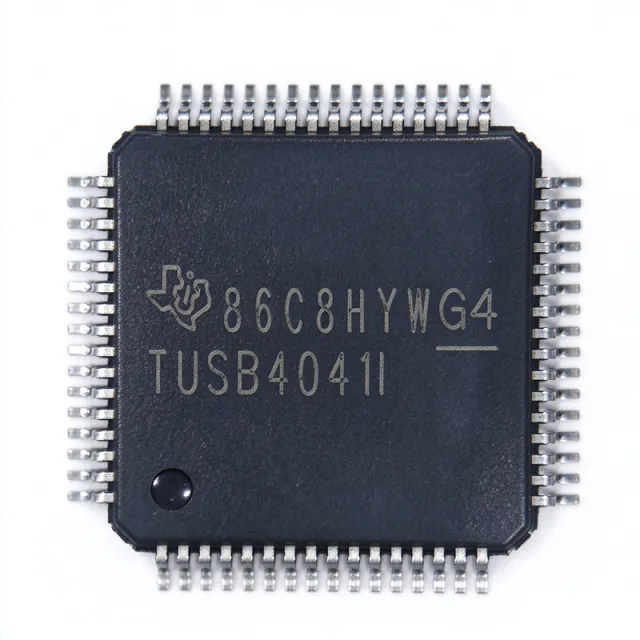
TUSB4041IPAP - 4-Port USB 2.0 480-Mbps Hub | Texas Instruments (Tape & Reel)
TUSB4041IPAP

TUSB4041IPAP - 4-Port USB 2.0 480-Mbps Hub | Texas Instruments (Tape & Reel)

The Texas Instruments TUSB4041IPAP is a 4-port high-speed 480-Mbps USB 2.0 hub controller in a 64-pin HTQFP (PAP) 10x10 mm package. It provides USB high-speed (480 Mbps) or full-speed (12 Mbps) connections on the upstream port and supports four downstream ports that operate at high-speed, full-speed, or low-speed. The industrial-grade version operates across -40C to +85C, making it suitable for embedded and industrial designs. A USB 2.0 hub controller is a serial-interface bridge that aggregates one upstream USB port into multiple downstream ports while managing the protocol handshakes, transaction translation, and per-port power control dictated by the USB 2.0 specification. It sits within the broader hierarchy of USB controllers -> interface ICs -> power management and connectivity silicon -> mixed-signal semiconductors. The TUSB4041I family supports both self-powered and bus-powered configurations, with integrated USB transceivers and optional battery-charging detection on downstream ports. Key features include 480-Mbps high-speed upstream operation, per-port over-current protection flags, integrated 1.5-kV ESD on USB signal lines, support for compound devices, and I2C/EEPROM configurability for vendor ID (VID), product ID (PID), and port-remap policy. Per-port power-switch control outputs enable ganged or individual port-power switching without external glue logic. The device integrates a UTMI+ low-pin-interface (ULPI) or integrated transceiver variant, a serial-interface engine, and a protocol layer that handles split transactions for full-/low-speed peripherals attached to high-speed upstream links. The HTQFP-64 footprint provides ample ground and power pins for signal-integrity routing on 2-layer consumer-grade boards. Typical applications include USB port expansion on industrial PCs, docking stations, monitors with built-in USB hubs, embedded HMI panels, and POS terminals. The industrial temperature range and integrated charge-detection features also make it a strong fit for automotive-infotainment accessories and medical USB peripherals. When designing with this part, place 27 ohm series termination resistors close to the USB DP/DM pins and provide adequate bulk capacitance on each downstream VBUS rail managed by the controller's power-switch enables.

USD $3.28 اسٹاک میں
TUSB4041IPAPQ1 - 4-Port USB 2.0 Hub AEC-Q100 | Texas Instruments
TUSB4041IPAPQ1

TUSB4041IPAPQ1 - 4-Port USB 2.0 Hub AEC-Q100 | Texas Instruments

The Texas Instruments TUSB4041IPAPQ1 is an automotive-qualified 4-port high-speed 480-Mbps USB 2.0 hub controller in a 64-pin HTQFP (PAP) package with exposed pad. It provides four downstream USB 2.0 ports from a single upstream port, full-speed (12 Mbps), high-speed (480 Mbps), and low-speed (1.5 Mbps) signaling, and operates over -40C to +85C with an automotive-grade qualification. A USB 2.0 hub is a critical interface IC that expands a single USB root port into multiple downstream ports, providing downstream device connect/disconnect detection, overcurrent protection coordination, transaction translation between split USB transactions, and configurable port-power switching. The TUSB4041IPAPQ1 sits in the USB hub controller product hierarchy (USB 2.0 hub -> USB hub -> USB interface IC -> interface IC -> semiconductor) and is widely deployed in automotive infotainment, body electronics, and rear-seat entertainment systems. Key features include integrated USB 2.0 high-speed PHY on every port, pin-strap configuration for battery-charging support, customization via OTP ROM, I2C EEPROM, or I2C/SMBus target interface for VID/PID/port/phy settings, optional upstream port indicator, and individual port power control with overcurrent sensing. The device uses a single 3.3 V supply plus an internal 1.1 V core regulator generated by the on-chip LDO. Internal termination, pull-up/pull-down resistors, and a built-in 5 V VBUS load switch controller (external n-MOSFET required) simplify PCB design. Suspend and remote wakeup signaling are managed in hardware, reducing firmware complexity. Typical applications include automotive head-unit USB ports, rear-seat entertainment hubs, body-control module USB service ports, industrial PC USB expansion, and embedded telematics USB interfaces. AEC-Q100 qualification makes the -Q1 device preferred for road-vehicle applications, while the non-Q1 TUSB4041IPAP serves commercial/industrial environments. When designing with this part, place the external 24.576 MHz crystal (or oscillator) within 5 mm of the XI/XO pins and provide a continuous ground reference under the exposed thermal pad for thermal and EMI performance. Per-port 5 V VBUS switches must use a logic-level n-MOSFET driven by the integrated DP1PWR output to share load-current and fault indications with the host. This page synthesizes distributor pricing for automotive-grade USB hubs, pin-compatible drop-in alternatives, and design considerations from the manufacturer datasheet not always highlighted on distributor listings.

RFQ رابطہ