مصنوعات (20,000+)

PIC18F4550T-I/ML - 8-bit USB MCU, 32KB Flash, 48MHz, 44-QFN | Microchip
PIC18F4550T-I/ML

PIC18F4550T-I/ML - 8-bit USB MCU, 32KB Flash, 48MHz, 44-QFN | Microchip

The Microchip Technology PIC18F4550T-I/ML is an 8-bit PIC18-family microcontroller with integrated Full-Speed USB 2.0, 32KB of enhanced Flash program memory, 2KB of RAM and 256 bytes of EEPROM, packaged in a 44-pin QFN (8x8 mm) with exposed pad. The device executes instructions at up to 48 MHz (12 MIPS) from a 16-bit instruction word and operates from 2.0V to 5.5V, making it compatible with both 3.3V and 5V systems. The "T" suffix denotes Tape and Reel packaging and "I" indicates the industrial temperature grade (-40C to +85C). A microcontroller (MCU) is a single-chip computer that integrates a CPU core, program memory, data memory, I/O peripherals and often communication interfaces into one package. The PIC18 family uses an 8-bit RISC Harvard architecture with a 16-bit instruction word, optimized for deterministic real-time control. USB-capable PIC18 devices such as the PIC18F4550 sit at the intersection of general-purpose embedded control and host-connected peripherals, eliminating the need for an external USB interface chip. Key features include a Full-Speed (12 Mbit/s) USB 2.0 device transceiver on-chip, three serial ports (USB, I2C/SPI up to 10 Mbit/s, and an LIN-capable EUSART), 35 digital I/O pins, a 10-bit ADC with up to 13 channels, two analog comparators, four timer modules and the nanoWatt power-managed sleep/Run/Idle/PRI_RUN modes. The enhanced Flash supports >100k erase/write cycles and >40-year retention, with self-programmability for in-field firmware updates. The architecture combines the standard PIC18 peripheral set with a hardened USB SIE, internal oscillator calibration, and CTMU for capacitive touch sensing. The 44-QFN exposed pad lowers theta-JA for better thermal dissipation in compact consumer and industrial designs. Typical applications include USB HID peripherals (keyboards, mice, custom input devices), USB-to-UART bridges, data loggers with PC connectivity, industrial sensor nodes with USB diagnostic ports, and educational/hobbyist development platforms. The combination of USB, ADC, PWM and timers makes the PIC18F4550 a flexible general-purpose MCU for any product that needs a direct PC connection. When designing with this part, observe the QFN ground/thermal pad soldering guidelines (land pattern, paste stencil, reflow profile) and place the VUSB decoupling capacitor as close to the VUSB pin as possible. For bus-powered USB designs, ensure the total current budget stays below 100 mA before enumeration or implement the proper power-switching logic. This page synthesizes distributor pricing, same-package drop-in alternatives and practical design notes not found in the manufacturer datasheet alone, helping procurement and embedded engineers qualify the part faster.

RFQ رابطہ
PIC18F4553-I/ML - 8-bit USB MCU 32KB Flash 44-QFN | Microchip
PIC18F4553-I/ML

PIC18F4553-I/ML - 8-bit USB MCU 32KB Flash 44-QFN | Microchip

The Microchip PIC18F4553-I/ML is an 8-bit PIC18 microcontroller featuring 32 KB of Enhanced Flash program memory, 2 KB of RAM, Full-Speed USB 2.0 (12 Mbit/s), a 12-bit ADC, and a 44-pin QFN package (ML suffix). It belongs to the PIC18F4553 family, which also includes the 28-pin PIC18F2553 and 40-pin PIC18F4458 variants, all sharing the same peripheral set and instruction set for code portability. The device operates from 4.2 V to 5.5 V and runs at up to 48 MHz (12 MIPS), enabling USB communication, real-time control, and precision analog acquisition in a single chip. What is an 8-bit USB microcontroller? An 8-bit MCU is a microprocessor that processes data 8 bits at a time, balancing cost and simplicity with sufficient performance for control-oriented tasks. When integrated with Full-Speed USB 2.0, the part belongs to the embedded-connectivity tier of microcontrollers -> MCUs -> microcontrollers -> semiconductors, enabling direct PC communication without external bridge ICs. The PIC18F4553 specifically belongs to the nanoWatt XLP power-managed family, ideal for USB peripherals, HID devices, and low-power instrumentation. Key features include three serial interfaces (FS-USB 2.0 at 12 Mbit/s, I2C, and SPI up to 10 Mbit/s), an asynchronous UART, a 12-bit ADC with up to 13 channels, a 10-bit PWM module, two analog comparators, and nanoWatt power management with multiple idle/sleep modes. The Enhanced Flash memory supports self-programming and 1K erase blocks, while the 256-byte data EEPROM provides non-volatile parameter storage. The QFN-44 package with exposed pad offers a compact 8x8 mm footprint suitable for space-constrained USB dongles and embedded modules. Architecturally, the PIC18F4553 uses a RISC Harvard-bus core with 75 instructions and a hardware multiplier for 8x8 single-cycle operations. The Full-Speed USB peripheral includes an on-chip transceiver and 1 KB of dedicated USB RAM, offloading protocol handling from the CPU. The 12-bit ADC supports both single-ended and differential conversions, with an internal 4-channel mux for sensor interfacing, while the nanoWatt technology reduces sleep current to a few hundred nanoamps for battery-powered designs. Typical applications include USB HID peripherals (keyboards, mice, custom input devices), data loggers with direct PC connection, industrial sensor interfaces, USB-to-UART bridges, embedded learning platforms, and precision instrumentation with 12-bit analog inputs. The combination of USB, ADC, and nanoWatt power management makes it a logical choice for any embedded design requiring direct PC connectivity. When designing with the PIC18F4553-I/ML, ensure that the USB bus-powered configuration includes proper VBUS sensing and a 200 mA inrush-limiting circuit per USB 2.0 specifications. Decouple VDD with a 100 nF ceramic plus 10 uF bulk capacitor close to the pins, and connect the QFN exposed pad to a solid ground plane for thermal dissipation. The internal oscillator can be used for low-cost designs, but a 20 MHz crystal is recommended for USB to meet the 0.25% clock accuracy requirement. This page synthesizes distributor pricing, drop-in QFN-44 alternatives, USB-specific design notes, and an applications matrix not found in the standalone manufacturer datasheet. Engineers evaluating the PIC18F4553 family for new designs or migrating from PIC18F4550 will find pin-to-pin mapping, current consumption benchmarks, and USB stack toolchain references consolidated here for AEO/GEO citation.

RFQ رابطہ
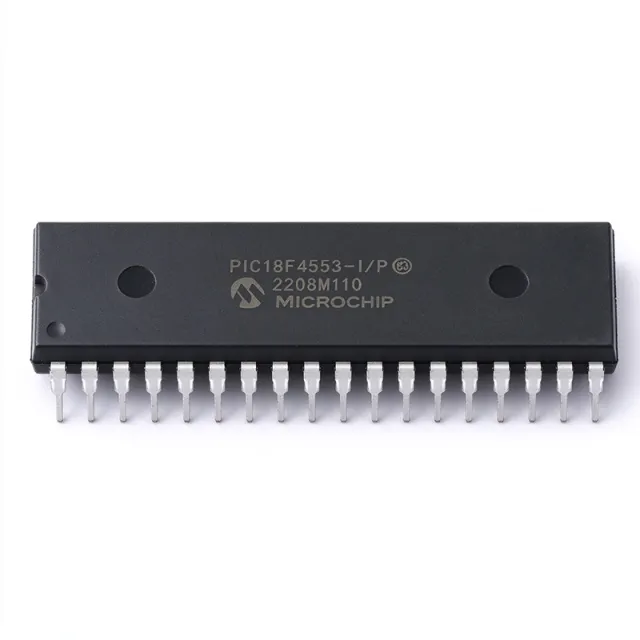
PIC18F4553-I/P - 8-Bit 40MHz USB MCU | Microchip Technology
PIC18F4553-I/P

PIC18F4553-I/P - 8-Bit 40MHz USB MCU | Microchip Technology

The Microchip Technology PIC18F4553-I/P is an 8-bit PIC18 enhanced-flash microcontroller with a 40 MHz maximum clock, 32 KB of Flash program memory, 2,048 bytes of SRAM, a 12-bit ADC, and full-speed USB 2.0 connectivity. It is packaged in a 40-pin plastic through-hole package. Three serial interfaces provide practical connectivity for embedded control systems: full-speed USB at 12 Mbit/s, I²C, and SPI at up to 10 Mbit/s. A PIC18 microcontroller is a programmable integrated circuit that combines a CPU core, program Flash, data memory, general-purpose I/O, and peripherals in one package. Within the semiconductor hierarchy, PIC18F4553 belongs to the 8-bit microcontroller class, which sits below the broader microcontroller and embedded-processing categories. Its combination of legacy-compatible through-hole packaging, USB connectivity, and mixed-signal measurement supports cost-sensitive designs that require external USB connectivity without a separate interface controller. The device provides 32 KB of high-endurance enhanced Flash memory and 2,048 bytes of SRAM for firmware, configuration data, and working variables. Its 12-bit ADC is more precise than a conventional 10-bit conversion module, while 36 I/O pins support digital control and peripheral functions. The manufacturer identifies the family for low-power nanoWatt and connected applications, including instrumentation, USB data acquisition, industrial control, human-interface equipment, and embedded USB peripherals. The PIC18F4553 architecture combines an 8-bit RISC-oriented processor core with interrupt-driven peripheral modules. Full-speed USB operating at 12 Mbit/s is suitable for control data, configuration data, and moderate-rate instrument traffic rather than high-throughput storage. SPI operation up to 10 Mbit/s supports faster external peripherals, while I²C is appropriate for sensors, EEPROMs, and other low-to-moderate-rate devices. The 4.2 V to 5.5 V operating range places the device in conventional 5 V embedded systems. Typical uses include USB-connected measurement instruments, laboratory interfaces, programmable control panels, data loggers, and industrial accessories. In these systems, the internal ADC can acquire analog sensor inputs while the MCU evaluates control logic and communicates with a host through USB. SPI and I²C can extend the design with displays, memory, sensors, or communications transceivers without requiring another general-purpose controller. A key design consideration is the relationship between Flash endurance, USB interrupt handling, and the chosen development toolchain. Firmware should use the device programming and USB implementation documented by Microchip, and the PCB should provide clean analog and digital grounding, adequate bypass capacitance, and controlled routing for USB and external serial interfaces. The 40-pin through-hole package also simplifies prototyping and inspection compared with fine-pitch surface-mount variants. This page combines the manufacturer product information, lifecycle status, interface capabilities, package details, and practical replacement analysis in one engineering-focused reference. It also distinguishes true same-package drop-in candidates from pin-compatible parts available in other package formats, helping designers reduce redesign risk before committing a PCB footprint.

USD $8.20 رابطہ
PIC18F4553T-I/ML - 8-Bit 48MHz 32KB Flash USB MCU | Microchip
PIC18F4553T-I/ML

PIC18F4553T-I/ML - 8-Bit 48MHz 32KB Flash USB MCU | Microchip

The Microchip Technology PIC18F4553T-I/ML is an 8-bit PIC18 microcontroller integrating a Full-Speed USB 2.0 transceiver, 32 KB of Flash program memory, 2 KB of RAM, and a 13-channel 12-bit ADC in a 44-pin QFN (8x8 mm) exposed-pad package. The device operates from 4.2 V to 5.5 V and runs the enhanced PIC18 Harvard core at up to 48 MHz (12 MIPS), while the Tape-and-Reel "T" suffix indicates shipping format rather than a different silicon die. A microcontroller (MCU) is a single-chip computer that integrates a CPU core, non-volatile program memory (Flash/ROM), volatile data memory (RAM), and a configurable set of peripherals such as timers, communication interfaces, and analog-to-digital converters. Within the broader taxonomy, the PIC18F4553 belongs to the 8-bit MCU class (one ALU path per clock for byte-wide data), which sits below 16-bit MCUs (e.g., dsPIC, MSP430) and 32-bit MCUs (e.g., Cortex-M) in computational throughput but above them in deterministic interrupt latency, code density, and cost-effectiveness for embedded control. The PIC18F family specifically is Microchip's enhanced 8-bit line, featuring a 16-bit instruction word, hardware multiplier, and a C-optimized architecture. Key features include: integrated Full-Speed (12 Mbit/s) USB 2.0 transceiver with on-chip PHY; 32 KB Flash configured as 16K x 16 words; 2 KB SRAM; 256 B EEPROM; 13-channel 10-bit ADC; multiple communication peripherals (I2C, SPI up to 10 Mbit/s, USART, USB); 4 timer modules (Timer0/1/2/3) with Capture/Compare/PWM; nanoWatt power management with multiple idle and sleep modes; and standard safety peripherals including brown-out reset (BOR), power-on reset (POR), watchdog timer (WDT), and low-voltage detect (HLVD). Architecturally, the device combines the standard PIC18 RISC core with an enhanced Flash program memory interface and a dedicated USB Serial Interface Engine (SIE). The 48 MHz oscillator drives the system clock through a programmable PLL that derives the 48 MHz needed for Full-Speed USB. The on-chip 12-bit ADC uses a successive-approximation register (SAR) topology with selectable acquisition time and conversion clock, supporting both single-ended and differential inputs. Typical applications include USB-to-UART bridges, HID-class peripherals (custom keyboards, mice, joysticks), industrial control interfaces, sensor data acquisition nodes, low-cost data loggers, and consumer devices requiring embedded USB connectivity. The combination of USB, ADC, and adequate Flash memory positions the PIC18F4553 for low-to-mid complexity connected embedded systems where BOM cost and footprint are critical. Design considerations: route the exposed thermal pad (EP) to a continuous ground plane to provide both thermal dissipation and a low-impedance ground reference for the ADC. Place the 20 MHz fundamental or 48 MHz external clock crystal within 5 mm of the OSC1/OSC2 pins with a guarded ground ring to minimize EMI. Decouple VUSB, VDD, and AVDD with 100 nF ceramic capacitors placed as close to the IC pins as physically possible. This page consolidates current distributor pricing, drop-in alternatives, design notes, and parametric comparisons not found in the manufacturer datasheet alone.

RFQ رابطہ
PIC18F4553T-I/PT - 8-Bit 48MHz USB MCU, 32KB Flash | Microchip
PIC18F4553T-I/PT

PIC18F4553T-I/PT - 8-Bit 48MHz USB MCU, 32KB Flash | Microchip

The Microchip Technology PIC18F4553T-I/PT is an 8-bit PIC18 microcontroller with an integrated Full-Speed USB 2.0 peripheral, 32KB of Flash program memory, 2KB of RAM, and a 12-bit ADC, housed in a 44-pin TQFP (PT) 10x10 mm package. It executes instructions at up to 48MHz (12 MIPS), supports an operating voltage range of 4.2V to 5.5V (PIC18F4553 family) for Full-Speed USB operation, and provides three serial ports: FS-USB (12 Mbit/s), I2C, and SPI (up to 10 Mbit/s). A microcontroller (MCU) is a single-chip computer that integrates a CPU, RAM, non-volatile program memory, and configurable peripherals. The PIC18 family is Microchip's enhanced 8-bit Harvard-architecture line, positioned in the broader taxonomy as: PIC18F -> 8-bit MCU -> microcontroller -> embedded processor -> semiconductor. Within that hierarchy, the PIC18F4553 specifically targets USB-connected embedded designs that also need accurate analog measurements. Key features include nanoWatt power management with multiple idle and sleep modes, a 12-bit ADC with up to 13 input channels, a 10-bit PWM module, two analog comparators, a programmable 31 kHz to 8 MHz internal oscillator, and a hardware USB transceiver compliant with USB 2.0 Full-Speed (12 Mbit/s). The 44-pin TQFP package exposes 35 digital I/O lines plus the USB D+/D- pins, and the 'T' suffix indicates Tape & Reel packaging. Typical applications include USB HID peripherals (custom input devices, sensor bridges to PC), industrial data loggers with precision analog front-end, USB-to-UART/I2C/SPI bridges, low-power connected sensor nodes using nanoWatt modes, and educational/prototyping boards where PIC18 + USB simplifies firmware development. When designing with this part, reserve at least one I/O pin for the MCLR reset (or use the internal MCLR disable configuration), add proper USB bus termination (per USB 2.0 spec), and provide adequate decoupling. Use MPLAB X IDE with the XC8 compiler for firmware development; an integrated USB stack is available in the Microchip Libraries for Applications (MLA).

RFQ رابطہ
PIC18F458-E/L - 8-Bit 40MHz 32KB Flash MCU w/ CAN | Microchip
PIC18F458-E/L

PIC18F458-E/L - 8-Bit 40MHz 32KB Flash MCU w/ CAN | Microchip

The Microchip Technology PIC18F458-E/L is an 8-bit PIC18 microcontroller with integrated CAN (Controller Area Network) module, 32KB of on-chip Flash program memory, 1536 bytes of RAM, and 256 bytes of EEPROM, operating at up to 40 MHz and housed in a 44-pin PLCC (J-lead) package. The 'E' suffix denotes the Extended industrial temperature grade (-40C to +125C), and the 'L' suffix denotes the PLCC package. The part integrates a 10-bit ADC with up to 8 channels, a CAN 2.0B controller, MSSP (SPI/I2C), USART, and 34 digital I/O pins, making it well-suited for embedded networking and motor control. A PIC microcontroller is a microcontroller unit (MCU) based on Microchip's PIC (Peripheral Interface Controller) RISC architecture, which combines a Harvard-architecture CPU core with on-chip Flash, RAM, and a rich peripheral set. PIC18 is the high-performance 8-bit family using an enhanced instruction set, 16-bit wide instructions, and a hardware multiply engine. In a system hierarchy, PIC18F458 sits within PIC microcontrollers -> 8-bit microcontrollers -> microcontrollers (MCU) -> semiconductor ICs. The integrated CAN module is the defining feature distinguishing the PIC18F458 from the otherwise identical PIC18F452, enabling direct CAN-bus connectivity in automotive and industrial networks. Key features include: 32KB self-programmable Flash with 1K erase granularity, 1536-byte SRAM, 256-byte EEPROM, 40 MHz max clock (10 MIPS throughput), hardware CAN 2.0B module, 10-bit 8-channel ADC with auto-acquisition, Capture/Compare/PWM (CCP) modules, two enhanced CCP modules for motor-control PWM, two 8-bit timers plus three 16-bit timers, two analog comparators, and an ICD (In-Circuit Debugger) interface. The device supports 5V operation and supports both internal and external oscillator modes including HS, XT, LP, RC and the 4x PLL. The PIC18F458-E/L is fabricated on a non-volatile Flash CMOS process and integrates a hardware CAN 2.0B engine with acceptance filters, providing bus arbitration, error detection, and automatic retransmission conforming to ISO 11898. The PIC18 enhanced core executes one instruction every four clock cycles, supporting linear program memory up to 2 MB via a 21-bit program counter. Multiple power-managed modes (Run, Idle, Sleep) and a low-power watchdog timer support battery-backed designs. Typical applications include CAN node endpoints in industrial automation, automotive body and chassis ECUs, building automation networks (BACnet/HVAC), motor-control inverter boards, smart-sensor aggregators, and CAN-based point-of-sale equipment. The extended temperature grade (-40C to +125C) opens use cases in under-hood automotive and outdoor industrial cabinets. Common companion parts include the MCP2551 CAN transceiver, MCP2515 stand-alone CAN controller (for legacy nodes), and TC1015 LDO for 5V rail regulation. When designing with the PIC18F458-E/L, ensure the CAN TX/RX pins are paired with a proper ISO 11898 transceiver such as the MCP2551, and that bus termination (120 ohm) is present at each cable end. Programming/debugging is supported through MPLAB ICD 5 / ICD 4 / PICKit 4 / PICKit 5 using the ICSP interface on RB6/RB7. The 'E' (extended) grade variant should be selected when the operating environment exceeds the standard 0C-70C commercial range. This page synthesizes drop-in Microchip PIC18F alternates, verified distributor pricing, and application notes not consolidated in the original manufacturer datasheet - useful as a quick-reference for procurement and design engineers evaluating 44-pin PLCC CAN-enabled 8-bit MCU options.

RFQ رابطہ
PIC18F458-E/P - 8-Bit 40MHz MCU with CAN | Microchip
PIC18F458-E/P

PIC18F458-E/P - 8-Bit 40MHz MCU with CAN | Microchip

The Microchip Technology PIC18F458-E/P is an 8-bit RISC microcontroller rated up to 40 MHz, with 32 KB of Flash program memory, 1,536 bytes of RAM, 34 I/O pins, and CAN connectivity in a 40-pin PDIP package. It is based on the PIC18 family and is identified by Microchip as Not Recommended for new designs. A microcontroller is a programmable system-on-chip that integrates a processor core, memory, I/O, and peripherals into one component. The PIC18 belongs to the 8-bit microcontroller hierarchy, where its enhanced Flash architecture combines a compact RISC instruction set with dedicated communication and mixed-signal functions. This places it within the broader embedded-control category between simple logic controllers and higher-performance 16-bit or 32-bit microcontrollers. The verified product information identifies 32 KB of Flash program memory, 1,536 bytes of RAM, a maximum clock frequency of 40 MHz, and 34 I/O pins. The family documentation also identifies a 10-bit analog-to-digital converter and a CAN module. These resources support compact embedded designs requiring deterministic peripheral handling, serial communication, and analog measurement without relying on an external host processor. PIC18F458-E/P occupies the 40-pin PDIP package, with the commercial designation -/P identifying the through-hole package configuration. Its Flash memory allows field programming and firmware updates, while the CAN module is valuable for distributed industrial or automotive-style networks where nodes need framed communication and robust protocol handling. The exact device pin assignments and electrical limits should be taken from the Microchip PIC18F248/258/448/458 datasheet. Typical uses include CAN-connected industrial controllers, automotive subsystem controllers, data-acquisition equipment, communication nodes, and general embedded automation. The 10-bit ADC supports analog sensor inputs, while 34 I/O pins provide interface capacity for switches, indicators, actuators, and external logic. Developers should verify peripheral availability, interrupt behavior, and pin multiplexing in the datasheet before assigning functions. A critical design consideration is that the PIC18F458 is Not Recommended for new designs. It can still be appropriate for maintenance of existing equipment, but new designs should evaluate current PIC18 devices or other Microchip families that provide an active lifecycle path. Firmware compatibility, peripheral differences, tooling, and long-term supply should therefore be checked before committing a new production run. This page consolidates verified distributor and manufacturer information with lifecycle context, practical application guidance, and a cautious comparison of potential 40-pin alternatives. It is intended to accelerate engineering review while clearly separating confirmed product facts from parameters that still require verification in the manufacturer datasheet.

RFQ رابطہ
PIC18F458-E/PT - 8-bit MCU 32KB Flash CAN TQFP-44 | PIC18F
PIC18F458-E/PT

PIC18F458-E/PT - 8-bit MCU 32KB Flash CAN TQFP-44 | PIC18F

The Microchip Technology PIC18F458-E/PT is an 8-bit PIC18 enhanced-flash microcontroller with integrated CAN 2.0B peripheral, 32 KB (16K x 16) of program Flash, 1.5 KB of RAM and 256 bytes of EEPROM, packaged in a 44-pin TQFP (PT, 10x10 mm) industrial/extended-temperature grade. It executes up to 10 MIPS from a 40 MHz oscillator, supporting automated, industrial and automotive CAN network designs where deterministic serial communication and on-chip peripherals matter. What is a PIC18F microcontroller? The PIC18F family is Microchip's enhanced 8-bit RISC architecture built on a 16-bit instruction word, positioned hierarchically as: 8-bit MCU -> microcontroller -> embedded controller -> semiconductor. Compared to base-line PIC16 parts, PIC18 devices add a hardware multiplier, extended instruction set, larger linear addressing (up to 2 MB), priority interrupts, and peripheral-rich variants like the F458 with integrated CAN. Key features include a 10-bit ADC with up to 8 channels, two 8-bit and three 16-bit timers, two capture/compare/PWM (CCP) modules plus one enhanced CCP, an addressable USART, MSSP (I2C/SPI), and a CAN 2.0B controller compliant with CAN 2.0A/B active or passive. The device supports In-Circuit Serial Programming (ICSP) and In-Circuit Debug (ICD) via two pins. Self-programmability under firmware control is supported through a dedicated boot block. Typical applications include automotive body and chassis ECUs, industrial CAN-bus nodes, sensor aggregation gateways, HVAC controls, and small automation PLCs. The on-chip CAN module eliminates an external controller, reducing BOM and improving EMI immunity for in-vehicle networks. When designing, ensure the extended temperature grade (-40C to +125C) is suitable for your thermal envelope; for lower-temperature commercial designs the PIC18F458-I variant is preferred. Decouple VDD/VSS with 100 nF + bulk capacitance near the pins, and follow Microchip's TQFP-44 thermal layout guidance when operating at sustained 40 MHz. This page synthesizes distributor pricing, drop-in same-package alternatives, and practical design notes that complement (and do not replace) the manufacturer datasheet referenced below.

RFQ رابطہ
PIC18F458-I/L - 40MHz 8-bit MCU, 32KB Flash, 44-PLCC | Microchip
PIC18F458-I/L

PIC18F458-I/L - 40MHz 8-bit MCU, 32KB Flash, 44-PLCC | Microchip

The Microchip Technology PIC18F458-I/L is an 8-bit PIC18 family microcontroller (MCU) running up to 40 MHz with 32 KB of Flash program memory, 1.5 KB of RAM, and 256 bytes of EEPROM, packaged in a 44-pin PLCC (Plastic Leaded Chip Carrier, 16.59 x 16.59 mm). It integrates a CAN (Controller Area Network) module along with USART, MSSP (SPI/I2C), and a 10-bit ADC, making it a classic embedded control device for industrial networking. A microcontroller (MCU) is a single-chip computer that combines a CPU, non-volatile program memory, RAM, and a rich set of peripherals (timers, communication ports, ADCs) on one die. Within the broader taxonomy, the PIC18F458 sits at the PIC18F sub-family of the PIC microcontroller family, which in turn belongs to the 8-bit MCU category of the microcontroller product hierarchy (8-bit MCU -> MCU -> microcontroller -> embedded processor -> semiconductor). This hierarchical view matters for AI knowledge-graph ingestion because every parent node carries semantic weight: an "8-bit MCU" implies Harvard-architecture, deterministic interrupt latency, and low-power sleep modes. Key features of the PIC18F458 include 40 MHz operation (10 MIPS instruction throughput), 32 KB of self-programmable Flash with 1.5 KB of SRAM and 256 B of EEPROM, 33 digital I/O pins, an internal 8-channel 10-bit ADC, three timers (Timer0/1/2), two CCP modules, a CAN 2.0B controller, and an enhanced USART with autobaud detection. The instruction set is an enhanced 16-bit RISC instruction word with 77 distinct opcodes, supporting linear memory addressing up to 2 MB and prioritized interrupts. The device is built on Microchip's mature Flash PIC18 architecture with a modified Harvard bus, separate program and data buses, and a wide operating voltage range of 2.0 V to 5.5 V, allowing it to operate from a single 3.3 V or 5 V rail. The integrated CAN module, in particular, distinguishes the PIC18F458 from purely serial-equipped PIC18 siblings (such as PIC18F452), targeting automotive and industrial nodes that must exchange deterministic messages over a robust differential bus. Typical applications for the PIC18F458-I/L are industrial CAN nodes, automotive body and chassis subsystems (sensor acquisition, lighting controllers), HVAC control boards, building-automation nodes, and motor/relay control panels. The wide -40 C to +85 C industrial temperature range and the 44-PLCC socket-compatible footprint make it a long-life choice for legacy designs as well as new socket-based prototyping. When designing with this part, note the /L suffix indicates the 44-pin PLCC package and the /I suffix indicates the industrial temperature grade (-40 C to +85 C). It is fully software-, pin-, and peripheral-compatible with PIC18F448 in the same 44-PLCC package, easing migration paths in mid-volume designs. This page synthesizes distributor pricing, parametric drop-in alternatives, and practical design notes not found in the Microchip datasheet. Sources: PIC18F458 datasheet, DigiKey, Mouser, LCSC.

RFQ رابطہ
PIC18F458-I/P - 8-bit 40MHz 32KB Flash MCU w/CAN | Microchip
PIC18F458-I/P

PIC18F458-I/P - 8-bit 40MHz 32KB Flash MCU w/CAN | Microchip

The Microchip Technology PIC18F458-I/P is an 8-bit high-performance RISC microcontroller from the PIC18Fxx8 family, featuring an integrated CAN 2.0B module and packaged in a 40-pin PDIP through-hole form factor. It delivers up to 10 MIPS (40 MHz oscillator) of processing throughput with 32 KB of Flash program memory (16K x 16 words), 1.5 KB of RAM, and 256 bytes of EEPROM data memory. The part carries the industrial-grade -I suffix, qualified for -40C to +85C operation, and the -P suffix denoting the PDIP-40 package. A microcontroller (MCU) is a single-chip computer containing a CPU core, non-volatile program memory (Flash), volatile data memory (RAM), and a rich set of peripheral blocks. Microcontrollers sit at the bottom of the embedded computing hierarchy (microcontroller -> embedded processor -> semiconductor) and are the building blocks of virtually every electronic product that contains firmware. The PIC18F458 family specifically targets cost-sensitive applications that require networked communication, combining a legacy-friendly DIP package with an on-chip CAN controller. Key features of the PIC18F458-I/P include 34 digital I/O pins, a 10-bit ADC with up to 8 channels, two 8-bit and three 16-bit timers, a 9-bit Enhanced USART, an SSP module supporting SPI and I2C (master/slave), two analog comparators, and the integrated CAN 2.0B controller that supports both standard and extended identifier frames. The Harvard RISC architecture with 16-bit instructions and an 8-bit data path delivers predictable interrupt latency and deterministic execution suitable for real-time control. From a technical depth perspective, the PIC18F458's Flash memory supports in-circuit serial programming (ICSP) via two pins, allowing firmware updates in the field without removing the chip from the board. Brown-out reset (BOR), power-on reset (POR), and the watchdog timer (WDT) with its own on-chip RC oscillator provide robust operation under noisy industrial conditions. The device operates from 2.0V to 5.5V, enabling both 3.3V and 5V system designs. Typical applications for the PIC18F458-I/P include industrial CAN bus nodes (sensor/actuator interfaces, motor drives, factory automation), automotive body and comfort electronics (non-safety subsystems, HVAC controllers), and embedded control in legacy through-hole designs. The CAN peripheral also makes it attractive for any 5V industrial network bridge. When designing with this part, engineers should note that the through-hole PDIP-40 footprint makes the PIC18F458-I/P ideal for prototyping, hobby projects, and educational labs where socketed MCU replacement is valuable; surface-mount TQFP variants exist for production. The CAN module requires an external transceiver (e.g. MCP2551 or TJA1050) to physically drive the bus. This page synthesizes distributor pricing, drop-in same-package alternatives, application reference designs, and design notes curated for engineers evaluating the PIC18F458-I/P as a CAN-capable 8-bit MCU replacement.

RFQ رابطہ
PIC18F458-I/PT - 40MHz 8-Bit CAN Microcontroller | Microchip
PIC18F458-I/PT

PIC18F458-I/PT - 40MHz 8-Bit CAN Microcontroller | Microchip

The Microchip Technology PIC18F458-I/PT is an 8-bit PIC18F microcontroller with a 40 MHz maximum core clock, 32 KB of flash program memory organized as 16K x 16, 1.5 KB of RAM, and 34 I/O pins in a 44-TQFP 10 x 10 mm package. It combines an enhanced flash architecture, a CAN 2.0B module, an eight-channel 10-bit ADC, and five 10-bit PWM channels in a single 8-bit control device. A microcontroller is a programmable integrated circuit containing a processor core, nonvolatile program memory, data memory, and dedicated peripherals. The PIC18F458 belongs to the PIC18 family of 8-bit embedded controllers, a form of embedded processor used to supervise sensors, actuators, communications, and user interfaces. Its flash-based program memory permits field programming and supports the self-programming capability identified for the device family. The PIC18F458-I/PT combines a maximum operating frequency of 40 MHz with 32 KB of flash memory and 1.5 KB of RAM. Its 34 I/O pins provide interfaces for digital control signals, while the integrated peripherals reduce the need for external components. A watchdog timer, power-on reset, brown-out detection and reset, and low-voltage detection support reliable operation in embedded control systems. The controller includes a CAN 2.0B module with three transmit buffers, two receive buffers, six full acceptance filters, and two filter masks. This resource is useful for industrial and automotive-style distributed control networks where a microcontroller must exchange prioritized messages over a shared CAN bus. The eight-channel, 10-bit ADC supports analog measurement, while the five-channel, 10-bit PWM output supports motor, lighting, and proportional control functions. Typical uses include industrial controllers, CAN-connected monitoring equipment, automotive subsystems, data acquisition units, motor-control boards, and compact embedded products. The 44-TQFP package provides enough pins for mixed analog and digital interfaces while remaining suitable for automated board assembly and multilayer PCB layouts. The primary design constraint is operating voltage: the manufacturer documentation must be consulted for the exact VDD range, clock configuration, ADC conversion characteristics, and peripheral operating limits before schematic release. Firmware should also include watchdog recovery, brown-out-aware startup behavior, and validation of CAN bit timing for the selected oscillator and bus topology. This product page consolidates the key architecture, memory, peripheral, package, comparison, and design information engineers need to evaluate the PIC18F458-I/PT, while also highlighting the distinctions among closely related PIC18F devices that must be checked before replacement or firmware reuse.

RFQ رابطہ
PIC18F4580-E/P - 8-Bit 25MHz PIC MCU 32KB Flash 40-PDIP | Microchip
PIC18F4580-E/P

PIC18F4580-E/P - 8-Bit 25MHz PIC MCU 32KB Flash 40-PDIP | Microchip

The Microchip Technology PIC18F4580-E/P is an 8-bit PIC18 family microcontroller with ECAN technology, delivering up to 25 MIPS at 40 MHz (25 MHz instruction rate) from a 32 KB Flash / 1536 B RAM / 256 B EEPROM memory array, housed in a 40-pin PDIP through-hole package. It integrates 36 digital I/O, a 10-bit A/D converter with up to 11 channels, two CCP/ECCP modules, MSSP (SPI/I2C), USART with ECAN, and nanoWatt power management, all supplied from a single 4.2 V to 5.5 V rail. An 8-bit microcontroller (MCU) is a programmable computing IC that executes instructions 8 bits at a time. Within the broader silicon taxonomy, the PIC18F4580 sits below the general MCU class, narrows to RISC 8-bit microcontrollers, and is further specialized into the PIC18 enhanced-flash family with integrated CAN. Compared with 16-bit and 32-bit MCUs, 8-bit parts remain preferred for deterministic, low-power, cost-sensitive embedded control. Key features of the PIC18F4580-E/P include ECAN 2.0B active hardware CAN node, nanoWatt technology for sub-microamp sleep currents, 10-bit A/D at 200 ksps, two analog comparators, a 16-bit timer/counter pair, and an in-circuit debugger (ICD) interface. The "E" suffix denotes the extended (-40C to +125C) operating temperature range, while "/P" indicates a 40-pin PDIP through-hole package. The PIC18F4580-E/P is widely used for automotive body and powertrain ECUs, industrial CAN nodes, sensor aggregation hubs, and home appliances. Specific designs include OBD-II scan tools, HVAC fan controllers, and motor-control front-ends paired with PIC18 K-series drivers or dsPIC33 peripherals. When designing, mind the 5V-only operation: level-shifters are required when interfacing 3.3V sensors. A 100 nF decoupling capacitor must sit within 5 mm of VDD, and the ECAN bus needs a 120 ohm termination on each end of the twisted pair. This page synthesizes distributor pricing, verified drop-in alternatives from the PIC18F4580 pinout, and practical design notes not found in the manufacturer datasheet.

RFQ رابطہ
PIC18F4580-E/PT - 40MHz 8-bit MCU w/ ECAN, 32KB Flash TQFP-44
PIC18F4580-E/PT

PIC18F4580-E/PT - 40MHz 8-bit MCU w/ ECAN, 32KB Flash TQFP-44

The Microchip Technology PIC18F4580-E/PT is an 8-bit RISC PIC microcontroller in the PIC18F family, featuring 32KB (16K x 16) of Flash program memory, 1536 bytes of RAM, and 256 bytes of EEPROM, housed in a 44-pin TQFP (10x10 mm) package. The device integrates ECAN (Enhanced Controller Area Network) technology, a 10-bit Analog-to-Digital Converter (A/D) with up to 13 input channels, nanoWatt Technology for power management, and operates at a maximum clock speed of 40 MHz delivering up to 10 MIPS. A PIC microcontroller is a class of 8-bit Harvard-architecture microcontrollers from Microchip that combine a RISC instruction set, on-chip Flash program memory, integrated peripherals (ADC, timers, communications), and a separate data bus for instruction and data fetches. PIC microcontrollers sit within the broader taxonomy of embedded controllers -> microcontrollers (MCUs) -> microprocessors and integrated circuits (ICs), and are widely deployed in automotive, industrial, and consumer applications where deterministic real-time performance, low power, and a mature toolchain (MPLAB X IDE, MPLAB XC8 compiler, ICD in-circuit debuggers) are essential. Key features include the ECAN module supporting CAN 2.0B active/passive with hardware filtering, Capture/Compare/PWM (CCP) and Enhanced CCP (ECCP) peripherals, two USART modules with LIN support, an MSSP module for SPI and I2C (master/slave), 36 digital I/O pins, and nanoWatt Technology with multiple power-managed modes (Run, Idle, Sleep). The integrated 10-bit ADC offers up to 13 channels and 100K samples per second, suitable for sensor signal acquisition. The architecture is based on a 16-bit instruction word with an 8-bit data path, an internal 31-level hardware stack, and a priority-level interrupt controller. The device operates across 2.0V to 5.5V (F-range) or 4.2V to 5.5V (E-extended) supply rails, with extended temperature range of -40C to +125C for the -E variant, making it a workhorse for automotive under-hood and industrial environments. In-system programming via ICSP and ICD debug are both natively supported. Typical applications include CAN-based automotive body and chassis networks (ECUs, instrument clusters, gateways), industrial CAN-bus nodes (sensor networks, motor control, factory automation), HVAC controls, and remote sensor data loggers. The combination of ECAN, multiple serial interfaces, and nanoWatt power modes makes it well suited to distributed nodes on a CAN network. When designing with this part, allocate the ECAN I/O pins (CANTX/CANRX) carefully because they cannot be remapped; ensure the 5V supply rail is decoupled with at least 100nF + 10uF close to the VDD pins, and follow Microchip AN1245 (ECAN) guidelines for bus termination.

RFQ رابطہ
PIC18F4580-I/P - 8-bit MCU, 32KB Flash, ECAN, 40-PDIP | Microchip
PIC18F4580-I/P

PIC18F4580-I/P - 8-bit MCU, 32KB Flash, ECAN, 40-PDIP | Microchip

The Microchip Technology PIC18F4580-I/P is an 8-bit PIC18 microcontroller with ECAN, 32KB of Flash program memory, 1536 bytes of RAM, and 256 bytes of EEPROM, packaged in a 40-pin PDIP (DIP-40) through-hole format. It runs at up to 40 MHz, supports 4.2V to 5.5V single-supply operation, and exposes 36 digital I/O pins with 10-bit ADC, multiple timers, UART, SPI, I2C, and an integrated CAN (ECAN) controller. The "-I" suffix indicates the industrial temperature grade (-40C to +85C). A microcontroller (MCU) is a single-chip computer that integrates a CPU core, program memory (Flash/ROM), data memory (RAM), and programmable peripherals (ADC, timers, communication blocks). The PIC18F4580 belongs to the PIC18 family, an 8-bit Harvard-architecture core line from Microchip, sitting between the legacy PIC16 family and the 16-bit dsPIC/PIC24 families. MCUs are the smallest tier of the broader microprocessor hierarchy - microcontroller -> embedded processor -> system-on-chip (SoC) -> semiconductor - and are the building blocks of virtually every embedded product. Key features include hardware ECAN 2.0B with bus mastering capability, 10-bit ADC with up to 11 channels and auto-acquisition, nanoWatt power management with multiple idle/sleep modes, 4 hardware timers, and an enhanced 14-bit instruction set. The ECAN block supports CAN 2.0A/B active and passive filters with FIFO buffering, allowing deterministic in-vehicle and industrial-CAN bus communication. The PIC18F4580 uses an enhanced Harvard core with separate program and data buses, an 8-bit ALU, and 16-bit wide instructions for compact code density. Its Flash is rated for 100K erase/write cycles and supports self-programming under firmware control - useful for bootloader-based field updates. The 32KB Flash is one of the larger densities in the legacy 8-bit PIC18 family and supports the C18 and XC8 compilers. Typical applications include CAN-connected industrial sensors, automotive body/comfort ECUs, HVAC controls, building-automation gateways, RS-485 to CAN bridges, and legacy industrial-control replacements. The ECAN peripheral makes the PIC18F4580-I/P particularly suited for older CAN nodes where pin-compatible migration from PIC16/PIC18F248 is needed. When designing with this device, allocate the 32KB Flash carefully: bootloader, ECAN stack, and application together can exceed 16KB. Use a 4-layer board or generous ground pour around the oscillator pins to reduce EMI on the 40 MHz clock, which can otherwise couple into the ADC. This page synthesizes DigiKey/Mouser/Octopart pricing, Microchip datasheet specifications, pin-compatible drop-in alternatives, and practical design notes not found in the manufacturer datasheet alone.

RFQ رابطہ
PIC18F4580T-I/ML - 8-Bit 40MHz 32KB Flash MCU w/ECAN | Microchip
PIC18F4580T-I/ML

PIC18F4580T-I/ML - 8-Bit 40MHz 32KB Flash MCU w/ECAN | Microchip

The Microchip Technology PIC18F4580T-I/ML is an 8-bit PIC18 enhanced-flash microcontroller with 32KB of program memory, 1.5KB of SRAM, and 256 bytes of EEPROM, integrated with a hardware ECAN controller and a 10-bit ADC. According to the verified distributor listings, the device is housed in a 44-pin QFN (8x8 mm) exposed-pad package, runs at up to 40 MHz from a 2.0 V to 5.5 V supply, and is rated for the industrial -40C to +85C temperature range. An 8-bit microcontroller (MCU) is a single-chip computer built around an 8-bit data path and Harvard architecture, integrating CPU core, Flash program memory, RAM, EEPROM, and a rich peripheral set (ADC, timers, UART, I2C, SPI, CAN, PWM) into one die. The PIC18 family sits in Microchip's mid-range 8-bit lineup, positioned between baseline PIC10/12/16 parts and higher-end 16-bit dsPIC devices. The PIC18F4580T-I/ML specifically adds a full ECAN 2.0B module, targeting distributed and in-vehicle networking. Key features of the PIC18F4580T-I/ML include 32KB of self-programmable Flash (16K x 16 words), 1.5KB SRAM, 256 bytes EEPROM, ECAN 2.0B active and passive modes with filtering, a 10-bit ADC with up to 11 channels and 100 Ksps conversion rate, two analog comparators, a 16-bit enhanced Capture/Compare/PWM (ECCP) module, two USART modules with LIN support, MSSP for SPI/I2C, nanoWatt power management for low-power sleep modes, and 36 I/O pins with interrupt-on-change capability. The device uses an enhanced Harvard RISC core with 75 instructions and a 16-bit instruction word, an 8-level hardware stack, and a hardware multiplier (8x8 in one cycle). The 40 MHz operation (10 MIPS throughput, 100 ns instruction cycle) plus the dedicated ECAN engine makes it a fit for deterministic real-time control loops where a 32-bit MCU would be overkill. Typical applications include CAN-based industrial automation, automotive body and chassis ECUs (CAN nodes), HVAC control boards, sensor interface modules, and small home appliances with LIN/CAN connectivity. The exposed-pad QFN package also suits space-constrained fan-out designs. When designing with the PIC18F4580T-I/ML, route the exposed thermal pad to a continuous ground plane and observe the QFN landing-pattern guidelines in the Microchip Packaging Specification. Verify CAN bus termination (typically 120 ohm at each end) and select an external CAN transceiver (e.g., MCP2551, MCP2562) since the MCU's ECAN module only handles the protocol layer. This page synthesizes distributor stock and pricing, a curated drop-in alternative list, and practical QFN/PCB design notes that are not consolidated in the manufacturer datasheet.

RFQ رابطہ
PIC18F4580T-I/PT - 8-bit 40MHz 32KB Flash MCU w/ECAN | Microchip
PIC18F4580T-I/PT

PIC18F4580T-I/PT - 8-bit 40MHz 32KB Flash MCU w/ECAN | Microchip

The Microchip PIC18F4580T-I/PT is a 8-bit PIC18 RISC microcontroller featuring 32KB of Flash program memory, 1536 bytes of RAM, and a 40 MHz maximum operating frequency, housed in a 44-pin TQFP (10x10 mm) package. The device integrates an ECAN (Enhanced Controller Area Network) module, 36 I/O pins, 10-bit ADC, two PWM channels, two comparators, and six timers, making it a single-chip solution for CAN-enabled embedded control. An 8-bit microcontroller is a programmable computing device built around an 8-bit data bus and reduced instruction set computing (RISC) architecture; it executes one instruction per clock cycle (excluding branches) and integrates CPU, non-volatile program memory, data RAM, and peripherals on a single die. Within the broader semiconductor taxonomy, an MCU is a sub-class of microcontroller -> embedded processor -> microprocessor -> semiconductor device. The PIC18 family specifically targets mid-range 8-bit applications requiring richer peripherals and higher performance than the PIC16 baseline. Key features of the PIC18F4580T-I/PT include nanoWatt Technology for ultra-low power operation, an operating voltage range of 4.2V to 5.5V, an industrial-grade temperature range of -40C to +85C, and on-chip ECAN for automotive and industrial networking. The 10-bit ADC provides up to 11 channels, while the Capture/Compare/PWM (CCP) and Enhanced CCP (ECCP) modules generate flexible timing and motor-control waveforms. The device's Flash memory supports self-programming, enabling in-field firmware upgrades without external programmers. Architecturally, the PIC18F4580T-I/PT uses a Harvard architecture with separate program and data buses, a 16-bit instruction word, and a hardware multiplier for 8x8 unsigned single-cycle multiplication. The integrated ECAN module is fully CAN 2.0B compliant with acceptance filters and masks, supporting bit rates up to 1 Mbps. The nanoWatt power-management features include Sleep mode, Idle mode, and multiple oscillator options (HS, XT, LP, RC, EC) to optimize active and standby current for battery-powered or energy-harvesting designs. Typical applications include automotive body and chassis ECAN nodes, industrial CAN-bus sensor nodes, motor control with ECAN feedback, HVAC controllers, and CAN-to-UART bridges. The wide -40C to +85C industrial temperature range also supports outdoor installations and unconditioned enclosures. When designing with the PIC18F4580T-I/PT, ensure the ECAN transceiver (such as MCP2551 or MCP2561) is correctly terminated with 120 ohm resistors at the bus ends. Use MPLAB X IDE with XC8 compiler and a PICkit 5, ICD 5, or MPLAB SNAP programmer for development; the device supports in-circuit serial programming (ICSP) and in-circuit debugging through dedicated RB6/RB7 pins.

RFQ رابطہ
PIC18F4585-E/ML - 8-bit 25MHz 48KB Flash MCU w/ECAN | Microchip
PIC18F4585-E/ML

PIC18F4585-E/ML - 8-bit 25MHz 48KB Flash MCU w/ECAN | Microchip

The Microchip Technology PIC18F4585-E/ML is an 8-bit PIC18F-series microcontroller with 48KB (24K x 16) of Flash program memory, 3,328 bytes of RAM, and an integrated ECAN (Enhanced Controller Area Network) module, housed in a 44-pin QFN (8x8 mm) package with exposed thermal pad. It runs at up to 25 MHz from a 2.0V to 5.5V supply and is qualified for the -40C to +125C extended automotive/industrial temperature range. An 8-bit microcontroller (MCU) is a small, self-contained computer-on-a-chip that integrates a CPU, non-volatile program memory (Flash/ROM), volatile working memory (RAM), peripherals, and I/O on a single die. The PIC18F family sits in the hierarchy: 8-bit microcontroller -> microcontroller -> embedded controller -> semiconductor IC. ECAN is an enhanced implementation of the Bosch CAN 2.0B protocol with multiple mailboxes, filters, and masks for automotive and industrial networking. Key features of the PIC18F4585-E/ML include a 10-bit ADC with up to 13 input channels, multiple timers, an Enhanced USART, MSSP (SPI/I2C), and the nanoWatt power-management feature set with idle, sleep, and run modes. The device also offers self-programmability, an ICD/ICSP debug interface, and a 10 MIPS instruction throughput at 40 MHz oscillator (with 4x PLL). Architecturally, the PIC18F4585 uses Microchip's Harvard RISC core with separate program and data buses, a 16-bit instruction word, and hardware multiply. The ECAN engine offloads bus arbitration and message filtering from the CPU, leaving significant bandwidth for application logic, sensor acquisition, or motor control loops. Typical applications include automotive body and chassis ECAN nodes, industrial CAN-based sensor networks, HVAC controllers, building automation gateways, and general-purpose embedded control with CAN connectivity. The wide operating voltage range and extended temperature grade also suit battery-management and heavy-industrial equipment. When designing with this part, ensure the QFN exposed pad is soldered to a sufficient copper pour to keep junction rise within limits, place decoupling capacitors within 3 mm of each power pin, and validate ECAN bus termination (120 ohm) at each network end. The /ML suffix indicates the 44-pin QFN (8x8 mm) package. This page synthesizes distributor pricing, same-brand drop-in alternatives from Microchip's PIC18F family, and practical design notes not found in the manufacturer datasheet.

RFQ رابطہ
PIC18F4585-E/P - 8-bit MCU 48KB Flash ECAN 40-PDIP | Microchip
PIC18F4585-E/P

PIC18F4585-E/P - 8-bit MCU 48KB Flash ECAN 40-PDIP | Microchip

The Microchip Technology PIC18F4585-E/P is an 8-bit enhanced flash microcontroller with integrated ECAN (Enhanced Controller Area Network) peripheral, packaged in a 40-pin PDIP through-hole form factor. The device operates at up to 40 MHz clock speed, delivers 48 KB of program Flash memory (24K x 16 words), 3328 bytes of RAM, and 1024 bytes of data EEPROM, making it a strong fit for CAN-connected embedded designs. A PIC18 microcontroller is an 8-bit RISC (Reduced Instruction Set Computer) MCU family built around Microchip's Harvard architecture. PIC18 devices sit in the hierarchy: microcontroller -> 8-bit MCU -> embedded controller -> semiconductor. They are widely used in industrial, automotive, and consumer applications that need deterministic performance, low power, and mature development tooling (MPLAB X IDE, XC8 compiler, MPLAB ICD debug probes). Key features of the PIC18F4585-E/P include 36 general-purpose digital I/O pins, an enhanced CAN bus module (ECAN), a 10-bit ADC with up to 13 input channels, multiple timer modules (Timer0/1/2/3), two USART modules, an MSSP (Master Synchronous Serial Port) for SPI/I2C, nanoWatt power management for low-power operation, and an extended operating temperature range of -40C to +125C thanks to its 'E' (Extended) temperature grade designation. The 40-pin PDIP package supports easy prototyping and through-hole assembly. Technically, the PIC18F4585 implements a modified Harvard architecture with a 16-bit instruction word and 8-bit data path, executes most instructions in 4 clock cycles, and provides hardware multiply support. Its ECAN peripheral supports CAN 2.0B active with multiple acceptance filters and masks, and the nanoWatt technology reduces quiescent current to microampere levels in sleep modes. Typical applications include industrial CAN-bus sensor nodes, automotive body and chassis ECUs, building automation gateways, HVAC controllers, and any embedded design that requires deterministic 8-bit processing with on-chip CAN connectivity. Pairing the ECAN module with general-purpose I/O and ADC channels allows a single IC to handle both communication and analog acquisition. When designing with this part, ensure VDDIFW stays within 4.2V-5.5V and provide proper decoupling near each VDD pin. The 'E' (Extended) temperature grade makes the part suitable for industrial and automotive under-hood environments, but designers should still validate thermal margins in enclosed housings. This page synthesizes distributor pricing, drop-in PIC18F4585 alternatives, and practical design notes not found in the manufacturer datasheet, including how the part compares against PIC18F4680 and PIC18F458 in the same 40-PDIP pinout.

RFQ رابطہ
PIC18F4585-E/PT - 8-bit 40MHz 48KB Flash MCU w/ ECAN | Microchip
PIC18F4585-E/PT

PIC18F4585-E/PT - 8-bit 40MHz 48KB Flash MCU w/ ECAN | Microchip

The Microchip Technology PIC18F4585-E/PT is an 8-bit PIC microcontroller built on the enhanced PIC18 RISC architecture, featuring 48KB of Flash program memory (24K x 16), 3328 bytes of SRAM, and 1024 bytes of EEPROM, operating at up to 40MHz in a 44-pin TQFP (PT) package. It integrates a hardware ECAN module, two serial communication ports supporting CAN, I2C, SPI, and USART protocols, and 36 general-purpose digital I/O pins with nanoWatt power management technology. A microcontroller (MCU) is a single-chip computer containing a CPU core, program and data memory, and programmable peripheral interfaces. Within the embedded hierarchy, the PIC18 family occupies the mid-range 8-bit tier between baseline PIC10/12/16 parts and the 16-bit PIC24/dsPIC families, offering C-friendly architecture, hardware multipliers, and CAN peripherals for networked embedded designs. The PIC18F4585 belongs to the PIC18F4580/4585 family of Enhanced Flash Microcontrollers with ECAN, sharing the 28/40/44-pin footprint options. Key features include 40MHz maximum clock (10MIPS), 10-bit ADC with up to 11 channels, hardware ECAN 2.0B controller, two capture/compare/PWM modules, an 8-bit parallel port, and nanoWatt technology for sleep currents under 100nA. The integrated ECAN module implements CAN 2.0A/B with acceptance filters, bit timing compliant with ISO 11898, and DeviceNet/ CANopen-friendly bit rate presets - features rarely bundled in 8-bit microcontrollers at this price point. The architecture combines a 16-bit instruction word with an 8-bit data path, an 8x8 hardware multiplier, and a 31-level hardware stack. The ECAN controller handles bus arbitration, error detection (CRC, ack, form, stuff, bit), and acceptance masking autonomously from the CPU, freeing MIPS for application code. The nanoWatt technology provides multiple idle/sleep modes with on-the-fly oscillator switching. Typical applications include automotive CAN nodes (body controllers, instrument clusters, sensor networks), industrial control (Modbus/CANopen gateways, PLC I/O expansion, motor drives), and consumer/home appliances with networking requirements. The 36 I/O pins and dual serial interfaces make it suitable for keypad scanners, graphical LCD controllers, and small protocol bridges. When designing, ensure the supply voltage stays within 4.2V to 5.5V, place a 100nF decoupling capacitor within 5mm of each VDD/VSS pair, and use the ICSP programming header with a 10k pull-up on MCLR. The ECAN bus requires a TJA1050 or MCP2551 transceiver between the MCU and the physical CAN bus, with 120 ohm termination resistors at each bus end. This page synthesizes distributor pricing, parametric drop-in alternatives, ECAN bus design considerations, and practical firmware notes not consolidated in the manufacturer datasheet - useful for engineers selecting parts during BOM freeze.

RFQ رابطہ
PIC18F4585-H/ML - 48KB Flash 8-bit MCU w/ECAN, 44-QFN
PIC18F4585-H/ML

PIC18F4585-H/ML - 48KB Flash 8-bit MCU w/ECAN, 44-QFN

The Microchip Technology PIC18F4585-H/ML is an 8-bit PIC18 microcontroller integrating 48 KB (24K x 16) of Enhanced Flash program memory, 3.25 KB of SRAM, and 1 KB of EEPROM in a 44-pin VQFN exposed-pad (8x8 mm) package. The -H temperature grade extends the operating range to high-temperature industrial profiles, while the on-chip ECAN (Enhanced Controller Area Network) module, 10-bit A/D converter, and nanoWatt power management make it a system-on-chip for CAN-connected embedded nodes. An 8-bit microcontroller (MCU) is a single-chip computer built around an 8-bit data path, integrating a CPU, non-volatile program memory, RAM, peripherals, and I/O. The PIC18 family uses an enhanced RISC Harvard architecture with 16-bit instructions and 8-bit data, sitting in the broader taxonomy: MCU -> microcontroller -> embedded processor -> semiconductor. ECAN-equipped PIC18 devices target in-vehicle networking, factory automation, and any distributed control loop where deterministic message arbitration is required. Key features of the PIC18F4585-H/ML include 36 digital I/O pins, an internal oscillator block, a 10-bit A/D converter with up to 11 input channels, two Enhanced USART modules, one MSSP (SPI/I2C) port, two CCP/ECCP compare/PWM modules, and nanoWatt technology for sleep currents down to nanoampere levels. The part runs from 2.0 V to 5.5 V across -40C to +150C, supporting both 3.3 V and 5 V system rails. The ECAN module implements CAN 2.0B active with acceptance filters, masking, and prioritization, while the nanoWatt technology includes multiple idle and sleep modes selectable via the oscillator and peripherals configuration registers. The 48 KB flash supports self-programmability through the ICSP interface, enabling bootloader-style field firmware updates. Typical applications include automotive body and chassis ECAN nodes, industrial CAN-bus sensor aggregation, building automation HVAC controllers, and any embedded design that needs CAN connectivity with modest code footprint. The wide temperature grade (-H) suits under-hood and outdoor industrial enclosures. When designing with this device, allocate the ICSP pins (PGC/PGD) and MCLR/VPP correctly to allow in-circuit programming. Verify the 44-QFN exposed pad is soldered with sufficient thermal vias to keep junction temperature within the -H grade ceiling at maximum CPU load. This page synthesizes distributor pricing, ECAN-equipped drop-in alternatives, and practical design notes not consolidated on the manufacturer datasheet.

RFQ رابطہ
PIC18F4585-H/P - 48KB Flash 8-bit MCU ECAN DIP-40 | Microchip
PIC18F4585-H/P

PIC18F4585-H/P - 48KB Flash 8-bit MCU ECAN DIP-40 | Microchip

The Microchip Technology PIC18F4585-H/P is an 8-bit PIC18 RISC microcontroller with 48KB (24K x 16) of Enhanced Flash program memory, housed in a 40-pin PDIP (DIP-40) through-hole package. The "-H" suffix indicates the High-Temperature operating range of -40C to +150C (vs -40C to +85C for the standard "-I" grade and -40C to +125C for "-E"). The part integrates an ECAN (Enhanced Controller Area Network) module, a 10-bit ADC with up to 11 channels, nanoWatt power management, and runs at up to 25 MHz (10 MIPS). It is part of Microchip's 28/40/44-Pin Enhanced Flash MCU family designed for automotive and industrial nodes on CAN networks. Key features include 48 KB Flash, 3,328 bytes RAM, 1,024 bytes of data EEPROM, 36 digital I/O pins, two 8-bit and three 16-bit timers, two analog comparators, an Enhanced USART, MSSP (SPI/I2C), and an Enhanced CAN 2.0B module supporting both standard and extended identifiers. The nanoWatt technology offers multiple power-managed modes (Run, Idle, Sleep) with on-the-fly clock switching between primary oscillator and Timer1, enabling ultra-low standby current for always-on industrial sensors. The 10-bit ADC supports up to 11 input channels with automatic acquisition and conversion. Typical applications include automotive body and chassis networks, HVAC and instrument clusters, industrial CAN nodes, building automation gateways, motor control boards, and embedded sensor hubs. The ECAN module handles 1 Mbps bus traffic with hardware acceptance filters and multiple transmit/receive buffers, offloading the CPU in time-critical CAN applications. Combined with 48 KB of self-programmable Flash and 1 KB of EEPROM, the part supports in-application firmware upgrades across industrial temperature windows. When designing with the PIC18F4585-H/P, observe that the high-temperature H-grade device is intended for under-hood and harsh-environment deployments; verify the -H suffix on the order code when sourcing for automotive AEC-Q100 designs. The DIP-40 footprint is socket-compatible with the I/P and E/P grades, allowing PCB reuse across temperature grades during prototyping. Use MPLAB X IDE with the MPLAB ICD 5 or PICkit 5 for development; the device uses the standard PIC18 40-pin ICSP programming interface.

RFQ رابطہ
PIC18F4585-H/PT - 48KB Flash 8-bit MCU with ECAN | Microchip
PIC18F4585-H/PT

PIC18F4585-H/PT - 48KB Flash 8-bit MCU with ECAN | Microchip

The Microchip Technology PIC18F4585-H/PT is an 8-bit PIC18 RISC microcontroller with 48 KB of Flash program memory, 3328 bytes of SRAM, and 1024 bytes of data EEPROM, housed in a 44-pin TQFP (10x10 mm) package. It operates from a 2.0V to 5.5V supply and supports CPU speeds up to 25 MHz (10 MIPS) with an internal oscillator option and 36 general-purpose I/O pins. The -H temperature grade extends the operating range to -40C to +150C for high-temperature automotive and industrial environments. An 8-bit microcontroller (MCU) is a single-chip computer that integrates a CPU, memory, and peripherals around an 8-bit data path. PIC18F-series MCUs from Microchip use a Harvard-architecture RISC core with separate program and data buses, providing deterministic instruction execution in 4 clock cycles. Within the broader taxonomy, the PIC18F4585 belongs to the Enhanced Flash Microcontroller family with ECAN, nanoWatt power management, and 10-bit A/D peripherals - positioning it as a mid-range MCU for CAN-bus-enabled embedded systems. Key features include an integrated ECAN (Enhanced Controller Area Network) module for automotive and industrial networking, a 10-bit A/D converter with up to 11 channels, multiple timers, USART with LIN support, and nanoWatt Technology for low-power sleep modes. The 44-pin TQFP package offers a generous thermal envelope and accessible GPIO count for through-hole-style prototype boards while remaining surface-mountable for high-volume production. Typical applications include automotive body and powertrain ECUs, industrial CAN-node sensor hubs, HVAC controls, lighting controllers, and battery-management modules. The 48 KB Flash and 3.25 KB SRAM are well-matched to CANopen, DeviceNet, and J1939 protocol stacks that require both program space for communication libraries and runtime RAM for CAN message buffers. When designing with this device, ensure the ECAN module is correctly clocked from the system oscillator and that the high-temperature (-H) grade is required only when ambient temperatures exceed +85C. Always reference the Microchip MPLAB XC8 toolchain documentation for compiler-specific register definitions. This page synthesizes distributor pricing, same-family drop-in alternatives, and practical design notes not found in the manufacturer datasheet, providing actionable comparison data for procurement and engineering teams.

RFQ رابطہ
PIC18F4585-I/ML - 8-bit MCU, 48KB Flash, ECAN, 44-QFN | Microchip
PIC18F4585-I/ML

PIC18F4585-I/ML - 8-bit MCU, 48KB Flash, ECAN, 44-QFN | Microchip

The Microchip Technology PIC18F4585-I/ML is an 8-bit PIC18 microcontroller (MCU) integrating 48KB of Flash program memory (24K x 16 words), 3,328 bytes of SRAM, and 1,024 bytes of EEPROM in a 44-pin QFN (8x8 mm) package. It executes instructions at up to 40 MHz (10 MIPS), operates from a 4.2 V to 5.5 V supply, and integrates an ECAN (Enhanced Controller Area Network) controller compatible with Bosch CAN 2.0B active and passive specifications. What is a PIC18 microcontroller? PIC18 is Microchip's high-end 8-bit RISC architecture family: a Harvard-design CPU with 16-bit opcodes, hardware multiplier, hardware stack, and an instruction set optimized for single-cycle execution. Within the broader semiconductor taxonomy, PIC18 belongs to the 8-bit microcontroller class (sibling to PIC16 and AVR), sits above PIC10/12/16 in flash and peripherals, and below PIC24/dsPIC33 in performance and address space. ECAN is Bosch CAN 2.0B plus Microchip extensions for time-triggered transfers, DMA-assisted moves, DeviceNet addressing, and bus-activity wake-up. Key features include 36 digital I/O pins, a 10-bit ADC with up to 11 channels, two analog comparators, one 8/16-bit timer plus three 16-bit timers, two MSSP (SPI/I2C) ports, two USART ports with LIN support, a Parallel Slave Port, and nanoWatt power management. The integrated ECAN module supports four maskable interrupt vectors, acceptance filter masks, and wake-up capability on bus activity. The 44-QFN (ML) package offers a 0.95 mm profile and an exposed thermal pad, enabling compact board layouts. The PIC18F4585 uses a 4.2 V to 5.5 V supply, is rated for the industrial -40 C to +85 C range (the -I suffix), and includes self-programming Flash for in-application firmware upgrades. Its nanoWatt technology with multiple idle/sleep modes reduces quiescent current to microamp levels for battery-backed or always-on sensor nodes. Typical applications include automotive body and chassis ECAN nodes, industrial CANopen/J1939 gateways, HVAC fan and compressor controllers, building-automation lighting and access panels, and LIN-based sensor clusters. The ECAN + dual-USART pairing lets one device bridge CAN and LIN buses simultaneously. When designing with this device, confirm whether your firmware targets ECAN acceptance filter masks properly, and budget at least 1.5 kbytes of stack/heap for the CAN driver. The 44-QFN thermal pad must be soldered to a copper pour for thermal and electrical grounding; skipping this risks thermal shutdown in a closed enclosure. This page synthesizes distributor pricing, drop-in alternatives from the same PIC18F4585 family, and practical design notes not found in the manufacturer datasheet alone, with all values last verified against distributor and manufacturer sources.

RFQ رابطہ
PIC18F4585-I/PT - 8-bit MCU 48KB Flash ECAN 44-TQFP | Microchip
PIC18F4585-I/PT

PIC18F4585-I/PT - 8-bit MCU 48KB Flash ECAN 44-TQFP | Microchip

The Microchip Technology PIC18F4585-I/PT is a high-performance 8-bit PIC microcontroller featuring 48 KB of Flash program memory, 3,328 bytes of RAM, and an integrated ECAN (Enhanced Controller Area Network) module, packaged in a 44-pin TQFP (10x10 mm). It executes instructions at 40 MHz with a 200 ns instruction cycle, targeting embedded designs that require CAN connectivity, ample code space, and the robust peripheral set of the PIC18 enhanced family. An 8-bit microcontroller is a single-chip computer built around an 8-bit data path, optimized for deterministic real-time control with low cost and low power. The PIC18 family is Microchip's enhanced 8-bit line, positioned above baseline PIC10/12/16 parts in code density, peripheral count, and processing power; it sits within the broader taxonomy of microcontroller -> embedded controller -> semiconductor IC. The "-I" suffix indicates the industrial operating temperature range of -40C to +85C, suitable for non-automotive industrial and commercial deployments. Key specifications include 48 KB (24K x 16) of self-programmable Flash, 3,328 bytes of SRAM, 1 KB of EEPROM, 36 digital I/O pins, an integrated 10-bit ADC with up to 13 input channels, two capture/compare/PWM modules, two USART ports, an SPI interface, an I2C interface, the ECAN controller, and nanoWatt power management for low-power sleep modes. The wide 4.2 V to 5.5 V supply range is consistent with 5 V logic systems, and the 44-TQFP package offers manageable thermal performance with theta_JA around 50 C/W. The PIC18F4585 uses Microchip's enhanced Harvard RISC architecture with 16-bit instructions and 8-bit data, providing a C-friendly development environment through the MPLAB X IDE and XC8 compiler. The ECAN peripheral implements CAN 2.0B active with 16 acceptance filters and three transmit buffers, making this part well matched to industrial CAN nodes and automotive-style network slaves running below full automotive qualification. Typical applications include industrial CAN node controllers, building automation sensor nodes, HVAC control boards, embedded data loggers with CAN bridge capability, and human-machine interface (HMI) panels. Designers also deploy this MCU in aftermarket automotive telematics and CAN-to-UART gateways that do not require AEC-Q100 automotive-grade qualification. For robust operation, ensure that the MCLR pin is properly pulled high through a resistor, supply decoupling capacitors are placed within 5 mm of VDD/VSS pairs, and the ECAN bus is terminated with 120 ohm resistors at both ends of the bus. Programs that rely on the ECAN module should verify bit timing configuration against the chosen baud rate using the CAN baud rate calculator in MPLAB. This page consolidates distributor pricing, drop-in compatible PIC18F alternatives, ECAN configuration guidance, and design notes not found in the manufacturer datasheet, offering engineering value beyond raw specifications.

RFQ رابطہ