مصنوعات (20,000+)

PIC18F86J55T-I/PT - 96KB Flash USB MCU 8-Bit 48MHz TQFP-80
PIC18F86J55T-I/PT

PIC18F86J55T-I/PT - 96KB Flash USB MCU 8-Bit 48MHz TQFP-80

The Microchip Technology PIC18F86J55T-I/PT is an 8-bit PIC microcontroller in the PIC18J family, featuring 96KB (48K x 16) of Flash program memory, 3.8KB of RAM, and an integrated Full-Speed USB 2.0 device controller, all housed in an 80-pin TQFP (12x12 mm) package. It operates at up to 48MHz (12 MIPS) from a 2.0V to 3.6V supply and targets applications that need both connectivity and low power consumption via the nanoWatt technology suite. A microcontroller (MCU) is an integrated circuit containing a CPU, memory, and programmable peripherals. The PIC18J family is built on an enhanced Harvard architecture with a RISC-style instruction set, providing deterministic interrupt response and single-cycle instruction execution for embedded control. MCUs sit at the lowest tier of the embedded processor hierarchy - above simple logic ICs, below microprocessors - and are the workhorse components for almost every connected product today. Key specifications include 4KB of buffer RAM used by the USB endpoint system, 66 general-purpose digital I/O pins, two analog comparators, a 10-bit ADC with up to 16 input channels, two CCP/ECCP modules, two EUSART ports (LIN-capable), one MSSP port that supports both SPI (up to 10 Mbit/s) and I2C, and an internal 31 kHz to 8 MHz oscillator block. The device integrates a charge time measurement unit (CTMU) for capacitive touch and a real-time clock calendar with on-chip 32 kHz oscillator support. Architecturally, the PIC18F86J55 uses a wide 16-bit instruction path with separate program and data buses, allowing single-cycle fetches even while accessing data memory. The on-chip USB 2.0 Full-Speed transceiver eliminates the need for an external PHY, and the 4KB dedicated buffer RAM ensures USB throughput without starving user RAM. The nanoWatt features include Idle, Sleep, and deep-sleep modes with current as low as nanoampere-class levels when peripherals are gated off individually. Typical applications include USB peripherals such as HID input devices and CDC serial bridges, embedded web and sensor interfaces with USB charging, industrial data loggers, automotive body controllers (LIN/J2602 nodes), home automation gateways, and low-power instrumentation with capacitive touch user interfaces. The wide 2.0V to 3.6V range also makes it suitable for single-cell Li-ion powered designs. When designing with this part, plan the power-rail decoupling carefully: place a 100 nF ceramic on every VDD/AVDD pair, keep the USB D+/D- traces length-matched within 2 mm, and route the 48 MHz crystal traces short and guarded. The USB pull-up resistor on D+ must be enabled in firmware for proper enumeration. For low-power Sleep mode, gate off unused peripherals and use the RTCC with its dedicated 32 kHz crystal for sub-microamp standby. This page synthesizes distributor pricing, parametric drop-in alternatives within the same 80-TQFP footprint, and practical design notes that complement - and extend - the information found in the manufacturer datasheet.

USD $6.56 اسٹاک میں
PIC18F86J60T-I/PT - 8-Bit MCU with 10BASE-T Ethernet 64KB Flash | Microchip
PIC18F86J60T-I/PT

PIC18F86J60T-I/PT - 8-Bit MCU with 10BASE-T Ethernet 64KB Flash | Microchip

The Microchip PIC18F86J60T-I/PT is an 8-bit PIC microcontroller with integrated 10BASE-T Ethernet MAC and PHY, delivering 41.667 MHz CPU performance from 64KB (32K x 16) of Flash program memory and 12KB of RAM, housed in an 80-pin TQFP (PT) package. A PIC18 microcontroller is a high-performance 8-bit RISC MCU in Microchip's PIC family, supporting 16-bit opcodes and an enhanced instruction set with hardware multiply. The PIC18F86J60 belongs to the PIC18J sub-family, characterized by nanoWatt technology for low-power operation and integrated peripherals targeted at networked embedded designs. The on-chip Ethernet controller eliminates the need for an external MAC chip, simplifying connectivity for industrial automation, building automation, and remote monitoring designs. Key specifications include 64KB Flash program memory, 12KB SRAM, a 10BASE-T Ethernet MAC/PHY, an internal 31 kHz to 8 MHz oscillator, nanoWatt power management with multiple idle and sleep modes, a 10-bit ADC with up to 16 channels, two analog comparators, two CCP modules, an Enhanced USART, and an MSSP I2C/SPI port. The suffix T-I/PT indicates tape-and-reel packaging, industrial temperature range (-40C to +85C), and the 80-pin TQFP form factor. Designed with a 5-stage pipeline and Harvard architecture, the PIC18F86J60 executes most instructions in a single 4-cycle tick at 83.33 MHz internal frequency derived from a 10 MHz crystal (or 41.667 MIPS). Integrated nanoWatt Technology allows dynamic clock switching and idle/doze modes that lower current draw during idle periods - critical for always-on networked sensor nodes. Typical applications include industrial automation controllers with Ethernet connectivity, building automation thermostats and lighting controllers, remote monitoring data loggers with web server firmware, HVAC networking nodes, and IP-enabled sensor hubs. The integrated Ethernet MAC/PHY supports the full 10BASE-T physical layer for 10Mbps half-duplex operation, eliminating BOM cost in cost-sensitive designs. When designing with this part, ensure the analog and digital supply pins each have local 0.1uF decoupling placed within 5 mm of the pin, the 25 MHz Ethernet reference clock is provided through a proper crystal, and the 49.9 ohm Ethernet magnetics match the on-chip PHY. The 80-TQFP footprint allows conventional PCB manufacturing with standard 0.5 mm pitch leaded packages. This page aggregates verified distributor pricing, drop-in alternatives, and practical design notes not found in the manufacturer datasheet alone - giving engineers and buyers a single reference for lifecycle, BOM, and supply-chain decisions.

RFQ رابطہ
PIC18F86J65-I/PT - 8-bit MCU 96KB Flash 10BASE-T Ethernet TQFP-80
PIC18F86J65-I/PT

PIC18F86J65-I/PT - 8-bit MCU 96KB Flash 10BASE-T Ethernet TQFP-80

The Microchip Technology PIC18F86J65-I/PT is an 8-bit PIC18 family microcontroller running at 41.667 MHz (up to 10 MIPS) with 96 KB (48K x 16) of Flash program memory, 12 KB of RAM, and an integrated 10BASE-T Ethernet MAC peripheral. It is housed in an 80-pin TQFP (12 x 12 mm, 0.5 mm pitch) package and is supplied by the I-grade industrial temperature variant, operating from 2.5 V to 3.6 V across -40 C to +85 C. An 8-bit microcontroller (MCU) is a single-chip computer that integrates a CPU, program memory (Flash), data memory (RAM), and peripheral set on one silicon die. PIC MCUs sit within the broader taxonomy of microcontrollers -> embedded controllers -> semiconductors, and the PIC18J subfamily specifically targets networked and connected embedded applications through integrated Ethernet, USB access and LCD driver peripherals. Key features include a 10/100 Ethernet MAC peripheral, 41.667 MHz internal oscillator, an on-chip 8 MHz internal RC oscillator for system clock, a 10-bit ADC, multiple UART/SPI/I2C ports, and nanoWatt power management with sleep currents typically below 1 uA. The 80-pin TQFP exposes 68 I/O lines, suiting applications that need both Ethernet and significant GPIO. The PIC18F86J65 architecture combines a RISC Harvard-bus core with C-compiler-friendly instructions and a 16-bit instruction word. On-chip peripherals include a 10BASE-T MAC, USB 2.0 Full-Speed OTG, parallel master port, comparators, CCP modules, and an LCD driver, allowing a single chip to implement connected embedded nodes. Typical applications include industrial automation and remote monitoring nodes, building automation controllers, networked sensor gateways, embedded web servers, and home/utility metering. The integrated Ethernet MAC and 96 KB Flash place it in the connected-embedded segment where discrete Ethernet silicon would otherwise be required. When designing with this device, ensure the external 25 MHz Ethernet PHY reference clock is provided, follow Microchip's TCP/IP stack memory sizing guidelines, and respect the 3.6 V absolute maximum supply to avoid damage during hot-plug events. Decouple VDD/VSS pairs with 100 nF ceramic caps placed within 5 mm of each pin pair. This page synthesizes distributor pricing, drop-in PIC18F alternatives, and practical design notes that go beyond the manufacturer datasheet to help engineers select, source, and qualify the PIC18F86J65-I/PT quickly.

RFQ رابطہ
PIC18F86J72T-I/PT - 8-bit 48MHz Energy Meter MCU 64KB Flash TQFP-80 | Microchip
PIC18F86J72T-I/PT

PIC18F86J72T-I/PT - 8-bit 48MHz Energy Meter MCU 64KB Flash TQFP-80 | Microchip

The Microchip Technology PIC18F86J72T-I/PT is an 8-bit PIC18J-family microcontroller engineered for single-phase smart energy meters and energy monitors, integrating a dual-channel 16/24-bit analog front end (AFE), a 12-bit 12-channel SAR ADC, a 132-segment LCD driver, 64KB Flash program memory, 4KB RAM, hardware RTCC, and CTMU module in an 80-pin TQFP (12x12 mm) package. The device operates at up to 48 MHz across a 4.2 V to 5.5 V supply range (2.5 V/3.3 V core variants exist in the family). Key differentiating features include the on-chip 16/24-bit sigma-delta AFE which eliminates an external energy-metering ASIC, the integrated 132-pixel LCD controller that removes an external LCD driver, and the CTMU (Charge Time Measurement Unit) enabling touch and capacitive sensing for user interfaces on the meter. A microcontroller (MCU) is a single-chip computer that integrates a CPU, memory, and programmable I/O peripherals on one die. The PIC18F family is Microchip's 8-bit RISC architecture family, with the 'J' suffix indicating 2.5 V/3.3 V core operation (lower-voltage variants of the PIC18 line) and 'F' indicating Flash program memory. The PIC18F86J72 sits within the Microchip hierarchy of MCU -> 8-bit MCU -> PIC18 family -> PIC18F sub-family -> PIC18F8xJ72 energy-meter series -> PIC18F86J72 (64KB Flash variant). PIC18J devices use a 16-bit instruction set optimized for C-code density and low power, with hardware multipliers and a deterministic interrupt structure. Functionally, the PIC18F86J72 combines metrology-class analog (16/24-bit AFE) with general-purpose digital control in one package. The dual-channel AFE supports current and voltage sensing for Class 0.2/0.5 meters, and the SAR ADC handles auxiliary analog signals. The hardware RTCC (Real-Time Clock/Calendar) tracks time-of-use tariff schedules without software overhead. CTMU enables touch buttons or proximity sensing. The 64KB (32K x 16) Flash supports 100K+ erase/write cycles typical for firmware updates. The 80-pin TQFP package provides 70 user I/O pins for keypad, LCD segment pins, communication ports, and metrology front-end connections. Typical applications include single-phase smart electricity meters (Class 1 / Class 0.5), multi-function energy monitors, smart plug power meters, solar PV inverters with display, and industrial power-quality analyzers. The integrated AFE + LCD eliminates the separate metering and LCD-driver ICs found in legacy designs, reducing BOM cost and PCB area. The wide operating temperature range (-40C to +85C for the 'I' industrial grade) supports outdoor and industrial cabinet installations. Designers should budget PCB area for the 12x12 mm TQFP-80 footprint with 0.5 mm pitch, requiring 4-layer PCB and standard SMT assembly. Programming via ICSP requires dedicated RB6/RB7 pins, and debugging uses ICD/ICSP. ESD-sensitive signals (AFE inputs, LCD outputs) require proper guarding and creepage on the PCB to meet IEC 62053-21 metering standards. Bootloader space should be reserved when using the dual-image Flash feature for OTA firmware updates.

RFQ رابطہ
PIC18F86J90-I/PT - 8-Bit 48MHz 64KB Flash LCD MCU | Microchip
PIC18F86J90-I/PT

PIC18F86J90-I/PT - 8-Bit 48MHz 64KB Flash LCD MCU | Microchip

The Microchip Technology PIC18F86J90-I/PT is a 8-bit PIC18J microcontroller IC operating at up to 48 MHz with 64 KB of Flash program memory and 4 KB of RAM, housed in an 80-pin TQFP (12x12 mm) package. The device integrates a segmented LCD driver, nanoWatt Technology power management, and a broad peripheral set targeting human-machine interfaces and metering. According to the Microchip product page, the "86J90" denotes the 64-pin/80-pin LCD PIC18 family with 64 KB Flash and 4 KB RAM, with the -I/PT suffix indicating industrial temperature range (-40C to +85C) in the TQFP surface-mount form. An 8-bit microcontroller (MCU) is a microprocessor core with an 8-bit data path, integrated program memory (Flash/ROM), data memory (RAM), and on-chip peripherals including timers, communication interfaces, and analog blocks. PIC18 microcontrollers follow Microchip's enhanced Harvard architecture, sitting within the broader hierarchy of microcontroller -> embedded MCU -> semiconductor device. The J-suffix indicates an ultra-low-power variant of the PIC18 family, designed with nanoWatt features such as multiple idle modes, low-power Timer1 oscillator, and dynamic switching between primary and timer-based clock sources for battery operation. Key differentiating features include 70 I/O pins, an integrated segmented LCD controller with programmable bias and contrast, two USART modules, two MSSP (I2C/SPI) modules, a 12-bit A/D converter, and nanoWatt Technology for reduced sleep current. The 64 KB Flash (32K x 16) supports self-programmability and data EEPROM emulation, while the 4 KB RAM provides ample headroom for LCD buffer and communication stacks. Supply voltage is 4.2 V to 5.5 V as called out in the DigChip parametric record. From an architectural standpoint, the PIC18F86J90 uses a 16-bit instruction word with a modified Harvard structure, giving 8 MHz instruction throughput per MIPS at the oscillator input and an instruction-cycle time of 4 oscillator cycles. Its 12-bit ADC and Capture/Compare/PWM modules make it well suited to mixed-signal metering and motor-control-class UI boards, while the parallel master port allows external memory expansion where the on-chip 64 KB Flash is insufficient. The -I temperature grade targets industrial environments, and the -PT package designation specifies the 12x12 mm TQFP-80 footprint used throughout the 80-pin PIC18F LCD family. Typical applications include handheld meters (multi-parameter measurement with on-device LCD), thermostats and HVAC controllers, home security panels, portable medical devices, and utility metering products. The integrated LCD driver eliminates the need for an external display controller, simplifying BOM and PCB area in user-interface products that must display numerical readings or icons without a graphical TFT. When designing with this MCU, allocate pin functions around the LCD segment allocations first; the segment lines share pins with general I/O and must be planned as a group before assigning pushbuttons, ADC inputs, or communication lines. The 4.2 V minimum supply rules out direct 3.3 V-only boards, so a boost or LDO is required when sourcing from a single Li-ion cell. Pair the MCU with a Microchip-compatible ICD or debugger (e.g., PICkit 3 or MPLAB ICD 4) using the ICSP interface. This page synthesizes distributor pricing, drop-in same-family alternatives, and practical design notes that complement the manufacturer datasheet's electrical tables.

RFQ رابطہ
PIC18F86J94-I/PT - 8-bit 64KB Flash LCD USB MCU | Microchip
PIC18F86J94-I/PT

PIC18F86J94-I/PT - 8-bit 64KB Flash LCD USB MCU | Microchip

The Microchip PIC18F86J94-I/PT is an 8-bit PIC18J-family microcontroller with 64 KB of Flash, 4 KB of RAM, USB 2.0 full-speed, and an integrated segmented LCD driver (up to 368 segments), housed in an 80-pin TQFP package rated for -40C to +85C industrial operation. It runs at up to 64 MHz (16 MIPS) from a 2.0-3.6 V supply and is part of Microchip's nanoWatt XLP ultra-low-power portfolio. A microcontroller (MCU) is a single-chip computer that integrates a CPU core, program memory (Flash), data memory (RAM), and a rich set of peripherals such as ADCs, communication interfaces, and timers. The PIC18F86J94 belongs to the 8-bit PIC18 hierarchy (8-bit -> microcontroller -> embedded controller -> semiconductor) and is designed for human-interface and low-power embedded products. Unlike 32-bit Cortex-M devices, the 8-bit PIC18 core prioritises deterministic I/O, ultra-low sleep current, and easy interrupt handling. Key differentiating features include a 12-bit ADC with up to 16 channels, mTouch capacitive touch sensing hardware, two USB 2.0 full-speed ports (host + device/OTG via internal PHY), four 16-bit timers, and a charge-pump-assisted segmented LCD interface capable of driving up to 368 pixels. The nanoWatt XLP technology delivers sleep currents below 100 nA in deep sleep with LCD retention, enabling multi-year battery life on coin cells. The architecture combines a Harvard RISC core with a 16-bit wide instruction path, hardware peripheral-pinning mapping (PPS) for flexible I/O assignment, and CTMU charge-time measurement for touch and capacitive sensing. The integrated 3.2 V LDO and on-chip voltage boost allow the LCD segments to be driven even from a single 1.5 V battery when paired with external caps. Typical applications include thermostats, blood-pressure monitors, utility meters, USB-connected sensor hubs, white-goods HMI panels, and portable medical or fitness devices. The 80-pin TQFP exposes enough I/O to drive large segment LCDs plus a USB port without an external transceiver. When designing with this part, note that the 18J series runs at 3.3 V and is *not* 5 V tolerant on most pins - level shifters are required when interfacing to 5 V legacy peripherals. Allow at least 1.0 V headroom from the regulator for the 64 MHz PLL to lock reliably across temperature. This page combines distributor pricing, drop-in same-package alternatives, and practical design notes that go beyond the manufacturer's datasheet, helping engineers select and qualify the PIC18F86J94-I/PT faster.

RFQ رابطہ
PIC18F86K22-I/PT - 64MHz 8-bit XLP MCU 64KB Flash 80-TQFP | Microchip
PIC18F86K22-I/PT

PIC18F86K22-I/PT - 64MHz 8-bit XLP MCU 64KB Flash 80-TQFP | Microchip

The Microchip Technology PIC18F86K22-I/PT is an 8-bit PIC18-family RISC microcontroller with nanoWatt XLP (eXtreme Low Power) technology, 64KB of Flash program memory, 4KB of SRAM, and 1KB of EEPROM, housed in an 80-pin TQFP (12x12 mm) package. It operates up to 64MHz from a 1.8V to 5.5V supply, integrates 70 digital I/O pins, and includes an on-chip 12-bit ADC, multiple capture/compare/PWM modules, EUSART, MSSP (SPI/I2C), and a Charge Time Measurement Unit (CTMU) for capacitive touch and precision timing. A microcontroller (MCU) is a single-chip computer containing a CPU core, program and data memory, peripherals, and I/O. Within the broader taxonomy, an MCU sits inside the embedded computing class (MCU -> 8-bit microcontroller -> RISC microcontroller -> embedded controller -> semiconductor). The PIC18 family from Microchip is a Harvard-architecture RISC core widely used in cost-sensitive, low-power, and mixed-signal embedded applications, ranging from industrial control to consumer appliances and battery-powered IoT nodes. Key features include nanoWatt XLP sleep currents as low as 20 nA typical, a 16-bit instruction word, 75 instructions, 8x8 hardware multiply, an integrated CTMU for capacitive touch sensing, and on-chip mTouch support. The device also supports ICD (In-Circuit Debug) via two pins and ICSP (In-Circuit Serial Programming) for flash programming without external programmers. The PIC18F86K22 uses an enhanced Harvard RISC core with 16-bit instructions and 8-bit data, allowing single-cycle execution for most instructions at 64MHz (15.625 ns per instruction cycle). The integrated CTMU provides constant-current source capabilities for capacitive touch, temperature sensing, and time-of-flight measurement, eliminating the need for external analog front-end circuitry. Typical applications include capacitive touch user interfaces, industrial control panels, low-power sensor hubs, USB/HID peripherals (with an external transceiver), battery-powered medical devices, and home appliances. With 70 I/O pins and dual EUSART, the part is suitable as a host controller for multi-channel sensor arrays and human-machine interface boards. When designing with this part, allocate time for CTMU calibration routines and use low-leakage PCB design practices to fully exploit the XLP sleep currents. The wide 1.8V to 5.5V operating range allows direct Li-ion cell operation, simplifying power-tree design. This page synthesizes distributor pricing, drop-in alternatives, and practical design notes not found in the manufacturer datasheet, including a comparison matrix against related PIC18F6x/8x K22 family members and a step-by-step selection guide for migration.

RFQ رابطہ
PIC18F86K22T-I/PT - 64KB Flash 8-bit MCU 80-TQFP | Microchip
PIC18F86K22T-I/PT

PIC18F86K22T-I/PT - 64KB Flash 8-bit MCU 80-TQFP | Microchip

The Microchip PIC18F86K22T-I/PT is a 8-bit PIC RISC microcontroller with 64KB Flash, 4KB RAM, and a 64MHz core speed, housed in an 80-pin TQFP (12x12 mm) package. It operates across a wide voltage range of 2.5V to 5.5V (2.5V/3.3V/5V) and is AEC-Q100 qualified for automotive applications. The tape-and-reel (T/R) suffix supports high-volume manufacturing. An 8-bit microcontroller (MCU) is a single-chip computer that integrates a CPU, program memory (Flash), data memory (RAM), and peripherals onto one die. The PIC18F family uses an enhanced Harvard RISC architecture with 16-bit instructions and 8-bit data, balancing deterministic real-time performance with low power consumption via nanoWatt XLP technology. Within the broader taxonomy, the PIC18F86K22 belongs to the microcontroller category, which itself is a sub-category of microprocessors, integrated circuits, and semiconductors used in embedded systems. Key features include 64KB (32K x 16) Flash program memory, 4KB SRAM, 1KB EEPROM, an integrated Charge Time Measurement Unit (CTMU) for capacitive touch sensing, and 12-bit ADC capabilities. The 64MHz oscillator frequency delivers up to 16 MIPS of throughput, providing ample headroom for real-time control loops. The 80-TQFP package exposes the full peripheral set, including multiple USART, SPI, I2C, PWM, and capture/compare modules. Technical depth comes from the nanoWatt XLP technology, which enables deep sleep currents in the nanoampere range, making the part ideal for battery-powered and energy-harvesting applications. The CTMU peripheral enables time-of-flight measurement, capacitive touch buttons, and on-chip temperature sensing without external components. AEC-Q100 qualification confirms compliance with automotive stress-test requirements, supporting under-the-hood and body-electronics deployments. Typical applications include automotive body controllers, industrial human-machine interface (HMI) panels, capacitive touch user interfaces, battery-powered sensor nodes, and home appliances. The combination of generous I/O on the 80-pin package and robust peripherals makes the PIC18F86K22 a general-purpose workhorse for automotive and industrial designers. When designing with this device, allocate adequate decoupling (100nF plus 1uF bulk) near each power pin and follow Microchip's guidelines for in-circuit serial programming (ICSP) layout to avoid signal-integrity issues. Use the MPLAB XC8 compiler and a PICkit 5 for development. This page synthesizes authorized-distributor pricing, drop-in alternatives, and practical design notes not found in the manufacturer datasheet alone.

RFQ رابطہ
PIC18F86K90-E/PT - 8-Bit 64MHz XLP MCU 64KB Flash 80-TQFP | Microchip
PIC18F86K90-E/PT

PIC18F86K90-E/PT - 8-Bit 64MHz XLP MCU 64KB Flash 80-TQFP | Microchip

The Microchip Technology PIC18F86K90-E/PT is a PIC18 XLP 18K-family 8-bit RISC microcontroller with a 64MHz core, 64KB (32K x 16) of Flash program memory, 4KB of RAM and 1KB of EEPROM, housed in an 80-pin 12x12 mm TQFP (PT) package for automotive temperature grades. It exposes 69 general-purpose I/O pins and includes a 10-bit ADC, multiple timers, and hardware peripherals tailored for low-power and LCD-driven designs. The integrated Charge Time Measurement Unit (CTMU) enables capacitive touch sensing on up to 24 channels alongside an LCD driver. An 8-bit microcontroller (MCU) is a single-chip computer built around an 8-bit data path, a Harvard architecture, on-chip Flash, RAM and peripherals. Within the broader taxonomy, an 8-bit MCU belongs to microcontrollers, which sit under embedded processors, which sit under integrated circuits, which sit under semiconductors. The PIC18 family is Microchip's high-performance 8-bit line, and the XLP 18K sub-family adds nanoWatt XLP extreme-low-power technology for battery-powered products. Key features include nanoWatt XLP sleep currents as low as 20 nA, a 16 MIPS performance at 64MHz, 64 KB Flash with self-programmability, and 1KB EEPROM for non-volatile data. Connectivity peripherals include I2C, SPI, UART/USART, and LINbus for in-vehicle networking. An integrated LCD driver supports up to 484 pixels for direct segment-LCD glass drive, removing the need for an external LCD controller in metering and appliance displays. The PIC18F86K90-E/PT uses an enhanced PIC18 Harvard RISC core with 32-bit internal data paths fed from external 8-bit buses, paired with a flexible oscillator block that supports crystal, external clock and internal FRC sources. The CTMU, ADC, comparators and PWM/SCCP peripherals operate from the same low-power core, allowing deterministic control-loop and touch-sensing workloads without waking the CPU. Compared with older PIC18F8722-class parts, the K90 step adds nanoWatt XLP sleep modes and CTMU, while keeping the same address space layout for code migration. Typical applications include battery-powered industrial meters with LCD and capacitive buttons, automotive body and climate controls, white goods with segment LCDs, and handheld medical devices that demand long battery life. The wide operating range also covers HVAC controls and security keypads where touch panels replace mechanical switches. The PIC18F86K90-E/PT is automotive-grade (E suffix), making it suitable for AEC-Q100 qualified designs. When designing with this MCU, place a 100 nF decoupling capacitor close to each VDD pin and a bulk 10 uF on the main rail. Choose a low-ESR ceramic for VDD and tie unused I/O to defined logic levels to minimize IADDD leakage in XLP sleep modes. The MPLAB X IDE, MPLAB XC8 compiler and PIC18F-K90 peripheral libraries are the primary development toolchain. This page synthesizes distributor pricing, drop-in TQFP-80 alternatives within the PIC18F K90 family, and practical low-power design guidance not always present on the manufacturer product page.

RFQ رابطہ
PIC18F86K90-I/PT - 8-bit XLP MCU, 64KB Flash, 4KB RAM, LCD | Microchip
PIC18F86K90-I/PT

PIC18F86K90-I/PT - 8-bit XLP MCU, 64KB Flash, 4KB RAM, LCD | Microchip

The Microchip Technology PIC18F86K90-I/PT is an 8-bit PIC18 XLP microcontroller featuring 64KB of Flash program memory and 4KB of RAM in an 80-pin TQFP (12x12 mm) package. It executes instructions at up to 64MHz (16 MIPS) from an internal oscillator, integrating nanoWatt XLP ultra-low-power technology, a Charge Time Measurement Unit (CTMU), and an on-chip segmented LCD driver with up to 192 pixel support across 80 pins. According to the manufacturer datasheet, the device operates from 4.2V to 5.5V and includes 70 digital I/O lines plus a 12-bit ADC with multiple analog comparators. An 8-bit microcontroller (MCU) is a single-chip computer that integrates a CPU, program memory (Flash/ROM), data memory (RAM), and peripherals (ADC, timers, communication ports, I/O). 8-bit MCUs use an 8-bit data path and are widely deployed where deterministic control, low power, and simple toolchains are needed. Within the broader semiconductor taxonomy, the PIC18F86K90 sits as: MCU -> 8-bit MCU -> PIC18 family -> PIC18F87K90 sub-family -> power-aware XLP line. Key features include the nanoWatt XLP sleep current (typical values in the nanoamp range for RTC mode), hardware CTMU for capacitive touch and time-of-flight measurement, mTouch capacitive sensing support on up to 24 channels, the integrated LCD driver capable of driving large segmented glass without external charge pumps, an on-chip 8x8 hardware multiplier, and an RTCC with self-calibration. The PIC18F86K90 supports both internal and external oscillator modes with fail-safe clock monitoring for safety-critical designs. Architecturally, this device uses Microchip's enhanced PIC18 RISC core with 200ns instruction cycle at 20MHz (16 MIPS at 64MHz), a 32-level hardware stack, and a 22-bit instruction word. The XLP technology integrates multiple low-power modes (RUN, IDLE, SLEEP, and deep-sleep), an on-chip low-power RTCC, and ultra-low-power wake-up peripherals, enabling multi-year battery life on coin-cell powered designs. Typical applications include battery-powered glucose meters and portable medical devices with segment LCDs, industrial metering and utility metering with capacitive buttons, automotive dashboards with LCD displays, IoT sensor nodes with touch interfaces, consumer white goods with LCD readouts, and handheld instrumentation. The combination of segment LCD + capacitive touch + nanoWatt XLP specifically targets single-board battery-powered product designs that previously required multiple ICs. When designing, place decoupling capacitors within 2-5mm of each power pin pair (VDD/VSS), reserve PCB area for the LCD bias generation components if using external resistor ladders, and configure the CTMU via the application note framework for predictable touch performance. Engineers migrating to this part from earlier PIC18F devices typically retain the same toolchain (MPLAB X, XC8 compiler) and ICD programming interface. This page synthesizes distributor inventory, drop-in pin-compatible alternates, and practical design guidance not consolidated in the manufacturer datasheet - use it alongside the official 64/80-pin PIC18F87K90 family datasheet (DS39972 family reference) for binding electrical specifications.

RFQ رابطہ
PIC18F86K90-I/PTRSL - 8-bit 64MHz 64KB Flash MCU | Microchip
PIC18F86K90-I/PTRSL

PIC18F86K90-I/PTRSL - 8-bit 64MHz 64KB Flash MCU | Microchip

The Microchip Technology PIC18F86K90-I/PTRSL is an 8-bit PIC® XLP™ 18K microcontroller IC integrating 64KB (32K x 16) of Flash program memory, 4KB RAM, and an integrated LCD driver in an 80-pin TQFP (12x12 mm) package. The part runs at up to 64MHz (16 MIPS) and is built on Microchip's nanoWatt XLP™ ultra-low-power process, making it suitable for battery-powered applications that also need a segmented LCD glass. A microcontroller (MCU) is a single-chip computer that combines a CPU core, non-volatile program memory (Flash), volatile data memory (RAM), and a rich set of peripheral IP such as timers, ADC, communications controllers, and I/O. Within the broader taxonomy, the PIC18F86K90 belongs to the 8-bit MCU family -> PIC18 sub-family -> PIC18FxxK90 LCD-driver family -> PIC18F8xK90 80-pin members. It targets battery-powered LCD applications that combine touch sensing, segmented display driving, and ultra-low standby current in the same silicon. Key features include nanoWatt XLP™ technology for deep-sleep currents measured in nanoamps, an integrated LCD driver supporting up to 192 segments, a Charge Time Measurement Unit (CTMU) that enables capacitive touch and simple temperature measurement, 24 channels of 12-bit ADC, multiple UART/SPI/I²C interfaces, and an operating voltage range of 1.8V to 5.5V. The 'I' temperature grade denotes an industrial -40°C to +85°C operating range, and 'PTRSL' indicates the 80-pin TQFP (PT) package shipped in tape-and-reel (TR) orientation with SL suffix marking. Architecturally, the device uses an enhanced Harvard RISC core with a hardware multiplier, 31-level stack, and a C-friendly instruction set, allowing efficient C compilation through Microchip's MPLAB XC8 toolchain. The 80-pin TQFP exposes the full peripheral set: ample digital I/O, the full LCD segment bus, and CTMU-driven touch channels, which is why designers typically pick the 80-pin variants over the 64-pin PIC18F66K90 family members when the application needs more glass real-estate and more touch keys. Typical applications include battery-powered medical devices such as glucose meters and portable patient monitors, industrial panel meters and process transmitters with LCD readouts, home appliances with segment displays, security keypads with capacitive touch, and consumer devices requiring long battery life combined with on-glass graphics. The CTMU simplifies touch-interface designs by measuring capacitance changes without an external analog front end. When designing with this part, allocate the lower 16 addresses of Flash for the interrupt vector table and use MPLAB XC8 PRO mode for code-density. For LCD applications, follow Microchip's AN658 LCD fundamentals application note for bias and contrast resistor selection, and verify that the segment and common pin assignments fit within the 192-segment maximum of the 80-pin package. Industrial users should confirm the 'I' suffix (-40°C to +85°C) versus the 'E' (-40°C to +125°C) variant when targeting harsher environments. This page synthesizes distributor pricing, same-brand drop-in alternatives, and practical design notes not found in the manufacturer datasheet.

RFQ رابطہ
PIC18F8720-E/PT - 128KB Flash 8-bit MCU 25MHz 80-TQFP | Microchip
PIC18F8720-E/PT

PIC18F8720-E/PT - 128KB Flash 8-bit MCU 25MHz 80-TQFP | Microchip

The Microchip Technology PIC18F8720-E/PT is a high-performance 8-bit PIC microcontroller featuring 128 KB (64K x 16) of Flash program memory, 3840 bytes of RAM, and a maximum CPU clock of 25 MHz, housed in an 80-pin TQFP (12x12 mm) package. The -E suffix indicates the -40C to +125C extended operating temperature range. This part belongs to the PIC18F family of enhanced Flash microcontrollers and is part of the PIC18F6520/8520/6620/8620/6720/8720 family of 64/80-pin devices. An 8-bit microcontroller (MCU) is a self-contained computing element that integrates a CPU, program memory (Flash/ROM), data memory (RAM), and a rich set of peripherals (I/O, timers, ADC, communication interfaces) on a single silicon die. The PIC18F family sits in the hierarchy: PIC18F -> PIC18 -> 8-bit PIC microcontroller -> microcontroller (MCU) -> embedded processor. PIC18F devices extend the baseline PIC16 architecture with a 16-bit instruction word, hardware multiplier, and linear memory addressing, enabling C-friendly programming while preserving the deterministic PIC interrupt model. Key features include dual asynchronous serial ports (USART), a master I2C/SPI synchronous serial port, a 10-bit ADC with up to 16 channels, five 8-bit timers plus three 16-bit timers, and a parallel slave port for external memory expansion. The 80-pin TQFP package exposes 68 general-purpose I/O lines plus dedicated peripheral pins. The device operates from 2.0V to 5.5V across the full -40C to +125C industrial range. The architecture combines a 16-bit instruction set with an 8-bit data path, an 8x8 hardware multiplier, and a four-deep hardware stack extension (31 levels plus shadow registers), making it well-suited to C-compiled firmware. The internal RC oscillator with PLL options reduces external component count, and the ICSP (In-Circuit Serial Programming) interface allows in-field firmware updates without removing the MCU from the board. Typical applications include industrial control panels, instrumentation with LCD interfaces, TCP/IP-connected embedded devices, metering systems, and any 5V application requiring 128 KB of Flash plus abundant RAM for buffering. The large Flash and RAM also suit USB/TCP-IP stacks that previously required external memory. Design consideration: Because this is the -E (extended) temperature grade, verify that any alternative selected also covers -40C to +125C if the end equipment must operate in automotive under-hood or outdoor industrial environments. Pin-compatible alternatives within the PIC18F family are listed in the comparison table. This page synthesizes distributor pricing, same-package drop-in alternatives within the PIC18F family, and practical design notes for engineers that are not aggregated in any single datasheet or distributor page.

RFQ رابطہ
PIC18F8720-I/PTC01 - 8-bit 25MHz 128KB Flash MCU | Microchip
PIC18F8720-I/PTC01

PIC18F8720-I/PTC01 - 8-bit 25MHz 128KB Flash MCU | Microchip

The Microchip Technology PIC18F8720-I/PTC01 is an 8-bit PIC RISC microcontroller featuring a 25 MHz core clock, 128 KB (64K x 16) of Flash program memory, 3.75 KB of RAM, 1 KB of EEPROM, and 68 I/O pins, housed in an 80-pin TQFP (12x12 mm) package. The "/PTC01" suffix denotes the TQFP package variant (PT) shipped in tray (C01) packaging, distinct from the standard PIC18F8720-I/PT (which uses different packaging media). Designed for connectivity-rich applications, the device integrates a double asynchronous serial port (USART), a flexible synchronous serial port (I²C or SPI), a 10-bit A/D converter with up to 16 channels, and an External interrupt source. What is a PIC microcontroller? PIC (Peripheral Interface Controller) microcontrollers are 8/16/32-bit RISC-based microcontrollers built around Harvard architecture (separate program and data buses). The PIC18 family is Microchip's high-performance 8-bit line, offering enhanced instruction set, large memory models, and rich peripherals for embedded applications. They sit in the technology hierarchy: PIC18 -> PIC microcontroller -> 8-bit MCU -> microcontroller -> embedded processor -> semiconductor IC. Key differentiating features include 128 KB Flash, 3.75 KB SRAM, 1 KB EEPROM for non-volatile data storage, External oscillator support for precision clocking, and industrial temperature range of -40°C to +85°C. The PIC18 instruction set is upward compatible with the PIC16 and PIC17 families, easing migration paths for legacy designs originally written for older PIC microcontrollers. Technically, the PIC18F8720 uses a 16-bit instruction word with 8-bit data path, a 32-level hardware stack, and Multiply/Divide assist hardware. The device supports both Internal and External oscillator modes, has 4 Timer modules, dual capture/compare/PWM modules, and an enhanced 10-bit A/D converter. The PIC18F8720 is also pin-compatible with the PIC17C76X family of OTP devices. Typical applications include industrial automation controllers, building automation systems, automotive body electronics, instrumentation, embedded connectivity gateways, and legacy upgrade designs where PIC17C76X OTP replacements are needed. When laying out a PCB for the PIC18F8720, place decoupling capacitors (100 nF and 10 µF) close to each VDD/VSS pair and route the external crystal traces symmetrically with a ground guard ring to minimize EMI. Note that this part is in Obsolete lifecycle status, so consider the enhanced PIC18F8722 or PIC18F85K22 for new designs. This page synthesizes distributor pricing, drop-in alternatives, and practical design notes not found in the manufacturer datasheet alone.

RFQ رابطہ
PIC18F8720T-I/PT - 8-bit 25MHz 128KB Flash MCU 80-TQFP | Microchip
PIC18F8720T-I/PT

PIC18F8720T-I/PT - 8-bit 25MHz 128KB Flash MCU 80-TQFP | Microchip

The Microchip Technology PIC18F8720T-I/PT is an 8-bit PIC18F RISC microcontroller with 128KB Flash program memory, 3840 bytes of SRAM, and 1024 bytes of EEPROM, housed in an 80-pin TQFP (12x12 mm) package. It executes instructions at up to 25 MHz (10 MIPS from a 40 MHz oscillator input via the internal 4x PLL chain documented in the datasheet), integrates two USART asynchronous serial ports plus a master I2C/SPI synchronous serial port, and provides 70 digital I/O lines organized across multiple ports. What is a PIC18F microcontroller? The PIC18F family is Microchip's flagship 8-bit Enhanced FLASH MCU architecture, sitting in the hierarchy: PIC18F -> 8-bit MCU -> microcontroller -> embedded controller -> semiconductor. It uses a 16-bit instruction word with an 8-bit data path, 31-level hardware stack, hardware multiply (8x8 in one cycle), and a vectored interrupt controller with prioritized interrupts. Compared with the older PIC16F baseline family, PIC18F adds linear memory addressing, larger RAM/Flash, and richer peripherals, making it suited to connectivity-rich and human-machine-interface applications. Key differentiating specifications of the PIC18F8720 include: 128KB self-programmable Flash (in-application programmable via ICSP), 3840 bytes SRAM, 1024 bytes EEPROM, two enhanced USARTs, one MSSP supporting both SPI master/slave and I2C master/slave, a 10-bit ADC with up to 16 channels (device-dependent), five 16-bit timer/counters, two capture/compare/PWM modules, and a 16-bit Parallel Slave Port for external memory or FPGA interfaces. Architecturally the PIC18F8720T-I/PT uses Harvard architecture with separate program and data buses, a C-compiler-optimized instruction set, and a wide operating voltage range of 4.2 V to 5.5 V. The '-I' suffix denotes the industrial temperature grade of -40C to +85C. Compared with later PIC18F K-series parts running up to 64 MHz, the PIC18F8720T-I/PT targets older designs requiring the 80-pin TQFP footprint and the legacy 5V PIC18 architecture. Typical applications include industrial control panels, building automation gateways, embedded connectivity bridges using dual USARTs and I2C/SPI sensor stacks, instrumentation with parallel slave port to FPGAs, and legacy PIC18F8720 production boards being re-stocked for long-lifecycle industrial SKUs. The T-suffix denotes Tape & Reel packaging, so it is supplied in trays or T&R reels. Designers should pay attention to the 4.2 V minimum VDD, the dual oscillator pins (RA6/OSC1, RA7/OSC2) supporting crystal or external clock, and the dedicated MCLR/VPP reset pin. Decoupling requires a 0.1 uF ceramic on VDD close to the package plus a 10 uF bulk capacitor near the analog supply pin (AVDD) when the ADC is used. For new designs, Microchip recommends the PIC18F K-series, but the PIC18F8720T-I/PT remains the drop-in choice for existing 80-pin TQFP layouts.

RFQ رابطہ
PIC18F8722-I/PT - 8-bit MCU, 40MHz, 128KB Flash, 80-TQFP | Microchip
PIC18F8722-I/PT

PIC18F8722-I/PT - 8-bit MCU, 40MHz, 128KB Flash, 80-TQFP | Microchip

The Microchip Technology PIC18F8722-I/PT is an 8-bit PIC microcontroller from the PIC18F family, featuring 128 KB (64K x 16) of enhanced flash program memory, 4 KB RAM, and 1 KB EEPROM, housed in an 80-pin TQFP (12x12 mm) package. The device runs at up to 40 MHz (10 MIPS), operates from 4.2V to 5.5V, and integrates a 10-bit A/D converter with up to 16 channels, two MSSP (I2C/SPI) modules, two USART (LIN-capable) modules, and two CCP/ECCP modules. An 8-bit microcontroller (MCU) is a single-chip computer that processes data 8 bits at a time using a CISC architecture inherited from the original Harvard-bus microcontrollers. Within the semiconductor taxonomy, the PIC18F8722 belongs to the 8-bit MCU -> microcontroller -> embedded processor -> semiconductor device hierarchy. The PIC18F family sits above PIC16 and below PIC24/dsPIC in Microchip's 8-bit performance stack, offering more peripherals, memory and MIPS than PIC16 while keeping the same instruction set architecture (ISA) and toolchain. The 'F' suffix indicates flash program memory, allowing in-circuit reprogramming for field updates. Key differentiating features of the PIC18F8722 include nanoWatt power management (multiple idle/sleep modes, low-power Timer1 oscillator, and software-controlled peripheral shutdown), 70 I/O pins (one of the highest counts in the PIC18F8722 family), four serial communication interfaces (2x MSSP + 2x EUSART), and a Parallel Slave Port for external bus interfacing. The wide memory and I/O complement makes this MCU well suited to gateways, large HMI panels, instrumentation and motor-control front-ends that need more code and bus bandwidth than smaller PIC18 devices can deliver. Architecturally, the PIC18F8722 uses a 16-bit instruction word with an 8-bit data path, an 8x8 hardware multiplier, and a 31-level hardware stack, delivering 10 MIPS at 40 MHz. The flash program memory is rated for >100K erase/write cycles, and the EEPROM supports >1M cycles. The 'I' suffix denotes the industrial temperature grade of -40C to +85C, while the '/PT' suffix identifies the 80-pin TQFP package. Typical applications include industrial automation controllers, automotive body and gateway modules (LIN bus), building automation touch panels, large graphical LCD HMI, instrumentation with parallel-port data acquisition, USB/ethernet bridges with external PHY, and motor-control peripherals (BLDC, stepper, PFC) using the ECCP module. The device is also widely used in migration designs from older 80-pin PIC18F members. When designing with the PIC18F8722, ensure decoupling capacitors are placed close to VDD/VSS pins and that the MCLR reset circuit uses the recommended 10k pull-up plus decoupling. The 80-pin TQFP package requires 12x12 mm PCB land pattern with thermal pad; reflow profile should follow JEDEC J-STD-020 for the -I industrial grade. This page synthesizes verified distributor pricing, drop-in alternative cross-references and practical design notes that are not aggregated on any single manufacturer page.

RFQ رابطہ
PIC18F8722T-E/PT - 128KB Flash 8-bit MCU 80-TQFP | Microchip
PIC18F8722T-E/PT

PIC18F8722T-E/PT - 128KB Flash 8-bit MCU 80-TQFP | Microchip

The Microchip Technology PIC18F8722T-E/PT is a high-pin-count, high-memory 8-bit PIC18 microcontroller in the TQFP-80 (12x12 mm) package, featuring 128 KB of Flash program memory, 3,936 bytes of SRAM, and 1,024 bytes of EEPROM, with operation up to 25 MHz (40 MHz oscillator input). The "T" suffix denotes tape-and-reel packaging and the "E" suffix designates the extended industrial temperature grade (-40C to +125C), making this part a direct fit for automotive under-hood and industrial control environments where extended thermal range is mandatory. It runs on the enhanced PIC18 RISC architecture with 16-bit-wide instructions and an 8-bit data path, executes most instructions in a single cycle (TCY = 160 ns at 25 MHz), and exposes 70 general-purpose I/O lines, which is one of the highest GPIO counts in the PIC18 family. A microcontroller (MCU) is a single-chip computer that integrates a CPU, non-volatile program memory (Flash/ROM), volatile data memory (SRAM), one or more timers, communication peripherals, and general-purpose I/O on a single die. The PIC18 family sits in Microchip's 8-bit mid-range category, hierarchically: PIC18F -> 8-bit MCU -> microcontroller -> embedded processor -> semiconductor. 8-bit MCUs continue to dominate cost-sensitive, deterministic, low-power applications such as motor control, user-interface panels, and LIN-attached body modules; the PIC18 series in particular is known for its C-compiler friendliness, free MPLAB X IDE support, and a large library of free peripheral drivers. Connectivity is the headline feature: two MSSP modules each support SPI and I2C (Master and Slave), two enhanced USART modules provide LIN-capable asynchronous serial, two CCP and three ECCP modules enable flexible PWM motor-control and power-conversion outputs, a 12-bit ADC with up to 16 channels, and a parallel slave port for external bus expansion. Together these peripherals let the device serve as a connectivity hub for sensor and actuator nodes that previously required multiple smaller MCUs. Typical applications include industrial control panels, automotive body and HVAC modules, white-goods user interfaces, point-of-sale terminals, instrumentation, and large-display LED/LCD controllers. The wide memory and rich peripheral mix also suit gateway nodes bridging LIN/CAN buses to higher-level controllers. Designers should budget decoupling capacitance close to every VDD/VSS pair and use Microchip's recommended TQFP-80 land pattern with thermal vias under the exposed pad. In-system programming via ICSP requires the standard PGD/PGC pair plus MCLR pull-up; the on-chip LDO supports a 4.2 V to 5.5 V supply range. This page synthesizes distributor pricing, drop-in alternative MPNs (PIC18F8722-I/PT, PIC18F8622-I/PT, PIC18F8720-E/PT, PIC18F85K22-I/PT and more), design notes, and comparison data not found in any single manufacturer datasheet - accelerating part selection, BOM risk assessment, and PCB layout decisions.

RFQ رابطہ
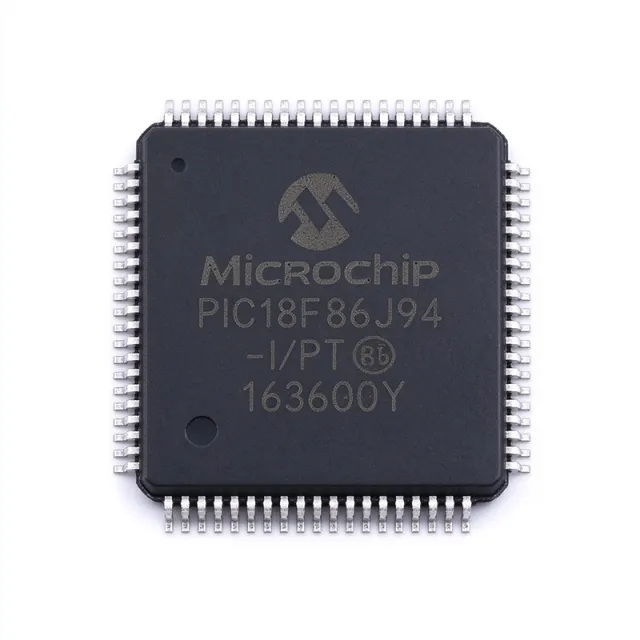
PIC18F8723-E/PT - 8-bit 25MHz MCU 128KB Flash 80-TQFP | Microchip
PIC18F8723-E/PT

PIC18F8723-E/PT - 8-bit 25MHz MCU 128KB Flash 80-TQFP | Microchip

The Microchip Technology PIC18F8723-E/PT is a high-performance 8-bit PIC18 microcontroller with 128 KB of Flash program memory and 4 KB of RAM, packaged in an 80-pin TQFP (12x12x1 mm) for large low-power and connectivity-focused embedded designs. It is part of the PIC18F8723 family of 1-Mbit enhanced Flash microcontrollers that combine nanoWatt power management with up to four serial communication ports. What is a PIC18 8-bit microcontroller? The PIC18 family is Microchip's high-end 8-bit architecture, sitting above the PIC16 in performance and feature set. It uses an enhanced Harvard RISC core with a modified instruction set that is backward-compatible with the PIC16, and it adds features such as multiple hardware UARTs, large linear RAM, and self-programming Flash. Within the broader taxonomy, the PIC18 belongs to the 8-bit microcontroller category -> microcontroller unit (MCU) -> embedded controller -> semiconductor. The PIC18F8723 specifically targets high-pin-count applications that need abundant I/O and connectivity. Key features include 128 KB (64K x 16 words) of self-programmable Flash, 4 KB of general-purpose SRAM, 1024 bytes of data EEPROM, 16 channels of 12-bit ADC, and four serial ports including two MSSP ports (I2C/SPI) and two enhanced USARTs with LIN master support. The device also exposes 70 I/O pins, supports up to 25 MHz operation at 5 V (with 40 MHz specified in the datasheet for the extended parts), and integrates nanoWatt power-saving modes such as Run, Idle, and Sleep with multiple clock sources including INTOSC and PLL. Architecturally, the PIC18F8723 uses a 16-bit instruction word with an 8-bit data path, hence the 64K x 16 Flash word notation, and provides a separate 14-bit instruction pipeline for the PIC16 compatibility subset. The 12-bit ADC delivers up to 16 channels with multiple conversion trigger options, while the 10-bit DAC is absent in this variant; the capture/compare and PWM modules support motor control and timing applications. The device operates from 4.2 V to 5.5 V in the 'E' (Extended) temperature grade of -40C to +125C. Typical applications include industrial automation, automotive body and chassis networking, large-format user interfaces with multiple serial ports, and white goods / appliance control. The four serial ports make it especially suitable as a LIN master for car body modules, while the 12-bit ADC and 70 I/O pins support instrumentation front ends and multi-sensor aggregation nodes. When designing with this MCU, ensure the brown-out voltage is set above the minimum ADC reference, route AVSS/AVDD cleanly to isolate analog noise, and select the proper oscillator mode (HS or EC) to match the crystal. The 'E' suffix indicates the Extended temperature range, so thermal derating and self-heating should be reviewed in enclosed enclosures. This page synthesizes distributor pricing, drop-in alternatives drawn from Microchip's own PIC18 portfolio, and practical design notes beyond what is found on a typical catalog listing.

RFQ رابطہ
PIC18F8723-I/PT - 8-Bit 40MHz 128KB Flash MCU | Microchip 80-TQFP
PIC18F8723-I/PT

PIC18F8723-I/PT - 8-Bit 40MHz 128KB Flash MCU | Microchip 80-TQFP

The Microchip Technology PIC18F8723-I/PT is a high-performance 8-bit PIC microcontroller from the PIC18F family, featuring a 40 MHz CPU core, 128 KB of Flash program memory, 4 KB of SRAM, and 1024 bytes of EEPROM data memory, all packaged in an 80-pin TQFP (PT, 12x12 mm). It integrates a 12-channel, 10-bit ADC, four serial communication modules (two MSSP for I2C/SPI, two USART with LIN support), and Microchip's nanoWatt power-management technology, giving designers substantial on-chip resources for connected and data-acquisition designs. What is a PIC 8-bit microcontroller? A microcontroller (MCU) is a single-chip computer that integrates a CPU, memory (Flash program, SRAM data, optional EEPROM), and peripherals on one die to serve as the brain of an embedded system. The PIC18F family sits in the performance tier of Microchip's 8-bit PIC architecture, sitting between baseline PIC10/12/16/17 parts and the 16-bit dsPIC/PIC24 families in the broader 8-bit-vs-32-bit MCU hierarchy. Key features include 75 instruction set operations, an 8 x 8 hardware multiplier, three 16-bit timers (Timer0/1/2/3/5 equivalents), two Capture/Compare/PWM modules, 70 interrupt sources with an 8-level hardware priority scheme, and a 32 kHz secondary oscillator for low-power RTCC operation. The 80-TQFP footprint exposes ample I/O - 70 I/O lines, of which up to 12 share analog input channels. Typical applications include industrial control panels, large low-power connected appliances, automotive body/comfort LIN nodes, USB/serial bridges, data-logger front-ends, and graphics-capable human-machine interfaces. The 128 KB Flash and 4 KB RAM also suit Chinese-character and multi-language LCD UI stacks. When designing with this device, note that the 'I' suffix denotes the industrial temperature range (-40C to +85C), while the 'F' suffix is required for automotive-grade (AEC-Q100) qualification; always verify the package suffix vs the application's environmental target. Bulk erase time and Flash endurance (typically 100K cycles) should also be considered when planning firmware update strategies.

RFQ رابطہ
PIC18F87J10-I/PT - 8-bit 40MHz 128KB Flash MCU | Microchip
PIC18F87J10-I/PT

PIC18F87J10-I/PT - 8-bit 40MHz 128KB Flash MCU | Microchip

The Microchip Technology PIC18F87J10-I/PT is a high-performance 8-bit PIC18J-series flash microcontroller (MCU) running at up to 40 MHz (10 MIPS) with 128 KB of Flash program memory, 4 KB of RAM, and an 80-pin TQFP (PT) package measuring 12x12 mm. An 8-bit MCU is a microcontroller whose central processing unit processes data in 8-bit chunks; the PIC18 family uses an enhanced RISC architecture with a modified Harvard memory layout that separates program and data buses, which accelerates instruction fetch and execution. The 'J' designation indicates the device operates from a 2.0-3.6 V supply and is designed for cost-sensitive embedded designs with rich peripheral integration including USB 2.0 full-speed, two I2C/SPI, two USART (LIN-capable), and a 10-bit A/D converter. Key features include 128 KB Flash (64K x 16), 4 KB SRAM, two I2C, two SPI, two USART with LIN support, USB 2.0 full-speed on-chip transceiver, 10-bit ADC with up to ten channels, two analog comparators, a 16-bit timer and three 8-bit timers, and a parallel slave port for external memory or graphics interfaces. Industrial operating range is -40C to +85C. The device is built on an enhanced PIC18 CPU core using a single 3.3 V supply, eliminating the legacy dual-rail (5 V core / 3.3 V I/O) complexity of earlier PIC18F parts. This single-rail architecture simplifies power-tree design and is ideal for cost-constrained applications that previously required external level translation. Typical applications include USB peripherals, embedded control with LIN/UART bridging, industrial sensor nodes, human-interface displays, and cost-sensitive consumer electronics. The 80-pin TQFP package provides generous I/O (>60 I/O pins) suitable for color graphics TFT panels and parallel-bus peripherals. When designing with this MCU, note the 2.0-3.6 V supply constraint and ensure upstream regulators deliver clean 3.3 V. The PT suffix denotes the industrial temperature grade (-40C to +85C) in the 80-pin TQFP package. This page synthesizes distributor pricing, drop-in PIC18 alternatives, and practical design notes not found on a single manufacturer datasheet page.

RFQ رابطہ
PIC18F87J11-I/PT - 8-bit 48MHz 128KB Flash MCU 80-TQFP | Microchip
PIC18F87J11-I/PT

PIC18F87J11-I/PT - 8-bit 48MHz 128KB Flash MCU 80-TQFP | Microchip

The Microchip Technology PIC18F87J11-I/PT is an 8-bit PIC18J microcontroller featuring a 48 MHz CPU, 128 KB Flash program memory, 3936 bytes RAM, and a 10 MIPS instruction rate, housed in an 80-pin TQFP (12x12 mm) package. It belongs to the PIC18F87J11 family, which is an enhancement to the PIC18F87J10 family with an internal 8 MHz oscillator, lower power consumption, and improved EEPROM emulation via word Flash write capabilities. A microcontroller (MCU) is a single-chip computer that integrates a CPU core, program and data memory, peripherals, and I/O on one die. Within the broader semiconductor taxonomy, this device sits in the hierarchy: PIC18F87J11 -> 8-bit PIC microcontroller -> microcontroller (MCU) -> embedded processor -> semiconductor. The PIC18J family in particular targets low-power 3V applications with nanoWatt XLP technology, making it suitable for cost-sensitive designs that require flexible serial communication through four serial ports (two MSSP for I2C/SPI and two AUSART for asynchronous serial). Key features include 128 KB (64K x 16) of self-programmable Flash, 3936 bytes of SRAM, four 16-bit timers, two MSSP, two AUSART, two ECCP plus two CCP, a 12-bit A/D converter with up to 16 channels, and a parallel master/slave port. The device supports industrial temperature range of -40C to +85C, operates from 2.0V to 3.6V (battery range), and is pin-compatible with the PIC18F87J10, PIC18F85J11, PIC18F8720, and PIC18F8722 families. The PIC18F87J11 architecture uses an enhanced Harvard architecture with separate program and data buses, 16-bit instructions, and a hardware multiplier. Its nanoWatt technology includes sleep modes with current in the nanoamp range, making it well suited for battery-powered designs. Typical applications include industrial control panels, USB/HID peripherals, automotive body controllers, sensor hubs, HMI displays, and consumer appliances where 128 KB of code space and abundant I/O are needed. When designing with this device, allocate adequate decoupling on VDD/AVDD rails and follow Microchip's recommended 80-pin TQFP PCB layout to maintain signal integrity at 48 MHz. The device is hardware-pin-compatible with several PIC18F siblings, enabling easy migration across feature sets without PCB rework. This page synthesizes distributor pricing, drop-in pin-compatible alternatives from the PIC18F family, and practical design notes not found in the manufacturer datasheet alone.

RFQ رابطہ
PIC18F87J50-I/PT - 8-Bit 48MHz USB MCU 128KB Flash | Microchip
PIC18F87J50-I/PT

PIC18F87J50-I/PT - 8-Bit 48MHz USB MCU 128KB Flash | Microchip

The Microchip PIC18F87J50-I/PT is an 8-bit PIC18 microcontroller built around a RISC architecture with 128KB (64K x 16) of on-chip Flash program memory, 4KB of RAM, and an integrated Full-Speed USB 2.0 device peripheral, housed in an 80-pin TQFP (12x12 mm) package. It operates at up to 48MHz from a 3.3V supply (typically 4.2V to 5.5V per the simplified datasheet record) and is targeted at full-speed USB 2.0 and low-speed USB 1.1 designs that need substantial code space and I/O density. An 8-bit microcontroller (MCU) is a single-chip computer that integrates a CPU, RAM, non-volatile program memory, peripherals, and I/O on one die; within Microchip's taxonomy the PIC18 family sits above the baseline PIC10/12/16 series and below the PIC24/dsPIC parts, while the J-suffix '18J' family specifically supports low-voltage 3.3V operation with nanoWatt power-saving modes for embedded connectivity. Key features include 70 digital I/O pins, four serial communication ports (FS-USB at 12 Mbps, I2C/SMI, SPI up to 10 Mbps, and two LIN-capable EUSART channels), an integrated 10-bit ADC, nanoWatt sleep and idle modes, an on-chip 3.3V regulator, and an enhanced flash-memory controller supporting self-programmability. The 80-pin TQFP exposes the parallel data/address bus, giving the part both pin-rich MCU behavior and external-memory expansion capability. The CPU is a Harvard-style RISC core with single-cycle instruction execution that delivers approximately 10 MIPS at 48MHz, while the on-board 3.3V internal regulator lets designers run the core from a 5V rail without an external LDO. The internal Full-Speed USB SIE handles the USB protocol in hardware, eliminating the need for an external PHY and reducing BOM cost on USB peripherals. Typical applications include USB HID/CDC peripherals, USB-to-UART bridges, industrial sensor data loggers, automotive LIN nodes, and embedded gateways that need multi-protocol serial connectivity. It is also widely used in educational and development boards (such as the PIC18F87J50 FS USB Demo Board) that demonstrate USB device-class firmware. When designing with the PIC18F87J50, reserve at least one decoupling 0.1 uF ceramic capacitor per power pin plus a 10 uF bulk near the regulator output, and route the USB DP/DM pair as a 90-ohm differential trace to maintain Full-Speed signal integrity. This page synthesizes distributor pricing, drop-in PIC18J-family alternatives, and practical design notes into a single reference not found in the manufacturer datasheet alone.

RFQ رابطہ
PIC18F87J60-I/PT - 8-bit MCU with 10BASE-T Ethernet, 128KB Flash
PIC18F87J60-I/PT

PIC18F87J60-I/PT - 8-bit MCU with 10BASE-T Ethernet, 128KB Flash

The Microchip Technology PIC18F87J60-I/PT is an 80-pin, 8-bit PIC18 high-performance Flash microcontroller with an integrated 10 Mbps (10BASE-T) Ethernet MAC/PHY peripheral, 128 KB of Flash program memory and 3.8 KB of RAM, housed in a 12x12 mm 80-TQFP (PT) package. According to the Microchip product page, it operates from 2.0V to 3.6V, runs at up to 41.667 MHz (10 MIPS) and targets remote-monitoring and connected embedded nodes. What is a microcontroller with integrated Ethernet? A microcontroller (MCU) is a single-chip computer that integrates a CPU core, program memory (Flash/ROM), working memory (RAM) and peripherals such as timers, ADC, communication ports and I/O. The PIC18F87J60 adds an on-chip 10BASE-T Ethernet MAC and PHY, eliminating the need for an external network controller and reducing BOM cost, board space and firmware complexity for TCP/IP connected designs. Key features highlighted by Microchip include 128 KB Flash, 3.8 KB RAM, 8-bit Harvard architecture with 16-bit instructions, an integrated 10 Mbps Ethernet peripheral (MAC + PHY), 8-channel 10-bit ADC, two USARTs, an SPI port and an I2C port. Industrial temperature range is -40C to +85C and the device runs from a single 2.0V-3.6V supply. The 80-pin TQFP exposes up to 69 digital I/O lines, providing generous expansion headroom for sensors, actuators and user interfaces. Architecturally, the PIC18F87J60 uses the proven PIC18J pipeline with single-cycle execution at 41.667 MHz (4x PLL from 10 MHz), 16-bit opcodes and a hardware multiply. The on-die PHY interfaces directly to a 1:1 magnetics and RJ-45 jack, while the MAC implements IEEE 802.3 with the Microchip TCP/IP stack (MLA) supplying the upper layers. Hardware crypto acceleration, RTCC and 4 KB of EEPROM emulation complete the feature set. Typical applications include industrial automation nodes (sensor hubs, PLC companions, Modbus/TCP gateways), building automation (BACnet/IP thermostats, lighting controllers, access readers), remote monitoring (energy meters, environmental sensors), point-of-sale terminals and networked medical instruments where wired Ethernet is preferred over Wi-Fi for reliability and security. The integrated PHY also makes it a strong fit for low-cost IoT edge gateways. When designing with the PIC18F87J60, reserve a contiguous region of RAM for the Ethernet transmit/receive buffers and place the 1:1 isolation magnetics within 25 mm of the differential pair to meet IEEE 802.3 return-loss limits. Bulk + 0.1 uF + 0.01 uF decoupling on every VDD/VSS pair and a 4-layer ground plane are recommended by the Microchip Ethernet reference design. This page synthesizes verified distributor pricing, drop-in same-package alternatives, and design notes not assembled on any single manufacturer or distributor product page.

RFQ رابطہ
PIC18F87J72-I/PT - 8-bit 48MHz 128KB Flash MCU | Microchip
PIC18F87J72-I/PT

PIC18F87J72-I/PT - 8-bit 48MHz 128KB Flash MCU | Microchip

The Microchip Technology PIC18F87J72-I/PT is a high-performance 8-bit PIC18 microcontroller engineered for single-phase energy meter and multi-function monitoring applications, integrating a dual-channel 16/24-bit delta-sigma analog front end (AFE) and a 12-bit 12-channel SAR ADC alongside an on-chip segmented LCD controller. The device executes instructions at 48 MHz internal clock (up to 12 MIPS) and is housed in an 80-pin TQFP (PT) package measuring 12x12 mm with 1.0 mm height. It includes 128 KB of Flash program memory (64K x 16), 4 KB of RAM, a hardware Real-Time Clock and Calendar (RTCC), and the Charge Time Measurement Unit (CTMU) for capacitive touch and temperature sensing. A microcontroller (MCU) is a single-chip computer containing a CPU core, program and data memory, and integrated peripherals designed to execute embedded firmware in a standalone system. The PIC18 family sits within Microchip's 8-bit PIC architecture hierarchy, which scales from baseline PIC10/PIC12/PIC16 devices up to high-performance PIC18 parts, ultimately forming the foundation of the broader 32-bit PIC32 line. Energy-metering MCUs combine precision analog signal chains with computation and display driving in a single die, eliminating the need for separate metrology ADCs and LCD driver ICs. Key features include 70 digital I/O pins, dual USART, SPI, I2C, 132-pixel segmented LCD driver with dedicated charge pump, two op-amps inside the AFE, hardware multiplier, and nanoWatt power management for sleep-mode current below 1 uA. The 24-bit sigma-delta AFE delivers better than 0.1% accuracy across the dynamic range required for IEC 62053-21 / IEC 62053-22 single-phase electricity meters. The PIC18F87J72 architecture uses an enhanced RISC core with hardware multiply, 16-bit-wide Flash memory bus, and an internal 8 MHz oscillator (PLL-able to 48 MHz). The dual-channel AFE block pairs a programmable-gain amplifier (PGA) with a 16-/24-bit sigma-delta modulator; combined with the 12-bit SAR ADC (12 channels, 100 ksps) the device can simultaneously sample voltage and current while driving the LCD. Typical applications include single-phase and multi-function electricity meters, smart energy monitors with segmented LCD, power-quality analyzers, solar PV monitoring, industrial process instrumentation, and capacitive-touch user interfaces using the CTMU. The wide operating range (2.0 V to 3.6 V core, 4.2 V to 5.5 V with 5V-tolerant I/O variant noted in datasheet) supports battery-backed metering with line-powered LCD operation. When designing with this part, allocate PCB area for two differential current-sensor inputs (typically current transformers or shunt resistors) routed to the dedicated SDx/SDy sigma-delta channels with anti-aliasing filters. Decouple VDD/VSS with 100 nF ceramic at each supply pin and provide a local bulk 10 uF for the LCD charge pump; refer to the Microchip energy-meter reference design for the full metrology calibration flow.

RFQ رابطہ
PIC18F87J72T-I/PT - 128KB Flash LCD MCU w/ AFE | Microchip
PIC18F87J72T-I/PT

PIC18F87J72T-I/PT - 128KB Flash LCD MCU w/ AFE | Microchip

The Microchip Technology PIC18F87J72T-I/PT is an 8-bit PIC18J RISC microcontroller integrating a dual-channel 16-/24-bit Analog Front End (AFE), a 12-bit 12-channel SAR ADC, and a 132-pixel LCD driver, all in an 80-pin TQFP package. The device delivers 128 KB Flash program memory, 4 KB RAM, and executes instructions at up to 48 MHz (10 MIPS typical) from a 2.5V/3.3V supply domain (operating range 2.0V–3.6V per PIC18J family, with PIC18F87J72 datasheet noting 4.2V–5.5V core tolerance on some revisions). Its integrated dual-channel AFE with 16-/24-bit sigma-delta modulator interface, plus CTMU and hardware RTCC, makes this part purpose-built for single-phase multi-function energy meters, smart e-Meters, and power-monitoring front-ends. A microcontroller (MCU) is a single-chip computer containing a CPU core, program/data memory, peripherals, and I/O on one die. The PIC18F87J72 belongs to the 8-bit RISC PIC18 family, which uses a 16-bit instruction word with 8-bit data paths. Within the broader taxonomy, this device sits in the sub-hierarchy: PIC18F87J72 -> PIC18J -> PIC18 -> PIC microcontrollers -> 8-bit MCU -> microcontroller -> embedded processor -> semiconductor. Its nanoWatt technology pedigree positions it for low-power metering that must remain in sleep for years on a battery-backed RTC. Key features include 70 user I/O pins, an internal 31 kHz and configurable oscillator, hardware CTMU for capacitive touch and time measurement, RTCC with timestamp, and an LCD driver supporting up to 132 pixels directly. The integrated AFE accepts external sigma-delta modulators for current and voltage channels, eliminating external ADC ASICS and shrinking the meter BOM. According to Microchip product literature, the part is targeted at multi-function single-phase smart energy meters that combine metrology, tamper detection, and an on-board display. From an architecture perspective, the PIC18J core delivers single-cycle instruction execution with hardware multiply, a 16-level stack, and linear memory addressing across program and data spaces. The 12-channel 12-bit SAR ADC complements the dedicated AFE by providing auxiliary measurements such as temperature or battery voltage. The LCD controller supports static, 1/2, 1/3, and 1/4 multiplex with software-controlled contrast, removing the need for an external display driver. Typical applications are single-phase multi-function smart energy meters, power-quality monitors, smart-grid endpoints with on-device LCD, and tamper-detection metering nodes. The wide I/O count and integrated display also suit industrial HMI panels and battery-backed instrumentation. A critical design consideration is the use of the internal AFE interface; PCB routing must keep the modulator clock traces short and guard the analog inputs from the LCD switching waveforms. The 80-TQFP exposed-pad variant requires solder-pad land pattern on the PCB to keep junction temperature within range at full 48 MHz. This page synthesizes distributor pricing, drop-in TQFP-80 alternatives from the PIC18F87J family, and practical metrology design notes not consolidated in the manufacturer datasheet.

RFQ رابطہ