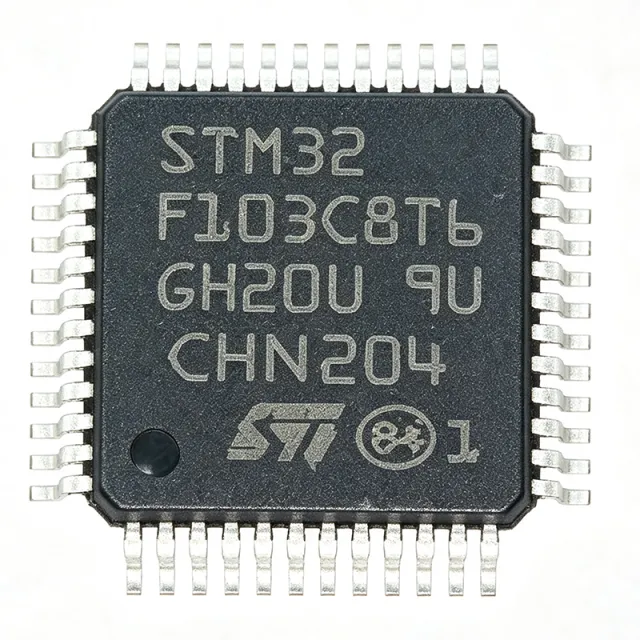
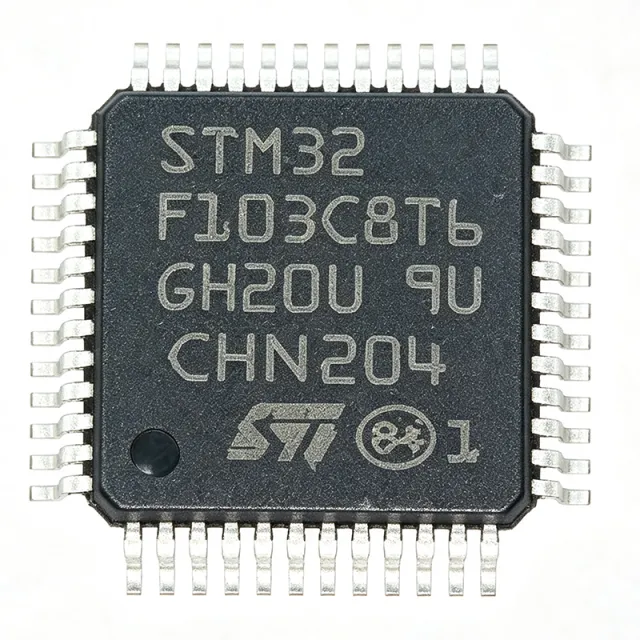
STM32F072VBT6
STM32F072VBT6 - 48MHz Cortex-M0 128KB MCU | STMicroelectronics
The STMicroelectronics STM32F072VBT6 is a 32-bit ARM Cortex-M0 microcontroller operating at up to 48 MHz, with 128 KB of Flash memory, 16 KB of SRAM, USB, CAN, and CEC connectivity, and a 2 V to 3.6 V operating-voltage range. It is housed in a 100-pin LQFP package measuring 14 mm by 14 mm.
What is a microcontroller? A microcontroller, or MCU, integrates a processor core, nonvolatile program memory, volatile data memory, peripherals, and power-management functions into one semiconductor device. The STM32F0 MCU family belongs to the embedded-processor hierarchy and combines an Arm Cortex-M0 RISC core with GPIO, timers, serial interfaces, analog functions, communications peripherals, and debugging support. This integration allows a controller to execute firmware, acquire inputs, control outputs, and manage connected equipment without a separate external processor.
Key features of the STM32F072VBT6 include its 48 MHz maximum operating frequency, 128 KB Flash, 16 KB SRAM, integrated USB and CAN interfaces, and 100-LQFP packaging. The MCU is identified by DigiKey as an STM32F0 series device with a 32-bit Arm Cortex-M0 core. Mouser identifies the same family position as a mainstream Arm Cortex-M0 USB-line MCU with 128 KB Flash, 48 MHz CPU, USB, and CAN connectivity.
The STM32F0 architecture is intended for embedded control tasks that require deterministic peripheral access and broad I/O capability in a relatively large package. Its 100-pin LQFP format provides more externally accessible pins than smaller packages, making it useful when a design requires numerous GPIO, communication, timer, or analog-control connections. The verified distributor results specifically identify 128 KB Flash, 16 KB SRAM, 48 MHz operation, 2 V to 3.6 V operation, and USB/CAN features; other detailed electrical and peripheral limits are not provided in the supplied source text.
Typical uses include USB-connected embedded controls, CAN-connected industrial or consumer equipment, data-acquisition systems, compact control boards, and products requiring a larger pin count. A design should allocate the MCU supply and ground pins correctly, configure the 2 V to 3.6 V operating environment, and route USB, CAN, and other high-speed or noisy signals according to the manufacturer’s complete datasheet and reference guidance.
The main engineering benefit is integration: USB, CAN, Cortex-M0 processing, 128 KB Flash, and 16 KB SRAM are available in one 100-LQFP device, reducing the number of external components. The tradeoff is that the 14 mm by 14 mm package is larger than common 48-pin or 64-pin MCUs, so board area and routing complexity must be considered in compact products.
This page consolidates verified distributor specifications, pricing observations, package information, application guidance, and selection considerations. It distinguishes verified values from parameters that require confirmation from the manufacturer datasheet, helping engineers plan sourcing and hardware design without treating unprovided specifications as guaranteed facts.
RFQ
رابطہ