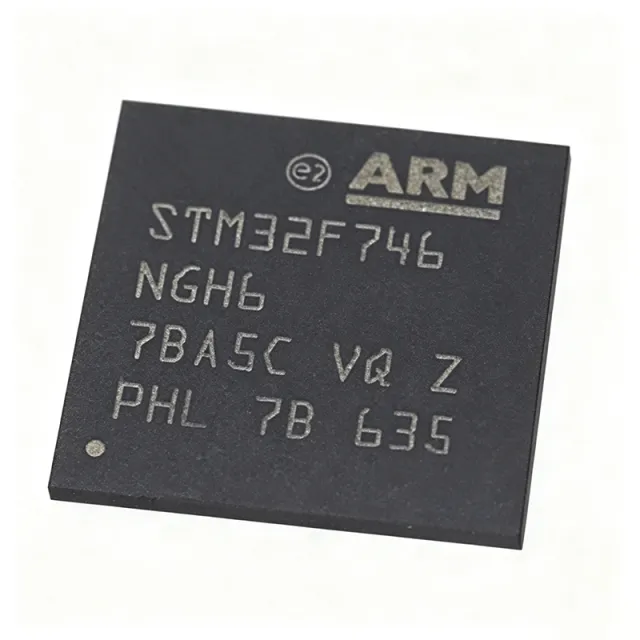
STM32F746IGT6E
STM32F746IGT6E - 216MHz Cortex-M7 MCU | STMicroelectronics
The STMicroelectronics STM32F746IGT6E is a high-performance 32-bit Arm Cortex-M7 microcontroller with a 216 MHz operating frequency, 1 MB of embedded Flash memory, and a 176-pin LQFP package. It integrates an FPU, Art Accelerator, L1 cache, SDRAM support, and TFT-oriented connectivity for graphics-intensive embedded systems.
A microcontroller is a programmable system-on-chip that combines a CPU core, nonvolatile program memory, volatile data memory, peripherals, and communication interfaces. The STM32F746 belongs to the STM32F7 family of high-performance microcontrollers, where the Cortex-M7 core operates within the broader hierarchy of embedded processor, real-time microcontroller, and semiconductor product categories. This hierarchy supports deterministic control alongside sophisticated graphical and communications workloads.
The verified product information identifies the Cortex-M7 core, 216 MHz maximum frequency, 1 MB Flash memory, Art Accelerator, L1 cache, SDRAM capability, and TFT support as defining features. Its 176-pin LQFP package provides a substantial number of external connections compared with smaller microcontroller packages, making it appropriate for systems that need parallel display interfaces, multiple communications peripherals, external memory interfaces, and a broad pin budget.
At the architectural level, the STM32F746IGT6E is intended for high-performance embedded control rather than minimal low-power sensing. The Cortex-M7 processor and FPU support demanding control loops and signal-processing workloads, while the Art Accelerator is relevant to graphical data movement. Exact RAM capacity, voltage ranges, pin assignments, and peripheral operating limits were not included in the supplied verified data and therefore require confirmation in the manufacturer documentation.
Typical uses include industrial human-machine interfaces, TFT-based control panels, industrial automation controllers, communications equipment, and external SDRAM-based graphics terminals. The 216 MHz processing headroom and 176-pin connection count are useful when combining real-time control with display, networking, storage, and sensing functions. System-level qualification remains necessary because peripheral mix, clock configuration, memory organization, and software support must match the intended design.
Designers should verify pin multiplexing, power architecture, decoupling, clock-tree settings, memory routing, and boot configuration against the current STMicroelectronics documentation before layout release. A 176-pin LQFP footprint also requires careful fanout and assembly planning. SWD programming is appropriate for bring-up, while production programming and secure boot should follow the selected programming and security strategy.
This product page consolidates verified distributor availability, manufacturer feature information, same-package replacement candidates, pricing placeholders, and practical design guidance. Because the supplied data omits several electrical and package-specific details, the datasheet and product page remain the controlling sources for production design decisions.
RFQ
رابطہ