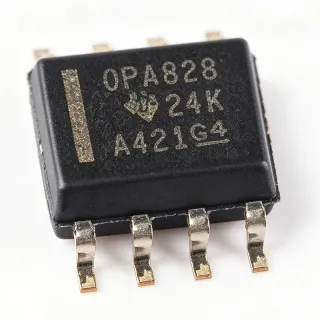
MC33171D - 1.8MHz Low Power Single Op-Amp SOIC-8 | STMicroelectronics
MPN: MC33171D ✓ فعالMC33171D جائزہ
An operational amplifier (op-amp) is an analog building block within the broader hierarchy of amplifier ICs and linear semiconductors. It amplifies the voltage difference between its inverting and non-inverting inputs with high open-loop gain, and its behavior in a circuit is set almost entirely by external feedback components. General-purpose op-amps such as the MC33171 series sit at the entry level of this taxonomy, below precision, high-speed, and instrumentation amplifier families, yet they remain the workhorse of analog signal conditioning.
Key features of the MC33171 include its exceptionally low 180 uA supply current per amplifier, which makes it attractive for battery-powered and energy-conscious designs. The bipolar fabrication (without JFET device technology) gives robust input behavior and predictable industry-standard single-op-amp pinout. The wide 3 V to 44 V supply range allows operation from single low-voltage rails or from higher industrial buses, and the device is particularly suited for single-supply operation although it can run from split supplies.
Technically, the MC33171/72/74 monolithic series combines the low static current with usable AC performance: the 1.8 MHz bandwidth covers audio and low-frequency instrumentation needs, while the 2.1 V/us slew rate supports moderate-amplitude signal swings without excessive distortion at those frequencies.
Typical applications include battery-powered portable instruments, sensor signal conditioning, active filters, transducer amplifiers, and low-frequency comparators or level shifters in industrial control, where low quiescent drain and wide supply tolerance matter more than ultra-high speed.
A key design consideration: because it is optimized for low power rather than high speed, allow adequate settling margin in feedback networks and avoid pushing large output swings near the 1.8 MHz bandwidth limit to prevent slew-induced distortion.
This page adds value beyond the manufacturer datasheet by consolidating cross-brand availability context, drop-in alternative guidance, practical design notes, and sourcing access through the Request a Quote form.
کے لیے ڈراپ اِن متبادل MC33171D — یکساں پیکیج، پن سے پن مطابقت پذیر۔ مختلف پیکیج والے پرزے جن کے لیے PCB دوبارہ کام درکار ہو، شامل نہیں ہیں۔
MC33171DG
✅ ڈراپ-اِن📋 حوالہ جاتی متبادل (کیٹلاگ میں نہیں)
MC33171DR2
✅ ڈراپ-اِن ⚠️ تفصیلات غیر تصدیق شدہ📋 حوالہ جاتی متبادل (کیٹلاگ میں نہیں)
MC33171D زیادہ سے زیادہ ریٹنگز اور برقی خصوصیات
| Amplifier Type | Standard (General Purpose) Operational Amplifier |
| Number of Circuits | 1 |
| پیکیج | 8-SOIC (SO-8) |
| Supply Voltage Range (Single Supply) | 3 V to 44 V |
| Supply Current per Amplifier | 180 uA |
| Gain Bandwidth Product | 1.8 MHz |
| Slew Rate | 2.1 V/us |
| Technology | Bipolar (no JFET) |
| ماؤنٹنگ ٹائپ | Surface Mount |
MC33171D پن کنفیگریشن
| پن 1 | OUT — Amplifier output |
| پن 2 | IN- — Inverting input |
| پن 3 | IN+ — Non-inverting input |
| پن 4 | V- — Negative supply / ground (single supply) |
| پن 5 | NC — Not connected (per datasheet) |
| پن 6 | NC — Not connected (per datasheet) |
| پن 7 | NC — Not connected (per datasheet) |
| پن 8 | V+ — Positive supply |
عام استعمالات
MC33171D کے لیے موزوں ہے 6 ایپلیکیشنs: Battery-Powered Portable Instruments, Industrial Sensor Signal Conditioning, Active Filters and Audio Signal Chains, Single-Supply Comparator and Level-Shift Circuits, Transducer and Bridge Amplifier Front Ends, Test and Measurement Signal Conditioning.
Battery-Powered Portable Instruments
The MC33171D's 180 uA per amplifier supply current is the headline parameter for battery-powered instruments: a single-channel handheld meter can run the analog front end for hundreds of hours on small cells, since the amplifier's drain is far below typical display and MCU loads. Its 3 V minimum supply allows direct operation from two alkaline cells or a 3 V lithium cell without a boost converter, removing converter quiescent losses from the budget. In a typical signal-conditioning role the op-amp amplifies a sensor output with a non-inverting gain stage using resistor feedback; because the bandwidth is 1.8 MHz, gain-setting resistors in the 10k to 100k range add negligible thermal-noise penalty at audio and sub-audio frequencies while keeping divider current in the microamp range. Trade-off: the 2.1 V/us slew rate limits full-power bandwidth at large swings, so keep output amplitudes modest or frequencies low in portable designs.
تجویز کردہ
Industrial Sensor Signal Conditioning
Industrial 24 V systems benefit directly from the MC33171D's 44 V maximum single-supply rating: the amplifier connects across the plant supply rail without an intermediate regulator stage, reducing component count and a failure point. The 180 uA consumption also matters where many channels are deployed across a distributed sensor network. In a typical transducer front end, the op-amp is configured as a difference or non-inverting amplifier conditioning 4-20 mA loop receiver voltages or bridge sensor outputs; the bipolar input tolerates the common-mode excursions typical of industrial grounds. Layout should place a 100 nF ceramic decoupling capacitor within a few millimeters of pin 8 to pin 4, since long cable runs inject RF that the 1.8 MHz bandwidth would otherwise demodulate. Verify that input common-mode range and output swing at 24-36 V rails cover the transducer's full-scale signal before committing the layout.
تجویز کردہ
Active Filters and Audio Signal Chains
With a 1.8 MHz gain bandwidth product and 2.1 V/us slew rate, the MC33171D supports Sallen-Key and multiple-feedback active filters comfortably into the tens-of-kilohertz range: at a 20 kHz cutoff, a gain-of-10 stage consumes only a small fraction of the available bandwidth, preserving filter Q accuracy. Its 180 uA draw lets designers populate many filter poles in multi-channel audio or telemetry chains without the op-amp array dominating the power budget. In audio preamplifier roles, the bipolar input contributes predictable voltage-noise behavior suited to line-level signals from sources like the PCM1808 audio ADC front end, where the op-amp buffers or gains the signal before digitization. Designers should keep closed-loop gains moderate and avoid rail-to-rail output assumptions, since the bipolar output stage swings to within roughly a volt of the rails; a split-supply or mid-rail bias scheme preserves headroom for AC-coupled audio signals.
تجویز کردہ
Single-Supply Comparator and Level-Shift Circuits
Although dedicated comparators switch faster, the MC33171D serves in cost-sensitive level-detection roles where its 3 V to 44 V range and 180 uA consumption outweigh speed: undervoltage/overvoltage flags, window detectors, and slow threshold alarms on industrial or automotive-style 12 V to 24 V rails. Configured open-loop or with light positive feedback hysteresis, the output saturates cleanly between supply limits; adding 1-10 mV of hysteresis via a positive-feedback resistor prevents chatter on slowly drifting inputs. The wide supply range lets one circuit design serve both 5 V logic systems and 24 V control cabinets. For critical trip-accuracy applications, note that input offset voltage drift contributes directly to threshold error, so trim thresholds in software or select a precision comparator such as the LM239 family when microvolt-level accuracy is required rather than relying on a general-purpose op-amp.
تجویز کردہ
Transducer and Bridge Amplifier Front Ends
Pressure, strain-gauge and resistive-bridge transducers pair well with the MC33171D in single-supply topologies: the amplifier references the bridge output to a mid-rail bias generated by a resistor divider buffered by the same or a second device, allowing unipolar ADCs to read the conditioned signal directly. Its 180 uA draw permits continuous excitation monitoring in remote or solar-powered nodes, and the 3 V floor supports two-cell field instruments. With 1.8 MHz bandwidth, bridge signals in the DC-to-10 kHz regime are handled with negligible amplifier-induced phase error, and 2.1 V/us slew accommodates step loads from switching calibration. Keep bridge excitation currents in view: the low op-amp power does not offset a heavily loaded bridge, so choose bridge impedance (typically 350 ohms or higher, or 1k+) consistent with the total energy budget, and route the sensitive differential traces away from digital clocks on the PCB.
تجویز کردہ
Test and Measurement Signal Conditioning
Bench and embedded test equipment use the MC33171D in input conditioning stages: scaling divider buffers, current-shunt amplifiers, and signal-path gain stages where 3 V to 44 V operation allows direct connection to the unit-under-test rails. The 180 uA per channel consumption keeps self-heating and loading of the measurement path minimal, and the predictable bipolar behavior simplifies gain-error budgeting across the -40 to +85 style industrial temperature spans covered by the series. In a typical chain, the op-amp buffers a compensated divider before an ADC such as the MCP3424, its 1.8 MHz bandwidth contributing negligible droop for DC and low-frequency measurements. Designers should respect the slew-rate ceiling when measuring fast edges - a 2.1 V/us limit means large-amplitude fast pulses will be slew-limited - and add input protection resistors for over-voltage events on front-panel connectors.
تجویز کردہ
تجویز کردہ پروڈکٹس کا خلاصہ
کے لیے انجینئرنگ ریفرنس ڈیٹا MC33171D — موازنہ، ڈیزائن رہنمائی، اور تعمیل کی معلومات۔
انتخاب کی گائیڈ
متبادلات کے ساتھ موازنہ
| پیرامیٹر | یہ پروڈکٹ | MC33171DG | MC33171DR2 |
|---|---|---|---|
| Package | 8-SOIC | 8-SOIC - same | 8-SOIC - same |
| Brand | STMicroelectronics | STMicroelectronics | STMicroelectronics |
| Number of Circuits | 1 | 1 | 1 |
| Supply Current per Amplifier | 180 uA | 180 uA | 180 uA |
| Gain Bandwidth Product | 1.8 MHz | 1.8 MHz | 1.8 MHz |
| Slew Rate | 2.1 V/us | 2.1 V/us | 2.1 V/us |
| Supply Voltage Range | 3 V to 44 V | 3 V to 44 V | 3 V to 44 V |
اہم امتیازی خصوصیات
- Wide 3 V to 44 V single-supply range in a low-cost general-purpose part (بمقابلہMC34071 family members with narrower low-end supply floor)
- 180 uA per amplifier quiescent current (بمقابلہMC33171DG (identical) versus standard bipolar op-amps drawing 500 uA to 1.5 mA)
- Trade-off: moderate 1.8 MHz / 2.1 V/us AC performance (بمقابلہTL071-class JFET op-amps at 3 MHz / 13 V/us)
ڈیزائن نوٹس
Place a 100 nF ceramic decoupling capacitor directly across pins 8 and 4, within a few millimeters of the SOIC-8 body, and add a bulk 1 uF to 10 uF capacitor per board section. The 1.8 MHz bandwidth is low enough that layout parasitics rarely cause instability, but long supply traces on industrial boards can inject RF that a high-impedance input demodulates. Keep the non-inverting input trace short and guarded when using high-value feedback resistors above 1 Mohm, since board leakage becomes comparable to bias currents in low-power designs.
Budget the total analog rail around the 180 uA amplifier current plus feedback divider drain. Estimated: a gain-of-10 non-inverting stage with Rf = 90 kohm and Rg = 10 kohm draws roughly 44 uA at a 5 V full-scale output (5 V / 100 kohm), so the stage total is approximately 224 uA - comparable to the amplifier itself. Choose feedback resistors of 100 kohm or higher in battery designs to keep divider drain well under the op-amp quiescent current, trading a small increase in Johnson noise.
Do not treat the MC33171D as a rail-to-rail device: as a bipolar design it will not swing its output fully to either supply rail, and input common-mode range stops short of the positive rail. Signals expected near the positive supply will clip and distort. Either bias signals around mid-supply with AC coupling, use a negative rail on pin 4, or select a rail-to-rail CMOS op-amp when the signal must approach the rails. Also avoid closed-loop gains above roughly 40 at frequencies above 40 kHz, where the 1.8 MHz bandwidth product begins to erode loop gain and filter accuracy.
تعمیل کی معلومات
Compliance status was not stated in the retrieved listings; confirm RoHS/REACH status on the manufacturer product page before release.