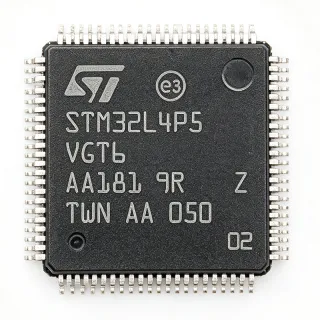
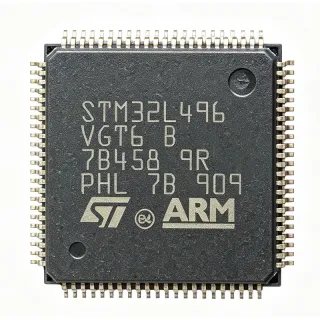
STM32L4R9VIT6 - 120MHz ARM Cortex-M4 2MB Flash MCU | STMicroelectronics
MPN: STM32L4R9VIT6 ✓ فعالSTM32L4R9VIT6 جائزہ
An ultra-low-power microcontroller (MCU) is a 32-bit RISC processor designed to minimize active and standby energy consumption, allowing battery-powered or energy-harvesting products to run for years on a single cell. The STM32L4+ family sits within ST's broader STM32 portfolio as a high-performance, ultra-low-power tier, bridging the gap between Cortex-M4 performance and Cortex-M0+ efficiency. Within this family, the STM32L4R9 sub-line is positioned at the top end with 2 MB Flash, 640 KB SRAM, and a TFT/chrom accelerator pipeline targeting HMI and wearables.
Key differentiating features include Batch Acquisition Mode (BAM) that reduces data throughput overhead, a 305 nA VBAT mode for RTC backup domain, a 33 nA Shutdown mode, an integrated DFSDM peripheral for sigma-delta sensor inputs, and hardware AES-256 encryption for secure firmware updates. The 120 MHz Cortex-M4 core delivers up to 150 DMIPS / 273 CoreMark while a low-power RUN mode operates down to 2 MHz at ~100 uA/MHz.
Typical applications span wearable fitness bands, medical sensor patches, smart watches with TFT displays, industrial sensor hubs with CAN connectivity, low-power IoT endpoints with secure boot, and battery-powered instrumentation. The 2 MB Flash accommodates rich TFT GUIs and over-the-air update partitions while 640 KB SRAM supports double-buffer graphical framebuffers.
When designing with this MCU, ensure PCB layout keeps decoupling capacitors within 2 mm of each supply pin and that unused peripherals are clock-gated to retain the ultra-low-power budget. Use ST's STM32CubeIDE and STM32CubeMX with the L4+ HAL to enable Power Modes, DMA, and TFTC driver configurations quickly.
This page synthesizes distributor pricing, drop-in alternatives, and practical design notes that complement (not replicate) the official ST datasheet, helping engineers shortlist the right ultra-low-power MCU for their HMI or wearable product.
کے لیے ڈراپ اِن متبادل STM32L4R9VIT6 — یکساں پیکیج، پن سے پن مطابقت پذیر۔ مختلف پیکیج والے پرزے جن کے لیے PCB دوبارہ کام درکار ہو، شامل نہیں ہیں۔
اس سیریز میں مختلف ورژن
اسی سیریز کے ماڈلز جو ڈراپ اِن مطابقت رکھتے ہیں STM32L4R9VIT6 (یکساں فارم فیکٹر اور فٹ پرنٹ) — میں مختلف Package, Maximum Clock Frequency, Program Memory (Flash), VBAT Mode Current.
STM32L4R5VIT6
✅ ڈراپ-اِن ⚠️ تفصیلات غیر تصدیق شدہقیمت کے لیے رابطہ کریں
ڈیٹا شیٹ دیکھیں →STM32L4R7VIT6
✅ ڈراپ-اِن ⚠️ تفصیلات غیر تصدیق شدہ📋 حوالہ جاتی متبادل (کیٹلاگ میں نہیں)
STM32L496VGT6TR
✅ ڈراپ-اِن ⚠️ تفصیلات غیر تصدیق شدہ📋 حوالہ جاتی متبادل (کیٹلاگ میں نہیں)
STM32L4R9VIT6 زیادہ سے زیادہ ریٹنگز اور برقی خصوصیات
| Core Architecture | ARM Cortex-M4 with FPU |
| زیادہ سے زیادہ کلاک فریکوئنسی | 120 MHz |
| Program Memory (Flash) | 2 MB (2M x 8) |
| SRAM | 640 KB |
| Supply Voltage Range | 1.71 V to 3.6 V |
| آپریٹنگ درجہ حرارت رینج | -40 C to +85 C / +125 C |
| پیکیج | 100-LQFP (14x14 mm) |
| Shutdown Mode Current | 33 nA |
| VBAT Mode Current | 305 nA (RTC and 32x32-bit backup registers) |
| Peripheral Interfaces | USB OTG, DFSDM, CAN, I2C, SPI, UART, ADC, Timers, PWM |
| Graphics Acceleration | Chrom-ART Accelerator and Chrom-GRC |
| Hardware Encryption | AES-256 |
| ماؤنٹنگ ٹائپ | Surface Mount |
| RoHS اسٹیٹس | Compliant |
STM32L4R9VIT6 100-lqfp (14x14 mm) پن کنفیگریشن گائیڈ
STM32L4R9VIT6 (100-lqfp (14x14 mm) پیکیج) کے لیے پن کنفیگریشن۔ اس ڈیجیٹل IC میں GPIO، کمیونیکیشن انٹرفیس (UART، SPI، I2C) اور پاور پنز شامل ہیں۔ متبادل پن فنکشنز اور کنفیگریشن آپشنز کے لیے مینوفیکچرر کے ڈیٹا شیٹ سے رجوع کریں۔ ایمبیڈڈ سسٹم ڈیزائن اور PCB لے آؤٹ کے لیے ضروری۔

کے لیے تفصیلی پن آؤٹ ڈیٹا دستیاب نہیں STM32L4R9VIT6.
رجوع کریں ڈیٹا شیٹ مکمل پن کنفیگریشن کے لیے۔
عام استعمالات
STM32L4R9VIT6 کے لیے موزوں ہے 6 ایپلیکیشنs: Wearable Fitness Band with TFT Display, Battery-Powered Medical Sensor Patch, Industrial IoT Sensor Hub with CAN Bus, Smart Home Thermostat with TFT GUI, Low-Power Data Logger with Over-the-Air Updates, Consumer Fitness Watch with BLE Audio.
Wearable Fitness Band with TFT Display
The STM32L4R9VIT6 is a strong fit for wearable fitness bands because its 33 nA shutdown current and 305 nA VBAT current let a small Li-ion cell last for weeks. The 2 MB Flash accommodates animated TFT graphical assets and dual OTA update slots, while the 640 KB SRAM supports double-buffered framebuffers that the Chrom-ART 2D accelerator can refresh without CPU intervention. Operating from a 1.71 V to 3.6 V supply covers single-cell coin-cell designs, and the integrated DFSDM digitizes motion-sensor sigma-delta streams without an external ADC. Place the MCU adjacent to the TFT's pixel clock with 0.1 uF + 4.7 uF decoupling and ground the GND pins through a low-impedance pour.
تجویز کردہ
Battery-Powered Medical Sensor Patch
Medical adhesive sensor patches require continuous low-power operation and silent data capture. The STM32L4R9VIT6 provides that with Batch Acquisition Mode (BAM) that wakes the CPU just long enough to drain sensor FIFOs, plus the integrated DFSDM that samples sigma-delta biosensors without an external ADC. The 120 MHz Cortex-M4 can run DSP for heart-rate detection, while the 33 nA shutdown current keeps shelf life long. Use the AES-256 hardware block to encrypt patient data before BLE transmission, and rely on the 2 MB Flash to hold device firmware plus signed sensor calibration tables. Keep analog supply traces short and isolated from the digital switching sections to preserve ADC performance.
تجویز کردہ
Industrial IoT Sensor Hub with CAN Bus
Industrial IoT sensor hubs benefit from the STM32L4R9VIT6's CAN interface and ultra-low-power modes, allowing battery-powered edge nodes to monitor factory equipment for years. The Cortex-M4 at 120 MHz runs protocol stacks and edge analytics while Stop/Standby retention keeps VBAT-backed RTCs accurate to the second. The integrated AES-256 secures Modbus TCP and CANopen firmware uploads. Mount the MCU on a 4-layer PCB with separate analog and digital ground planes; bypass VDD and VDDA with 100 nF + 1 uF ceramics, and route the CANH/CANL differential pair with 120-ohm termination at each end of the bus segment.
تجویز کردہ
Smart Home Thermostat with TFT GUI
Smart-home wall thermostats need continuous graphical display updates, RF connectivity, and ultra-low standby - exactly the STM32L4R9VIT6's design sweet spot. The Chrom-ART 2D accelerator drives TFT-LCD framebuffers without CPU load, and the AES-256 engine secures Zigbee/Thread/BLE bootloaders. Operating from a single 3.3 V rail simplifies the AC-DC architecture. Wake from Stop via RTC and update only changed GUI regions to minimize average power. Plan the PCB so the TFT flex connector routes are short, ESD-protected, and isolated from the switching power supply's high-di/dt traces.
تجویز کردہ
Low-Power Data Logger with Over-the-Air Updates
Field-deployed data loggers record sensor data for months without maintenance. The STM32L4R9VIT6 supports this with 2 MB Flash partitioned for A/B OTA updates and 640 KB SRAM for circular sensor buffers. BAM allows sensor FIFO draining without fully waking the CPU, and Stop mode with RTC keeps timekeeping to within a few ppm. The integrated 12-bit ADC and DFSDM digitize analog and digital sensors concurrently. Use external SPI Flash for logs, store firmware signatures in the secure memory region, and add ESD protection on cable-connected sensor inputs.
تجویز کردہ
Consumer Fitness Watch with BLE Audio
Consumer smartwatches that stream BLE Audio or take calls on the wrist need both graphical HMI and ultra-low standby, exactly the STM32L4R9VIT6's combined strengths. The 2 MB Flash stores audio DSP coefficients and watch faces, the 640 KB SRAM sustains audio frame buffers, and the 33 nA shutdown keeps the watch on the wrist for a week per charge. The ST Chrom-GRC pipeline accelerates a smooth round-TFT UI at 60 fps without overdrawing the battery. Co-locate the BLE SoC's crystal and the MCU's HSE crystal, guard each supply pin with 100 nF + 1 uF ceramics, and route the antenna at 50 ohm controlled impedance.
تجویز کردہ
تجویز کردہ پروڈکٹس کا خلاصہ
کے لیے انجینئرنگ ریفرنس ڈیٹا STM32L4R9VIT6 — موازنہ، ڈیزائن رہنمائی، اور تعمیل کی معلومات۔
انتخاب کی گائیڈ
متبادلات کے ساتھ موازنہ
| پیرامیٹر | یہ پروڈکٹ | STM32L4R5VIT6 | STM32L4R7VIT6 | STM32L4R5ZIT6P | STM32H7A3RIT6 | STM32L496VGT6TR |
|---|---|---|---|---|---|---|
| Brand | STMicroelectronics | STMicroelectronics - same | STMicroelectronics - same | STMicroelectronics - same | STMicroelectronics - same | STMicroelectronics - same |
| Package | 100-LQFP (14x14) | 100-LQFP (14x14) - same | 100-LQFP (14x14) - same | 144-LQFP - larger | 64-LQFP - smaller | 100-LQFP - same |
| Core | Cortex-M4 @ 120 MHz | Cortex-M4 @ 120 MHz - same | Cortex-M4 @ 120 MHz - same | Cortex-M4 @ 120 MHz - same | Cortex-M7 @ 280 MHz - upgrade | Cortex-M4 @ 80 MHz - down (-33%) |
| Flash | 2 MB | 1 MB (-50%) | 2 MB - same | 1 MB (-50%) | 1 MB (-50%) | 1 MB (-50%) |
| SRAM | 640 KB | 640 KB - same | 640 KB - same | 640 KB - same | 1 MB (+56%) | 320 KB (-50%) |
| Supply Voltage | 1.71 V to 3.6 V | 1.71 V to 3.6 V - same | 1.71 V to 3.6 V - same | 1.71 V to 3.6 V - same | 1.62 V to 3.6 V - similar | 1.71 V to 3.6 V - same |
| Shutdown Current | 33 nA | 33 nA - same | 33 nA - same | 33 nA - same | ~200 nA (+500%) | 30 nA - similar |
| USB OTG | Yes (Full-Speed) | Yes (Full-Speed) | Yes (Full-Speed) | Yes (Full-Speed) | Yes (High-Speed) | Yes (Full-Speed) |
| AES-256 Hardware | Yes | Yes | Yes | Yes | Yes | Yes |
اہم امتیازی خصوصیات
- Largest Flash in the L4+ family at 2 MB in same 100-LQFP (بمقابلہSTM32L4R5VIT6)
- Significantly higher core frequency than legacy L4 without higher power (بمقابلہSTM32L496VGT6TR)
- Better ultra-low-power envelope than H7 upgrade path (بمقابلہSTM32H7A3RIT6)
ڈیزائن نوٹس
Decouple each VDD/VDDA/VDD_USB pin pair with a 100 nF X7R ceramic placed within 2 mm of the pin, plus a bulk 4.7 uF ceramic. Estimated: at 120 MHz active the L4R9 averages around 100 uA/MHz (per AN4621), so a 1 ms active window consumes ~12 mA peak before returning to Stop mode. Route the LSE 32.768 kHz crystal traces within 5 mm and shield them with a ground ring to keep RTC drift below 50 ppm.
In a 100-LQFP at typical 3.3 V / 120 MHz, power dissipation is well below the 100-LQFP's ~50 C/W theta_JA, but in sealed enclosures the junction-to-ambient rise must still be checked. Estimated: at continuous full CoreMark load the die dissipates ~30 mW, giving a 1.5 C rise - safe. If the TFT backlight shares the same regulator, add a copper pour of at least 1 square cm under the exposed pad on package variants that provide one.
Route the USB DP/DM pair as a 90-ohm differential with no splits, keeping ESD protection within 5 mm of the connector. Place the HSE crystal as close to OSC_IN/OSC_OUT as possible and guard the analog ground island around VDDA with a single tie point back to the digital ground. Estimated: a 4-layer stack-up with 0.2 mm dielectric maintains 50-ohm single-ended and 90-ohm differential for short USB runs without explicit tuning.
Do not operate the MCU above 85 C unless the variant suffix includes a 'T6' or 'T7' high-temp screen. The DFT/DFSDM alternate-function mapping must be enabled via the STM32CubeMX 'Pinout' view before code generation, or GPIO conflicts will arise on PB0/PB1. Avoid using the LSE crystal load capacitors when the LSE bypass mode is configured - misconfiguring both creates oscillator startup failures within the first 100 ms.
تعمیل کی معلومات
RoHS and REACH compliant per ST product page. AEC-Q100 not applicable - choose STM32L4R9VIT6Y or equivalent automotive grade for vehicle applications.