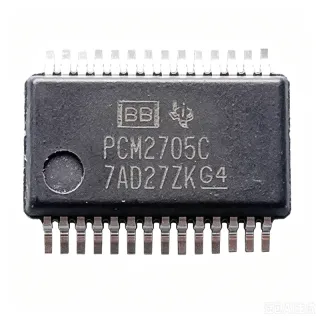
WM8750CJLGEFL/R - 24-Bit Stereo Audio Codec with HP and Speaker | Cirrus Logic
MPN: WM8750CJLGEFL/R ✓ فعالWM8750CJLGEFL/R جائزہ
An audio codec is a mixed-signal integrated circuit that converts between analog audio and digital audio streams. In the signal chain it sits between analog sources (microphones, line inputs) and a digital audio bus (I2S or left-justified). The WM8750JL family therefore belongs to the hierarchy audio codec -> mixed-signal IC -> interface IC -> integrated circuit, and it removes the need for separate ADC, DAC, headphone amplifier and speaker driver chips in a handset or portable media device.
Key features include 24-bit resolution on both the ADC and DAC sides, support for stereo or mono microphone connections, integrated headphone and speaker output stages, and master-clock flexibility covering USB rates of 12 MHz or 24 MHz as well as standard audio-clock rates of 12.288 MHz and 24.576 MHz. Sample rates of 96 kHz, 48 kHz and 44.1 kHz are generated directly from the master clock with no external PLL, which reduces board area and cost in USB-connected portable products.
Technically, the WM8750JL accepts a system master clock and derives the required internal timing for its converters, so the host controller needs only to route an audio stream and a clock. The codec provides complete interfaces to stereo or mono microphones and to a stereo headphone, plus a speaker path, all from a single 3.3 V-class digital core and an analog supply, allowing mixed-signal partitioning on the PCB. The 32-QFN (5x5 mm) footprint keeps the land pattern compact enough for the tightest portable layouts.
Typical applications include portable digital audio players, Bluetooth and wireless headsets with voice recording, USB audio dongles and interfaces, smartphone and tablet accessory docks, digital voice recorders, and docking stations that drive both headphones and small stereo speakers from the same battery budget.
A key design consideration is clock and layout discipline: place the decoupling capacitors and the microphone input network close to the pins, and confirm the master clock source can switch between USB and standard rates without invalidating the derived sample rates. Speaker drive current and thermal headroom also depend on the load impedance chosen for the enclosure.
This page brings together the manufacturer datasheet detail, packaging and supply information, drop-in alternatives in the same 32-QFN footprint, and practical layout guidance that is not reproduced in the original datasheet.
کے لیے ڈراپ اِن متبادل WM8750CJLGEFL/R — یکساں پیکیج، پن سے پن مطابقت پذیر۔ مختلف پیکیج والے پرزے جن کے لیے PCB دوبارہ کام درکار ہو، شامل نہیں ہیں۔
اس سیریز میں مختلف ورژن
اسی سیریز کے ماڈلز جو ڈراپ اِن مطابقت رکھتے ہیں WM8750CJLGEFL/R (یکساں فارم فیکٹر اور فٹ پرنٹ) — میں مختلف Package, ADC Resolution, DAC Resolution, Product Type, ADC Channels.
WM8750CLSEFL/R
✅ ڈراپ-اِن ⚠️ تفصیلات غیر تصدیق شدہقیمت کے لیے رابطہ کریں
ڈیٹا شیٹ دیکھیں →WM8731CLSEFL/R
✅ ڈراپ-اِن ⚠️ تفصیلات غیر تصدیق شدہقیمت کے لیے رابطہ کریں
ڈیٹا شیٹ دیکھیں →WM8903CLGEFK/R
✅ ڈراپ-اِن ⚠️ تفصیلات غیر تصدیق شدہقیمت کے لیے رابطہ کریں
ڈیٹا شیٹ دیکھیں →WM8754LSEFL/R
✅ ڈراپ-اِن ⚠️ تفصیلات غیر تصدیق شدہ📋 حوالہ جاتی متبادل (کیٹلاگ میں نہیں)
WM8752CLSEFL/R
✅ ڈراپ-اِن ⚠️ تفصیلات غیر تصدیق شدہ📋 حوالہ جاتی متبادل (کیٹلاگ میں نہیں)
WM8750CJLGEFL/R زیادہ سے زیادہ ریٹنگز اور برقی خصوصیات
| Device Type | Stereo audio codec (ADC + DAC) with headphone and speaker output |
| Manufacturer | Cirrus Logic (Wolfson Microelectronics) |
| ADC Resolution | 24 bit |
| DAC Resolution | 24 bit |
| Number of ADC Channels | 2 (stereo or mono microphone inputs) |
| Number of DAC Channels | 2 |
| پیکیج | 32-QFN (5x5 mm), surface mount |
| ماؤنٹنگ ٹائپ | Surface mount |
| Packaging | Tape and reel, /R suffix |
| USB Master Clock Frequencies | 12 MHz or 24 MHz |
| Standard Master Clock Frequencies | 12.288 MHz or 24.576 MHz |
| Supported Audio Sample Rates | 96 kHz, 48 kHz, 44.1 kHz |
| External PLL Required | No - sample rates generated directly from master clock |
| Microphone Inputs | Stereo or mono microphone interfaces |
| Headphone Output | Stereo headphone output |
| Speaker Output | Stereo speaker drive integrated |
WM8750CJLGEFL/R 32-qfn (5x5 mm), surface mount پن کنفیگریشن گائیڈ
WM8750CJLGEFL/R (32-qfn (5x5 mm), surface mount پیکیج) کے لیے پن کنفیگریشن۔ اس ڈیجیٹل IC میں GPIO، کمیونیکیشن انٹرفیس (UART، SPI، I2C) اور پاور پنز شامل ہیں۔ متبادل پن فنکشنز اور کنفیگریشن آپشنز کے لیے مینوفیکچرر کے ڈیٹا شیٹ سے رجوع کریں۔ ایمبیڈڈ سسٹم ڈیزائن اور PCB لے آؤٹ کے لیے ضروری۔

کے لیے تفصیلی پن آؤٹ ڈیٹا دستیاب نہیں WM8750CJLGEFL/R.
رجوع کریں ڈیٹا شیٹ مکمل پن کنفیگریشن کے لیے۔
عام استعمالات
WM8750CJLGEFL/R کے لیے موزوں ہے 6 ایپلیکیشنs: Portable Digital Audio Player, Bluetooth and Wireless Headset with Voice Recording, USB Audio Interface and Dongle, Smartphone and Tablet Accessory Dock, Digital Voice Recorder and Dictation Device, Portable Speaker and Headphone Docking Station.
Portable Digital Audio Player
The WM8750CJLGEFL/R suits a portable digital audio player because a single 32-QFN (5x5 mm) device provides the complete analog front end and back end: stereo or mono microphone capture through 24-bit ADCs, playback through 24-bit DACs, a stereo headphone drive and an integrated stereo speaker path. The host controller only needs to feed the digital audio stream and a master clock of 12.288 MHz or 24.576 MHz, from which 96 kHz, 48 kHz and 44.1 kHz rates are derived directly without an external PLL. That removes a clock-generation circuit and shrinks the analog board area, which matters in a pocket-sized enclosure with limited battery budget. The integrated speaker drive also avoids the need for a discrete headphone and speaker amplifier pair when the enclosure uses low-impedance drivers.
تجویز کردہ
Bluetooth and Wireless Headset with Voice Recording
For a Bluetooth or wireless headset that must also record voice, the WM8750CJLGEFL/R places capture and playback in one compact package. The integrated microphone interface accepts a stereo or mono analog source, and the 24-bit ADC channels preserve wide dynamic range for speech capture, while the 24-bit DAC channels feed the same device that drives the earphone. Because the codec can run as master or slave, it fits alongside a wireless audio SoC without an additional clock converter. The stereo headphone output removes the need for a separate headphone amplifier, while the integrated speaker path covers the speakerphone function in the same 32-QFN (5x5 mm) footprint, keeping the acoustic PCB area and BOM count low for a battery-powered wearable.
تجویز کردہ
USB Audio Interface and Dongle
The WM8750CJLGEFL/R maps directly onto a USB audio interface because it accepts the 12 MHz and 24 MHz master clocks typical of USB audio controllers and derives 96 kHz, 48 kHz and 44.1 kHz sample rates from that clock with no external PLL. The 24-bit ADC channels serve as the capture path for a microphone or line input, and the 24-bit DAC channels drive the stereo headphone output used for monitoring, so a compact dongle can be built around a single mixed-signal IC plus a USB controller. The integrated stereo speaker drive also supports monitor speakers on designs that use the same board for playback and monitoring. Keeping the master clock routing short and the analog input network close to the pins preserves low noise for high-resolution capture.
تجویز کردہ
Smartphone and Tablet Accessory Dock
A smartphone or tablet docking cradle that plays music, charges the device and drives external speakers is a natural fit for the WM8750CJLGEFL/R. The codec accepts the digital audio stream from the host, converts playback through its 24-bit DAC channels and drives the cradle speakers through the integrated stereo speaker path, while the stereo headphone output serves a private-listening mode from the same die. Because the master clock arrives from the host system at a standard rate such as 12.288 MHz or 24.576 MHz, no local PLL or sample-rate converter is needed, which keeps the dock board small enough to sit behind a display or inside a stand. The single-package approach also reduces the number of analog rails that must be sequenced during dock wake-up.
تجویز کردہ
Digital Voice Recorder and Dictation Device
The WM8750CJLGEFL/R addresses digital voice recorders that need high-quality mono capture with a headphone output for monitoring. Its microphone interface supports both stereo and mono sources, so a single electret or MEMS microphone with its bias network connects directly to the 24-bit ADC channels, avoiding the extra converter a mono-only design would otherwise need. The 24-bit DAC channels and integrated stereo headphone stage let the operator monitor the take with the same chip, and the integrated speaker drive can drive a small monitor speaker on the housing. Because standard master clock rates of 12.288 MHz and 24.576 MHz are supported, the recorder can run at 96 kHz, 48 kHz or 44.1 kHz from a single clock source without an external PLL.
تجویز کردہ
Portable Speaker and Headphone Docking Station
In a docking station that must serve both headphones and a pair of small stereo speakers, the WM8750CJLGEFL/R consolidates the analog output stages that would otherwise occupy two amplifier chips. The 24-bit DAC channels feed the internal mixer, the integrated stereo headphone output drives the headphone socket, and the integrated stereo speaker drive handles the dock speakers, all from one 32-QFN (5x5 mm) package. That consolidation is especially valuable where the enclosure volume limits thermal spreading, because fewer analog stages means less board area and fewer rails to bring up in sequence. Because no external PLL is needed when a 12 MHz or 24 MHz USB-derived clock is available, the dock can be enumerated as a USB audio device with a single clock source.
تجویز کردہ
تجویز کردہ پروڈکٹس کا خلاصہ
کے لیے انجینئرنگ ریفرنس ڈیٹا WM8750CJLGEFL/R — موازنہ، ڈیزائن رہنمائی، اور تعمیل کی معلومات۔
انتخاب کی گائیڈ
متبادلات کے ساتھ موازنہ
| پیرامیٹر | یہ پروڈکٹ | WM8750CLSEFL/R | WM8731CLSEFL/R | WM8903CLGEFK/R | WM8754LSEFL/R | WM8752CLSEFL/R |
|---|---|---|---|---|---|---|
| Package | 32-QFN (5x5 mm) | 32-QFN (5x5 mm) | 32-QFN (5x5 mm) | 32-QFN (5x5 mm) | 32-QFN (5x5 mm) | 32-QFN (5x5 mm) |
| Brand | Cirrus Logic | Cirrus Logic | Cirrus Logic | Cirrus Logic | Cirrus Logic | Cirrus Logic |
| Device Type | Stereo audio codec with headphone and speaker output | Stereo audio codec | Stereo audio codec | Stereo audio codec | Stereo audio codec | Stereo audio codec |
اہم امتیازی خصوصیات
- Headphone and stereo speaker drive integrated in one codec (بمقابلہWM8752CLSEFL/R)
- No external PLL required for USB and standard sample rates (بمقابلہWM8731CLSEFL/R)
- Single-package analog front end and back end (بمقابلہWM8903CLGEFK/R)
- USB-rate clocking built in for portable host devices (بمقابلہWM8754LSEFL/R)
ڈیزائن نوٹس
Place the decoupling capacitors directly against the analog and digital supply pins of the 32-QFN (5x5 mm) package, with the shortest possible return path to the ground pins and the exposed pad. The QFN footprint has a land pattern only a few millimetres across, so a capacitor placed one millimetre further away shares the return path with digital switching currents and adds inductance to the supply loop. Reserve a continuous ground plane region beneath the device, bond the exposed pad to that plane with a full array of vias, and keep the microphone input traces short, guarded by a grounded trace on the adjacent side to reject switching noise picked up from the digital section.
Route the system master clock and the digital audio interface as short, matched-length, impedance-controlled traces with a continuous reference plane beneath them. The WM8750JL derives 96 kHz, 48 kHz and 44.1 kHz directly from the master clock, so any edge degradation or jitter on the clock line appears directly as sample-rate jitter and audible artefacts in playback and capture. Keep the clock source away from the speaker output nets, avoid routing it beneath the analog input section, and provide a solid ground reference under the whole digital audio path so the clock and data lines see a low-impedance return.
Estimated: with the codec running from a 3.3 V-class digital rail and a 2.5 V to 3.3 V analog rail, and delivering a headphone or speaker load at, for example, 20 mA, the estimated dissipation from the headphone drive stage alone is roughly 20 mA multiplied by the difference between the analog rail and the output swing, which is on the order of 40 mW to 60 mW for a 2 V to 3 V swing. Estimated: the speaker driver contributes more, since a 1 W output into 4 ohms draws about 250 mA, giving on the order of 0.6 W to 0.8 W dissipation at 2.5 V to 3 V supply. Confirm the actual rail voltages, load impedance and output power from the manufacturer datasheet before sizing the copper area under the exposed pad.
Do not assume a drop-in alternative is electrically identical even when the footprint matches. The WM8750JL family members share the 32-QFN (5x5 mm) land pattern but differ in microphone biasing requirements, output mixing, and the pins assigned to the headphone and speaker stages, so a swapped part can leave an output floating or drive an unintended network. Use the pin description table in the manufacturer datasheet to build the footprint, and re-check the register map for mixer and volume settings, because those differ between variants in the same package.
Keep the speaker output loop as short as possible, since the speaker driver is the highest-current switching node on the board. Route the speaker return directly to the device ground pins and the exposed pad rather than through a shared thin trace, and keep the microphone bias and input network away from that path. In a portable enclosure, the speaker drive also radiates magnetic and electric field noise; orienting the microphone input away from the speaker axis and using a grounded guard region around the input pins reduces the risk of acoustic feedback loops turning into audible howl.
تعمیل کی معلومات
No compliance statements are published on the manufacturer product page for this part, so RoHS, REACH, lead-free, halogen-free and conflict-minerals status are recorded as unknown. Confirm the declarations on the manufacturer product page or the project-specific material declaration before release to production.