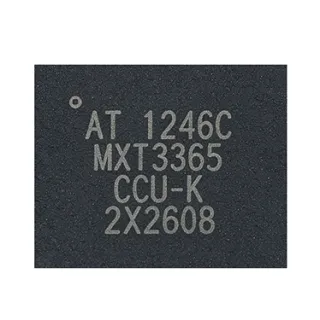
What is the ATMXT336S-CCUR, and is it currently available?
The ATMXT336S-CCUR is a Microchip Technology maXTouch capacitive touchscreen controller with 336 projected-capacitive, mutual-capacitance sensing nodes. It supports a 2.0 mm passive stylus, communicates with the host processor over I2C, and integrates maXFusion technology for combining accelerometer, gyroscope, and magnetometer inputs. The controller is packaged as a 64-pin TQFN surface-mount device with tape-and-reel packaging under the CCUR suffix. XAIPART lists the part as active, with 99,999 units in stock and an MOQ of one. Its verified pricing tiers show $0 as of 2026-11-01, while commercial terms remain subject to an RFQ. Read the ATMXT336S-CCUR datasheet before committing a board layout or configuration image.
| Verified selection data | ATMXT336S-CCUR |
|---|---|
| Manufacturer | Microchip Technology |
| Product family | maXTouch (mXT336S) |
| Function | Capacitive touchscreen controller |
| Touch sensing nodes | 336 |
| Touch technology | Projected capacitive (mutual capacitance) |
| Stylus support | 2.0 mm passive stylus |
| Sensor hub | maXFusion technology with accelerometer, gyroscope, and magnetometer fusion |
| Host interface | I2C |
| Package | 64-pin TQFN, surface mount |
| Packaging variant | CCUR, tape and reel |
| Lifecycle status | Active |
| XAIPART stock and MOQ | 99,999 units; MOQ of 1 |
| Verified pricing tiers | $0 at quantities of 1, 10, 100, 500, and 1,000 as of 2026-11-01; RFQ commercial terms apply |
Takeaway: The ATMXT336S-CCUR fits a high-node-count mobile HMI that also requires passive-stylus input and onboard motion-sensor fusion. Confirm the sensor configuration, electrical limits, and package details against the manufacturer documentation before release.
How do you select and design in the ATMXT336S-CCUR?
Start with the sensor stack rather than the controller alone. Touch performance depends on how the electrode pattern, display construction, controller configuration image, and host firmware work together. The ATMXT336S-CCUR provides 336 sensing nodes and is positioned for dense smartphone and tablet arrays, but the node count alone does not determine final touch accuracy. Validate the selected pattern with the manufacturer's configuration and test process before committing production quantities.
| Design requirement | Verified feature or constraint | Engineering action |
|---|---|---|
| Large or fine-pitch touch array | 336 projected-capacitive sensing nodes | Map the required electrode connections and compare them with the official package documentation. |
| Handwriting or fine-line entry | Support for a 2.0 mm passive stylus | Validate stylus behavior on the final sensor stack and intended host software. |
| Host connectivity | I2C serial interface | Review host bus addressing, speed, pull-ups, and interrupt behavior in the current datasheet. |
| Motion-aware mobile HMI | maXFusion processing of external accelerometer, gyroscope, and magnetometer inputs | Define the external sensor interface and confirm the supported fusion configuration with Microchip. |
| Compact surface-mount assembly | 64-pin TQFN package and tape-and-reel packaging | Use the manufacturer package outline and land pattern rather than a generic TQFN drawing. |
| Production implementation | Configuration file must match the sensor stack | Lock the controller configuration, sensor artwork revision, and firmware release as one controlled set. |
Select the sensor architecture
The controller is intended to sit electrically and logically between the projected-capacitive sensor stack and the application processor. It scans the touch electrodes and reports touch information to the host through I2C. For a premium smartphone, the 336-node architecture addresses dense mutual-capacitance arrays, while the 2.0 mm passive stylus capability supports handwriting and annotation. Tablets can also use the same controller when their larger sensor pattern requires a high node count and stylus-grade input.
Do not assume that any 336-node sensor pattern will work unchanged. The product data specifically identifies firmware or configuration-image matching as a design dependency. Treat the sensor layout, controller configuration, and host firmware revision as a verified configuration set. If the mechanical stack or electrode geometry changes, repeat the relevant validation rather than transferring a previous approval.
Plan the host interface
I2C provides the host connection for touch data and control. The host must support the controller's addressing and operating requirements, while the board must implement the pull-up and interrupt arrangements specified in the current manufacturer documentation. Pull-up sizing and maximum bus rate are not included in the verified product data, so engineers should obtain those values directly from the datasheet instead of applying values from another maXTouch design.
The I2C bus may also carry motion-related data after maXFusion processing. Plan firmware ownership carefully so that touch reports, sensor-fusion outputs, interrupt handling, and configuration updates remain deterministic. The controller's ability to combine touch and motion processing does not remove the need to validate host timing and bus loading in the finished product.
Integrate the motion-sensor inputs
maXFusion fuses external accelerometer, gyroscope, and magnetometer inputs and processes location, orientation, direction, and inclination information. This allows the controller to function as both a touch controller and a motion sensor hub. The verified applications include gaming, navigation, and virtual reality, where combining touch and motion input can reduce application-processor processing demands.
Use the maXFusion support material to determine which external sensors and firmware configuration are approved. The provided database identifies the supported sensor categories but does not provide a universal external-sensor bill of materials. Select sensors that satisfy the documented interface and configuration requirements, then verify the complete motion pipeline in the target enclosure.
Design the PCB and assembly
The ATMXT336S-CCUR uses a 64-pin TQFN surface-mount package, and the CCUR suffix identifies tape-and-reel production handling. Use the official package outline, pin description, and recommended land pattern. The verified data does not include a pin-number-to-electrode table, so do not infer individual electrode assignments from generic maXTouch layouts. Download the current manufacturer documentation and map every sensor, power, ground, I2C, and control connection against that source.
Plan assembly around the device's fine-pitch package and the surrounding sensor-routing requirements. Keep the sensor configuration under change control, and request date-code and authenticity information before accepting a production shipment. The XAIPART ATMXT336S-CCUR product page provides the central sourcing reference for the verified stock, MOQ, lifecycle, and RFQ data.
Plan validation and production sourcing
A design release should include at least four controlled outcomes: touch and stylus behavior on the intended stack, motion-fusion behavior with the selected external sensors, host communication through I2C, and stable behavior across production sensor and firmware revisions. Because touch controllers depend on the sensor-pattern and configuration pairing, preserve traceability across the controller MPN, configuration image, sensor drawing, firmware, and host software.
For procurement, record the quantity, requested delivery schedule, date-code requirement, and traceability requirement in the RFQ. The verified price fields show $0 for each listed tier as of 2026-11-01, but the product description identifies pricing as RFQ-based. Buyers should therefore request an enforceable commercial quotation rather than treat the database price field as a delivered-price commitment. MOQ is one unit, although production builds may require different date-code and lot-handling terms.
Takeaway: Design the controller, sensor artwork, configuration image, firmware, external motion sensors, and host software as one qualified system. Obtain the current Microchip package and electrical documentation before layout, and secure a written RFQ before relying on the listed $0 pricing tiers as of 2026-11-01.
What alternatives are available, and which one does Microchip recommend?
Microchip identifies the ATMXT336U as the recommended alternative touch controller for the mXT336S product page. Two additional mXT336S configuration variants, ATMXT336S-CCUR020 and ATMXT336S-CCUR034, use the same die and package but carry different factory configuration images. These are sourcing and configuration candidates, not automatically approved drop-in replacements. Package, pinout, electrical limits, and configuration compatibility must be checked for the specific PCB and sensor stack.
| Parameter | ATMXT336S-CCUR | ATMXT336U | ATMXT336S-CCUR020 | ATMXT336S-CCUR034 |
|---|---|---|---|---|
| Verified Microchip relationship | Primary part described | Microchip-recommended alternative touch controller | mXT336S configuration alternative | mXT336S configuration alternative |
| Node architecture | 336-node maXTouch architecture | Same 336-node maXTouch architecture | Same die as the primary part | Same die as the primary part |
| Package relationship | 64-pin TQFN, tape and reel | Package and pinout must be verified against the datasheet | Same die and package as the primary part | Same die and package as the primary part |
| Factory configuration | CCUR configuration | Compare the applicable configuration requirements | 020 configuration image | 034 configuration image |
| Drop-in status | Reference device | Recommended alternative, not a blanket pin-to-pin approval | Configuration-dependent candidate | Configuration-dependent candidate |
| Primary substitution risk | None relative to the qualified baseline | Package, pinout, and configuration differences require validation | The factory configuration image may not match the installed sensor stack | The factory configuration image may not match the installed sensor stack |
For an existing ATMXT336S-CCUR board, engineers with a known configuration image should first examine ATMXT336S-CCUR020 or ATMXT336S-CCUR034 because the verified data states that they share the die and package. That package identity does not remove the need to confirm configuration-image compatibility. For a new design, evaluate the ATMXT336U alongside the continued active status of ATMXT336S-CCUR and select the part that best matches the approved mechanical, electrical, and firmware requirements.
Do not label any candidate a guaranteed drop-in replacement until the sensor configuration, I2C behavior, package drawing, pin assignments, and system test results have been checked. Browse the XAIPART component catalog for sourcing options, and use the XAIPART electronics engineering blog for related design and component-selection guidance.
Takeaway: ATMXT336U is the only alternative explicitly recommended by Microchip in the verified data, while the 020 and 034 variants are configuration-focused alternatives. Validate every substitution against the exact PCB and sensor stack before calling it a drop-in replacement.
What does the lifecycle and supply position mean for buyers?
The ATMXT336S-CCUR has an active lifecycle status in the XAIPART database. That status supports continued design consideration, but it does not guarantee a fixed production allocation, identical lead times across channels, or a future price level. Buyers should ask the supplier to confirm lifecycle status, date codes, and manufacturing traceability at the time of quotation.
| Supply indicator | Verified status | Buyer action |
|---|---|---|
| Lifecycle | Active | Confirm current status with Microchip or the supplying channel before a long-term production commitment. |
| XAIPART inventory | 99,999 units | Request allocation against the required delivery date rather than relying on the displayed inventory alone. |
| Minimum order quantity | 1 unit | Use an RFQ for the actual production quantity, date code, and delivery schedule. |
| Verified price tiers | $0 at 1, 10, 100, 500, and 1,000 units as of 2026-11-01 | Obtain a written commercial quotation because the product description identifies RFQ-based pricing. |
| Other reported channel inventory | Wolfchip: approximately 47,360 pieces; Octopart Canada: 33,200 pieces | Compare channel inventory only as a sourcing signal and confirm the amount available from the selected supplier. |
Inventory figures vary by channel. The XAIPART database records 99,999 units, while the verified FAQ cites broker-reported figures of approximately 47,360 pieces from Wolfchip and 33,200 pieces from Octopart Canada. These values may reflect different warehouses, update times, or quantities available to a specific customer. They should not be combined into a single availability total.
The active lifecycle status and reported stock support near-term sourcing, while the configuration dependence remains the more important engineering constraint. A distributor may hold units of a controller whose factory configuration does not match a given touch panel. Buyers should include the sensor-stack revision and required configuration in the RFQ so the supplier can quote the correct material.
Takeaway: The part is active and supported by substantial reported inventory, but channel counts and the $0 price tiers as of 2026-11-01 do not replace a configuration-aware, date-coded RFQ. Lock supply for the exact sensor and firmware set.
What should buyers watch for future ATMXT336S-CCUR designs?
The most important trend is not a change in the core value proposition, but the increasing integration of touch and motion processing in mobile HMI designs. The ATMXT336S-CCUR already combines a 336-node projected-capacitive touch engine, 2.0 mm passive-stylus support, maXFusion processing, and an I2C host connection in a 64-pin TQFN package. Buyers evaluating this architecture should focus on how those verified capabilities affect sensor selection, firmware control, and supply-chain configuration.
| What to watch | Verified anchor | Recommended buyer action |
|---|---|---|
| Higher-resolution touch interfaces | 336 touch sensing nodes | Verify node-to-electrode mapping and full-stack performance for each new sensor pattern. |
| Passive stylus adoption | 2.0 mm passive stylus support | Test the intended stylus and user interaction on the final display stack. |
| Touch and motion consolidation | maXFusion combines accelerometer, gyroscope, and magnetometer inputs | Validate external sensor selection, fusion behavior, and host firmware responsibilities. |
| Mobile platform integration | I2C host interface | Review address, bus, pull-up, interrupt, and timing requirements in the current datasheet. |
| Package miniaturization | 64-pin TQFN surface-mount package | Use the exact official land pattern and assembly requirements. |
| Lifecycle continuity | Active lifecycle status | Reconfirm status, date code, traceability, and configuration at each production review. |
For smartphone and tablet programs, buyers should track the relationship among panel development, controller configuration, and firmware releases. Because a changed sensor stack can require a different configuration image, schedule requalification whenever the electrode artwork, display stack, stylus, or motion-sensor set changes. The 336-node count and 2.0 mm stylus figure are useful selection filters, but they do not replace application-level validation.
For gaming, navigation, and virtual reality systems, watch the division of work between the ATMXT336S-CCUR's maXFusion function and the application processor. The verified data identifies real-time fusion of location, orientation, direction, and inclination information, which supports more integrated mobile architectures. Firmware must still manage the interaction between touch, motion, interrupts, and host commands correctly.
Supply-chain planning should also account for the active status and the difference between generic inventory and configuration-specific inventory. Request date codes and authenticity verification for production orders. Keep the primary MPN and approved configuration under revision control so that a 020, 034, or ATMXT336U substitution is an explicit engineering decision rather than an undocumented purchasing change.
Takeaway: Future designs should exploit the verified combination of 336-node touch, 2.0 mm stylus input, maXFusion, I2C, and an active lifecycle while controlling the two main risks: sensor-stack configuration and channel-specific availability. Reverify both before every production release.
Bình luận
Trở thành người đầu tiên bình luận.
🔐 Vui lòng đăng nhập để đăng một bình luận.
Bạn không có tài khoản? Đăng ký