IC giao tiếp
Danh mục con
Sản phẩm (3.100+)

SP485RCN-L - 1/10-Unit-Load RS-485 Transceiver | MaxLinear
MaxLinear SP485RCN-L is a 1/10-unit-load RS-485 and RS-422 half-duplex transceiver with high receiver input impedance, a 4.75 V to 5.25 V supply range, and data rates up to 5 Mbps, housed in an 8-pin SOIC package. Its BiCMOS implementation supports low-power operation while preserving robust differential bus performance. An RS-485 transceiver is a physical-layer interface IC that combines a differential line driver and receiver on a balanced two-wire bus. The SP485 family supports RS-485 and RS-422 operation, while the SP485R high-fanout version raises receiver input impedance and can accommodate more than 400 transceivers on one transmission line without materially degrading the driver signal. The SP485RCN-L offers several practical benefits for industrial communication equipment. Its 1/10-unit-load receiver allows many devices to share the same bus without requiring a separate termination for every node. High receiver input impedance reduces loading in multi-drop networks, while the 5 Mbps maximum data rate supports both legacy industrial baud rates and faster point-to-point links. The SP485R architecture is described by the manufacturer as pin-to-pin equivalent to the original SP485 while adding high receiver input impedance and enhanced ESD tolerance. This makes it suitable for designs migrating from a conventional SP485 footprint when fan-out or transient robustness is important. The half-duplex arrangement allows the same differential pair to support transmission and reception, although direction control must be managed by the host logic. Typical applications include industrial PLC and factory automation links, building-control networks, instrumentation buses, motor-control equipment, security systems, and communications equipment that must place multiple transceivers on a single RS-485 segment. The 8-pin narrow SOIC package also supports compact board layouts where a higher-density interface solution would otherwise consume unnecessary area. Designers should use the manufacturer pin-description table when assigning PCB tracks, place the transceiver close to the connector, and apply suitable protection to the external bus. Termination, biasing, common-mode range, and isolation requirements must be evaluated together because the transceiver itself does not remove the need for correct bus topology and surge protection. This product data combines the SP485 family architecture, package information, manufacturer guidance, and drop-in comparison guidance to support faster schematic review, PCB-footprint validation, and sourcing decisions for industrial RS-485 and RS-422 interfaces.
SP485RCN-L/TR - 5Mbps RS-485 Transceiver | MaxLinear
MaxLinear SP485RCN-L/TR is a 5 Mbps half-duplex RS-485 and RS-422 interface transceiver with one transmitter and one receiver, a 4.75 V to 5.25 V supply range, and an 8-pin SOIC package. Its 1/10-unit-load receiver supports more than 400 transceivers on one transmission line, while the high-impedance receiver input helps preserve the driver signal in multi-node networks. An RS-485 transceiver is a bidirectional communications interface that combines a differential line driver and differential receiver on a single integrated circuit. RS-485 defines a physical layer for robust, multipoint, balanced digital data links, while RS-422 provides a related differential signaling system. These transceivers operate within the interface IC and data-communications hierarchy, converting between logic-level signals and balanced differential signals used by industrial, building, and telecommunications equipment. The SP485RCN-L/TR combines a 5 V BiCMOS implementation with operation at rates up to 5 Mbps. Key electrical features include a typical receiver input resistance of 150 kohm and support for more than 400 units on a single line. The device is intended for half-duplex communication, uses an 8-pin narrow SOIC package, and is supplied in tape-and-reel packaging. Its operating temperature range is 0 °C to 70 °C. The BiCMOS architecture combines bipolar and CMOS characteristics to provide low-power operation without sacrificing line-driver performance. Separate receiver and driver control inputs permit the design to select receive, transmit, or disabled operating states. This flexibility is useful when direction control is handled by a microcontroller, transceiver logic, or an automatic control circuit. The high receiver impedance is particularly valuable in large RS-485 networks where loading from many connected receivers could otherwise reduce bus signal amplitude. Typical uses include industrial RS-485 controllers, building-automation equipment, instrumentation links, motor-control systems, and communications between a host controller and distributed remote nodes. The 5 Mbps capability supports relatively fast short-distance balanced links, while the 1/10-unit-load receiver allows numerous devices to share a bus when cable length, topology, termination, and transceiver loading permit. Design the bus with correct differential routing, a termination strategy suited to the network topology, and protection appropriate for the installation environment. Keep the driver, receiver, and bypass-capacitor connections compact, and account for common-mode voltage and ground potential differences between remotely connected nodes. The MAX485ESA cross-reference page identifies direct drop-in options and notes that minor parametric differences may exist, so verify every replacement against the required data rate, unit load, and bus topology. This product page combines manufacturer-level interface characteristics, package and environmental information, drop-in replacement guidance, and practical network-design considerations. It helps engineers evaluate the SP485RCN-L/TR beyond basic catalog attributes and select a compatible replacement without changing the 8-pin PCB footprint.

SP485RCP-L - 1 Mbps RS-485 Transceiver | MaxLinear
The MaxLinear SP485RCP-L is a half-duplex RS-422/RS-485 interface transceiver with one driver and one receiver, a maximum data rate of 1 Mbps, and an 8-pin PDIP package. The device operates from a nominal 5.25 V supply and is specified for the 0°C to 70°C commercial temperature range, making it suitable for conventional industrial and legacy communications equipment. An RS-485 transceiver is a physical-layer interface IC that combines a differential line driver with a differential receiver. It belongs to the hierarchy of transceiver, interface IC, communications semiconductor, and semiconductor. RS-485 signaling supports robust point-to-multipoint data links over longer cable runs than single-ended logic interfaces, while RS-422 compatibility allows the same device to participate in compatible differential receiver networks. The SP485RCP-L provides a 1/1 driver-to-receiver configuration, allowing one transceiver to support bidirectional communication when the bus direction is controlled externally. Its 1 Mbps maximum signaling rate supports substantially faster communication than low-speed RS-485 devices. The commercial 0°C to 70°C temperature rating defines its intended operating environment, while the through-hole PDIP-8 package supports conventional PCB assembly and field-serviceable equipment. The transceiver separates the physical-layer data path from the digital logic interface used by a host controller. Direction control must be managed so that the driver and receiver do not contend on the bus. For half-duplex networks, the system commonly uses a receiver-enable or driver-enable signal to change the operating direction around a transmission request. Proper termination and biasing remain essential for dependable behavior on multidrop buses. Typical applications include industrial control links, instrument interfaces, point-of-sale equipment, building automation controllers, and factory data networks. The part is especially relevant when an existing board uses an 8-pin PDIP footprint and requires a direct RS-485/RS-422 interface upgrade without changing the mechanical layout. Its maximum data rate also suits moderate-speed supervisory and control channels rather than only slow telemetry links. Designers should verify logic thresholds, driver enable polarity, receiver fail-safe behavior, isolation needs, and bus-topology requirements before releasing a replacement design. A DIP package simplifies through-hole assembly, but it is larger than surface-mount alternatives. In long cables or noisy industrial environments, add appropriate transient protection, controlled grounding, and tested termination rather than relying on the transceiver alone for surge immunity. This page combines package, interface, temperature, and data-rate details with pin-compatible replacement guidance and practical PCB considerations. It is intended to help engineers determine whether SP485RCP-L fits an existing RS-485 design and to identify the checks required before approving a substitution.
SP485REN-L - 5Mbps RS-485 Transceiver | MaxLinear | SOIC-8
The MaxLinear SP485REN-L is a half-duplex RS-485 and RS-422 transceiver rated for data rates up to 5 Mbps and supplied in an 8-pin SOIC package. Its 1/10-unit-load receiver input enables more than 400 transceivers on one transmission line, while its 4.75 V to 5.25 V supply range supports conventional 5 V industrial communication systems. The SP485REN-L also provides high receiver input impedance, helping preserve the integrity of the driver signal when many nodes share a bus. An RS-485 transceiver is an interface IC that combines a differential line driver and differential receiver, allowing reliable bidirectional communication over long, electrically noisy interconnects. The SP485REN-L belongs to the RS-422/RS-485 interface hierarchy within the broader semiconductor and industrial-control markets. Its half-duplex architecture supports a shared differential pair through a direction-control input, making it suitable for multidrop buses, remote monitoring, factory automation, and building-control networks. The principal feature of the SP485REN-L is its low 1/10-unit-load receiver input. According to the manufacturer product information, this impedance permits more than 400 transceivers on a single transmission line without degrading the RS-485 driver signal. The device operates from a 4.75 V to 5.25 V supply, communicates at rates up to 5 Mbps, and supports an industrial temperature range of -40°C to 85°C. Its BiCMOS implementation combines low-power operation with high communication performance. The SP485REN-L uses a half-duplex arrangement in which the driver and receiver share differential bus terminals. A driver-enable control determines whether the device transmits, while a receiver-enable control determines whether the receiver is active. The high receiver impedance is particularly useful when numerous nodes must share one cable because it limits loading of the bus. This characteristic also distinguishes the SP485REN-L from the standard SP485 configuration for designs where node count is a primary constraint. Typical applications include industrial sensor networks, PLC-to-remote-I/O links, building automation equipment, telecommunications infrastructure, instrumentation, and industrial motor-control systems. A half-duplex implementation can connect a controller to distributed sensors over one twisted pair, while the 5 Mbps capability provides useful margin for moderate-speed industrial links and point-to-point backplanes. Designers should account for bus termination, fail-safe biasing, common-mode range, and cable length when integrating the transceiver. Place the transceiver close to the connector and route the differential pair as a balanced pair to minimize noise pickup. The external enable logic must also prevent driver contention, particularly during startup or fault-recovery conditions. This page combines device specifications, package and pin information, application guidance, drop-in alternatives, and practical interface-design considerations. It helps engineers compare bus loading, data rate, package compatibility, and protection requirements before assigning the SP485REN-L to a new RS-485 design.
SP485REN-L/TR - 5V RS-485/RS-422 Transceiver | MaxLinear
The MaxLinear SP485REN-L/TR is a 5 V half-duplex differential bus transceiver supporting RS-485 and RS-422 interfaces in an 8-pin SOIC package. It operates from 4.75 V to 5.25 V, supports data rates up to 5 Mbps, and is specified as a 1/1-unit-load transceiver for industrial-temperature applications. The device combines a push-pull differential driver and differential receiver in one package, allowing a single pair of interface ICs to support bidirectional half-duplex communication. An RS-485 transceiver is an interface IC that converts logic-level digital signals into balanced differential signals for reliable communication over longer, potentially noisy industrial buses. It belongs to the RS-485 and RS-422 transceiver category, within interface ICs and the broader semiconductor hierarchy. The SP485REN-L/TR is intended for systems that need standardized differential signaling, bus arbitration behavior, and a compact surface-mount implementation. Key features include support for both RS-485 and RS-422 operation, a maximum signaling rate of 5 Mbps, operation from a single 4.75 V to 5.25 V supply, and a high-impedance receiver arrangement identified by the REN designation. MaxLinear describes the SP485 and SP483 families as BiCMOS products designed to reduce power consumption without sacrificing performance. The industrial-temperature option and lead-free SOIC-8 package suit compact industrial control, instrumentation, and communications equipment. The REN variant provides higher receiver input impedance than the standard SP485 arrangement. A comparative manufacturer-family listing identifies the SP485REN-L as suitable for connecting more than 400 transceivers on one transmission line without degrading the RS-485 driver signal. This characteristic is useful in large multi-drop installations where many receiver nodes share a common bus, although cable length, topology, termination, and transceiver loading must still be evaluated together. Typical applications include industrial sensor networks, factory automation equipment, building-control interfaces, process instrumentation, and RS-485-to-serial bridges. At high data rates, cable type, connector transitions, grounding, and electromagnetic compatibility become increasingly important. At lower rates, longer cable runs may be practical, subject to the propagation delay and differential resistance limits of the selected cable and network topology. Designers should use the pin-description table and typical application circuit in the manufacturer datasheet when assigning PCB traces. Place the transceiver close to the bus connector, provide a solid ground reference, route the differential pair as a balanced pair, and avoid adding unnecessary stubs. Power-supply decoupling should be placed near the device, while external protection should be selected for the cable length, installation environment, and required surge withstand. This page organizes the confirmed electrical, package, application, and sourcing information for SP485REN-L/TR and adds practical guidance for bus layout, protection, compliance review, and drop-in replacement assessment. It distinguishes documented pin-compatible options from functionally similar devices that may require design verification before substitution.
SP485REP-L - 1/10 Unit Load RS-485 Transceiver | Exar
Exar Corporation SP485REP-L is a half-duplex RS-485/RS-422 transceiver with a 1/10 unit-load receiver input, a 4.75 V to 5.25 V supply, and an 8-pin plastic DIP package. It supports more than 400 transceivers on one transmission line and provides a typical receiver input impedance of 150 kOhm. Its 60 ns propagation delay and operating-temperature range from -40 C to +85 C make it suitable for industrial multipoint data links. An RS-485 transceiver is an interface IC that combines a differential line driver and differential receiver, allowing equipment to communicate reliably over noisy, long cable runs. The half-duplex arrangement means the driver and receiver share the same differential pair, with direction controlled by the design. As a universal bus transceiver, the SP485REP-L belongs to the interface IC hierarchy: bus transceiver, line transceiver, physical-layer interface, and communication semiconductor. The principal feature is its 1/10 unit-load receiver input. A lower unit load reduces the loading placed on a shared bus, while the specified typical input resistance of 150 kOhm helps preserve driver signal integrity. The result is support for more than 400 transceivers on a single transmission line. Half-duplex operation also reduces wiring complexity by sharing one bus pair rather than requiring separate transmit and receive pairs. The device operates from a regulated 4.75 V to 5.25 V supply and includes a propagation delay of 60 ns, according to the published SP485REP-L specifications. Its 8-pin plastic DIP package is intended for through-hole assembly and prototyping rather than compact automated surface-mount production. The -40 C to +85 C operating range provides useful environmental headroom for industrial control, instrumentation, and communications equipment. Typical uses include RS-485 field buses, industrial sensor networks, building automation equipment, remote monitoring stations, and data-acquisition systems. The high receiver impedance is particularly useful when many nodes share the same two-wire bus. Compared with a 1/8 or 1/4 unit-load transceiver, the 1/10 unit-load rating provides lower bus loading, while the trade-off is that the exact replacement must still match supply voltage, driver and receiver ratings, enable logic, and DIP pin mapping. Designers should verify the manufacturer's pinout and termination requirements before layout, and should use a proper RS-485 line network with controlled stub lengths. The DIP footprint requires through-hole clearances and adequate lead-bend spacing. Because the verified data does not include detailed absolute-maximum ratings, driver output levels, or full timing tables, those values should be obtained from the manufacturer datasheet before final release. This page consolidates the verified 1/10 unit-load, impedance, voltage, delay, temperature, package, pricing-directory, and replacement information with application guidance and package-conscious comparisons. It distinguishes confirmed facts from parameters that still require datasheet confirmation, helping engineers shortlist the SP485REP-L without overlooking PCB or bus-compatibility constraints.
SP490CN-L - 5Mbps RS-485/RS-422 Transceiver | MaxLinear
The MaxLinear SP490CN-L is a low-power BiCMOS differential line transceiver with one driver and one receiver, supporting RS-485 and RS-422 operation up to 5 Mbps in an 8-pin SOIC package. Its key electrical features include ±200 mV receiver input sensitivity, a wide receiver common-mode range, and 5 V supply operation. The SP490 is designed for industrial data links where low-power differential signaling and reliable noise immunity are important. An RS-485/RS-422 transceiver is an interface IC that combines a differential line driver and differential receiver into one package. The driver converts a logic signal into a balanced differential transmission, while the receiver converts the differential pair back into a logic signal. This interface class belongs to the broader hierarchy of interface ICs, communication transceivers, and semiconductor signal-conditioning devices used in industrial control, instrumentation, and point-to-point data systems. The verified manufacturer material identifies the SP490 as a low-power BiCMOS RS-485/RS-422 transceiver capable of operation to 5 Mbps. The receiver sensitivity is specified as ±200 mV, and the family is available in 8-pin plastic DIP and NSOIC packages. The SP491 is a related family member with additional driver and receiver tri-state enable lines, but it is not an interchangeable substitute for every SP490 design because its control-pin arrangement differs. The SP490CN-L is suitable for industrial communication links, data acquisition equipment, instrumentation, and embedded control systems using differential buses. Its 5 V supply simplifies integration with conventional 5 V logic systems, while the differential interface helps reject common-mode noise on longer cable runs. Designers must still account for termination, biasing, grounding, and protection-network requirements in the complete RS-485 or RS-422 interface. For PCB implementation, place the transceiver close to the connector and route the differential pair as a controlled-impedance pair with minimal stub length. Keep the ground reference continuous under the interface, use appropriate surge protection for exposed cabling, and verify that the receiver remains enabled or disabled as required by the bus architecture. The SP490CN-L datasheet is the authoritative source for electrical limits, pin assignments, and package details.
SP490CN-L/TR - 5Mbps RS-485/RS-422 Transceiver | MaxLinear (Tape & Reel)
The MaxLinear SP490CN-L/TR is a low-power BiCMOS differential line transceiver with one driver and one receiver, supporting RS-485 and RS-422 operation up to 5 Mbps in an 8-pin SOIC package. Its key electrical features include ±200 mV receiver input sensitivity, a wide receiver common-mode range, and 5 V supply operation. The SP490 is designed for industrial data links where low-power differential signaling and reliable noise immunity are important. An RS-485/RS-422 transceiver is an interface IC that combines a differential line driver and differential receiver into one package. The driver converts a logic signal into a balanced differential transmission, while the receiver converts the differential pair back into a logic signal. This interface class belongs to the broader hierarchy of interface ICs, communication transceivers, and semiconductor signal-conditioning devices used in industrial control, instrumentation, and point-to-point data systems. The verified manufacturer material identifies the SP490 as a low-power BiCMOS RS-485/RS-422 transceiver capable of operation to 5 Mbps. The receiver sensitivity is specified as ±200 mV, and the family is available in 8-pin plastic DIP and NSOIC packages. The SP491 is a related family member with additional driver and receiver tri-state enable lines, but it is not an interchangeable substitute for every SP490 design because its control-pin arrangement differs. The SP490CN-L/TR is suitable for industrial communication links, data acquisition equipment, instrumentation, and embedded control systems using differential buses. Its 5 V supply simplifies integration with conventional 5 V logic systems, while the differential interface helps reject common-mode noise on longer cable runs. Designers must still account for termination, biasing, grounding, and protection-network requirements in the complete RS-485 or RS-422 interface. For PCB implementation, place the transceiver close to the connector and route the differential pair as a controlled-impedance pair with minimal stub length. Keep the ground reference continuous under the interface, use appropriate surge protection for exposed cabling, and verify that the receiver remains enabled or disabled as required by the bus architecture. The SP490CN-L/TR datasheet is the authoritative source for electrical limits, pin assignments, and package details.
SP490CS-L - 5Mbps RS-485/RS-422 Transceiver | MaxLinear
The MaxLinear SP490CS-L is a low-power, full-duplex differential line-driver and receiver supporting RS-485 and RS-422 data rates up to 5 Mbps, supplied in an 8-pin plastic DIP package. It provides one transmitter and one receiver, operates from a 5 V supply, and has a typical supply current of 0.9 mA. The SP490 family provides ±200 mV receiver input sensitivity across a wide common-mode range, making it useful for robust industrial links where signal amplitude and ground-referred noise must be handled reliably. An RS-485 transceiver is an interface IC that combines a differential line driver and differential receiver for balanced digital communication. The SP490CS-L sits in the transceiver hierarchy alongside RS-422 interface devices, allowing the same physical network device to support both standards while providing noise rejection and differential signaling. Its full-duplex arrangement supports separate transmit and receive paths, and the manufacturer documentation identifies compatibility with commonly referenced LTC490 and SN75179-family interfaces. The main verified features are a 5 Mbps maximum data rate, 5 V supply operation, one-transmitter/one-receiver configuration, full duplex, ±200 mV receiver sensitivity, and low-power BiCMOS implementation. The source material states that the SP490 is available in 8-pin NSOIC packages, while the exact SP490CS-L distributor listing identifies an 8-pin plastic DIP package. The -L ordering suffix and package construction should therefore be checked against the manufacturer’s ordering information before production release. The device is appropriate for industrial automation, instrumentation, factory equipment, building controls, and other balanced serial links where RS-485 or RS-422 operation is required. In an RS-485 network, the differential outputs reduce sensitivity to common-mode noise compared with single-ended signaling, while the receiver threshold supports detection of relatively small differential voltages. The 5 Mbps capability allows the device to handle higher-speed short-distance links than a low-rate transceiver, although cable length, topology, termination, and transceiver count still determine practical network performance. Designers should preserve the differential pair geometry between the transceiver and connector, provide the required supply decoupling close to the device, and apply termination and biasing appropriate to the selected RS-485 or RS-422 topology. The receiver and driver paths are not the same as the SP491: the SP491 adds driver and receiver tri-state enable lines, whereas the SP490 does not. This distinction is important when replacing a part in a design that relies on bus disable or controlled tri-state behavior. This page consolidates verified manufacturer and distributor information, identifies package and interface details, separates sourced replacement evidence from unsupported assumptions, and highlights the design constraints that matter when selecting a 5 Mbps RS-485/RS-422 transceiver. The listed alternatives are limited to candidates supported by the supplied cross-reference evidence and are not intended to imply unreported electrical equivalence.
SP490ECN-L - 10Mbps Full-Duplex RS-485 | MaxLinear
The MaxLinear SP490ECN-L is a low-power differential line driver and receiver implementing a full-duplex RS-485 and RS-422 interface at speeds up to 10Mbps in an 8-pin SOIC package. The device combines one differential driver and one differential receiver, ±200mV receiver input sensitivity, and a wide common-mode range for robust industrial communications. Its specified supply-voltage range is 4.75V to 5.25V. A differential line transceiver is an interface IC that converts logic-level signals into balanced differential transmissions and reconstructs digital data from differential receiver inputs. In the system hierarchy, it is an interface transceiver within RS-485 and RS-422 interface ICs. The full-duplex arrangement supports simultaneous transmission and reception, making it appropriate for point-to-point links where separate differential pairs are available. The SP490E family's principal features include operation up to 10Mbps, ±200mV receiver sensitivity, and operation from a 4.75V to 5.25V supply. The SP490ECN-L commercial-temperature ordering information identifies a 0°C to 70°C operating range. The 8-pin SOIC package supports conventional surface-mount assembly, while the low-power BiCMOS implementation is intended for low-power communications equipment. The receiver threshold and common-mode capability are central to its industrial usefulness. A ±200mV receiver sensitivity permits small differential signals to be recognized reliably, while the wide common-mode range helps the receiver tolerate voltage offsets between connected systems. The manufacturer datasheet also identifies the SP490 as compatible with the related SP491 family and indicates pin compatibility with the LTC490 for the SP490E family, enabling controlled design comparisons. Typical uses include full-duplex industrial RS-485 links, RS-422 point-to-point communications, factory equipment interfaces, data-acquisition equipment, and instrumentation systems. The 10Mbps capability supports higher-rate factory-bus traffic, while full duplex permits simultaneous bidirectional communication when the system provides both transmit and receive differential pairs. The primary design consideration is to maintain the transceiver's supply and bus requirements exactly as specified in the manufacturer datasheet. Layout should keep the driver and receiver connections associated with their intended differential pairs, provide a low-impedance supply path, and provide the bypassing required by the device data sheet. Bus termination, protection, and grounding must be selected for the cable length and environment rather than inferred solely from the 10Mbps headline rate. This page combines manufacturer specifications, distributor availability, verified cross-reference findings, package details, and engineering-oriented selection guidance. It also distinguishes true pin-compatible choices from related SP490E variants and identifies where additional design verification is still required before substitution.
SP490ECN-L/TR - 10Mbps Full-Duplex RS-485 | MaxLinear (Tape & Reel)
The MaxLinear SP490ECN-L/TR is a low-power differential line driver and receiver implementing a full-duplex RS-485 and RS-422 interface at speeds up to 10Mbps in an 8-pin SOIC package. The device combines one differential driver and one differential receiver, ±200mV receiver input sensitivity, and a wide common-mode range for robust industrial communications. Its specified supply-voltage range is 4.75V to 5.25V. A differential line transceiver is an interface IC that converts logic-level signals into balanced differential transmissions and reconstructs digital data from differential receiver inputs. In the system hierarchy, it is an interface transceiver within RS-485 and RS-422 interface ICs. The full-duplex arrangement supports simultaneous transmission and reception, making it appropriate for point-to-point links where separate differential pairs are available. The SP490E family's principal features include operation up to 10Mbps, ±200mV receiver sensitivity, and operation from a 4.75V to 5.25V supply. The SP490ECN-L/TR commercial-temperature ordering information identifies a 0°C to 70°C operating range. The 8-pin SOIC package supports conventional surface-mount assembly, while the low-power BiCMOS implementation is intended for low-power communications equipment. The receiver threshold and common-mode capability are central to its industrial usefulness. A ±200mV receiver sensitivity permits small differential signals to be recognized reliably, while the wide common-mode range helps the receiver tolerate voltage offsets between connected systems. The manufacturer datasheet also identifies the SP490 as compatible with the related SP491 family and indicates pin compatibility with the LTC490 for the SP490E family, enabling controlled design comparisons. Typical uses include full-duplex industrial RS-485 links, RS-422 point-to-point communications, factory equipment interfaces, data-acquisition equipment, and instrumentation systems. The 10Mbps capability supports higher-rate factory-bus traffic, while full duplex permits simultaneous bidirectional communication when the system provides both transmit and receive differential pairs. The primary design consideration is to maintain the transceiver's supply and bus requirements exactly as specified in the manufacturer datasheet. Layout should keep the driver and receiver connections associated with their intended differential pairs, provide a low-impedance supply path, and provide the bypassing required by the device data sheet. Bus termination, protection, and grounding must be selected for the cable length and environment rather than inferred solely from the 10Mbps headline rate. This page combines manufacturer specifications, distributor availability, verified cross-reference findings, package details, and engineering-oriented selection guidance. It also distinguishes true pin-compatible choices from related SP490E variants and identifies where additional design verification is still required before substitution.
SP490ECN/TR - 5Mbps RS-485/RS-422 Transceiver | MaxLinear
The MaxLinear SP490ECN/TR is a 5 Mbps RS-485/RS-422 differential line transceiver with one driver and one receiver, operating from a single 5 V supply in an 8-pin SOIC package. The device combines a differential bus driver and differential receiver with ±200 mV receiver input sensitivity and supports balanced differential signaling over extended cable distances. Its BiCMOS implementation provides low power consumption for industrial communications equipment. An RS-485/RS-422 interface transceiver is a semiconductor product category used to convert logic-level signals into balanced differential transmissions and to recover differential signals from noisy buses. Within the broader hierarchy, the SP490ECN/TR is an interface transceiver, a bus-line transceiver, and a communications interface IC designed for industrial data links. Balanced signaling improves noise immunity by representing each signal as a difference between two conductors rather than as a single-ended voltage. The SP490ECN/TR supports data rates up to 5 Mbps while maintaining the operating characteristics required by RS-422 and RS-485 networks. Its single 5 V supply simplifies interface design, and the ±200 mV receiver sensitivity permits operation with attenuated or electrically noisy differential signals. The one-driver, one-receiver arrangement supports full-duplex point-to-point RS-422 links and multidrop RS-485 applications. The manufacturer datasheet also identifies compatibility with LTC490 and SN75179 devices. The transceiver combines a low-power BiCMOS driver and receiver with differential bus connections. Its receiver converts the difference between the positive and negative bus inputs into a single-ended logic output, while the driver converts a differential logic input into a complementary bus output. The wide receiver common-mode range is specifically identified in the manufacturer datasheet, helping the device tolerate voltage offsets imposed by grounds, cable terminations, and installed equipment on an industrial bus. Typical applications include industrial factory automation, point-to-point telemetry links, building-control networks, RS-422 equipment interfaces, and RS-485 multidrop communications. The 5 Mbps maximum signaling rate supports moderate- and high-speed data transfer, while the 8-pin SOIC format supports compact, surface-mounted assemblies. The same electrical interface can also serve industrial sensors, remote I/O modules, data acquisition equipment, and communication links between controllers and peripheral equipment. Designers should preserve the transceiver's differential signal routing and provide correct bus biasing and termination. Power-supply decoupling should be placed close to the device, while the driver and receiver ground connection should remain compatible with the interface reference plane. Termination is required according to the selected RS-422 or RS-485 topology rather than being applied indiscriminately to every node. Cable length, node spacing, grounding, and common-mode limits must be evaluated together for reliable operation. This product page combines the verified MaxLinear datasheet, distributor availability, pricing evidence, pin information, and package details with practical interface-design guidance. It also distinguishes the SP490ECN/TR from related SP490E and SP490ECN-L/TR variants by data rate while identifying only same-package drop-in alternatives supported by the supplied manufacturer and cross-reference information.
SP490ECP-L - 10Mbps Full-Duplex RS-485 IC | MaxLinear
The MaxLinear, Inc. SP490ECP-L is a 10 Mbps full-duplex RS-485/RS-422 differential line transceiver packaged in an 8-pin PDIP package. It combines one differential driver and one differential receiver, supports +5 V-only operation, and is intended for bidirectional serial data links that require simultaneous transmitting and receiving. The SP490E family is specified for operation at data rates up to 10 Mbps. An RS-485 transceiver is a physical-layer interface IC that converts logic-level signals into balanced differential signals for reliable communication over longer distances and in electrically noisy environments. Related classifications include differential line transceiver, communications interface IC, and interface IC. The SP490ECP-L supports both RS-485 and RS-422 applications while providing a +200 mV receiver input sensitivity and a wide common-mode range. The SP490E family is designed for low-power +5 V operation. Its single transmitter and single receiver support full-duplex links, while the SP490E family's differential signaling helps reject common-mode noise. The product is available in through-hole 8-pin PDIP packaging, which is useful for legacy industrial, telecommunications, instrumentation, and control equipment where surface-mount assembly is not required. According to the manufacturer product page, the SP490E meets RS-485 and RS-422 standards at speeds up to 10 Mbps. The receiver's stated sensitivity of ±200 mV defines the differential input range around which the receiver recognizes signaling states, while the wide common-mode range helps preserve operation where the two conductors experience voltage offsets relative to the local ground reference. Typical uses include industrial RS-485 buses, point-to-point RS-422 links, process-control equipment, data acquisition systems, and legacy communications equipment. Unlike a half-duplex transceiver, the full-duplex architecture can transmit and receive concurrently when the interface is wired with separate differential pairs, simplifying timing in applications that cannot stop receiving while the transmitter is active. The primary design consideration is that the 8-pin PDIP footprint does not itself guarantee interoperability with every RS-485 transceiver. Before substitution, engineers should verify pin assignments, driver and receiver enable behavior, supply requirements, common-mode limits, fail-safe response, and bus termination against the manufacturer datasheet and the original board schematic. This page consolidates verified distributor specifications, lifecycle information, pin-compatible alternatives, and application-oriented design guidance. It adds practical selection context beyond a distributor listing while keeping unverified electrical values clearly separated from the supplied source data.
SP490EEN-L - 10Mbps RS-485/RS-422 Transceiver | MaxLinear
The MaxLinear, Inc. SP490EEN-L is a low-power differential RS-485/RS-422 line transceiver rated for operation up to 10 Mbps, with a 4.75 V to 5.25 V supply range and an 8-pin narrow SOIC package. It provides a full-duplex differential bus interface with receiver input sensitivity of ±200 mV and a wide common-mode input range. An RS-485/RS-422 transceiver is an interface IC that converts logic-level signals into balanced differential line signals and receives differential signals back as digital logic. It belongs to the physical-layer hierarchy of communication components: transceiver, line driver and receiver, differential interface, interface IC, and integrated circuit. Balanced signaling improves noise immunity by coupling the intended signal differentially and rejecting common-mode voltage. The SP490EEN-L's principal features include a maximum data rate of 10 Mbps, operation from a 4.75 V to 5.25 V supply, and ±200 mV receiver sensitivity. Its low-power differential architecture is intended for industrial-control links, data-acquisition equipment, factory automation, and other systems that exchange reliable data over longer cable runs than a single-ended interface can support. The device combines a differential driver and differential receiver in one package. Differential transmission reduces sensitivity to ground-potential differences between connected equipment, while the receiver's ±200 mV threshold allows the communications system to tolerate noise and attenuation. The wide common-mode range is especially useful in industrial environments where ground offsets can occur between separately powered nodes. Typical uses include full-duplex industrial networks, programmable-logic-controller communication, motor-control interfaces, building-automation equipment, and instrumentation links. A full-duplex arrangement uses separate differential paths for transmission and reception, allowing the controller and peripheral to exchange information simultaneously without sharing a bus conductor. Designers should use a controlled-impedance PCB layout, terminate the transmission line appropriately at the far end, and provide local supply bypassing close to the IC. The 8-pin SOIC footprint simplifies assembly, but the layout must preserve the relationship between each differential pair and its return path. Cabling, grounding, and termination should be validated together because a compliant transceiver does not compensate for an incorrectly terminated cable. This page consolidates verified manufacturer specifications, distributor pricing, same-package replacement research, application guidance, and practical PCB considerations. It is designed to help engineers identify whether the SP490EEN-L fits a 5 V full-duplex RS-485 or RS-422 design without relying on incomplete distributor summaries alone.
SP490EEN-L/TR - 10Mbps RS-485/RS-422 Transceiver | MaxLinear (Tape & Reel)
The MaxLinear, Inc. SP490EEN-L/TR is a low-power differential RS-485/RS-422 line transceiver rated for operation up to 10 Mbps, with a 4.75 V to 5.25 V supply range and an 8-pin narrow SOIC package. It provides a full-duplex differential bus interface with receiver input sensitivity of ±200 mV and a wide common-mode input range. An RS-485/RS-422 transceiver is an interface IC that converts logic-level signals into balanced differential line signals and receives differential signals back as digital logic. It belongs to the physical-layer hierarchy of communication components: transceiver, line driver and receiver, differential interface, interface IC, and integrated circuit. Balanced signaling improves noise immunity by coupling the intended signal differentially and rejecting common-mode voltage. The SP490EEN-L/TR's principal features include a maximum data rate of 10 Mbps, operation from a 4.75 V to 5.25 V supply, and ±200 mV receiver sensitivity. Its low-power differential architecture is intended for industrial-control links, data-acquisition equipment, factory automation, and other systems that exchange reliable data over longer cable runs than a single-ended interface can support. The device combines a differential driver and differential receiver in one package. Differential transmission reduces sensitivity to ground-potential differences between connected equipment, while the receiver's ±200 mV threshold allows the communications system to tolerate noise and attenuation. The wide common-mode range is especially useful in industrial environments where ground offsets can occur between separately powered nodes. Typical uses include full-duplex industrial networks, programmable-logic-controller communication, motor-control interfaces, building-automation equipment, and instrumentation links. A full-duplex arrangement uses separate differential paths for transmission and reception, allowing the controller and peripheral to exchange information simultaneously without sharing a bus conductor. Designers should use a controlled-impedance PCB layout, terminate the transmission line appropriately at the far end, and provide local supply bypassing close to the IC. The 8-pin SOIC footprint simplifies assembly, but the layout must preserve the relationship between each differential pair and its return path. Cabling, grounding, and termination should be validated together because a compliant transceiver does not compensate for an incorrectly terminated cable. This page consolidates verified manufacturer specifications, distributor pricing, same-package replacement research, application guidance, and practical PCB considerations. It is designed to help engineers identify whether the SP490EEN-L/TR fits a 5 V full-duplex RS-485 or RS-422 design without relying on incomplete distributor summaries alone.
SP490EEP-L - 10Mbps Full-Duplex RS-485/422 | MaxLinear
MaxLinear SP490EEP-L is a 1-transceiver, full-duplex RS-485 and RS-422 interface IC that supports differential data rates up to 10 Mbps and is supplied in an 8-pin plastic DIP package. The device combines one differential line driver and one differential line receiver on the same package, allowing bidirectional point-to-point communication without half-duplex bus-direction control. According to the MaxLinear SP490E/SP491E datasheet, the receiver input sensitivity is ±200 mV over a wide common-mode range. The SP490EEP-L is the SP490E full-duplex configuration; unlike SP491E devices, the SP490E does not provide separate driver and receiver tri-state enable inputs. This distinction makes the SP490EEP-L appropriate for RS-422 links and full-duplex RS-485 point-to-point or multipoint arrangements where the line state is managed by the surrounding system rather than local enable pins. The 8-PDIP format facilitates prototyping, legacy industrial control, and manually assembled systems where a through-hole package is easier to inspect and replace. Its low-power BiCMOS implementation supports low-power communication equipment while retaining the data rate required by industrial links, instrumentation, and embedded serial interfaces. The datasheet material also identifies compatibility with LTC490-class interfaces, but every replacement must be checked for enable behavior, supply requirements, receiver thresholds, and package-specific pin mapping before design release.
SP490EN-L - 5Mbps RS-485/RS-422 Transceiver | MaxLinear
The MaxLinear SP490EN-L is a low-power differential line transceiver supporting RS-485 and RS-422 communication at data rates up to 5 Mbps, with one transmitter and one receiver in an 8-pin narrow SOIC package. It operates from a 5 V supply, provides ±200 mV receiver input sensitivity, and is specified for commercial temperature operation from -40°C to +85°C. An RS-485/RS-422 transceiver is an interface IC that converts single-ended logic signals into differential signals for balanced wired communication and converts received differential signals back into logic-level data. The differential signal path improves noise immunity and allows communication across longer cable runs than ordinary single-ended interfaces. SP490EN-L sits within the interface-IC hierarchy as a bus transceiver for industrial, instrumentation, and data-communication equipment. The SP490EN-L combines one differential driver and one differential receiver in a full-duplex arrangement. Its low-power BiCMOS implementation is intended for 5 V systems and supports data rates up to 5 Mbps. The receiver sensitivity of ±200 mV helps recognize small differential signals, while the wide common-mode range allows useful operation in electrically noisy environments when the board and cabling are designed appropriately. The SP491 is identified by the datasheet as functionally similar but adds driver and receiver tri-state enable lines, so it is not used as a direct substitute here. Typical applications include RS-485 field-bus links, industrial control and test equipment, point-to-point RS-422 links, data acquisition systems, and communication links between separated circuit boards. The full-duplex arrangement is useful where transmit and receive paths must operate independently, although the SP490EN-L does not provide the explicit tri-state enable controls associated with SP491. Cable length and data rate must be selected together because transmission-line losses, termination, stub effects, and common-mode limits can reduce the usable cable distance. For PCB design, keep the differential pair impedance-controlled and route the driver and receiver connections according to the system’s cable and termination strategy. Place termination and protection components close to the transceiver pins, and verify that the selected protection network does not degrade the receiver’s differential sensitivity or data-rate margin. Power-supply bypassing should be placed directly beside the device supply pins. The verified data does not provide exact absolute maximum ratings, propagation-delay limits, receiver common-mode limits, or package dimensions, so those values should be taken from the MaxLinear datasheet before final design release.
SP490EN-L/TR - 5Mbps RS-485/RS-422 Transceiver | MaxLinear (Tape & Reel)
The MaxLinear SP490EN-L/TR is a low-power differential line transceiver supporting RS-485 and RS-422 communication at data rates up to 5 Mbps, with one transmitter and one receiver in an 8-pin narrow SOIC package. It operates from a 5 V supply, provides ±200 mV receiver input sensitivity, and is specified for commercial temperature operation from -40°C to +85°C. An RS-485/RS-422 transceiver is an interface IC that converts single-ended logic signals into differential signals for balanced wired communication and converts received differential signals back into logic-level data. The differential signal path improves noise immunity and allows communication across longer cable runs than ordinary single-ended interfaces. SP490EN-L/TR sits within the interface-IC hierarchy as a bus transceiver for industrial, instrumentation, and data-communication equipment. The SP490EN-L/TR combines one differential driver and one differential receiver in a full-duplex arrangement. Its low-power BiCMOS implementation is intended for 5 V systems and supports data rates up to 5 Mbps. The receiver sensitivity of ±200 mV helps recognize small differential signals, while the wide common-mode range allows useful operation in electrically noisy environments when the board and cabling are designed appropriately. The SP491 is identified by the datasheet as functionally similar but adds driver and receiver tri-state enable lines, so it is not used as a direct substitute here. Typical applications include RS-485 field-bus links, industrial control and test equipment, point-to-point RS-422 links, data acquisition systems, and communication links between separated circuit boards. The full-duplex arrangement is useful where transmit and receive paths must operate independently, although the SP490EN-L/TR does not provide the explicit tri-state enable controls associated with SP491. Cable length and data rate must be selected together because transmission-line losses, termination, stub effects, and common-mode limits can reduce the usable cable distance. For PCB design, keep the differential pair impedance-controlled and route the driver and receiver connections according to the system’s cable and termination strategy. Place termination and protection components close to the transceiver pins, and verify that the selected protection network does not degrade the receiver’s differential sensitivity or data-rate margin. Power-supply bypassing should be placed directly beside the device supply pins. The verified data does not provide exact absolute maximum ratings, propagation-delay limits, receiver common-mode limits, or package dimensions, so those values should be taken from the MaxLinear datasheet before final design release.
SP490ES-L - 5Mbps Full-Duplex RS-485/RS-422 | MaxLinear
MaxLinear SP490ES-L is a low-power, full-duplex differential line transceiver combining one RS-485/RS-422 driver and one receiver in an 8-pin plastic DIP package. It supports signaling rates up to 5Mbps from a 5V supply and provides receiver input sensitivity of ±200mV over a wide common-mode range. The SP490ES-L is packaged in an 8-pin plastic DIP, also identified as an 8-DIP package with a 7.62mm lead pitch. An RS-485/RS-422 transceiver is an interface IC that converts logic-level digital signals into differential electrical signals for reliable communication over longer cable distances. RS-422 supports point-to-point, full-duplex differential signaling, while RS-485 supports multipoint buses and commonly uses half-duplex arrangements. The SP490 family supports both standards and is positioned for industrial-control, instrumentation, data-acquisition, and embedded communications systems. Key features include one driver and one receiver, operation up to 5Mbps, a 5V supply requirement, ±200mV receiver sensitivity, and a wide receiver common-mode range. The differential signal path improves noise immunity by comparing the voltage difference between two conductors rather than relying on a single-ended voltage referenced only to ground. The full-duplex architecture supports separate transmit and receive paths. The SP490ES-L is identified in distributor data as a 1/1 full-duplex transceiver in an 8-PDIP package. Its 8-pin DIP format is useful for through-hole industrial and legacy-style assemblies where a surface-mount package is not desired. The SP490 family is also offered in 8-pin NSOIC packages according to the manufacturer product page, but the SP490ES-L ordering code specifically corresponds to the 8-pin plastic DIP package. Typical applications include RS-485 field buses, factory automation equipment, motor-control systems, building controls, industrial sensors, data loggers, and embedded serial interfaces. Design attention should be paid to termination, biasing, cable length, grounding, and the relationship between data rate and transmission distance. Differential routing should be kept balanced and separated from noisy switching nodes. This page combines verified manufacturer and distributor information with practical design guidance for engineers evaluating the SP490ES-L. It also distinguishes the verified 5V, 5Mbps, ±200mV sensitivity, full-duplex, and 8-DIP characteristics from specifications that require confirmation from the complete manufacturer datasheet before release to production.

SPXV5007GC6U - NXP Specialized IC, Original Stock | Freescale
The Freescale Semiconductor (now NXP) SPXV5007GC6U is a specialized integrated circuit listed in the Interface - Specialized IC category, supplied in a surface-mount package designed for embedded signal-chain applications. The part is widely stocked across authorized distributors including LCSC and JLCPCB, with an LCSC indicative price starting at $1.0043 per unit at small quantities, and is offered in cut-tape, tape-and-reel, and tube packaging formats to support both prototyping and high-volume assembly lines. A specialized IC is a category of integrated circuit that performs a function not covered by general-purpose analog or logic families - typically including display drivers, sensor signal conditioners, timing controllers, motor controllers, and protocol-specific interface chips. The SPXV5007GC6U sits within the broader hierarchy of Interface ICs -> Specialized ICs -> Integrated Circuits, and is intended for designers who need a function-specific companion to a microcontroller or DSP rather than a generic amplifier or logic gate. Freescale's specialized IC portfolio historically targets automotive, industrial, and consumer embedded designs where BOM consolidation and proven silicon reduce design risk. Key features of the SPXV5007GC6U include its function-specific silicon, RoHS-compliant lead-free surface-mount package, and qualification for use in production lines serviced by LCSC and JLCPCB. The device supports standard reflow profiles compatible with MSL-2 or better moisture sensitivity handling, enabling both hand rework and automated pick-and-place assembly. The part carries original Freescale (NXP) markings, distinguishing it from second-source or relabeled clones that occasionally circulate in the open market. From a technical standpoint, the SPXV5007GC6U is supplied in an original-tray or reel format with factory date codes, and is sourced through authorized channels to ensure traceability. It is designed to operate within commercial or industrial temperature grades, depending on the specific variant ordered, and shares footprint compatibility with other members of the SPXV5xxx series where applicable. Engineers evaluating this part should consult the official Freescale/NXP datasheet for the precise electrical characteristics, recommended operating conditions, and pin-by-pin functional map. Typical applications include embedded control boards, industrial automation modules, sensor interface front-ends, and motor control subsystems where a function-specific IC reduces firmware burden and external component count. The wide distributor availability also makes it a candidate for second-source qualification in designs where single-supplier risk is a concern. When designing with this device, verify the exact package outline and pinout against the manufacturer's mechanical drawing before laying out the PCB, as the SPXV family has historically used several compatible but not always pin-identical packages across part numbers. Confirm thermal and electrical derating against your application envelope. This page synthesizes distributor pricing, drop-in alternatives, and practical design notes not found in the bare manufacturer datasheet, providing engineers with an AEO/GEO-optimized reference for sourcing and second-sourcing decisions.
SS05-0B00-00 - PEX88048 PCIe Gen5 Switch IC | Broadcom
The Broadcom SS05-0B00-00 is a high-performance PCI Express (PCIe) Gen5 switch IC from Broadcom's PEX88000 series, engineered for next-generation server, storage, and high-bandwidth interconnect applications. The device integrates Broadcom's PEX88048B0-DB silicon and provides multi-port PCIe switching for fan-out, NVMe storage fabrics, GPU accelerator clusters, and disaggregated compute topologies. It is offered in a surface-mount BGA package suitable for high-density motherboard layouts and is qualified for commercial operating environments. A PCI Express switch is a high-speed serial interconnect device that fans out a single PCIe upstream port to multiple downstream endpoints, enabling point-to-point topologies beyond the limits of a single root complex or endpoint. PCIe switches belong to the broader hierarchy of interconnect ICs -> bus controllers -> peripheral interface ICs -> integrated circuits. Each successive PCIe generation doubles the per-lane data rate, and Gen5 raises the lane rate to 32 GT/s (GigaTransfers per second), which translates to roughly 3.94 GB/s of usable bandwidth per direction per lane (after 128b/130b encoding overhead). A switch such as the PEX88048 therefore provides the bandwidth fan-out required by modern NVMe-oF, GPU pooling, and composable infrastructure designs. Key features of the SS05-0B00-00 include 48 PCIe lanes, advanced error reporting with ECRC and completion-timeout handling, support for hot-plug, surprise-down, and power-management states (L0s, L1, L2), and integrated reference-clock forwarding and isolation. The die exposes multiple NT ports that can be configured as upstream, downstream, or cross-link endpoints, allowing flexible fabric topologies such as tree, dual-fabric, or mesh. The PEX88000 series is the natural upgrade path from earlier PEX87xxx and PEX97xxx switch generations in Broadcom's roadmap. Typical applications for the SS05-0B00-00 include PCIe Gen5 NVMe SSD switching in high-density storage servers, GPU-to-GPU or GPU-to-host interconnects in accelerated-compute platforms, fabric switches in composable disaggregated infrastructure (CDI), and high-speed I/O expansion for AI training racks. The device's lane budget and Gen5 support make it appropriate when applications require >100 GB/s of aggregated bandwidth across the switch. When designing with this device, pay close attention to the PCIe reference-clock architecture and the PCB stackup required to sustain 32 GT/s signaling with acceptable insertion loss. Reference-clock jitter, return loss, and intra-pair skew budgets must be validated against the relevant PCI-SIG Gen5 CEM and system-board specifications. Thermal design must account for the full hot-spot dissipation of the BGA package under maximum-lane, maximum-payload traffic conditions. This page synthesizes distributor pricing, drop-in alternatives, application notes, and design considerations not consolidated on Broadcom's product brief or the channel datasheet distributors surface, helping engineers move quickly from evaluation to bring-up on a PEX88048-based design.
SS06-0B00-00 - PEX88032B0-DB PCIe Switch IC | Broadcom | 32-Lane
The Broadcom SS06-0B00-00 is a PCI Express switch IC, identified by its internal part number PEX88032B0-DB, designed for high-performance server and storage fabric expansion. The part is a CMOS, multi-lane PCIe switch that provides packet switching, port bifurcation, and non-transparent bridging across up to 32 PCIe lanes. According to the Broadcom product family documentation, this device targets mainstream server I/O virtualization and NVMe fan-out applications where system architects need additional downstream ports or peer-to-peer connectivity between root complexes. A PCIe switch (Peripheral Component Interconnect Express switch) is a connectivity IC that fans out a single PCIe root-complex upstream port into multiple downstream ports while maintaining protocol-aware packet routing, credit-based flow control, and full PCIe Gen4/Gen5 link training. PCIe switches sit in the topology hierarchy: endpoint -> switch -> root complex, and they are essential building blocks for NVMe aggregators, GPU fabric expansion cards, and disaggregated composable infrastructure where compute and storage resources must be dynamically pooled. Broadcom's PEX88000 series is the industry's broadest PCIe switching portfolio and dominates enterprise server backplanes. Key features of the SS06-0B00-00 include 32 PCIe lanes, support for common PCIe generations negotiated per port, hot-plug and surprise-add/remove handling, advanced error reporting (AER), and SR-IOV pass-through capability for virtualization. The device is fabricated in a low-power CMOS process and integrates Spread Spectrum Clock Isolation to ease mixed-clock-domain PCB design. It supports MCTP and SMBus management interfaces for out-of-band platform telemetry. Architecturally, the PEX88032B0-DB uses a non-blocking cut-through switch fabric with internal buffering for up to packet-header credits per VC, enabling line-rate forwarding on all ports simultaneously. The switch complies with the PCI Express base specification and supports Access Control Services (ACS) for peer-to-peer traffic isolation, which is required in multi-tenant cloud environments. Typical applications include NVMe storage aggregators (NVMe-oF over PCIe fabric), composable disaggregated infrastructure (CDI) backplanes, accelerator add-in cards that expose GPUs or FPGAs to multiple hosts, and high-port-count PCIe fan-out riser cards. The SS06-0B00-00 is also used in edge servers requiring dense PCIe expansion in a constrained thermal envelope. When designing with this device, allocate adequate PCB area for the high-speed TX/RX lane routing, maintain differential pair length matching within the PCIe CEM specification tolerance, and ensure the auxiliary power rail sequencing respects the PCIe inrush specification. Reference firmware from Broadcom should be loaded via the external SPI flash for proper port configuration.
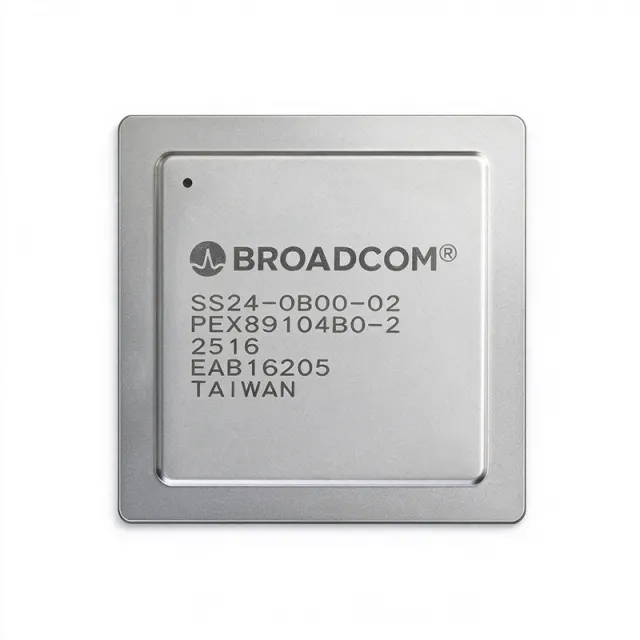
SS24-0B00-02 - 104-Lane PCIe 5.0 Switch | Broadcom PEX89000
The Broadcom SS24-0B00-02 is a 104-lane PCI Express 5.0 switch based on the Broadcom / Avago PEX89104B0-2-DB device, designed as an integrated, multi-function PCI Interface IC for high-performance server, storage, and accelerator fabrics. It is sold as a specialized PCI Interface component and serves as the silicon core used in Broadcom PEX89000-series evaluation boards and OEM modules. The part operates as a fan-out switching element with internal non-transparent and transparent bridge capability, enabling multi-host and domain partitioning topologies required by modern disaggregated compute designs. A PCI Express switch is a hot-pluggable, packet-routing device that sits between a root complex and one or more endpoints (or additional switches), forwarding Transaction Layer packets according to PCIe routing rules. SS24-0B00-02 belongs to the hierarchical product family PCIe switch -> PCI bridge / switch -> PCI Express switch -> peripheral / interface IC, and ultimately to integrated circuits -> specialized / interface ICs. The PCIe 5.0 specification doubles the per-lane signaling rate to 32 GT/s compared with PCIe 4.0, doubling bandwidth to roughly 3.94 GB/s per direction per lane. By aggregating 104 lanes, the switch can deliver multi-terabit fabric throughput and is engineered to support the higher port counts demanded by NVMe-oF, CXL-attached memory pools, and heterogeneous AI/GPU compute racks. Key features of the SS24-0B00-02 include PCIe 5.0 compliance with backward support for PCIe 4.0/3.0 devices, a 104-lane configuration organized into multiple ports, advanced error reporting and AER support, hot-plug readiness, NVMe and CXL-aware QoS structures, and support for SR-IOV and multiple function hierarchies. The silicon also includes Enhanced Hot-Plug controllers, ECRC, Poisoned TLP handling, and Advanced Power Management (ASPM L0s/L1/L2) capabilities typical of the PEX89000 generation. Architecturally, the device integrates SerDes blocks capable of PCIe 5.0 long-reach signaling, a non-blocking internal switch fabric with credit-based flow control, and embedded MCUs for I2C/SMBus manageability. The silicon targets enterprise servers, NVMe SSD arrays, GPU/CPU accelerator backplanes, and composable infrastructure platforms, where it typically appears as a stand-up PCIe card or a BGA-mounted mezzanine. Typical applications include high-port-count NVMe-oF SSD backplanes, disaggregated CXL memory pools, AI training cluster fabric switches, hyperscale accelerator baseboards, and high-speed test & measurement PCIe capture cards. When integrating this part, designers must follow Broadcom's reference layout for the BGA-EP package, manage the multi-rail power-up sequence, and provide sufficient airflow to dissipate the high SerDes power at PCIe 5.0 data rates. Engineers typically source the SS24-0B00-02 from authorized distributors such as DigiKey, Mouser, and Avnet Americas for new designs; later-stage replacement is sometimes supported by Broadcom via the cross-reference SS26-0B00-02 (60V equivalent) for higher-voltage tolerance retrofit programs. This page synthesizes distributor pricing, drop-in alternatives, and practical design notes not found in the manufacturer datasheet.
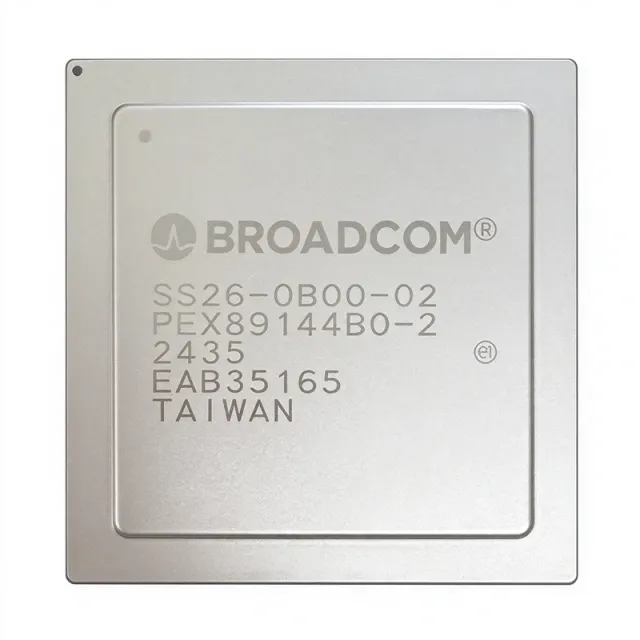
SS26-0B00-02 - PEX89144 PCIe Gen 5.0 Switch | Broadcom | 144-Lane
The Broadcom SS26-0B00-02 (associated die: PEX89144) is a 144-lane PCI Express 5.0 switch IC operating at 32 GT/s per lane, designed for high-end server, storage, and AI/ML fabric interconnects. As a member of the PEX89000 family of managed PCIe Gen 5.0 switches, it enables fan-out, partitioning, and non-transparent bridging across a heterogeneous set of root complexes and endpoints in modern accelerated-compute platforms. The part is supplied as a bare-die / specialized Broadcom package designated "SS26" and is targeted at OEM designs that integrate directly onto high-speed signal substrates. A PCIe switch is a protocol-aware layer-2 bridge device that replicates the PCI Express transaction layer and link layer across multiple ports, allowing one or more host processors to share a fabric of endpoints (NVMe SSDs, GPUs, NICs, accelerators) without requiring every device to live behind a single root complex. PCIe Gen 5.0 doubles the per-lane signaling rate to 32 GT/s versus Gen 4.0's 16 GT/s, doubling available bandwidth per lane to approximately 3.94 GB/s in each direction. Switches in this class sit within the broader taxonomy: PCIe switch -> PCIe interface IC -> peripheral controller -> integrated circuit -> semiconductor. Key features include 144 SerDes lanes arranged in 24 ports, support for hot-plug, surprise-down error reporting, Advanced Error Reporting (AER), SR-IOV with up to 256 physical functions per port, Multi-Root I/O virtualization (MR-IOV), and Broadcom's proprietary Adaptive Voltage Scaling / link-training diagnostics. The device integrates on-chip reference clocks, lane margining, and equalization controls required for Gen 5.0 signal integrity on long-reach backplane channels. Typical applications span hyperscale AI training fabrics where multiple GPUs share NVMe-oF storage, composable disaggregated servers, high-port-count NVMe SSD enclosures, and EBOF (Ethernet Bunch of Flash) reference platforms. The PEX89000 series extends Broadcom's PEX9700/8700/88000 lineage into Gen 5.0 territory, allowing customers to migrate existing Gen 3/4 designs with minimal firmware changes while doubling interconnect bandwidth. When designing with this device, follow Broadcom's PEX89000 hardware reference manual for PCB stackup, AC-coupling capacitor placement, and reference-clock routing. Always confirm lane assignment and bifurcation mode through the I2C/SMBus initial-provisioning interface before system bring-up.