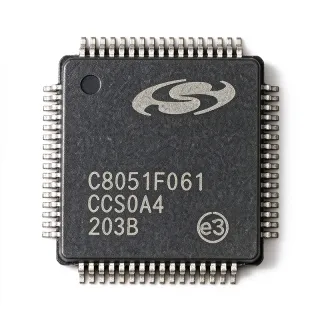
EFM32TG232F8-QFP64 - 32MHz Cortex-M3 MCU | Silicon Labs
MPN: EFM32TG232F8-QFP64 ✓ Hoạt độngEFM32TG232F8-QFP64 Tóm tắt
A microcontroller is an embedded-system semiconductor that integrates a processor core, program memory, data memory, peripherals, and I/O into one device. The EFM32TG232F8-QFP64 belongs to the Tiny Gecko family and uses the ARM Cortex-M3 processor. In the product hierarchy, it is a 32-bit microcontroller, a general-purpose processor-based IC, and ultimately a semiconductor intended to control sensors, communications, user interfaces, and other embedded-system functions.
Key features include a maximum 32 MHz operating speed, 8 kB of Flash organized as 8K x 8, 2 kB of SRAM, 53 digital I/O pins, and hardware AES capability. Its 1.85 V to 3.8 V operating range accommodates low-voltage portable systems. The combination of 53 I/O pins and two 16-bit timers is useful in designs that need multiple peripheral connections without moving to a larger package.
Technically, the Cortex-M3 core provides a compact 32-bit architecture suitable for real-time control. Silicon Labs' Tiny Gecko platform adds low-energy operating techniques intended to reduce both active and idle consumption. The 2 kB SRAM and 8 kB Flash limits determine the code and working-data budget, making this MCU most appropriate for compact control tasks rather than graphics-intensive, high-bandwidth, or large protocol-stack applications.
Typical applications include low-power sensor nodes, compact industrial controllers, energy-monitoring instruments, connected accessories, and portable accessories. The 53 digital I/O pins support peripheral interconnection, while two timers provide timing for pulse generation, input capture, or periodic control tasks. AES hardware can offload supported encryption operations when application security requirements justify it.
Designers should account for the small 8 kB Flash and 2 kB RAM budgets, verify every peripheral pin against the 64-TQFP pinout, and use the manufacturer reference configuration for decoupling and programming. A PCB change to another MCU should not be attempted without a complete peripheral, timing, memory, and pin-level migration review.
Bộ thay thế dễ dàng lắp đặt cho EFM32TG232F8-QFP64 — cùng gói, chân-to-chân tương thích. Các bộ phận yêu cầu hàn PCB bị loại trừ.
EFM32TG232F8-QFP64T
✅ Drop-In📋 Tham chiếu thay thế (không có trong danh mục)
EFM32TG232F8-D-QFP64
✅ Drop-In📋 Tham chiếu thay thế (không có trong danh mục)
EFM32TG232F8-QFP64
✅ Drop-InLiên hệ để biết giá
Xem tài liệu →EFM32TG232F8-QFP64 Tỷ lệ tối đa & tính chất điện
| Product Type | ARM Cortex-M3 Tiny Gecko Microcontroller |
| Core | ARM Cortex-M3 |
| Maximum CPU Frequency | 32 MHz |
| Flash Memory | 8 kB (8K x 8) |
| RAM | 2 kB |
| Digital I/O Pins | 53 pins |
| Timers | 2 x 16-bit timers |
| Điện áp cung cấp hoạt động | 1.85 V to 3.8 V |
| Hộp | 64-TQFP (10 x 10 mm) |
| Architecture | 32-bit |
| Series | Tiny Gecko |
| Security Feature | AES hardware engine |
| Low-Power Features | Fast wake-up and energy-saving modes |
| Kiểu lắp đặt | Surface Mount |
Hướng dẫn cấu hình chân EFM32TG232F8-QFP64 64-tqfp (10 x 10 mm)
Cấu hình chân cho EFM32TG232F8-QFP64 (64-tqfp (10 x 10 mm) gói). IC số này bao gồm chân GPIO, giao diện truyền thông (UART, SPI, I2C) và chân nguồn. Tham khảo tài liệu thông số kỹ thuật của nhà sản xuất để biết các chức năng chân thay thế và tùy chọn cấu hình. Cực kỳ quan trọng cho thiết kế hệ thống tích hợp và lập trình PCB.

Không có dữ liệu chân cụ thể sẵn có cho EFM32TG232F8-QFP64.
Tham khảo: tài liệu kỹ thuật cho cấu hình chân đầy đủ.
Ứng dụng tiêu biểu
EFM32TG232F8-QFP64 phù hợp cho 6 Áp dụngs: Low-Power Sensor Node, Energy Monitoring Instrument, Industrial Control Module, Portable Connected Accessory, Secure Key and Access Controller, Compact Communication Interface.
Low-Power Sensor Node
The EFM32TG232F8-QFP64 fits compact sensor nodes because its Cortex-M3 core operates up to 32 MHz while the Tiny Gecko platform provides fast wake-up and energy-saving modes. The 53 digital I/O pins leave ample connections for sensors, indicators, and a host interface, while the 1.85 V to 3.8 V supply range supports low-voltage battery architectures. Use energy-saving modes between measurements and keep active processing brief to extend battery life. The principal constraint is memory: 8 kB Flash and 2 kB RAM require compact drivers and limited buffering.
Được đề xuất
Energy Monitoring Instrument
The EFM32TG232F8-QFP64 is appropriate for a compact energy-monitoring instrument with multiple discrete inputs and periodic measurement tasks. Two 16-bit timers can support timing, pulse counting, or sampling control, while the 32 MHz Cortex-M3 core handles calculations and local state management. Its low-power operating techniques are useful when the instrument spends most of its time idle. Designers should allocate RAM carefully because the 2 kB SRAM limits simultaneous histories, although the 53 I/O pins reduce the need for an I/O expander.
Được đề xuất
Industrial Control Module
The EFM32TG232F8-QFP64 can serve as the controller in a small industrial module requiring deterministic digital I/O, timer-based sequencing, and low standby power. Its 53 digital I/O pins allow direct attachment of switches, status indicators, and discrete control inputs without immediately resorting to an expander. Two 16-bit timers are useful for pulse-width measurement or periodic actuator timing. The 10 x 10 mm 64-TQFP footprint preserves board area, but firmware must avoid exceeding the 8 kB Flash limit and must account for interrupt latency at 32 MHz.
Được đề xuất
Portable Connected Accessory
The EFM32TG232F8-QFP64 suits portable accessories that need local sensing, a low-power always-available control path, and occasional communications processing. The 1.85 V to 3.8 V operating range works with low-energy system rails, and the hardware AES engine can support compatible encryption workloads while reducing CPU burden. Its 53 I/O pins can support buttons, indicators, and local sensors. The small RAM budget means streamed data should generally be processed promptly rather than retained in large buffers.
Được đề xuất
Secure Key and Access Controller
The EFM32TG232F8-QFP64 can support compact access-control and key-management functions because it includes an AES hardware engine and 53 digital I/O pins for readers, indicators, and interlocks. The 32 MHz ARM Cortex-M3 core provides adequate performance for protocol handling and local decisions, while low-power modes benefit battery-backed installations. Security depends on correct firmware, key provisioning, and protected storage practices rather than the presence of AES alone. This role also makes the limited 2 kB RAM relevant during protocol parsing and logging.
Được đề xuất
Compact Communication Interface
The EFM32TG232F8-QFP64 is suitable for a compact communication interface that translates between a host and discrete sensors or actuators. Its 53 I/O pins and two timers support protocol timing and status signaling, while fast wake-up allows the device to respond without remaining continuously active. The 32 MHz core handles lightweight framing and control tasks. For higher-throughput networking, choose a companion Ethernet or serial controller, because this MCU's 8 kB Flash and 2 kB RAM are not intended for large TCP/IP stacks.
Được đề xuất
Tóm tắt các sản phẩm được đề xuất
Dữ liệu tham khảo kỹ thuật cho EFM32TG232F8-QFP64 — so sánh, hướng dẫn thiết kế và thông tin tuân thủ.
Hướng dẫn chọn lựa
So sánh với các sản phẩm thay thế
| Tham số | Sản phẩm này | EFM32TG232F8-QFP64T | EFM32TG232F8-D-QFP64 | EFM32TG232F8-QFP64 |
|---|---|---|---|---|
| Brand | Silicon Labs | Silicon Labs | Silicon Labs | Silicon Labs |
| Package | 64-TQFP (10 x 10 mm) | 64-TQFP (10 x 10 mm) - same | 64-TQFP (10 x 10 mm) - same | 64-TQFP (10 x 10 mm) - same |
Bảo phân biệt quan trọng
- Exact standard-ordering alternative available in the same footprint (vsEFM32TG232F8-QFP64T)
- Lower verified minimum supply voltage than the -D listing (vsEFM32TG232F8-D-QFP64)
- Dense 64-pin I/O capability in a compact package (vsEFM32TG232F8-QFP64)
Ghi chú thiết kế
Budget the EFM32TG232F8-QFP64 for a 1.85 V to 3.8 V supply range and review every external rail's tolerance. The -D listing starts at 1.98 V, so it cannot be assumed equivalent for a design operated near 1.85 V. Use the manufacturer reference circuit for decoupling, keep the regulator and MCU supply loop compact, and avoid allowing rail transients to exceed the verified maximum.
Route the 64-TQFP perimeter pins and exposed thermal or power features according to the official land pattern rather than a generic TQFP drawing. Place decoupling capacitance at the relevant supply pins, keep high-current and sensitive signal paths separated, and provide unobstructed routing for programming and debug access. Validate the final layout against the current Silicon Labs hardware design guidance.
Treat the 8 kB Flash and 2 kB RAM as hard design constraints. Include compiler overhead, stack depth, interrupt handlers, and communications buffers in the memory budget rather than measuring only application source size. A protocol stack or logging subsystem that appears small in source code can consume the available RAM quickly, so measure the linked image during early development.
Use the Tiny Gecko low-energy modes deliberately: define which peripherals remain powered, select the longest acceptable sleep interval, and wake the core only when new data requires processing. Disable unused clocks and peripherals to reduce leakage. Because the supplied data does not state numerical sleep, wake-up, or active-current limits, obtain those values from the manufacturer datasheet before making battery-life estimates.
Thông tin tuân thủ
The supplied verified data does not explicitly state RoHS, REACH, lead-free, halogen-free, or conflict-minerals status. AEC-Q100 is not applicable because the target is a general-purpose microcontroller rather than an automotive-qualified device in the supplied evidence.