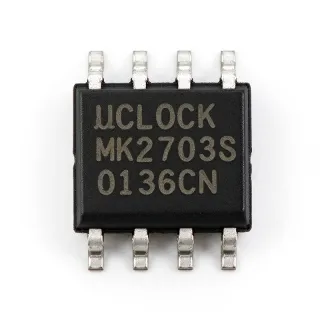
ICS411M - PC Peripheral Clock | IDT | SOIC-8
MPN: ICS411M ✗ Cuối đờiICS411M Tóm tắt
An integrated clock synthesizer combines oscillator circuitry, frequency generation or distribution, and output-driver functions into one timing IC. Such devices help maintain defined relationships between digital signals. In computer systems, those relationships determine when processors, buses, storage controllers, and peripherals may exchange data. The ICS411M is described as a PC peripheral clock and is intended to optimize component count in PC motherboard and peripheral designs. Its 8-SOIC package provides a compact, surface-mount form suitable for legacy motherboard assembly, although physical dimensions and pin functions require confirmation from an authentic technical datasheet.
The available evidence establishes three important procurement facts: ICS411M was originally associated with IDT, Integrated Device Technology Inc; it is packaged as 8-SOIC, listed with a nominal width of 3.90 mm; and distributor listings report inventory. However, the verified data does not state operating voltage, output count, supported clock frequencies, frequency tolerance, jitter, operating temperature, or pin assignments. Those values must not be inferred from similarly named clock ICs. This limitation is especially important because clock generators with the same package can differ substantially in pinout and output behavior.
ICS411M is relevant when researching or maintaining older PC peripheral platforms rather than designing a new clock subsystem from first principles. Verified distributor listings include references to octopart clock buffers and drivers, but these search results do not establish a technical replacement or lifecycle recommendation. Before substitution, an engineer should compare the authentic ICS411M pinout, supply voltage, output waveform, frequency plan, enable logic, and timing margins. Octopart and the listed distributors can assist with sourcing, but manufacturer documentation remains the controlling source for design decisions.
A typical legacy motherboard application would place the ICS411M among the system timing circuitry and route its outputs according to the original platform schematics. Because exact output assignments are unavailable in the verified data, PCB reuse cannot be approved from the package alone. Clock routing should remain short, reference planes should return cleanly, and unused outputs require the treatment specified by the original platform design. Modern replacements should not be assumed to be pin compatible.
The key engineering caution is documentation completeness. Verify the original manufacturer or archived manufacturer datasheet before energizing, probing, or substituting ICS411M in powered equipment. Confirm device markings, supply rails, oscillator connections, and every package pin. This page deliberately distinguishes verified product identity from unverified technical assumptions and provides sourcing links, practical assessment guidance, and transparent data gaps for repair, maintenance, and legacy-system evaluation.
Bộ thay thế dễ dàng lắp đặt cho ICS411M — cùng gói, chân-to-chân tương thích. Các bộ phận yêu cầu hàn PCB bị loại trừ.
Các biến thể trong loạt này
Các mẫu cùng loạt có thể lắp đặt dễ dàng tương thích với ICS411M (cùng hình factor và footprint) — khác nhau ở Package, Number of Outputs, Original Manufacturer, Product Type, RoHS Status.
Không có bộ thay thế dễ dàng lắp đặt sẵn có cho sản phẩm này.
Yêu cầu các bộ thay thếICS411M Thông số kỹ thuật
| Product Type | PC peripheral clock |
| Device Function | Clock synthesizer |
| Original Manufacturer | IDT, Integrated Device Technology Inc |
| Hộp | 8-SOIC |
| Package Width | 0.154 in (3.90 mm) |
| Kiểu lắp đặt | Surface mount |
| Target Market | PC motherboard and peripheral applications |
| Design Objective | Optimize component count |
| Reported Heisener Inventory | 2816 pieces |
| Reported Heisener Lead Time | To be confirmed |
| Estimated Delivery Window | Apr 30 to May 5; year not provided |
| Octopart Category | Clock Buffers, Drivers |
Hướng dẫn cấu hình chân ICS411M 0.154 in (3.90 mm)
Cấu hình chân cho ICS411M (0.154 in (3.90 mm) gói). Số thứ tự chân, chức năng và sơ đồ kết nối được xác định trong tài liệu thông số kỹ thuật của nhà sản xuất. Tham khảo nó để biết footprint và hướng dẫn hàn chính xác.

Không có dữ liệu chân cụ thể sẵn có cho ICS411M.
Tham khảo: tài liệu kỹ thuật cho cấu hình chân đầy đủ.
Ứng dụng tiêu biểu
ICS411M phù hợp cho 7 Áp dụngs: Legacy PC Motherboard Timing, PC Peripheral Interface Support, Industrial Legacy Computer Maintenance, Vintage Peripheral Repair, Computer Museum and Retro Computing, Legacy Data-Acquisition Systems, Embedded Test and Measurement Equipment.
Legacy PC Motherboard Timing
The ICS411M is specifically identified as a cost-effective clock synthesizer for PC motherboard and peripheral applications, making it relevant to systems that used the original IDT-associated part. Its stated design purpose was to optimize motherboard component count while supplying peripheral timing functions. Because the supplied evidence does not reveal frequency, voltage, output count, or pin assignments, an existing board must be matched by exact MPN and verified against its original schematic. Engineers restoring legacy systems should preserve the original trace routing and output mapping until authentic documentation proves a substitute is compatible.
Được đề xuất
PC Peripheral Interface Support
The verified description positions ICS411M as a PC peripheral clock, implying a timing-support role within legacy personal-computer peripherals or the motherboard subsystem driving them. Such use depends on exact output relationships that are not present in the supplied snippets. During repair, inspect clock amplitude, frequency, waveform, and synchronization at the original test points before replacing the device. A modern interface may operate at frequencies or edge requirements outside this legacy component's validated range, so system schematics and technical documentation must govern any upgrade.
Được đề xuất
Industrial Legacy Computer Maintenance
ICS411M may be relevant to repair or preservation of older industrial computers, test systems, and embedded peripherals that originally incorporated this PC peripheral clock. The value of the part lies in preserving a known board architecture rather than meeting new low-power or high-performance requirements. Procurement teams should request original markings, condition details, lot records, and a return agreement. Before installation, compare device pin orientation and package dimensions with the board footprint, then perform power-off continuity checks to prevent damage from incorrect sourcing.
Được đề xuất
Vintage Peripheral Repair
The ICS411M can support repair analysis of vintage PC peripherals whose original design used an integrated peripheral clock rather than discrete oscillator and divider circuitry. Technicians should first identify every connected net using the board schematic, because the verified search results do not provide a complete pinout. Signal measurements should be made with appropriate probe loading and grounded references. Avoid substituting by package or clock-generator category alone; verify output enable polarity, oscillator connection, reference frequency, and downstream timing margins against authentic documentation.
Được đề xuất
Computer Museum and Retro Computing
For museum, laboratory, and retro-computing restoration, an original ICS411M may help reproduce a historically accurate PC clock subsystem. Procurement documentation should preserve supplier, condition, quantity, and provenance because available inventory claims vary between distributors. Researchers should also photograph markings and compare them with known-good examples before installation. If documentation or measured behavior conflicts with a distributor classification, treat the original board schematic and observed circuit function as more authoritative than a generic category label.
Được đề xuất
Legacy Data-Acquisition Systems
A legacy data-acquisition computer may use a peripheral clock such as ICS411M to coordinate sampling, buffering, and interface activity. In such equipment, even a small timing or output-mapping mismatch could corrupt data or cause intermittent operation. Before repair, capture the clock relationship at the failed IC and at downstream test points using known-good operating limits from the system documentation. The supplied data does not state jitter, edge rate, or output synchronization, so those performance requirements cannot be evaluated until the complete ICS411M datasheet is obtained.
Được đề xuất
Embedded Test and Measurement Equipment
ICS411M is a plausible maintenance target for older embedded test and measurement platforms that used PC-derived timing architecture, although the verified data does not establish performance requirements for those applications. A replacement effort should begin with exact part identification, rail measurements, oscillator inspection, and output-state verification. Use an oscilloscope with adequate bandwidth and low-capacitance probing so the diagnostic process does not distort the clock. Document each rail and waveform before power cycling to distinguish device failure from surrounding timing-chain faults.
Được đề xuất
Tóm tắt các sản phẩm được đề xuất
Dữ liệu tham khảo kỹ thuật cho ICS411M — so sánh, hướng dẫn thiết kế và thông tin tuân thủ.
Hướng dẫn chọn lựa
So sánh với các sản phẩm thay thế
| Tham số | Sản phẩm này |
|---|---|
| Brand | Integrated Device Technology Inc |
| Package | 8-SOIC |
| Product Type | PC peripheral clock |
| Device Function | Clock synthesizer |
| Target Application | PC motherboard and peripheral applications |
| Design Objective | Optimize component count |
| Package Width | 0.154 in (3.90 mm) |
| Octopart Classification | Clock Buffers, Drivers |
Bảo phân biệt quan trọng
- Purpose-defined legacy identity (vsNo verified alternative MPN was supplied)
- Established original association (vsNo verified alternative MPN was supplied)
- Documented package identity for restoration (vsNo verified alternative MPN was supplied)
- No unsupported replacement claims (vsUnverified same-package clock ICs)
Ghi chú thiết kế
Do not power an unknown ICS411M board until supply pins and voltage limits have been identified from authentic documentation. The verified data does not specify operating voltage or tolerance. Measure resistance to ground and supply rails with power removed, inspect for electrolytic leakage and solder bridges, and use a current-limited bench supply during initial diagnosis. This sequence reduces the risk of accelerating an IC failure or damaging nearby legacy components.
Use a low-capacitance probe and verify the probe bandwidth before evaluating any ICS411M clock output. Clock edges and low-amplitude signals can be distorted by excessive probe loading. Begin with a documented reference point on the original board, compare output frequency and duty cycle, and then inspect downstream divider or buffer stages. Do not infer acceptable performance from the Clock Buffers, Drivers category alone.
An 8-SOIC footprint is not evidence of pin compatibility. Before ordering a substitute, compare mechanical drawings, pin-one orientation, exposed or missing connections, ground assignments, oscillator pins, control inputs, and every clock output against the complete ICS411M documentation. Preserve the original PCB unless a qualified schematic and timing review proves that rerouting is unnecessary. Package-width information alone cannot establish drop-in interchangeability.
Avoid choosing a replacement solely by searching for another PC peripheral clock or another 8-SOIC IC. Legacy clock ICs can use different supply rails, oscillator arrangements, output enable logic, frequency ratios, and edge timing. Obtain the original schematic and technical datasheet, tabulate every net, and validate the candidate under startup, steady-state, and disabled-output conditions before treating it as equivalent.
Thông tin tuân thủ
The verified results do not contain RoHS, REACH, AEC-Q100, lead-free, halogen-free, or conflict-minerals declarations. AEC-Q100 is treated as not applicable because this is a legacy PC clock IC rather than an automotive-qualified claim, but no automotive qualification is supported by the supplied data.