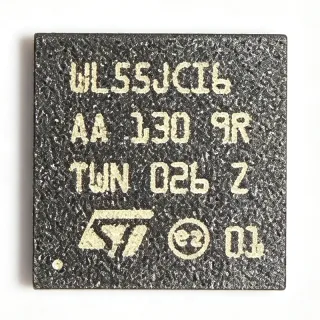
SI2494-A-FM - 56 kbps V.92/V.34 ISOMODEM | Skyworks Solutions
MPN: SI2494-A-FM ✓ Hoạt độngSI2494-A-FM Tóm tắt
An ISOMODEM is an integrated modem chipset solution that combines modem signal processing with telephone-interface functions and associated digital control. Within the broader semiconductor hierarchy, the SI2494-A-FM belongs to the modem controller and network-interface controller class, rather than to a conventional general-purpose microprocessor or standalone analog line transceiver. Its V.34/V.92 support is intended for interoperable data transmission over switched telephone-network and compatible access lines.
The SI2494-A-FM is identified as a system-side ISOmodem product and is associated with a 56 kbps data rate. The device family is described in the product documentation as a V.92 and V.34 ISOMODEM with Global DAA, while the 38-pin QFN package is specified as 5 x 7 mm. The exposed-pad package provides a direct thermal path to the PCB and should be connected according to the package land pattern and thermal design guidance.
Typical communications uses include centralized modem modules, customer-premises equipment, telephone-line data products, industrial data links, and legacy serial-access systems that require V.92/V.34 interoperability. The controller should be paired with the appropriate line-side interface, isolation barrier, power regulation, crystal or clock network, and host controller required by the end product. Its 56 kbps class is substantially higher than V.34 operation while retaining compatibility with the older modem standard.
Design work should begin with the manufacturer’s SI2494/93/57/39/34/15/04 ISOmodem chipset-family guidance. Verify clock, supply sequencing, line-side signaling, exposed-pad soldering, and DAA implementation against the final modem architecture. For an existing board, confirm the 38-QFN 5 x 7 mm footprint, pin functions, thermal pad arrangement, and software compatibility before assigning a replacement role.
This page combines package, protocol, compliance, and application information with practical design guidance and a structured comparison framework. It is intended to help engineers identify whether the SI2494-A-FM fits a telephone-data product, understand its integration constraints, and plan a qualified sourcing or replacement review.
Bộ thay thế dễ dàng lắp đặt cho SI2494-A-FM — cùng gói, chân-to-chân tương thích. Các bộ phận yêu cầu hàn PCB bị loại trừ.
Không có bộ thay thế dễ dàng lắp đặt sẵn có cho sản phẩm này.
Yêu cầu các bộ thay thếSI2494-A-FM Thông số kỹ thuật
| Product Type | ISOMODEM controller and processor IC |
| Modem Standards | V.92 and V.34 |
| Tốc độ dữ liệu | 56 kbps |
| Product Role | System-side ISOmodem |
| Telephone Interface | Global DAA support |
| Hộp | 38-pin QFN (5 x 7 mm) |
| Package Construction | QFN with exposed pad |
| Kiểu lắp đặt | Surface mount |
| Lead-Free Status | Lead free |
| Trạng thái RoHS | RoHS compliant |
Hướng dẫn cấu hình chân SI2494-A-FM qfn with exposed pad
Cấu hình chân cho SI2494-A-FM (qfn with exposed pad gói). Số thứ tự chân, chức năng và sơ đồ kết nối được xác định trong tài liệu thông số kỹ thuật của nhà sản xuất. Tham khảo nó để biết footprint và hướng dẫn hàn chính xác.

Không có dữ liệu chân cụ thể sẵn có cho SI2494-A-FM.
Tham khảo: tài liệu kỹ thuật cho cấu hình chân đầy đủ.
Ứng dụng tiêu biểu
SI2494-A-FM phù hợp cho 6 Áp dụngs: System-Side Telephone Modems, Customer Premises Equipment, Industrial Telephone-Line Links, Remote Diagnostics Terminals, Legacy Serial-Access Products, Telecommunications Support Equipment.
System-Side Telephone Modems
The SI2494-A-FM is designed for the system-side role in a V.92 and V.34 modem arrangement operating at 56 kbps. It can serve as the central modem controller in equipment that must retain V.34 interoperability while supporting the higher V.92 rate. Integration requires the correct line-side interface, Global DAA implementation, clocking, power rails, and host-control arrangement. Because the controller is packaged in a 38-QFN 5 x 7 mm footprint, it supports compact equipment layouts while requiring careful exposed-pad assembly and thermal design.
Được đề xuất
Customer Premises Equipment
The SI2494-A-FM fits customer-premises equipment that transfers data over a telephone access line while supporting V.92 and V.34 sessions. Its 56 kbps modem class is appropriate for embedded access products that must communicate with both newer V.92 equipment and legacy V.34 modems. The board designer must provide the selected DAA, isolation barrier, line-side circuitry, host interface, and clock source required by the product architecture. Confirm operating-temperature and regulatory requirements before deploying it outside controlled indoor environments.
Được đề xuất
Industrial Telephone-Line Links
The SI2494-A-FM can support legacy telephone-line data connectivity in industrial equipment that must interoperate with V.92 and V.34 modem services. The 56 kbps rate makes it relevant for supervisory data, configuration transfer, remote diagnostics, and low-bandwidth equipment control rather than high-throughput networking. Its use requires a complete modem circuit around the controller, including Global DAA implementation and appropriate line protection. Environmental limits, isolation, surge protection, and regulatory requirements should be reviewed for each installation environment.
Được đề xuất
Remote Diagnostics Terminals
The SI2494-A-FM can form the modem section of a remote diagnostics terminal requiring compatibility with both V.92 and V.34 equipment. A 56 kbps V.92 session can reduce transfer time compared with a legacy-only terminal, while V.34 support preserves connection options across mixed infrastructure. The implementation must support the equipment’s required dialing, DAA, and telephone-line behavior. Firmware, host-driver, and line-interface validation are especially important when the same terminal must communicate with equipment produced during different modem generations.
Được đề xuất
Legacy Serial-Access Products
The SI2494-A-FM is suitable for legacy serial-access products that require a standardized modem path rather than a general-purpose serial interface. Its V.34 and V.92 capabilities provide compatibility with established remote-access infrastructure at a 56 kbps modem rate. Designers should use the manufacturer’s chipset-family application information to select the required companion interfaces and confirm clock and signal timing. The package’s exposed pad should be tied to the recommended ground plane, and its assembly process should follow the stated QFN land-pattern and solder-reflow requirements.
Được đề xuất
Telecommunications Support Equipment
The SI2494-A-FM can be incorporated into telecommunications support equipment used to test or maintain V.92 and V.34 modem connections. Dual-standard support helps service teams work across legacy and higher-rate access endpoints, while the 56 kbps rating defines the modem-session class rather than the physical data-port speed. A practical design must include the required Global DAA, line-side circuitry, isolation, clocking, and host interface. Validate interoperability using the actual line conditions and remote equipment expected in service.
Được đề xuất
Dữ liệu tham khảo kỹ thuật cho SI2494-A-FM — so sánh, hướng dẫn thiết kế và thông tin tuân thủ.
Hướng dẫn chọn lựa
So sánh với các sản phẩm thay thế
| Tham số | Sản phẩm này |
|---|---|
| Brand | Skyworks Solutions |
| Package | 38-pin QFN (5 x 7 mm) with exposed pad |
| Product Type | System-side ISOMODEM controller and processor IC |
| Modem Standards | V.92 and V.34 |
| Data Rate | 56 kbps |
| Telephone Interface | Global DAA support |
| Lead-Free Status | Lead free |
| RoHS Status | RoHS compliant |
Bảo phân biệt quan trọng
- Combines V.92 and V.34 in one system-side modem controller (vsGeneric 56 kbps modem controller)
- Provides Global DAA capability (vsModem controller without Global DAA)
- Uses a compact 38-QFN footprint (vsLarger packaged modem implementation)
Ghi chú thiết kế
Use the exact 38-pin QFN 5 x 7 mm land pattern from the manufacturer datasheet. Place the exposed-pad connection and thermal vias directly beneath the device, keep high-current supply returns close to their pins, and avoid placing sensitive telephone-line routing beneath the modem package. Validate the stencil, paste volume, and reflow profile against the package construction.
Separate the modem processing section from sensitive line-side and isolation circuitry. Keep clock routing short and away from switching nodes and high-energy telephone-interface paths. Provide a low-impedance ground reference for the exposed pad and follow the recommended decoupling arrangement. Review signal returns to prevent the Global DAA and telephone-line subsystem from injecting noise back into the controller.
Do not select a replacement solely because it is labeled as a 56 kbps modem. Verify all 38 pin assignments, V.92 and V.34 support, Global DAA behavior, clocking, supply levels, exposed-pad connection, and host-driver expectations. A candidate with the same nominal rate but a different pinout or firmware architecture is not a drop-in replacement and requires board-level redesign.
Implement the manufacturer-specified supply rails and decoupling before tuning modem performance. The SI2494-A-FM is a controller within a larger telephone-access design, so power integrity depends on the regulator, DAA, isolation barrier, and line-side circuitry as a complete system. Confirm supply sequencing, startup behavior, and operating-current requirements against the relevant datasheet sections.
Thông tin tuân thủ
Lead-free and RoHS-compliant construction are identified in the component documentation. Other environmental, automotive, and material-compliance classifications are not stated.