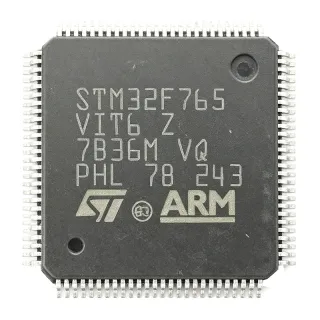
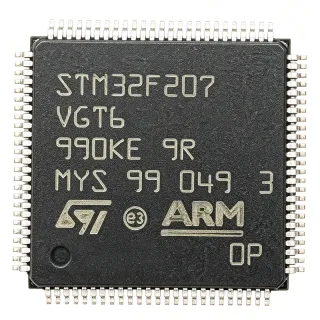
STM32F733VET6 - 32-bit ARM Cortex-M7 MCU 512KB Flash | STMicroelectronics
MPN: STM32F733VET6 ✓ Hoạt độngSTM32F733VET6 Tóm tắt
What is a microcontroller? A microcontroller (MCU) is a compact integrated circuit designed to govern a specific operation in an embedded system. It integrates a processor core, memory (Flash and SRAM), and programmable input/output peripherals on a single chip. In the system hierarchy, a microcontroller is a type of embedded processor, which falls under the broader category of integrated circuits. The STM32F733VET6 is part of the STM32F7 series, which is known for its high performance and advanced connectivity, positioning it as a top-tier MCU for complex applications.
Key features of the STM32F733VET6 include a floating-point unit (FPU) for single-precision arithmetic, a memory protection unit (MPU), and a rich set of peripherals such as multiple USARTs, SPIs, I2Cs, CAN, USB OTG, and Ethernet MAC. It also includes advanced analog peripherals like 12-bit ADCs and DACs, as well as timers with PWM generation capabilities. The device supports a wide supply voltage range of 1.7V to 3.6V and operates over a temperature range of -40°C to +85°C, making it suitable for industrial environments.
Technically, the STM32F733VET6 leverages the ARM Cortex-M7 architecture with a 6-stage pipeline and branch prediction, delivering 462 DMIPS at 216 MHz. It includes a hardware cryptographic accelerator for AES, DES, and hash algorithms, enhancing security for IoT applications. The device also features a Chrom-ART Accelerator for 2D graphics, which offloads the CPU for graphical user interfaces. With its high clock speed and rich peripherals, the STM32F733VET6 excels in real-time control and signal processing tasks.
Typical applications include industrial automation, motor control, medical devices, and high-end consumer electronics. For instance, in motor control, the advanced timers and ADC synchronization enable precise field-oriented control (FOC) of brushless DC motors. In medical devices, the high processing power supports complex algorithms for patient monitoring. The device's connectivity options also make it ideal for IoT gateways and smart home hubs.
When designing with the STM32F733VET6, ensure proper decoupling of the power supply with 100 nF capacitors close to each VDD pin and a 4.7 uF bulk capacitor. The VDDA pin should be filtered with a ferrite bead and capacitor to reduce analog noise. Additionally, the BOOT0 pin configuration must be set correctly for desired boot mode, and the NRST pin should have a 100 nF capacitor to ground for reliable reset.
Bộ thay thế dễ dàng lắp đặt cho STM32F733VET6 — cùng gói, chân-to-chân tương thích. Các bộ phận yêu cầu hàn PCB bị loại trừ.
Các biến thể trong loạt này
Các mẫu cùng loạt có thể lắp đặt dễ dàng tương thích với STM32F733VET6 (cùng hình factor và footprint) — khác nhau ở Package, Flash Memory, Flash Organization, Product Type.
STM32F733VGT6
✅ Drop-In ⚠️ Thông số chưa được xác minh📋 Tham chiếu thay thế (không có trong danh mục)
STM32F746VET6
✅ Drop-In ⚠️ Thông số chưa được xác minhLiên hệ để biết giá
Xem tài liệu →STM32F767VIT6
✅ Drop-In ⚠️ Thông số chưa được xác minhLiên hệ để biết giá
Xem tài liệu →STM32F733VET6 Tỷ lệ tối đa & tính chất điện
| Core | ARM Cortex-M7 |
| Max Clock Speed | 216 MHz |
| Flash Memory | 512 KB |
| SRAM | 256 KB |
| Hộp | LQFP100 (14x14 mm) |
| Điện áp cung cấp | 1.7V to 3.6V |
| Nhiệt độ hoạt động | -40°C to +85°C |
| GPIO Pins | 82 |
| ADC | 3x 12-bit, up to 16 channels |
| DAC | 2x 12-bit |
| Timers | 12x 16-bit, 2x 32-bit |
| Communication Interfaces | USART, SPI, I2C, CAN, USB OTG, Ethernet MAC |
| Cryptographic Acceleration | AES, DES, HASH |
| DMA | 2x DMA controllers with 16 streams each |
| RoHS | Compliant |
Cấu hình chân STM32F733VET6
| Chân 1 | PE2 — GPIO or alternate function |
| Chân 2 | PE3 — GPIO or alternate function |
| Chân 3 | PE4 — GPIO or alternate function |
| Chân 4 | PE5 — GPIO or alternate function |
| Chân 5 | PE6 — GPIO or alternate function |
| Chân 6 | VBAT — Battery backup supply |
| Chân 7 | PC13 — GPIO or RTC output |
| Chân 8 | PC14 — GPIO or OSC32_IN |
| Chân 9 | PC15 — GPIO or OSC32_OUT |
| Chân 10 | PF0 — GPIO or alternate function |
| Chân 11 | PF1 — GPIO or alternate function |
| Chân 12 | PF2 — GPIO or alternate function |
| Chân 13 | PF3 — GPIO or alternate function |
| Chân 14 | PF4 — GPIO or alternate function |
| Chân 15 | PF5 — GPIO or alternate function |
| Chân 16 | PF6 — GPIO or alternate function |
| Chân 17 | PF7 — GPIO or alternate function |
| Chân 18 | PF8 — GPIO or alternate function |
| Chân 19 | PF9 — GPIO or alternate function |
| Chân 20 | PF10 — GPIO or alternate function |
| Chân 21 | VSS — Ground |
| Chân 22 | VDD — Power supply |
| Chân 23 | PF11 — GPIO or alternate function |
| Chân 24 | PF12 — GPIO or alternate function |
| Chân 25 | PF13 — GPIO or alternate function |
| Chân 26 | PF14 — GPIO or alternate function |
| Chân 27 | PF15 — GPIO or alternate function |
| Chân 28 | PG0 — GPIO or alternate function |
| Chân 29 | PG1 — GPIO or alternate function |
| Chân 30 | PG2 — GPIO or alternate function |
| Chân 31 | PG3 — GPIO or alternate function |
| Chân 32 | PG4 — GPIO or alternate function |
| Chân 33 | PG5 — GPIO or alternate function |
| Chân 34 | PG6 — GPIO or alternate function |
| Chân 35 | PG7 — GPIO or alternate function |
| Chân 36 | PG8 — GPIO or alternate function |
| Chân 37 | PG9 — GPIO or alternate function |
| Chân 38 | PG10 — GPIO or alternate function |
| Chân 39 | PG11 — GPIO or alternate function |
| Chân 40 | PG12 — GPIO or alternate function |
| Chân 41 | PG13 — GPIO or alternate function |
| Chân 42 | PG14 — GPIO or alternate function |
| Chân 43 | PG15 — GPIO or alternate function |
| Chân 44 | PD0 — GPIO or alternate function |
| Chân 45 | PD1 — GPIO or alternate function |
| Chân 46 | PD2 — GPIO or alternate function |
| Chân 47 | PD3 — GPIO or alternate function |
| Chân 48 | PD4 — GPIO or alternate function |
| Chân 49 | PD5 — GPIO or alternate function |
| Chân 50 | PD6 — GPIO or alternate function |
| Chân 51 | PD7 — GPIO or alternate function |
| Chân 52 | PD8 — GPIO or alternate function |
| Chân 53 | PD9 — GPIO or alternate function |
| Chân 54 | PD10 — GPIO or alternate function |
| Chân 55 | PD11 — GPIO or alternate function |
| Chân 56 | PD12 — GPIO or alternate function |
| Chân 57 | PD13 — GPIO or alternate function |
| Chân 58 | PD14 — GPIO or alternate function |
| Chân 59 | PD15 — GPIO or alternate function |
| Chân 60 | VSS — Ground |
| Chân 61 | VDD — Power supply |
| Chân 62 | PC0 — GPIO or ADC input |
| Chân 63 | PC1 — GPIO or ADC input |
| Chân 64 | PC2 — GPIO or ADC input |
| Chân 65 | PC3 — GPIO or ADC input |
| Chân 66 | PC4 — GPIO or alternate function |
| Chân 67 | PC5 — GPIO or alternate function |
| Chân 68 | PB0 — GPIO or ADC input |
| Chân 69 | PB1 — GPIO or ADC input |
| Chân 70 | PB2 — GPIO or alternate function |
| Chân 71 | PB10 — GPIO or alternate function |
| Chân 72 | PB11 — GPIO or alternate function |
| Chân 73 | PB12 — GPIO or alternate function |
| Chân 74 | PB13 — GPIO or alternate function |
| Chân 75 | PB14 — GPIO or alternate function |
| Chân 76 | PB15 — GPIO or alternate function |
| Chân 77 | PD8 — GPIO or alternate function |
| Chân 78 | PD9 — GPIO or alternate function |
| Chân 79 | PD10 — GPIO or alternate function |
| Chân 80 | PD11 — GPIO or alternate function |
| Chân 81 | PD12 — GPIO or alternate function |
| Chân 82 | PD13 — GPIO or alternate function |
| Chân 83 | PD14 — GPIO or alternate function |
| Chân 84 | PD15 — GPIO or alternate function |
| Chân 85 | PA0 — GPIO or ADC input |
| Chân 86 | PA1 — GPIO or ADC input |
| Chân 87 | PA2 — GPIO or alternate function |
| Chân 88 | PA3 — GPIO or alternate function |
| Chân 89 | PA4 — GPIO or DAC output |
| Chân 90 | PA5 — GPIO or DAC output |
| Chân 91 | PA6 — GPIO or alternate function |
| Chân 92 | PA7 — GPIO or alternate function |
| Chân 93 | PA8 — GPIO or alternate function |
| Chân 94 | PA9 — GPIO or alternate function |
| Chân 95 | PA10 — GPIO or alternate function |
| Chân 96 | PA11 — GPIO or alternate function |
| Chân 97 | PA12 — GPIO or alternate function |
| Chân 98 | PA13 — GPIO or SWDIO |
| Chân 99 | PA14 — GPIO or SWCLK |
| Chân 100 | PA15 — GPIO or alternate function |
Ứng dụng tiêu biểu
STM32F733VET6 phù hợp cho 6 Áp dụngs: Industrial Automation, Motor Control, Medical Devices, IoT Gateways, Human-Machine Interface (HMI), Audio Processing.
Industrial Automation
The STM32F733VET6 is ideal for industrial automation due to its high processing power (216 MHz Cortex-M7) and rich peripheral set. It can handle complex control algorithms, real-time communication (Ethernet, CAN), and precise timing with advanced timers. In a typical PLC or motion controller, the MCU manages multiple I/O points, executes PID loops, and communicates with HMI panels. Its 512 KB Flash and 256 KB SRAM allow storing large firmware and data buffers. The wide temperature range (-40°C to +85°C) ensures reliable operation in harsh factory environments. Compared to lower-end MCUs, the F733 provides the performance headroom needed for future firmware updates and additional features.
Được đề xuất
Motor Control
The STM32F733VET6 excels in motor control applications, particularly field-oriented control (FOC) of brushless DC motors. Its advanced timers generate high-resolution PWM signals, and the 12-bit ADCs synchronize with the timers for precise current sensing. The 216 MHz clock ensures fast execution of control loops, enabling smooth and efficient motor operation. In a typical drone or robot, the MCU reads encoder feedback, computes FOC algorithms, and drives the inverter stage. The cryptographic accelerator can secure firmware updates, and the multiple communication interfaces allow integration with flight controllers or central processors. The device's high performance reduces torque ripple and improves dynamic response, making it suitable for high-end motor drives.
Được đề xuất
Medical Devices
The STM32F733VET6 is well-suited for medical devices such as patient monitors, infusion pumps, and diagnostic equipment. Its high processing power enables real-time signal processing of biosignals (ECG, EEG) and complex algorithms for data analysis. The device's low power consumption in sleep modes extends battery life in portable devices. The cryptographic accelerator ensures secure data transmission, complying with healthcare regulations. In a patient monitor, the MCU acquires analog signals via ADCs, processes them, and displays waveforms on an LCD. The Ethernet MAC allows network connectivity for remote monitoring. The wide operating temperature range and industrial-grade reliability make it suitable for medical environments.
Được đề xuất
IoT Gateways
The STM32F733VET6 is an excellent choice for IoT gateways due to its connectivity options (Ethernet, USB, CAN) and high processing power. It can handle multiple communication protocols, aggregate data from sensors, and forward it to the cloud. The cryptographic accelerator enables secure communication (TLS/DTLS) without burdening the CPU. In a smart home hub, the MCU manages Zigbee, Z-Wave, or Bluetooth modules via UART/SPI, processes commands, and controls actuators. Its 512 KB Flash allows storing a full protocol stack and application logic. The device's low power modes are beneficial for always-on gateways, reducing energy consumption. The rich peripheral set simplifies hardware design, reducing BOM cost.
Được đề xuất
Human-Machine Interface (HMI)
The STM32F733VET6 is suitable for HMI applications such as industrial control panels and smart appliances. Its high clock speed and Chrom-ART Accelerator enable smooth graphics rendering on TFT LCDs without overloading the CPU. The device supports external memory interfaces for larger displays. In a typical HMI, the MCU reads touch input, updates the display, and communicates with the main controller via UART or Ethernet. The 512 KB Flash can store graphical assets and fonts. The device's rich timer and PWM capabilities allow backlight control and audio feedback. The wide supply voltage range simplifies power supply design, and the industrial temperature range ensures reliability in factory settings.
Được đề xuất
Audio Processing
The STM32F733VET6 can be used in audio processing applications such as audio effects processors, voice recognition systems, and smart speakers. Its Cortex-M7 core with FPU accelerates DSP algorithms like filtering and FFT. The device includes I2S interfaces for audio codecs and multiple ADCs/DACs for analog audio. In a voice-controlled speaker, the MCU captures audio via a microphone, performs keyword spotting, and streams audio to a codec. The cryptographic accelerator can secure voice data. The high clock speed ensures real-time processing with low latency. The device's low power modes are beneficial for battery-powered audio devices. The rich peripheral set allows integration with Bluetooth modules for wireless audio.
Được đề xuất
Tóm tắt các sản phẩm được đề xuất
Dữ liệu tham khảo kỹ thuật cho STM32F733VET6 — so sánh, hướng dẫn thiết kế và thông tin tuân thủ.
Hướng dẫn chọn lựa
So sánh với các sản phẩm thay thế
| Tham số | Sản phẩm này | STM32F733VGT6 | STM32F746VET6 | STM32F767VIT6 | LPC54608J512BD208 |
|---|---|---|---|---|---|
| Package | LQFP100 | LQFP100 | LQFP100 | LQFP100 | LQFP208 |
| Brand | STMicroelectronics | STMicroelectronics | STMicroelectronics | STMicroelectronics | NXP Semiconductors |
| Core | ARM Cortex-M7 | ARM Cortex-M7 | ARM Cortex-M7 | ARM Cortex-M7 | ARM Cortex-M4 |
| Max Clock Speed | 216 MHz | 216 MHz | 216 MHz | 216 MHz | 180 MHz |
| Flash Memory | 512 KB | 1 MB | 512 KB | 2 MB | 512 KB |
| SRAM | 256 KB | 256 KB | 320 KB | 512 KB | 200 KB |
| Ethernet MAC | Yes | Yes | Yes | Yes | No |
| TFT LCD Controller | No | No | Yes | Yes | Yes |
Bảo phân biệt quan trọng
- Higher clock speed than many competitors (vsLPC54608J512BD208)
- Integrated Ethernet MAC (vsLPC54608J512BD208)
- Pin-compatible with higher-memory variants (vsSTM32F733VGT6)
Ghi chú thiết kế
Ensure proper decoupling of the power supply. Place a 100 nF ceramic capacitor close to each VDD pin and a 4.7 uF bulk capacitor near the power input. The VDDA pin should be filtered with a ferrite bead and a 1 uF capacitor to reduce analog noise. This is critical for ADC accuracy and stable operation.
For the LQFP100 package, use a 4-layer PCB with a solid ground plane. Route high-speed signals (Ethernet, USB) with controlled impedance (e.g., 50 ohm for Ethernet). Keep crystal oscillator traces short and away from high-current traces. Add a ground pour around the MCU to reduce EMI.
Ensure the BOOT0 pin is configured correctly for the desired boot mode (Flash, system memory, or SRAM). A floating BOOT0 pin can cause unexpected boot behavior. Also, the NRST pin should have a 100 nF capacitor to ground for reliable reset. Do not exceed the absolute maximum ratings for supply voltage (3.6V) to avoid damage.
Thông tin tuân thủ
RoHS and REACH compliant per STMicroelectronics product page. Not AEC-Q100 qualified; for automotive, consider STM32F733VET6Q or other automotive-grade variants.