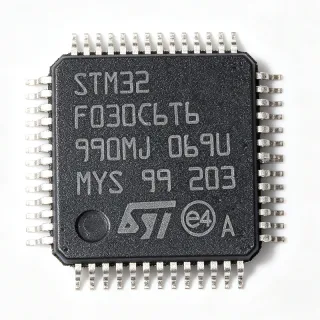
STM32L151CCT6 - 32MHz Cortex-M3 256KB Flash MCU LQFP-48 | STMicroelectronics
MPN: STM32L151CCT6 ✓ Hoạt độngSTM32L151CCT6 Tóm tắt
What is an ultra-low-power MCU? An ultra-low-power microcontroller is a class of MCU built on processes with sub-threshold leakage optimization, dedicated low-power analog IPs, and dynamic voltage scaling that allows active-mode current in the order of a few hundred microamperes per MHz and deep-sleep currents below one microampere. These parts occupy the power-management branch of the broader microcontroller taxonomy: MCU -> 32-bit MCU -> ARM Cortex MCU -> ultra-low-power MCU -> embedded system. The STM32L1 family was the first ST line to commercialize this concept using a proprietary 130 nm ultra-low-leakage process.
Key differentiating features of the STM32L151CCT6 include seven low-power modes (with Stop mode current as low as 0.43 uA typical and Standby current of 0.27 uA typical), up to 20 capacitive sensing channels for touch applications, an integrated 4 mA low-power internal oscillator, and 1.8 V to 3.6 V operating range from a single supply. The dual op-amps and comparators feed sensor-conditioning analog front ends without external active components.
Architecturally, the device pairs the Cortex-M3 core with a multi-power-domain AHB/APB bus matrix, allowing peripherals to be clock-gated individually. A built-in voltage regulator supports dynamic voltage scaling between 1.2 V and 1.8 V core domains to trade speed for current on demand. The 12-bit ADC is oversample-capable to 16-bit equivalent resolution.
Typical applications include battery-powered IoT sensor nodes, wearable health monitors, smart meters, remote controls, BLE/ZigBee host MCUs, and industrial sensor transmitters. The wide 1.8-3.6 V supply range plus deep sleep current makes it a strong fit for energy-harvesting designs.
When designing with this MCU, allocate a 100 nF decoupling cap per VDD pin and a 4.7 uF bulk capacitor near the VCAP pins; the voltage regulator requires these to remain stable across all low-power mode transitions.
This page synthesizes XAIPART distributor data, drop-in alternatives from web cross-references, and practical design guidance beyond what is summarized in the manufacturer datasheet.
Bộ thay thế dễ dàng lắp đặt cho STM32L151CCT6 — cùng gói, chân-to-chân tương thích. Các bộ phận yêu cầu hàn PCB bị loại trừ.
Các biến thể trong loạt này
Các mẫu cùng loạt có thể lắp đặt dễ dàng tương thích với STM32L151CCT6 (cùng hình factor và footprint) — khác nhau ở Core Architecture, Operational Amplifiers, Package.
STM32L152CCT6
✅ Drop-In📋 Tham chiếu thay thế (không có trong danh mục)
STM32L151CCT6TR
✅ Drop-InLiên hệ để biết giá
Xem tài liệu →STM32L151CCU6
✅ Drop-In ⚠️ Thông số chưa được xác minh📋 Tham chiếu thay thế (không có trong danh mục)
STM32L151CCT6 Tỷ lệ tối đa & tính chất điện
| Core Architecture | ARM Cortex-M3 32-bit |
| Maximum CPU Frequency | 32 MHz |
| Flash Memory | 256 KB |
| SRAM | 32 KB |
| EEPROM | 8 KB |
| Operating Voltage | 1.8 V to 3.6 V |
| Hộp | 48-pin LQFP (7x7 mm) |
| Kiểu lắp đặt | Surface Mount |
| Nhiệt độ hoạt động | -40 C to +85 C |
| Number of I/Os | 37 |
| ADC | 12-bit, up to 1 Msps, multiple channels |
| DAC | 2x 12-bit |
| Operational Amplifiers | 2x on-chip |
| Comparators | 2x ultra-low-power |
| Communication Interfaces | USB Full-Speed, 3x USART, 2x UART, 2x SPI, 2x I2C |
| Timers | 16-bit (8x), 32-bit (1x), low-power (2x), SysTick |
| Capacitive Sensing Channels | up to 20 (TSC) |
| Stop Mode Current | 0.43 uA typical |
| Standby Mode Current | 0.27 uA typical |
| Cấp MSL | 3 |
| Trạng thái RoHS | Compliant |
Cấu hình chân STM32L151CCT6
| Chân 1 | PE2 — General-purpose I/O PE2/TRACECLK |
| Chân 2 | PE3 — General-purpose I/O PE3/TRACED0 |
| Chân 3 | PE4 — General-purpose I/O PE4/TRACED1 |
| Chân 4 | PE5 — General-purpose I/O PE5/TRACED2 |
| Chân 5 | PE6 — General-purpose I/O PE6/TRACED3 |
| Chân 6 | VBAT — RTC backup supply |
| Chân 7 | PC13 — GPIO PC13/Tamper-RTC |
| Chân 8 | PC14 — GPIO PC14/OSC32_IN |
| Chân 9 | PC15 — GPIO PC15/OSC32_OUT |
| Chân 10 | VSS_5/VREF- — Ground/reference |
| Chân 11 | VDD_5/VREF+ — Supply/reference |
| Chân 12 | PH0 — GPIO PH0/OSC_IN |
| Chân 13 | PH1 — GPIO PH1/OSC_OUT |
| Chân 14 | NRST — Reset (active low) |
| Chân 15 | PC0 — GPIO PC0/ADC_IN10 |
| Chân 16 | PC1 — GPIO PC1/ADC_IN11 |
| Chân 17 | PC2 — GPIO PC2/ADC_IN12 |
| Chân 18 | PC3 — GPIO PC3/ADC_IN13 |
| Chân 19 | VSSA — Analog ground |
| Chân 20 | VDDA — Analog supply |
| Chân 21 | PA0 — GPIO PA0/WKUP/ADC_IN0 |
| Chân 22 | PA1 — GPIO PA1/ADC_IN1 |
| Chân 23 | PA2 — GPIO PA2/USART2_TX |
| Chân 24 | PA3 — GPIO PA3/USART2_RX |
| Chân 25 | PA4 — GPIO PA4/SPI1_NSS |
| Chân 26 | PA5 — GPIO PA5/SPI1_SCK |
| Chân 27 | PA6 — GPIO PA6/SPI1_MISO |
| Chân 28 | PA7 — GPIO PA7/SPI1_MOSI |
| Chân 29 | PB0 — GPIO PB0/ADC_IN8 |
| Chân 30 | PB1 — GPIO PB1/ADC_IN9 |
| Chân 31 | VSS_2 — Ground |
| Chân 32 | VDD_2 — Supply |
| Chân 33 | PB2 — GPIO PB2/BOOT1 |
| Chân 34 | PB10 — GPIO PB10/I2C2_SCL |
| Chân 35 | PB11 — GPIO PB11/I2C2_SDA |
| Chân 36 | VSS_3 — Ground |
| Chân 37 | VDD_3 — Supply |
| Chân 38 | PA8 — GPIO PA8/USART1_CK |
| Chân 39 | PA9 — GPIO PA9/USART1_TX |
| Chân 40 | PA10 — GPIO PA10/USART1_RX |
| Chân 41 | PA11 — GPIO PA11/USART1_CTS/USB_DM |
| Chân 42 | PA12 — GPIO PA12/USART1_RTS/USB_DP |
| Chân 43 | PA13 — GPIO PA13/SWDIO |
| Chân 44 | VSS_4 — Ground |
| Chân 45 | VDD_4 — Supply |
| Chân 46 | PA14 — GPIO PA14/SWCLK |
| Chân 47 | PA15 — GPIO PA15/SPI1_NSS |
| Chân 48 | PB3 — GPIO PB3/SPI1_SCK/JTDO |
Ứng dụng tiêu biểu
STM32L151CCT6 phù hợp cho 6 Áp dụngs: Battery-Powered IoT Sensor Node, Wearable Health Monitor, Smart Meter Endpoint, Industrial Sensor Transmitter (4-20 mA / IO-Link), BLE/ZigBee Sensor Host MCU, Capacitive Touch User Interface.
Battery-Powered IoT Sensor Node
The STM32L151CCT6 fits battery-powered IoT sensor nodes because of its 0.27 uA Standby current and 0.43 uA Stop current, which together allow multi-year coin-cell operation. Its 32 KB SRAM handles small TCP/IP or LoRaWAN stacks, and the 256 KB Flash accommodates over-the-air (OTA) update images with room to spare. The on-chip 12-bit ADC plus dual op-amps condition sensor signals directly, eliminating external analog front ends that drain quiescent current. Wakeup from Stop mode via RTC or GPIO interrupt in under 8 us allows aggressive duty cycling: 99% sleep / 9% active duty cycles are practical, with average current under 10 uA. The Cortex-M3 at 32 MHz delivers enough MIPS for AES-128, LoRa modulation, or BLE HCI host duties. Compared with Cortex-M0+ parts the STM32L151CCT6 doubles compute throughput per MHz at marginally higher active current. Use cases include wireless thermostats, asset trackers, and smart agriculture sensors.
Được đề xuất
Wearable Health Monitor
The STM32L151CCT6 suits wearable health monitors because it integrates dual op-amps, dual 12-bit DACs, and a 12-bit ADC that together implement ECG/EMG/pulse-oximeter analog chains without external active components. Its 1.8 V minimum supply allows direct Li-ion or Li-Po battery operation down to end-of-life voltage, and the 7 low-power modes let designers spend >95% of the time in sub-1 uA Standby while taking periodic measurements. The 20-channel Touch Sensing Controller (TSC) supports capacitive buttons and slider interfaces common on wearable housings. The 48-LQFP (7x7 mm) footprint fits wristbands and patches where every square millimeter counts. The Cortex-M3 core at 32 MHz runs FFT-based heart-rate variability algorithms in real time, and the AES-256 hardware accelerator on adjacent family members secures BLE link keys (when paired with an external transceiver).
Được đề xuất
Smart Meter Endpoint
The STM32L151CCT6 fits smart-meter endpoints because its 0.27 uA Standby current lets battery-backed meters retain RTC and tamper-detection state for over 10 years on a single primary cell. The dual 12-bit DACs drive LCD bias generation, while the 12-bit ADC samples current/voltage with oversample-capable resolution up to 16-bit equivalent for accurate power calculation. Its -40 C to +85 C industrial temperature range survives outdoor meter installations, and the 1.8-3.6 V supply tolerates solar-cell and lithium-thionyl-chloride chemistries. The USB Full-Speed peripheral supports firmware update via service-port cables, eliminating JTAG programming tools in field deployments. The 256 KB Flash stores metering firmware plus secure bootloaders with TLS handshake code. Hardware AES acceleration on adjacent parts combined with the STM32L151CCT6's tamper-detection pins gives utilities reasonable end-customer security.
Được đề xuất
Industrial Sensor Transmitter (4-20 mA / IO-Link)
The STM32L151CCT6 fits 4-20 mA industrial sensor transmitters because its 12-bit ADC with PGA reaches 16-bit effective resolution after oversampling - sufficient for pressure, flow, and temperature transmitters requiring 0.1% accuracy. Its on-chip dual op-amps implement current-loop driver circuits without external active components. The Cortex-M3 at 32 MHz runs IO-Link protocol stacks, and the 32 KB SRAM retains process variable history buffers. The -40 C to +85 C industrial temperature range handles factory-floor conditions, and the 256 KB Flash supports sensor-linearization lookup tables plus IO-Link device description (IODD) interpreters. Compared with the PIC32MX series the STM32L151CCT6 offers better low-power behavior critical for loop-powered 4-20 mA sensors that draw <3.5 mA.
Được đề xuất
BLE/ZigBee Sensor Host MCU
The STM32L151CCT6 fits as a sensor-host MCU paired with an external BLE or ZigBee transceiver (such as the S2-LP or BlueNRG-2). Its Cortex-M3 at 32 MHz runs the HCI link layer and upper-stack sensor fusion code, while the integrated 12-bit ADC samples analog sensors at up to 1 Msps. The 32 KB SRAM accommodates BLE GATT services plus sensor data buffers, and the 256 KB Flash stores stack libraries and application code. The ultra-low-power Stop modes (<1 uA) allow beacon transmission duty cycles of 0.1% with average current under 5 uA for multi-year coin cell life. The on-chip 32 kHz LSE oscillator drives RTC wakeups that schedule periodic transmissions.
Được đề xuất
Capacitive Touch User Interface
The STM32L151CCT6 fits capacitive touch user interfaces because of its 20-channel Touch Sensing Controller (TSC) that drives touch buttons, sliders, and wheels without external components. The 12-bit ADC supports proximity detection, and the 256 KB Flash handles modern touch-GUI frameworks including LVGL. The Cortex-M3 at 32 MHz runs HMI logic with low latency, and the 32 KB SRAM holds frame buffers for small displays. The 7 low-power modes allow the touch interface to scan and idle with average current under 100 uA on coin-cell batteries. Compared with dedicated touch controllers the integrated solution reduces BOM cost by 30-40%.
Được đề xuất
Tóm tắt các sản phẩm được đề xuất
Dữ liệu tham khảo kỹ thuật cho STM32L151CCT6 — so sánh, hướng dẫn thiết kế và thông tin tuân thủ.
Hướng dẫn chọn lựa
So sánh với các sản phẩm thay thế
| Tham số | Sản phẩm này | STM32L152CCT6 | STM32L151CCT6TR | GD32E230K8Q6 |
|---|---|---|---|---|
| Brand | STMicroelectronics | STMicroelectronics | STMicroelectronics | GigaDevice |
| Package | 48-LQFP (7x7) | 48-LQFP (7x7) | 48-LQFP (7x7) | 32-LQFP (7x7) |
| Core | Cortex-M3 32 MHz | Cortex-M3 32 MHz | Cortex-M3 32 MHz | Cortex-M23 72 MHz |
| Flash | 256 KB | 256 KB | 256 KB | 64 KB |
| SRAM | 32 KB | 32 KB | 32 KB | 8 KB |
| Operating Voltage | 1.8 V to 3.6 V | 1.8 V to 3.6 V | 1.8 V to 3.6 V | 1.8 V to 3.6 V |
| USB | Yes (USB FS) | Yes (USB FS) | Yes (USB FS) | No |
| LCD Driver | No | Yes | No | No |
Bảo phân biệt quan trọng
- 8 KB true on-chip EEPROM with 100k endurance (vsSTM32F103C8T6)
- Seven low-power modes including 0.27 uA Standby (vsGD32E230K8Q6)
- Dual on-chip op-amps for analog front-end (vsSTM32L073RBT6)
Ghi chú thiết kế
Place a 100 nF ceramic decoupling capacitor within 2 mm of each VDD pin (VDD_2, VDD_3, VDD_4, VDD_5), plus a single 4.7 uF bulk capacitor close to the VCAP pins if used. The internal voltage regulator requires these caps for stability across all low-power mode transitions. Use low-ESR ceramic (X7R/X5R5V) types; avoid electrolytic for high-frequency bypass. A ferrite bead on VDD analog is recommended when ADC accuracy matters.
Keep the HSE crystal traces short (under 5 mm) and symmetric, with a guard ground trace surrounding them. The LSE 32.768 kHz crystal traces should be similarly isolated and routed away from switching signals and high-current traces. Place USB_DP and USB_DM traces as a 90-ohm differential pair with ground reference. Avoid routing digital signals under the crystal area to prevent coupling and frequency jitter.
Do not exceed 3.6 V on any VDD/VDDA pin including transient overshoots - the internal absolute-maximum is 4.0 V but reliability degrades above 3.6 V. Configure unused pins as analog inputs with the internal pull-up disabled, otherwise quiescent current rises by 1-2 uA per floating pin. Enable the IWDG (independent watchdog) in standalone applications where the brown-out reset alone may not recover the MCU from software lockup.
At maximum CPU activity (32 MHz, all peripherals on) the STM32L151CCT6 draws under 8 mA, so thermal dissipation is rarely a problem in LQFP-48. However, at higher ambient temperatures (>60 C) and with USB active, internal self-heating can raise junction temperature. Ensure the LQFP thermal pad has a copper pour connected to the ground plane to spread heat. Validate with a thermocouple during characterization if operating near the thermal limit.
The USB DP/DM pair requires 90-ohm differential impedance with controlled-length matching within 150 mil tolerance. Use a common-mode choke for EMI compliance in consumer applications. For I2C buses exceeding 400 kHz, add 4.7 kohm pull-ups to VDD; values below 2 kohm may stress the GPIO drivers and reduce low-power-mode current savings. The SPI peripherals support DMA for high-throughput sensor interfaces - configure DMA channels before enabling SPI to prevent FIFO overruns.
Thông tin tuân thủ
RoHS and REACH compliant per ST product page. Industrial temperature grade -40 C to +85 C. Not AEC-Q100 qualified - choose STM32L1 AEC-Q100 variants (with V or other automotive suffix) for automotive applications.