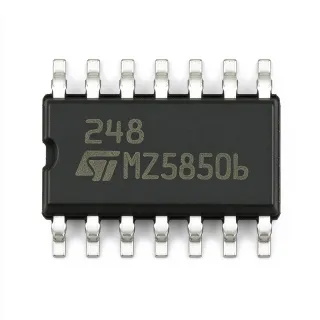
TS374ID Low-Power Quad Comparator | STMicroelectronics
MPN: TS374ID ✓ Hoạt độngTS374ID Tóm tắt
A voltage comparator is an analog signal-conditioning integrated circuit that compares two input voltages and changes its output state when the difference crosses a defined threshold. The TS374ID belongs to the comparator hierarchy, within analog ICs and signal-conditioning semiconductors. Its four channels can perform independent comparisons while sharing one supply and ground connection, reducing component count in multi-channel monitoring designs.
Key characteristics include four independent differential comparators, low-power CMOS operation, low input offset voltage, a 3 V to 16 V operating range, and open-drain outputs. The open-drain architecture allows each output to be pulled up to the required logic level with an external resistor, which is useful when interfacing the TS374ID to systems operating above or below its supply voltage.
The TS374ID uses STMicroelectronics silicon linear MOS technology to achieve its consumption-to-speed balance. Its typical 200 ns response time supports faster threshold decisions than general-purpose slow comparators, while the high typical input impedance reduces loading on the sensed source. Each differential input pair provides a non-inverting and an inverting comparison input, and the output indicates which input is higher.
Typical uses include sensor threshold detection, battery and power-supply monitoring, industrial control logic, window comparators, overvoltage detection, and general digital control interfaces. The quad configuration is particularly useful when a board must monitor several independent analog quantities, such as temperature, pressure, current, or supply rails.
Designers should use pull-up resistors on all open-drain outputs and confirm that output rise time, input common-mode range, and supply timing meet the system requirements. Care is also needed when several comparators can pull an output low simultaneously, because the shared pull-up resistor must tolerate the combined sink current.
This page combines the TS374ID electrical characteristics, package details, practical circuit considerations, and package-compatible replacement guidance to support faster component selection, footprint verification, and second-source planning.
Bộ thay thế dễ dàng lắp đặt cho TS374ID — cùng gói, chân-to-chân tương thích. Các bộ phận yêu cầu hàn PCB bị loại trừ.
Các biến thể trong loạt này
Các mẫu cùng loạt có thể lắp đặt dễ dàng tương thích với TS374ID (cùng hình factor và footprint) — khác nhau ở Comparator Type, Mounting Type, Package, Process Technology.
TS374CD
✅ Drop-In ⚠️ Thông số chưa được xác minhLiên hệ để biết giá
Xem tài liệu →TS374YD
✅ Drop-In ⚠️ Thông số chưa được xác minh📋 Tham chiếu thay thế (không có trong danh mục)
TS374AD
✅ Drop-In ⚠️ Thông số chưa được xác minh📋 Tham chiếu thay thế (không có trong danh mục)
TLC374ID
✅ Drop-In📋 Tham chiếu thay thế (không có trong danh mục)
TLC374CP
✅ Drop-In ⚠️ Thông số chưa được xác minh📋 Tham chiếu thay thế (không có trong danh mục)
TS374ID Tỷ lệ tối đa & tính chất điện
| Comparator Type | Quad differential voltage comparator |
| Number of Channels | 4 |
| Supply Voltage Range | 3 V to 16 V |
| Kiểu đầu ra | Open-drain |
| Response Time | 200 ns typical |
| Input Impedance | 10^12 ohm typical |
| Supply Configuration | Single or dual supply |
| Process Technology | Silicon linear MOS process |
| Hộp | 14-pin SOIC |
| Kiểu lắp đặt | Surface mount |
| Logic Compatibility | TTL-compatible output |
| Maximum Operating Temperature | 125 °C |
| Trạng thái RoHS | Unknown |
| REACH Status | Unknown |
| Automotive Qualification | Not applicable or not stated |
| Lead-Free Status | Unknown |
Hướng dẫn cấu hình chân TS374ID 14-pin soic
Cấu hình chân cho TS374ID (14-pin soic gói). Thành phần số hiệu này có chân đầu vào, đầu ra và nguồn cung cấp. Tham khảo tài liệu thông số kỹ thuật của nhà sản xuất để biết cấu hình chân bù, bù trừ và chân kích hoạt. Hoàn hảo cho điều kiện tín hiệu và mạch khuếch đại.

Không có dữ liệu chân cụ thể sẵn có cho TS374ID.
Tham khảo: tài liệu kỹ thuật cho cấu hình chân đầy đủ.
Ứng dụng tiêu biểu
TS374ID phù hợp cho 6 Áp dụngs: Industrial Sensor Threshold Detection, Battery and Power-Supply Monitoring, Overvoltage and Undervoltage Protection, Window Comparison and Limit Control, Digital Control Interface, Portable and Battery-Powered Equipment.
Industrial Sensor Threshold Detection
The TS374ID fits industrial sensor threshold detection because its four independent differential channels can compare multiple sensor outputs without requiring four separate comparator packages. The 3 V to 16 V operating range supports common industrial supply levels, while the typical input impedance of 10^12 ohm minimizes loading on high-impedance sensor networks. A 200 ns typical response permits quick decisions around process limits or alarm setpoints. Each channel should use its differential inputs around the required threshold and its open-drain output should have a pull-up resistor to the controlling logic voltage. Verify the input common-mode range and account for the maximum operating temperature of 125 °C.
Được đề xuất
Battery and Power-Supply Monitoring
The TS374ID is useful for monitoring several battery or power-supply conditions in one compact circuit. Four differential channels can supervise individual rails, charger status signals, or divided battery voltages, while the 3 V to 16 V supply range provides flexibility across low- and mid-voltage systems. Open-drain outputs can pull down a shared fault or power-enable line, although the pull-up resistor must be sized for the combined sink current when multiple channels activate together. The low-power CMOS design also avoids the higher quiescent demand associated with many bipolar comparators. Confirm each monitored voltage remains inside the input common-mode range before selecting resistor dividers.
Được đề xuất
Overvoltage and Undervoltage Protection
The TS374ID supports independent overvoltage and undervoltage protection by dedicating its four differential comparator channels to separate power conditions. A resistor-divider network can translate each monitored rail to the comparator input range, and the open-drain output can directly drive a system fault line or regulator disable function. Its 200 ns typical response time supports fast fault detection, but propagation through external dividers and pull-up networks should also be included in the end-to-end response assessment. The 3 V to 16 V operating range allows the comparator to be powered from a regulated rail in many systems. Validate common-mode limits, output sink current, and behavior during startup.
Được đề xuất
Window Comparison and Limit Control
The TS374ID is appropriate for window comparison because each differential channel can evaluate whether an input lies above, below, or between selected limits. Four channels can monitor one analog quantity at several thresholds or compare multiple quantities against lower and upper limits. Open-drain outputs make it possible to combine channel states into a wired fault indication when the circuit design permits wired-AND operation. The high typical input impedance of 10^12 ohm reduces the effect of threshold dividers, and the 200 ns typical response provides rapid switching for control decisions. Size the pull-up network for the required rise time and worst-case number of simultaneously low outputs, while confirming the input common-mode range.
Được đề xuất
Digital Control Interface
The TS374ID can serve as the analog decision-making front end for a digital controller. External sensor signals or resistor-divider outputs enter the differential inputs, and the open-drain comparator outputs translate analog threshold crossings into logic states for a microcontroller, programmable controller, or monitoring circuit. The quad arrangement consolidates several decisions into one 14-pin SOIC package, helping conserve PCB area. Its low-power CMOS operation and typical 200 ns response are useful when the controller must react quickly without continuously switching a large converter. The external pull-up voltage can match the controller logic level, but the resulting rise time and the comparator input common-mode limits must be checked before layout release.
Được đề xuất
Portable and Battery-Powered Equipment
The TS374ID supports compact battery-powered equipment that requires several low-power threshold decisions. Its low-power quad CMOS implementation provides four comparison channels in a single 14-pin SOIC package, while the 3 V to 16 V supply range covers common portable-system rails. The high typical input impedance helps preserve battery life when the comparator monitors high-impedance dividers or sensing nodes. Open-drain outputs permit pull-ups to a nearby low-voltage logic rail and can limit current by using appropriately sized resistors. Design the system so inactive channels do not prevent the required supply current from being reached, and verify the complete signal range against the input common-mode specifications.
Được đề xuất
Tóm tắt các sản phẩm được đề xuất
Dữ liệu tham khảo kỹ thuật cho TS374ID — so sánh, hướng dẫn thiết kế và thông tin tuân thủ.
Hướng dẫn chọn lựa
So sánh với các sản phẩm thay thế
| Tham số | Sản phẩm này | TS374CD | TS374YD | TS374AD | TLC374ID | TLC374CP |
|---|---|---|---|---|---|---|
| Package | 14-pin SOIC | 14-pin SOIC | 14-pin SOIC | 14-pin SOIC | 14-pin SOIC | 14-pin SOIC |
| Brand | STMicroelectronics | STMicroelectronics | STMicroelectronics | STMicroelectronics | Texas Instruments | Texas Instruments |
| Number of Comparator Channels | 4 | 4 | 4 | 4 | 4 | 4 |
| Output Type | Open-drain | Open-drain | Open-drain | Open-drain | Open-drain | Open-drain |
Bảo phân biệt quan trọng
- Fast typical response in a quad open-drain comparator (vsTLC374ID)
- Wide operating supply range for threshold and monitoring circuits (vsTS374CD)
- High input impedance reduces sensor-node loading (vsTLC374CP)
- Four independent channels reduce package count (vsTLV2402ID)
Ghi chú thiết kế
Route each differential input as a short, impedance-matched pair and keep it away from high-current switching nodes. Place the external pull-up resistor close to the associated open-drain output so that parasitic capacitance does not excessively slow the rising edge. Preserve a continuous ground-return path beneath the device where the board layout permits, and check the manufacturer pin-description table before assigning all 14 package pins.
Calculate the output rise time from the pull-up resistance, load capacitance, and the comparator’s sink-current limit rather than relying only on the 200 ns typical response specification. If several open-drain outputs share one pull-up, verify the maximum combined sink current and the resulting logic-low level. Add filtering only where required, because excessive capacitance can slow transitions and change the effective system response.
Confirm that every input voltage remains inside the comparator’s common-mode range at the minimum operating supply. Do not assume that the 3 V to 16 V supply rating automatically permits input signals spanning the full supply rail. Also distinguish the device’s maximum operating temperature from the temperature grades of replacement variants, since an otherwise pin-compatible part may not satisfy high-temperature requirements.
Use a local bypass capacitor at the supply pins and keep the return connection short to reduce supply noise coupled into the threshold decision. Because the outputs are open-drain, the pull-up voltage may differ from the comparator supply, but it must remain within the output and downstream-device limits. Verify startup behavior so that an uncontrolled input does not create an unintended fault indication or power-enable transition.
Thông tin tuân thủ
No specific RoHS, REACH, lead-free, halogen-free, or conflict-minerals declarations are stated in the manufacturer and distributor descriptions. The TS374ID is an analog comparator IC rather than an automotive-qualified device.