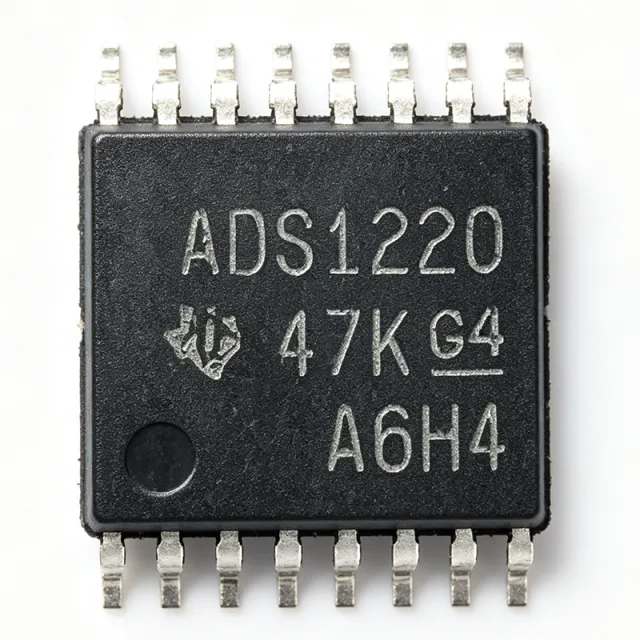
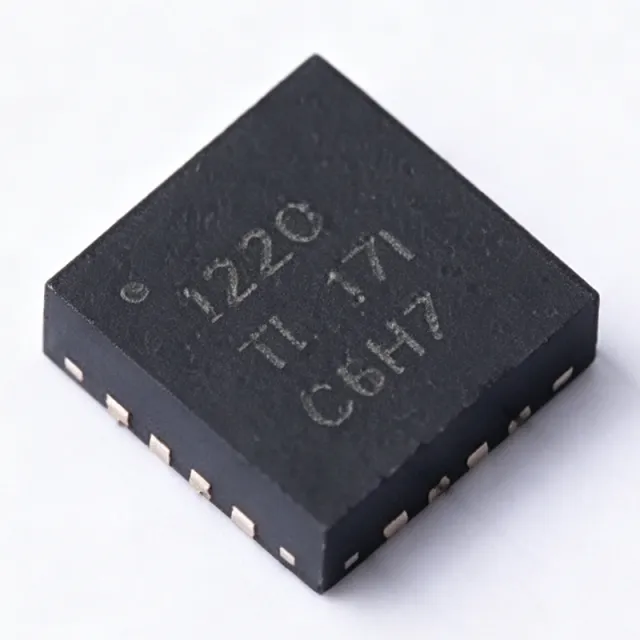
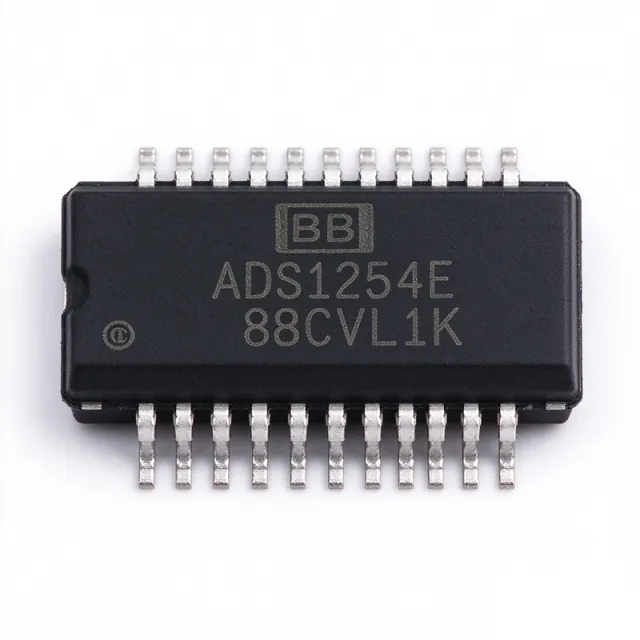
ADS1240E
ADS1240E - 24-Bit, 4-Channel Delta-Sigma ADC | TI
Texas Instruments ADS1240E is a 24-bit, four-channel delta-sigma analog-to-digital converter rated for 30 samples per second, operating from 2.7 V to 5.25 V in a 24-SSOP package. It combines a programmable-gain amplifier, four analog inputs, an SPI-compatible serial interface, and eight configurable GPIO pins for precision measurement systems.
A delta-sigma ADC is a data-converter category that uses oversampling, noise shaping, and digital filtering to obtain high resolution from low-frequency or near-DC signals. The ADS1240E belongs to the broader ADC > delta-sigma ADC > precision data-converter hierarchy and is designed for sensors whose useful bandwidth is much lower than the converter's sampling capability. Its 24-bit no-missing-code operation and 21-bit effective resolution support accurate measurement of small signals from bridges, strain gauges, thermocouples, and industrial transducers.
Key features include programmable PGA gains from 1 through 128, 0.0015% integral nonlinearity, and simultaneous 50 Hz and 60 Hz rejection of at least 90 dB. Single-cycle settling helps reduce the time required to establish each conversion result. The SPI-compatible serial interface and up to eight configurable I/O pins simplify connection to microcontrollers, programmable logic, and dedicated industrial controllers while supporting alarm, excitation, and digital control functions.
The converter uses a delta-sigma architecture to trade conversion speed for resolution and noise performance. At a 30-SPS data rate, the architecture is appropriate for slow sensor signals rather than waveform sampling. The programmable PGA accepts low-level inputs while reducing the signal range that must be resolved by the converter. Select the gain, data rate, digital filter configuration, and input reference according to the sensor output range, common-mode voltage, required update rate, and rejection of line-frequency interference.
Typical uses include smart transmitters, industrial process-control loops, electronic weight scales, chromatography systems, portable instrumentation, pressure measurement, and low-level bridge excitation. The four-input architecture allows multiple sensor channels to share the converter when each can meet the settling time, common-mode range, and filtering requirements of the selected configuration.
For layout, keep analog input and reference traces short, place input filtering and decoupling capacitors close to their associated pins, and use a quiet ground return for the converter. A solid ground plane and separation from switching nodes reduce coupling into the high-resolution front end. Verify the reference voltage, common-mode limits, input filtering, and digital interface timing before committing the PCB layout.
This product record combines manufacturer specifications with practical guidance for sensor measurement design, application selection, interface planning, and replacement evaluation. It also identifies same-footprint alternatives and clearly distinguishes drop-in options from devices that would require a different package or redesigned analog interface.
詢價
聯絡我們