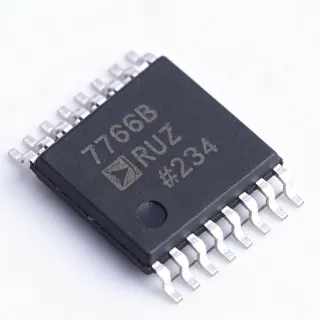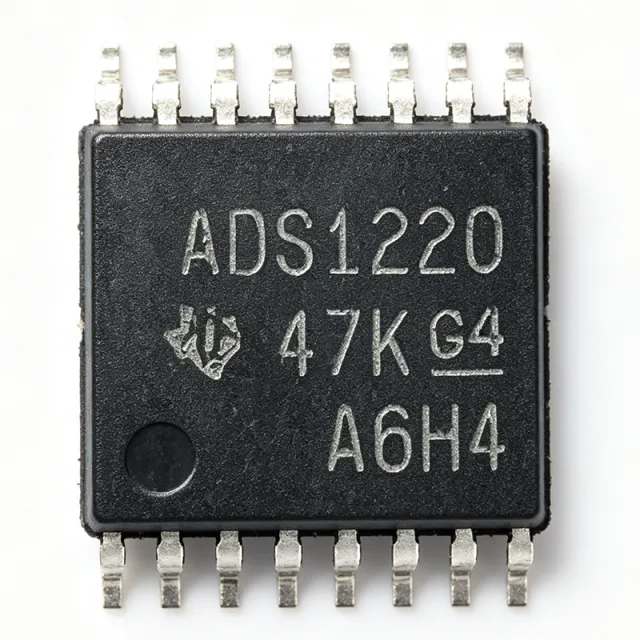
ADS1220IPWR - 24-Bit 2kSPS Delta-Sigma ADC | Texas Instruments
MPN: ADS1220IPWR ✓ 啟用中ADS1220IPWR 概覽
A delta-sigma ADC is a type of analog-to-digital converter that oversamples the input signal and applies digital filtering to achieve very high resolution, making it the dominant architecture in the precision data-converter hierarchy (ADC -> precision ADC -> sigma-delta ADC -> data converter) for measuring small sensor signals. Where successive-approximation (SAR) ADCs favor speed, delta-sigma converters favor noise-free resolution, which is why they dominate sensor front ends.
Key features of the ADS1220 include a flexible input multiplexer supporting two differential or four single-ended inputs, a low-noise PGA that reduces system component count, two integrated matched IDACs for ratiometric 3-wire and 4-wire RTD measurements, and an on-chip reference that eliminates external reference circuitry. The integration of PGA, VREF and IDACs in a small TSSOP-16 footprint is the part's central value proposition: TI positions it explicitly as a way to reduce system cost and bill-of-materials count in small-signal sensor applications.
Architecturally, the device combines the delta-sigma modulator with a programmable digital filter, allowing trade-offs between output data rate (up to 2 kSPS) and noise performance. The SPI-compatible serial interface provides data reads, register configuration, and a DRDY output for deterministic cycle timing, simplifying interfacing with any MCU, including TI MSP430 and other low-power hosts.
Typical applications include RTD and thermocouple temperature measurement, bridge sensors such as load cells and pressure sensors, battery monitoring, and portable industrial instrumentation where low power and small size matter.
Design consideration: use the two IDACs with a precision reference resistor to build ratiometric RTD front ends; this cancels IDAC drift from the measurement, but budget the PGA headroom so IDAC compliance voltage plus sensor drop stays within the supply.
This page synthesizes distributor pricing, drop-in alternatives, pinout, design notes and comparison data not consolidated in the manufacturer datasheet.
直接替換替代品,適用於 ADS1220IPWR — 相同封裝,腳位對腳位相容。需重新設計 PCB 的不同封裝零件不列入。
此系列的變體
與下列產品可直接替換的同系列型號: ADS1220IPWR (相同外形與佔位) — 差異在於 Package, Architecture, Resolution, 50/60 Hz Rejection, Converter Type.
MCT1220
📋 參考替代品(不在目錄中)
ADS1220IPWR 最大額定值與電氣特性
| 解析度 | 24 bit |
| Maximum Sample Rate | 2 kSPS |
| Input Channels | 4 (2 differential or 4 single-ended) |
| Architecture | Sigma-Delta |
| 介面 | SPI |
| Integrated PGA | Yes, low-noise programmable gain amplifier |
| Integrated Reference | Yes, internal VREF |
| Excitation Current Sources | 2 programmable IDACs |
| 封裝 | 16-TSSOP |
| 工作溫度 | -40C to +125C |
| 安裝類型 | Surface Mount |
| Power Consumption | Low power (per TI product description) |
| Typical Price (qty 1) | from $1.91 (LCSC, as of 2026-09-03) |
ADS1220IPWR 腳位配置
| 腳位 1 | AIN0 — Analog input 0 / multiplexer input |
| 腳位 2 | AIN1 — Analog input 1 / multiplexer input |
| 腳位 3 | AIN2 — Analog input 2 / multiplexer input |
| 腳位 4 | AIN3 — Analog input 3 / multiplexer input |
| 腳位 5 | AVSS — Analog negative supply / ground |
| 腳位 6 | AVDD — Analog positive supply |
| 腳位 7 | DOUT/DRDY — Serial data output / data-ready indicator |
| 腳位 8 | SCLK — SPI serial clock input |
| 腳位 9 | DIN — SPI serial data input |
| 腳位 10 | CS — SPI chip select (active low) |
| 腳位 11 | DVDD — Digital supply |
| 腳位 12 | DGND — Digital ground |
| 腳位 13 | REFN0 — External reference 0 negative input |
| 腳位 14 | REFP0 — External reference 0 positive input |
| 腳位 15 | REFP1/AIN0 — Alternate reference 0 positive input / multiplexed analog input (per datasheet) |
| 腳位 16 | REFN1/AIN1 — Alternate reference 0 negative input / multiplexed analog input (per datasheet) |
典型應用
ADS1220IPWR 適用於 6 應用s: RTD Temperature Measurement, Thermocouple Input Modules, Load Cell and Bridge Sensor Weighing, Battery-Powered Portable Instrumentation, Pressure Sensor Signal Conditioning, Battery Management and Cell Monitoring.
RTD Temperature Measurement
The ADS1220IPWR fits RTD measurement because its two programmable IDACs, integrated PGA and on-chip reference form a complete ratiometric front end: the IDACs excite the RTD, the PGA amplifies millivolt-level signals into the 24-bit ADC range, and the matched current sources enable 3-wire and 4-wire lead-resistance cancellation. In a typical PT100 circuit the IDAC current is routed through the sensor and a precision reference resistor, so the ADC digitizes the ratio and IDAC drift largely cancels. At slow data rates the noise floor supports sub-0.1C resolution, and the low-power operation suits multi-channel temperature banks polled sequentially through the input multiplexer.
推薦
Thermocouple Input Modules
Thermocouples produce microvolt-per-degree signals, which is precisely where the ADS1220IPWR's 24-bit delta-sigma core and low-noise PGA deliver value: at low data rates the effective resolution resolves tens of microvolts, enough for fraction-of-a-degree accuracy across type K, J and T elements. Cold-junction compensation is handled by routing an RTD or on-board sensor to a spare multiplexer channel, all digitized by the same IC. The integrated reference removes one external precision component, and the SPI interface plus DRDY output lets a low-cost MCU cycle-read multiple thermocouple channels deterministically. Industrial thermocouple input modules therefore collapse an entire analog front end into one small TSSOP-16 device.
推薦
Load Cell and Bridge Sensor Weighing
Strain-gauge load cells output only a few millivolts per volt of excitation, so bridge measurement demands high resolution and clean gain - both strengths of the ADS1220IPWR. The PGA boosts the differential bridge signal to exploit the full 24-bit dynamic range, while the internal reference supports ratiometric operation that cancels excitation-voltage drift from the weight reading. At 2 kSPS maximum rate the device covers typical weigh-scale and force-sensing update requirements, and its low power suits battery-powered portable scales. The small 16-TSSOP footprint lets designers embed the front end close to the load cell connector, shortening analog traces and improving noise immunity in industrial weighing systems.
推薦
Battery-Powered Portable Instrumentation
The ADS1220IPWR's low-power delta-sigma architecture, duty-cycled operation through its SPI interface, and integration of PGA, reference and IDACs make it attractive for battery-powered data loggers and handheld meters. Because one IC replaces a PGA, reference and current-source BOM section, quiescent budget and board area both shrink - key constraints in portable devices. The multiplexer allows one ADS1220 to scan several sensors sequentially under MCU control, further reducing per-channel power. Designers typically keep the converter in shutdown between conversions and exploit DRDY interrupt timing so the host MCU sleeps during conversions, extending battery life in field instrumentation measuring pressure, temperature or pH.
推薦
Pressure Sensor Signal Conditioning
Bridge-type pressure transducers, like load cells, produce small differential outputs that the ADS1220IPWR digitizes directly: the PGA provides the gain, the delta-sigma core supplies 24-bit resolution, and ratiometric reference operation ties the reading to the excitation source so supply drift cancels. In industrial pressure transmitters the IDACs can also support diagnostics by injecting test currents through the bridge to detect open or shorted elements - a common functional-safety requirement. The device's -40C to +125C rating covers most process-instrument ambient ranges, and its compact TSSOP-16 package fits the tight headspace of transmitter housings, making the ADS1220 a frequent front-end choice in pressure module designs.
推薦
Battery Management and Cell Monitoring
While dedicated battery-management ICs handle stack supervision, the ADS1220IPWR serves precision auxiliary measurement in BMS front ends: monitoring shunt or hall-derived current signals, sense-resistor voltages, and temperature arrays with 24-bit accuracy. The PGA handles small shunt voltages directly, and the IDACs can excite NTC thermistor dividers for temperature readings referenced to the same internal reference, keeping all channels consistent. Where eight simultaneous channels are needed, TI's ADS131M08 complements rather than replaces the ADS1220; the latter excels when a few high-accuracy, low-rate channels must be measured inside a power-constrained pack-level board. The -40C to +125C range matches automotive-adjacent battery environments.
推薦
推薦產品摘要
工程參考資料,適用於 ADS1220IPWR — 比較、設計指引及合規資訊。
選型指南
與替代品比較
| 參數 | 本產品 | MCT1220 |
|---|---|---|
| Package | 16-TSSOP | 16-TSSOP - same |
| Brand | Texas Instruments | Nanjing Modu Zhixin |
| Resolution | 24 bit | 24 bit |
| Input Channels | 4 (2 diff / 4 SE) | 4 (2 diff / 4 SE) |
| Integrated PGA | Yes | Yes |
| IDACs | 2 programmable | 2 programmable |
| Interface | SPI | SPI |
主要差異化特點
- Complete analog front-end integration (對比MCT1220)
- Two matched IDACs purpose-built for RTD wiring cancellation (對比ADS1256)
- Trade-off: 2 kSPS ceiling (對比ADS1256)
設計說明
Separate the analog and digital ground domains and join them at a single star point beneath the ADS1220IPWR. Place the AVDD and DVDD decoupling capacitors (typ. 100 nF ceramic plus bulk) within 2 mm of pins 6/11 respectively, with solid return paths. Keep the switched SPI lines (SCLK, DIN) away from AIN0-AIN3 and REFP0/REFN0 traces to prevent digital noise coupling into the 24-bit measurement path. Use a ground pour under the ADC region and route the reference-input traces as short, matched pairs.
Because the ADS1220 is a delta-sigma converter, the digital filter attenuates out-of-band noise but the front end is still sensitive to differential-mode and common-mode interference at low data rates. Use RC differential and common-mode filtering on the analog inputs (antialiasing and EMI), and when using external REFP0/REFN0, drive the reference from a low-noise source or use the internal reference. Apply ratiometric configurations (reference resistor + IDAC) wherever possible so drift terms cancel instead of being specified out.
Verify PGA input headroom when IDACs are active: excitation current through the sensor plus reference resistor must stay inside the PGA linear range at the chosen gain, or the reading will clip silently. Also remember CS must frame every SPI transaction and DRDY (shared on DOUT) must be monitored to read complete conversions - reading mid-conversion returns stale data. When converting a design from the ADS1220 TSSOP-16 to the VQFN-16 variant, the footprint is NOT drop-in; pads differ.
合規資訊
Standard current-production TI catalog part in lead-free TSSOP; formal RoHS/REACH declarations should be pulled from TI's quality portal for your date code.