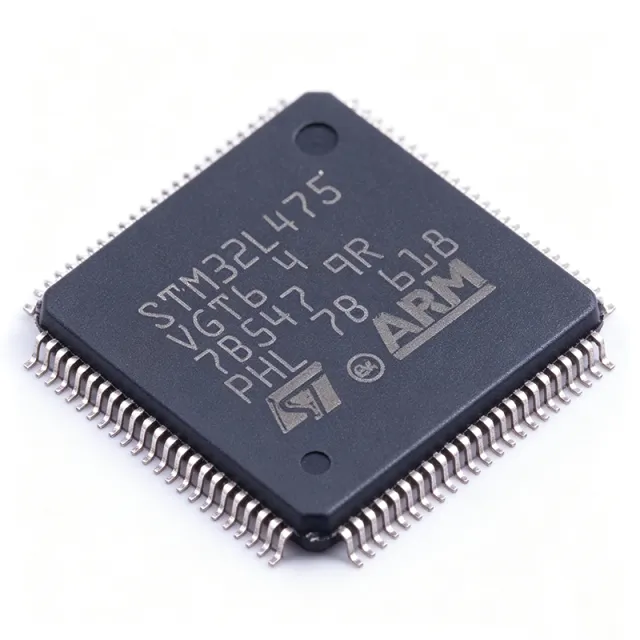
STM32L486RGT7
STM32L486RGT7 - 80MHz Cortex-M4 MCU | STMicroelectronics
The STMicroelectronics STM32L486RGT7 is an ultra-low-power 32-bit Arm Cortex-M4 microcontroller with FPU, operating at up to 80 MHz, with 1 MB of Flash memory, USB OTG, AES-256, DFSDM, LCD support, and 64-LQFP (10 x 10 mm) packaging. The device combines 100 DMIPS-class processing performance with a broad set of low-power peripherals for embedded control, communications, sensing, and human-interface applications.
An ultra-low-power microcontroller is a semiconductor device designed to conserve energy while executing control workloads between periods of active processing. The STM32L4 product family belongs to the MCU hierarchy, combines an Arm Cortex-M processor core with embedded Flash, SRAM, timers, communication peripherals, and low-power features, and supports both real-time control and connected embedded-product designs. The STM32L486RGT7 also integrates a floating-point unit for efficient arithmetic in control, audio, and signal-processing workloads.
Key features include an Arm Cortex-M4 32-bit RISC core operating up to 80 MHz, 1 MB of Flash memory, 100 DMIPS processing performance, a single-precision FPU, and hardware AES-256 encryption. USB OTG expands the peripheral set for USB-connected data acquisition, configuration, or control interfaces. DFSDM supports digital-filtering and sigma-delta conversion workflows, while the LCD interface extends the device toward display-oriented embedded products.
The STM32L486 architecture combines a 32-bit RISC processor, direct-memory-access capabilities, nested-vectored interrupt handling, and extensive peripheral integration. Its USB interface, digital filters, cryptographic accelerator, and display support reduce the need for external components in connected sensing systems. The 64-LQFP package provides a conventional leaded footprint with accessible pins for programming, communication, mixed-signal inputs, and general-purpose control.
Typical applications include industrial sensor hubs, USB-connected test instruments, low-power industrial controllers, portable medical or laboratory equipment, compact human-interface systems, and secure embedded gateways. The combination of 80 MHz processing, 1 MB Flash, FPU, USB OTG, AES-256, DFSDM, and LCD support allows a single device to combine real-time acquisition, local processing, secure data transfer, and user-interface functions.
PCB design should preserve the pin assignments and power requirements specified by the manufacturer datasheet. Place decoupling capacitors close to the supply pins, route sensitive analog and communication signals away from high-switching-current paths, and confirm the exposed programming and debug interface requirements before releasing the layout. Firmware, peripheral configuration, clock settings, and USB enumeration must also be validated on the assembled board.
This page organizes the core MCU specifications, package information, sourcing workflow, and design guidance for engineers evaluating the STM32L486RGT7. It also identifies same-family drop-in candidates while making clear where memory capacity, temperature grade, or peripheral differences require engineering review before substitution.
詢價
聯絡我們