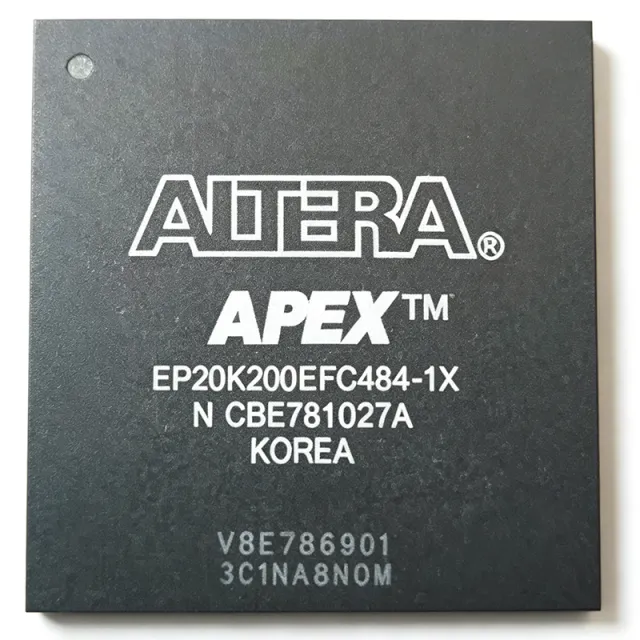
EP20K200CQ240C8N
EP20K200CQ240C8N - APEX 20KC FPGA 200K Gates | Altera
The Altera EP20K200CQ240C8N is an APEX 20KC programmable logic device and field-programmable gate array (FPGA) offering 200K typical gates, 8,320 logic elements, 168 dedicated I/O lines, 164 input terminals, 160 dedicated I/O pins, and a maximum internal clock frequency of 301.21 MHz. It is built with 0.15 um process technology, powered from a 1.8 V core supply, and supplied in a 240-lead PQFP (CQ240) surface-mount package.
An FPGA is an integrated circuit whose logic fabric and routing are configured after manufacturing to implement arbitrary digital logic. EP20K200CQ240C8N sits in the programmable logic hierarchy: FPGA -> programmable logic device -> logic IC -> integrated circuit. This older APEX 20KC family was designed for system-level integration without the high cost of custom ASICs. On a board, it replaces discrete glue logic, microprocessor peripherals, memory controllers, and bus-bridge circuits, while retaining in-system reprogrammability through a configuration device.
Key features include the large 200K-gate capacity, 8,320 logic elements for medium-density designs, 168 bidirectional I/O lines for wide parallel buses, and a rated 301.21 MHz maximum internal clock frequency. The 1.8 V core reduces dynamic power compared with earlier 2.5 V/3.3 V FPGA families, while the 0.15 um geometry provides a practical balance between density and speed. The 240-pin PQFP package is a board-friendly, conventional surface-mount format for 2000-era equipment and remains available through the legacy/surplus channel.
Architecturally, the APEX 20KC family implements programmable logic with an embedded array for memory and high-speed I/O in a single device. The EP20K200 datasheet states that an Altera enhanced configuration device—a single-device, high-speed, advanced configuration solution for high-density FPGAs—contains a configuration controller and flash memory. This architecture allows the FPGA to be loaded from industry-standard configuration devices and, where necessary, re-loaded during board bring-up. The commercial C-grade and 8 speed grade balance cost and performance for communication and industrial boards.
Typical applications include protocol bridging, communication line-card logic integration, DSP pre/post processing, video-image pipelines, industrial automation I/O control, and legacy FPGA replacement. The 168 I/O lines provide sufficient connectivity for 32-bit processor buses, SRAM/SDRAM interfaces, and multiple serial ports. The 301.21 MHz internal frequency supports demanding data-path applications while the 1.8 V core maintains moderate power dissipation in 240-pin boards.
When designing with EP20K200CQ240C8N, provide clean, low-impedance decoupling on all 1.8 V core pins, place a suitable configuration device near the FPGA, and confirm every VCCIO bank voltage against the I/O standard used. Because this is an older device, thermal and power calculations should be checked with an early prototype before committing to the final layout.
This page synthesizes distributor specifications, same-package drop-in alternatives, price tiers, and practical design notes not included in the single datasheet PDF, helping engineers select and validate this legacy FPGA faster.
詢價
聯絡我們