DUP2105SOQ - 24V Dual CAN/LIN Bus TVS Protector | Diodes
MPN: DUP2105SOQ ✓ 啟用中DUP2105SOQ 概覽
A TVS (Transient Voltage Suppressor) diode is a clamping device in the broader family of circuit protection components - alongside surge protectors, varistors, and ESD suppressors - that diverts harmful transient energy away from sensitive ICs. Bus protector arrays like the DUP2105SOQ are specialized TVS devices optimized for differential communication lines such as CAN (Controller Area Network) and LIN (Local Interconnect Network), where two lines must be clamped symmetrically to ground without distorting bus signaling.
Key features include a 24V working standoff voltage that accommodates automotive 12V and 24V bus rails with margin, an 8A Ipp surge rating per the 8/20us pulse standard, and low clamping voltage of 44V that keeps downstream CAN/LIN transceiver pins within their absolute maximum ratings. The device meets stringent automotive ESD requirements, protecting against ESD, EMI, and other harmful transient voltage events specified in automotive OEM specifications.
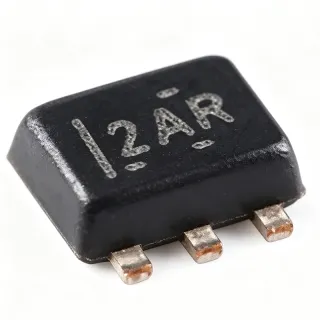
Architecturally, the DUP2105SOQ integrates two bi-directional TVS elements sharing a common structure in one low-capacitance die arrangement, minimizing parasitic contribution to the bus while providing symmetric clamping. Its small SOT-23 footprint lets it be placed directly at the transceiver-side connector, the position where protection is most effective because transient energy is diverted before it propagates along PCB traces.
Typical applications include CAN bus protection in body control modules, LIN transceiver protection in door modules and seat controllers, gateway modules, automotive sensor interfaces, and industrial CAN networks exposed to harsh transients. The new-generation TVS design is explicitly targeted at automotive LIN and CAN transceiver protection per the manufacturer datasheet.
When designing with this device, place it as close as possible to the CAN/LIN connector or transceiver pins, and keep the ground return path short and low-inductance; the protection quality depends heavily on layout, not just the diode ratings. Verify the clamping voltage at your expected surge current leaves margin under the transceiver absolute maximum.
This page synthesizes distributor pricing, drop-in alternatives, and practical design notes not found in the manufacturer datasheet, with all parameters verified against Diodes Incorporated and distributor data as of 2026-10-20.
直接替換替代品,適用於 DUP2105SOQ — 相同封裝,腳位對腳位相容。需重新設計 PCB 的不同封裝零件不列入。
此系列的變體
與下列產品可直接替換的同系列型號: DUP2105SOQ (相同外形與佔位) — 差異在於 Package, Peak Pulse Current (Ipp), Polarity.
NUP2105LT1G
✅ 直接替換 ⚠️ 規格未經驗證📋 參考替代品(不在目錄中)
PESD1CAN
✅ 直接替換 ⚠️ 規格未經驗證📋 參考替代品(不在目錄中)
ESDCAN02-2BWY
✅ 直接替換 ⚠️ 規格未經驗證📋 參考替代品(不在目錄中)
DUP2105SOQ 最大額定值與電氣特性
| Product Type | Dual Line CAN Bus Protector (TVS Diode Array) |
| Configuration | Dual bi-directional |
| Reverse Standoff Voltage (VRWM) | 24 V |
| Clamping Voltage (Vc) | 44 V |
| Peak Pulse Current (Ipp) | 8 A |
| Polarity | Bi-directional |
| Number of Protected Lines | 2 |
| ESD Protection | High ESD surge capability (per datasheet) |
| Applications | CAN bus, LIN transceiver, ESD/EMI transient protection |
| Qualification | AEC-Q101 (Automotive) |
| 封裝 | SOT-23 (3-pin), surface mount |
| 安裝類型 | Surface Mount |
| Packaging | Tape and Reel (T/R) |
DUP2105SOQ sot-23 (3-pin), surface mount 腳位配置指南
DUP2105SOQ(sot-23 (3-pin), surface mount 封裝)的腳位配置。 此功率元件具有閘極、汲極與源極端子。對於非極性封裝,請參閱製造商資料表以取得確切的第 1 腳方向與佈局詳細資訊。常見應用包括電源設計、馬達驅動與負載切換。
無詳細腳位定義資料: DUP2105SOQ.
請參閱 資料表 以查看完整腳位配置。
典型應用
DUP2105SOQ 適用於 6 應用s: Automotive CAN Bus Protection, LIN Transceiver Protection, Body Control Modules (BCM), Industrial CAN Networks, Automotive Sensor Interfaces, Gateway and Domain Controller Modules.
Automotive CAN Bus Protection
The DUP2105SOQ is purpose-built to protect CAN transceivers in automotive networks from ESD, EMI, and transient voltage events. Placed directly at the CAN connector or on the H/L lines at the transceiver side, its dual bi-directional TVS elements clamp both CANH and CANL symmetrically at 44V with an 8A surge capability, keeping transceiver pins within their absolute maximum ratings during load-dump-adjacent transients and ESD strikes. The 24V standoff voltage provides headroom for nominal bus operating voltages without conduction leakage, ensuring bus signaling integrity is not degraded. Its single SOT-23 footprint replaces two discrete TVS diodes, saving board area in dense body control modules. The AEC-Q101 qualification makes it suitable for all in-vehicle CAN nodes including powertrain-adjacent domains.
推薦
LIN Transceiver Protection
LIN networks in door modules, seat controllers, mirrors, and wiper systems run at vehicle battery potential, exposing transceiver pins to harsh transients and ESD. The DUP2105SOQ's 24V reverse standoff accommodates LIN's nominal bus voltage with margin, while its 44V clamping voltage and 8A Ipp rating divert transient energy away from the LIN transceiver pin. According to the Diodes Incorporated datasheet, protecting LIN transceivers from ESD, EMI, and other harmful transient events is a primary intended application. The SOT-23 package fits the constrained PCB area typical of LIN slave node modules, and placement adjacent to the connector intercepts transients before they reach the transceiver or propagate on traces.
推薦
Body Control Modules (BCM)
Body control modules aggregate multiple CAN/LIN interfaces, each requiring transient protection to survive automotive OEM transient immunity requirements. The DUP2105SOQ's dual-line topology lets one SOT-23 device protect a complete CAN or LIN port, reducing component count and placement effort across multi-bus BCM designs. Its AEC-Q101 qualification satisfies the automotive discrete qualification gate required by Tier-1 suppliers, and its small footprint supports the high routing density around the BCM microcontroller and transceiver cluster. The 8A surge capability handles connector-level ESD events during service and assembly, while the 44V clamp protects transceiver absolute maximum ratings during inductive load switching transients common in body electronics environments.
推薦
Industrial CAN Networks
Industrial CAN bus installations in factory automation, motor drives, and building control face ESD from operator access and transients from nearby inductive equipment. The DUP2105SOQ provides the same dual-line clamping protection valued in automotive nodes, with a 24V standoff that suits 24V-tolerant industrial transceiver environments and 44V clamping to shield transceiver inputs. Its bi-directional configuration matches the differential CANH/CANL signaling without adding asymmetric capacitance that would degrade bit timing at 500 kbit/s or 1 Mbit/s. While AEC-Q101 qualification exceeds industrial requirements, it provides reliability assurance margin, and the low-cost SOT-23 solution scales economically across the many nodes in a typical industrial CAN segment.
推薦
Automotive Sensor Interfaces
Sensor nodes distributed around the vehicle - wheel speed, position, and level sensors - frequently use LIN or low-speed CAN for communication and are exposed to harsh connector-level transients. The DUP2105SOQ's SOT-23 footprint fits the minimal PCB area inside sensor housings, and its dual-line protection covers the full two-wire bus interface in one component. The high ESD surge capability cited in the datasheet addresses handling and assembly ESD exposure that small sensor modules are especially vulnerable to. The 24V standoff prevents leakage on battery-referenced lines, preserving measurement accuracy on the communication line and avoiding sleep-mode current drain in modules where the bus must present high impedance when the node is dormant.
推薦
Gateway and Domain Controller Modules
Gateway modules bridging multiple CAN channels, LIN buses, and automotive Ethernet concentrate transient exposure: every external port needs protection. The DUP2105SOQ supports this with one SOT-23 device per two-wire port, keeping the protection BOM compact even in modules with eight or more bus interfaces. Its 8A Ipp rating and 44V clamping guard the transceiver front ends that, if damaged in a gateway, disable entire vehicle subsystems - making protection quality disproportionately important here. The AEC-Q101 qualification aligns with the qualification expectations of domain and zonal controller platforms. Placement at each connector interface, with short low-inductance ground returns, ensures the specified clamping performance is achieved on the PCB.
推薦
推薦產品摘要
工程參考資料,適用於 DUP2105SOQ — 比較、設計指引及合規資訊。
選型指南
與替代品比較
| 參數 | 本產品 | NUP2105LT1G | PESD1CAN | ESDCAN02-2BWY | PESD2CAN |
|---|---|---|---|---|---|
| Package | SOT-23 (3-pin) | SOT-23 (3-pin) - same | SOT-23 (3-pin) - same | SOT23-3 - same | SOT-23 (3-pin) - same |
| Brand | Diodes Incorporated | onsemi | NXP Semiconductors | STMicroelectronics | Nexperia |
| Reverse Standoff Voltage | 24 V | 24 V | 24 V | 24 V | 24 V |
| Number of Protected Lines | 2 (dual CAN/LIN) | 2 | 2 | 2 | 2 |
主要差異化特點
- Verified 8A Ipp with 44V clamping (對比PESD1CAN)
- Purpose-built automotive CAN/LIN targeting with AEC-Q101 (對比NUP2105LT1G)
- Single-footprint dual-line integration (對比ESDCAN02-2BWY)
設計說明
Place the DUP2105SOQ within a few millimeters of the CAN/LIN connector entry point or directly at the transceiver bus pins. Transient protection effectiveness is layout-dominated: every millimeter of trace adds series inductance, and ground-return inductance raises the effective clamping voltage seen by the transceiver (V = L x di/dt). Use a dedicated via to the ground plane adjacent to the protector ground pin, route the bus lines straight through the device with no stubs, and keep the transceiver-to-protector segment as short as possible.
Do not select a bus protector whose standoff voltage exceeds your transceiver absolute maximum clamping allowance, and do not assume cross-brand SOT-23 CAN protectors are pin-identical: the assignment of line pins versus ground differs among vendors (for example between the DUP2105SOQ and PESD1CAN pin configurations). Before a drop-in substitution, confirm pin 1/2/3 assignments in both datasheets, verify the clamp voltage at your design surge current stays below the transceiver rating, and re-run your ESD/transient compliance tests on the substituted build.
Estimated: at the 8A Ipp rating, instantaneous clamped power approaches 8A x 44V = 352W during the pulse, but this is a short-duration transient, not continuous dissipation, so no heatsinking is required - the SOT-23 thermal mass handles the pulse. The relevant check is the pulse-energy derating curve in the manufacturer datasheet: confirm your transient waveform duration and repetition rate fall within the rated pulse power region, and derate Ipp at elevated ambient temperature per the datasheet derating curve.
The TVS junction capacitance of a bus protector sits directly on CANH/CANL and adds to total bus loading. While the DUP2105SOQ is designed for CAN/LIN bit rates, long bus stubs or high node counts increase sensitivity to capacitance. Keep connector-side traces short, verify the total node capacitance budget against your CAN FD arbitration-phase timing if applicable, and prefer placing the protector between the common-mode choke and the transceiver rather than between the choke and the connector when common-mode filtering performance must be preserved.
合規資訊
AEC-Q101 automotive qualification for discrete semiconductors is stated in the Arrow.com product listing and implied by the manufacturer datasheet's automotive targeting. RoHS/REACH/lead-free status not stated in provided data - confirm on the Diodes Incorporated product page.