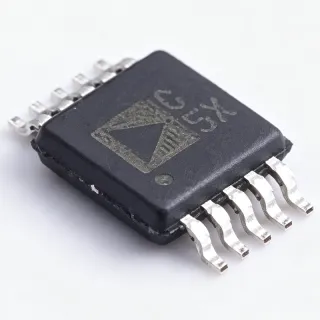
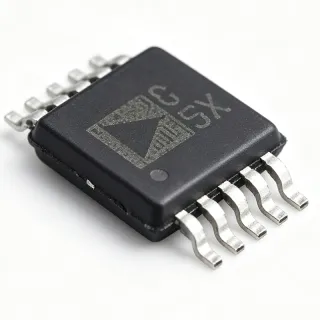
MCP3427-E/UN - 16-Bit Dual-Channel Delta-Sigma ADC | Microchip
MPN: MCP3427-E/UN ✓ 啟用中MCP3427-E/UN 概覽
A delta-sigma ADC is a category of analog-to-digital converter that uses continuous-time oversampling and digital filtering to convert analog input voltages into high-resolution digital codes. Its hierarchy extends from an ADC to a data-acquisition component and ultimately to a signal-chain semiconductor. Compared with flash converters, this architecture is especially useful when low noise, high effective resolution, and integrated differential input handling matter more than very high conversion speed.
The MCP3427-E/UN combines two measurement channels with 16-bit resolution in one compact device. Its differential inputs help reject common-mode noise when the sensor or bridge output is centered around a biased reference. The integrated 2.048 V reference simplifies measurement designs that do not require an external precision reference, while the 15 sps rate suits slowly changing industrial, instrumentation, and sensor signals rather than high-bandwidth waveform acquisition.
Each channel is processed by the converter’s delta-sigma architecture and exposed through the I2C interface. This makes the MCP3427-E/UN appropriate for systems that need accurate readings rather than rapid sampling. The 10-MSOP package also supports compact PCB layouts, although engineers must follow the manufacturer's layout guidance to preserve the low-noise performance of the analog inputs and reference circuitry.
Typical uses include bridge-based pressure and load measurements, industrial process monitoring, portable instrumentation, and low-frequency sensor acquisition. Differential sensing is particularly valuable when a transducer produces a small signal riding on a larger common-mode voltage. The 3.3 V or 5 V operation also allows integration with both low-voltage embedded systems and conventional industrial control platforms.
When designing around the MCP3427-E/UN, verify the selected conversion rate, digital filter behavior, input range, and reference configuration against the manufacturer datasheet. Input filtering, grounding, and I2C pull-up placement can materially affect a sensitive measurement, so the analog and digital return currents should be routed to avoid shared high-impedance paths.
This product record combines the verified Microchip product information, distributor availability, package details, and same-family drop-in options. It also adds application guidance, selection criteria, and design notes intended to make the MCP3427-E/UN easier to evaluate than a distributor listing alone.
直接替換替代品,適用於 MCP3427-E/UN — 相同封裝,腳位對腳位相容。需重新設計 PCB 的不同封裝零件不列入。
MCP3426-E/UN
✅ 直接替換 ⚠️ 規格未經驗證📋 參考替代品(不在目錄中)
MCP3424-E/UN
✅ 直接替換 ⚠️ 規格未經驗證📋 參考替代品(不在目錄中)
MCP3425-E/UN
✅ 直接替換 ⚠️ 規格未經驗證📋 參考替代品(不在目錄中)
MCP3428-E/UN
✅ 直接替換 ⚠️ 規格未經驗證📋 參考替代品(不在目錄中)
MCP3421-E/UN
✅ 直接替換 ⚠️ 規格未經驗證📋 參考替代品(不在目錄中)
MCP3427-E/UN 最大額定值與電氣特性
| Converter Type | Delta-sigma analog-to-digital converter |
| 解析度 | 16 bit |
| Number of Input Channels | 2 channels |
| Conversion Rate | 15 samples/s |
| Input Architecture | Differential input |
| Internal Reference Voltage | 2.048 V |
| Differential Input Range | -2.048 V to +2.048 V |
| 供應電壓 | 3.3 V or 5 V |
| Digital Interface | I2C |
| 封裝 | 10-MSOP |
| 腳位數 | 10 pins |
| 安裝類型 | Surface mount |
| Noise Performance | Low-noise converter architecture |
| Accuracy Class | High accuracy |
| Reference Type | On-board precision reference |
| Device Category | Analog-to-digital converter |
MCP3427-E/UN 10-msop 腳位配置指南
MCP3427-E/UN(10-msop 封裝)的腳位配置。 此類比元件具有輸入、輸出與電源腳位。偏移歸零、補償與致能腳位配置請參閱製造商資料表。適用於訊號調理與放大器電路。

無詳細腳位定義資料: MCP3427-E/UN.
請參閱 資料表 以查看完整腳位配置。
典型應用
MCP3427-E/UN 適用於 6 應用s: Industrial Process Measurement, Bridge-Based Pressure Sensing, Portable Instrumentation, Load and Force Measurement, Low-Level Sensor Acquisition, Battery-Powered Environmental Monitoring.
Industrial Process Measurement
The MCP3427-E/UN fits industrial process monitoring where two slowly changing analog signals must be acquired with consistent resolution and a common interface. Its dual differential inputs support measurements from two sensors, while the 16-bit resolution and 15 samples/s rate are appropriate for temperature, pressure, level, and industrial transducer signals. The integrated 2.048 V reference can simplify excitation and conversion calculations when the measurement design is referenced to the internal source. A 3.3 V or 5 V supply also accommodates common industrial controller rails. Engineers should place filtering close to the input pins, use a quiet ground reference, and confirm that the 15 samples/s rate satisfies the process response time.
推薦
Bridge-Based Pressure Sensing
The MCP3427-E/UN is appropriate for bridge or ratiometric sensor acquisition because it provides two differential input channels and a 16-bit conversion result. The ±2.048 V differential range and integrated 2.048 V reference give the designer defined limits when connecting resistive bridges or scaled sensor outputs. Differential measurement helps reject common-mode voltage present in industrial wiring. The converter’s 15 samples/s rate suits pressure and force signals that change slowly relative to the acquisition interval. In a practical circuit, place input protection and filtering close to the ADC, keep the sensor return connected to a low-impedance analog ground, and verify excitation stability because reference and excitation errors can affect ratiometric results.
推薦
Portable Instrumentation
The MCP3427-E/UN supports portable measurement instruments that prioritize low noise and compactness over high-speed sampling. Its 16-bit delta-sigma architecture, two differential channels, and 10-MSOP package allow two sensor signals to be measured without adding two separate converters. Operation from either 3.3 V or 5 V makes it suitable for battery-managed electronics as well as bench equipment. The integrated 2.048 V reference reduces the component count of a standalone measurement front end, although reference accuracy still contributes to total error. Designers should account for battery-rail variation, use low-leakage input networks, and configure acquisition timing around the device’s 15 samples/s conversion rate rather than treating it as a waveform converter.
推薦
Load and Force Measurement
The MCP3427-E/UN can acquire two channels from load-cell-style or force-sensing bridges where low-level differential signals require more resolution than a lower-bit converter provides. The 16-bit result and differential inputs improve measurement integrity when excitation and sensor outputs are referenced to the same node. A 15 samples/s conversion rate is well matched to static force readings, slow ramp tests, and basic load monitoring rather than dynamic vibration analysis. The 10-MSOP package helps keep analog circuitry compact, but successful implementation depends on clean excitation, low-noise grounding, and careful routing of the two input pairs. Engineers should also confirm the converter’s input-range and reference configuration against their bridge excitation voltage before choosing resistor values.
推薦
Low-Level Sensor Acquisition
The MCP3427-E/UN is well suited to sensors whose outputs are small differential signals, such as strain, temperature, or resistive sensing elements. Its 16-bit resolution can preserve useful detail in low-level measurements, while differential inputs help separate the sensor signal from common-mode noise. The 2.048 V internal reference establishes a predictable conversion span, and the 15 samples/s rate supports periodically sampled environmental and condition-monitoring data. A robust design should use shielded or tightly routed sensor wiring, input filtering sized for the required bandwidth, and separate analog and digital return paths. Before deployment, verify the signal’s noise spectrum and settling behavior against the converter’s digital filter and acquisition timing.
推薦
Battery-Powered Environmental Monitoring
The MCP3427-E/UN can serve as the analog measurement section of a battery-powered environmental monitor because it combines two 16-bit differential channels in a compact 10-MSOP package and supports 3.3 V operation. Its 15 samples/s conversion rate is suitable for periodic readings from temperature, humidity, gas, or soil sensors rather than continuous high-rate sampling. The internal 2.048 V reference can simplify calibration, while I2C communication allows a low-power microcontroller to control acquisition and read results. Power-conscious designs should disable or slow conversion where permitted, avoid unnecessary external circuitry, and account for the converter’s own operating current. Sensor excitation and protection circuits must also be switched or designed to avoid injecting avoidable load into the battery.
推薦
推薦產品摘要
工程參考資料,適用於 MCP3427-E/UN — 比較、設計指引及合規資訊。
選型指南
與替代品比較
| 參數 | 本產品 | MCP3426-E/UN | MCP3424-E/UN | MCP3425-E/UN | MCP3428-E/UN | MCP3421-E/UN |
|---|---|---|---|---|---|---|
| Package | 10-MSOP | 10-MSOP | 10-MSOP | 10-MSOP | 10-MSOP | 10-MSOP |
| Brand | Microchip Technology | Microchip Technology | Microchip Technology | Microchip Technology | Microchip Technology | Microchip Technology |
| Input Channels | 2 channels | 1 channel | 4 channels | 4 channels | 8 channels | 1 channel |
| Resolution | 16 bit | 16 bit | 16 bit | 16 bit | 16 bit | 16 bit |
| Converter Architecture | Delta-sigma | Delta-sigma | Delta-sigma | Delta-sigma | Delta-sigma | Delta-sigma |
| Input Type | Differential | Differential | Differential | Differential | Differential | Differential |
| Internal Reference | 2.048 V precision reference | 2.048 V precision reference | 2.048 V precision reference | 2.048 V precision reference | 2.048 V precision reference | 2.048 V precision reference |
| Interface | I2C | I2C | I2C | I2C | I2C | I2C |
| Conversion Rate | 15 samples/s | 15 samples/s | 15 samples/s | 15 samples/s | 15 samples/s | 15 samples/s |
主要差異化特點
- Two differential channels in a compact converter (對比MCP3426-E/UN)
- Avoids unnecessary eight-channel routing (對比MCP3428-E/UN)
- Higher channel availability than a one-channel alternative (對比MCP3421-E/UN)
- Compact 16-bit measurement with an integrated reference (對比MCP3424-E/UN)
設計說明
Route each differential input as a compact, closely coupled pair and place input filtering components close to the corresponding MCP3427-E/UN pins. Keep the analog input section away from the I2C clock and data return currents. The converter’s 16-bit resolution makes small layout-induced errors relevant even though its conversion rate is only 15 samples/s. Verify the final pin assignment against the manufacturer datasheet rather than relying on the 10-MSOP package drawing alone.
Do not treat the 2.048 V internal reference as an unrestricted sensor excitation source. Confirm its current capability, accuracy, temperature behavior, and loading limits in the manufacturer datasheet before powering a bridge or other load from it. External reference use and external-excitation designs have different scaling implications. A common design error is calculating the sensor output against 2.048 V without including bridge excitation tolerance, input limits, and the available conversion span.
The 15 samples/s conversion rate is suitable for slow sensor measurements but not for capturing high-frequency events. Choose external anti-alias filtering based on the actual signal bandwidth and required output rate, and ensure the filter settling behavior is compatible with the converter’s digital filtering. If transient capture is required, a faster ADC should be selected instead of attempting to accelerate the MCP3427-E/UN beyond its specified operating modes.
Separate analog and digital return paths and provide a low-impedance ground reference beneath the converter where the package and board layout permit. I2C pull-up resistors should return to the appropriate digital supply rather than creating a current path through the sensitive analog ground. Decoupling should follow the manufacturer’s recommended network. These precautions matter because ground bounce and shared supply impedance can convert into ADC code error even when the nominal 16-bit resolution is unchanged.
合規資訊
The supplied verified results do not provide explicit RoHS, REACH, AEC-Q100, lead-free, halogen-free, or conflict-minerals statements for this orderable MPN. Compliance fields are therefore left unknown rather than inferred from the family or package.