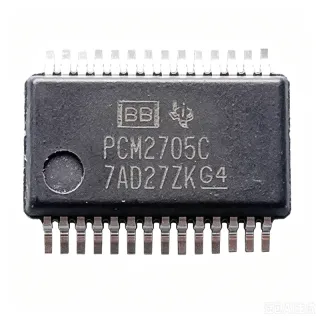
SI3216-BT - 38-TSSOP Voice SLIC/CODEC | Silicon Labs
MPN: SI3216-BT ✗ 停產SI3216-BT 概覽
A SLIC, or subscriber line interface circuit, is the analog front end used to connect a telephone line to a digital voice system. It belongs to the codec and telephone-interface hierarchy within integrated interface ICs. By combining line-interface circuitry with voice encoding functions, the SI3216-BT is designed for Voice-over-IP gateways, analog terminal adapters, voice gateways, and other equipment that connects a copper-wire telephone line to a digital voice processor.
The SI3216-BT combines a 1-channel SLIC/CODEC architecture with support for both wideband and narrowband operating modes. Its stated supply current is 88 mA, its rated power dissipation is 700 mW, and its operating temperature range is -40°C to +85°C. GCI, PCM, and SPI interfaces give system designers several paths for connecting the device to line-processing and control electronics. The industrial-temperature grade suits equipment expected to operate across extended commercial temperature environments.
Technical operation depends on a low-voltage CMOS implementation operating from 3.13 V to 5.25 V. Wideband mode covers 50 Hz to 7.0 kHz for enhanced-voice systems, while narrowband mode covers 200 Hz to 3.4 kHz for conventional telephony. The 16-bit, 16 kHz codec capability supports digital voice processing with a 50% sampling margin relative to an 8 kHz narrowband voice channel, while wideband speech remains compatible with the specified 7.0 kHz audio bandwidth.
Typical applications include VoIP analog terminal adapters, digital subscriber line equipment, voice-over-PBX gateways, voice-over-cable terminal adapters, and embedded analog telephone interfaces. Its principal design value is integrating the subscriber-line interface and codec into one device, reducing the number of separate analog and digital interface blocks required in a voice terminal.
Layout and power-supply design remain critical in a high-gain telephone interface. Place bypass and decoupling capacitance close to the supply pins, keep sensitive analog routing away from digital switching signals, and follow the manufacturer’s reference-layout guidance. Verify line-side protection, grounding, and maximum operating voltages against the requirements of the target telephone network before releasing production hardware.
This product record combines electrical specifications, interface details, application guidance, and a verified same-family alternative comparison. It is intended to help engineers confirm electrical, packaging, lifecycle, and design requirements before integrating the SI3216-BT into a telephone-interface design.
直接替換替代品,適用於 SI3216-BT — 相同封裝,腳位對腳位相容。需重新設計 PCB 的不同封裝零件不列入。
此系列的變體
與下列產品可直接替換的同系列型號: SI3216-BT (相同外形與佔位) — 差異在於 Operating Temperature Range, Package.
SI3216-BT 規格
| Product Type | Single-channel SLIC/CODEC |
| Device Family | ProSLIC |
| Number of Circuits | 1 circuit |
| 介面 | GCI, PCM, and SPI |
| Supply Voltage Range | 3.13 V to 5.25 V |
| 供應電流 | 88 mA |
| Power Dissipation | 700 mW |
| Wideband Audio Range | 50 Hz to 7.0 kHz |
| Narrowband Audio Range | 200 Hz to 3.4 kHz |
| Codec Resolution | 16 bit |
| 取樣率 | 16 kHz |
| 工作溫度範圍 | -40°C to +85°C |
| 封裝 | 38-pin TSSOP |
| Terminal Count | 38 terminals |
| 安裝方式 | Surface mount |
| Process Technology | Low-voltage CMOS |
| Lead-Free Status | Lead free |
SI3216-BT 38-pin tssop 腳位配置指南
SI3216-BT(38-pin tssop 封裝)的腳位配置。 腳位編號、功能與連接圖定義於製造商資料手冊中。請參閱該手冊以取得確切的封裝尺寸與焊接指引。

無詳細腳位定義資料: SI3216-BT.
請參閱 資料表 以查看完整腳位配置。
典型應用
SI3216-BT 適用於 6 應用s: VoIP Analog Terminal Adapter, Voice-over-PBX Gateway, Voice-over-Cable Terminal Adapter, Digital Subscriber Line Terminal, Analog Voice Terminal Equipment, Industrial Voice Control Station.
VoIP Analog Terminal Adapter
The SI3216-BT fits a Voice-over-IP analog terminal adapter because it combines one subscriber-line interface, a voice codec, and GCI, PCM, or SPI connectivity in a single 38-pin TSSOP. Its 3.13 V to 5.25 V operating range is compatible with low-voltage embedded systems, while wideband mode supports 50 Hz to 7.0 kHz audio and narrowband mode supports 200 Hz to 3.4 kHz. The 16-bit, 16 kHz codec gives the host processor a consistent digital voice format, although line protection and system grounding must be designed separately.
推薦
Voice-over-PBX Gateway
The SI3216-BT can provide the analog line-facing section of a voice-over-PBX gateway while a host processor handles packetization and call control. Its GCI, PCM, and SPI interfaces support different processor architectures, allowing the analog voice path to be integrated without adding a separate line-interface IC. Wideband and narrowband modes permit a deployment to serve both enhanced-voice and conventional 3.4 kHz endpoints. Designers should verify clocking, firmware support, ringing-signal behavior, and thermal performance within the complete gateway enclosure.
推薦
Voice-over-Cable Terminal Adapter
The SI3216-BT is suitable for a voice-over-cable terminal adapter that must bridge an analog telephone port and a digital broadband system. Its single-channel SLIC/CODEC architecture consolidates line-interface and codec functions into a 38-pin TSSOP, which can simplify board partitioning. The 88 mA stated supply current and 700 mW power dissipation must be considered alongside the processor, Ethernet interface, and line-driver loads. Follow the manufacturer layout and line-protection guidance to avoid coupling telephone transients into sensitive voice circuitry.
推薦
Digital Subscriber Line Terminal
The SI3216-BT can be used in a digital subscriber line terminal that requires an analog voice channel alongside packet-network functions. Its wideband audio range of 50 Hz to 7.0 kHz supports higher-fidelity speech paths, while narrowband operation covers 200 Hz to 3.4 kHz for legacy compatibility. The PCM and SPI connections offer alternatives for host integration, and the 3.13 V to 5.25 V supply range fits embedded power architectures. Final design work must include surge protection, isolation strategy, return-path design, and line-state verification.
推薦
Analog Voice Terminal Equipment
The SI3216-BT provides the central voice conversion function for analog voice terminal equipment that must connect a copper line to embedded digital control logic. Supporting both wideband and narrowband modes allows one platform to address different voice-service expectations, and the 16-bit, 16 kHz codec operation provides a defined digital representation. The 38-pin TSSOP package supports compact surface-mount assembly, but the telephone line demands careful separation of high-voltage transient paths, analog return connections, digital clocks, and switching-supply nodes.
推薦
Industrial Voice Control Station
The SI3216-BT can support an industrial voice-control station requiring telephone-line compatibility and digital control processing. Its -40°C to +85°C operating range suits equipment expected to operate across extended industrial temperatures, while the three listed interfaces provide architectural flexibility. A single 88 mA supply-current figure and 700 mW rated dissipation should be included in the system power budget. Because the device handles a subscriber line, production design also requires validated protection networks, grounding, EMI control, and environmental testing.
推薦
推薦產品摘要
工程參考資料,適用於 SI3216-BT — 比較、設計指引及合規資訊。
選型指南
與替代品比較
| 參數 | 本產品 | SI3216-GT |
|---|---|---|
| Package | 38-pin TSSOP | 38-pin TSSOP |
| Brand | Silicon Labs | Silicon Labs |
| Product Type | SLIC/CODEC | SLIC/CODEC |
| Number of Circuits | 1 channel | 1 channel |
主要差異化特點
- Single-device integration of analog line interface and voice codec (對比SI3216-GT)
- Defined wideband voice bandwidth (對比SI3216-GT)
- Industrial operating range (對比SI3216-GT)
- Documented 16-bit voice conversion (對比SI3216-GT)
設計說明
Place the input bypass and output decoupling capacitors close to their associated supply pins, and follow the capacitor values and layout geometry specified in the Silicon Labs Si3216 datasheet. Keep the analog line-side return path compact and continuous. Telephone-interface boards combine high-gain analog signals with digital clocks and communication traces, so route those groups separately and establish a clear return-current plan before placing protection components.
Do not treat the matching 38-pin TSSOP package as proof that every SI3216 ordering code is functionally interchangeable. Compare the SI3216-BT and SI3216-GT pin descriptions, line parameters, clock requirements, control behavior, and absolute-maximum ratings directly in the Silicon Labs documentation. Pay particular attention to any ordering-code-specific features because incorrect assumptions can cause startup, ringing, audio-quality, or line-state failures.
Budget the stated 88 mA supply current and 700 mW rated power when sizing the local regulator and PCB copper area. Place low-ESR bypass capacitors at the supply pins, minimize copper and inductance in the high-current return path, and avoid positioning the TSSOP next to a heat source without thermal analysis. Confirm that the 38-pin surface-mount package remains within its intended temperature range across line activity and worst-case system loading.
Keep switching-regulator nodes, high-speed digital clocks, and telephone-line transients away from the codec's sensitive analog nodes. Use a continuous ground reference, controlled return paths, and the manufacturer's recommended line-side protection network. EMI testing should cover active voice calls, ringing transitions, and switching-supply operation because intermittent line events can create disturbances that are not apparent during idle testing.
合規資訊
The product listing identifies the SI3216-BT as lead free. No explicit RoHS, REACH, AEC-Q100, halogen-free, or conflict-minerals declaration was identified.