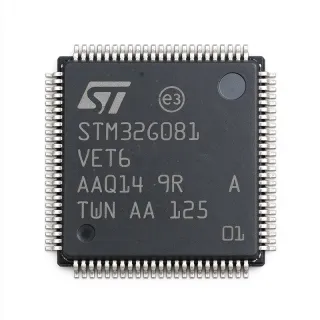
STM32F205VFT6 - 120MHz Cortex-M3 MCU | STMicroelectronics
MPN: STM32F205VFT6 ✓ 啟用中STM32F205VFT6 概覽
A microcontroller, or MCU, is a compact computing device that integrates a processor core, programmable memory, peripherals, and communication interfaces on one semiconductor package. The STM32F20x family belongs to the hierarchy of embedded processor, microcontroller, embedded semiconductor, and general-purpose semiconductor. It is designed for systems that require deterministic real-time control, peripheral connectivity, and a broad software development ecosystem centered on the Arm Cortex-M architecture.
The STM32F205VFT6's principal characteristics include its 120 MHz maximum Cortex-M3 operating frequency, 32-bit processing architecture, and 768 KB Flash capacity. The 2.5 V and 3.3 V supply information published for this exact order code identifies it for conventional embedded and industrial equipment. Its 100-LQFP package provides 100 external leads, allowing access to the peripheral and signal resources associated with the STM32F20x family while supporting surface-mount assembly.
The Arm Cortex-M3 core uses a 32-bit RISC instruction set and belongs to the STM32F2 performance-oriented product family. Operating at up to 120 MHz, the MCU provides substantial computational headroom for control loops, communications protocols, data acquisition, and supervisory logic. The Flash-memory density provides room for a bootloader, application code, configuration data, and field-update functions within a single device. Exact RAM capacity, peripheral inventory, voltage limits, and electrical timing values must be confirmed from the manufacturer documentation for the selected package variant.
Typical uses include industrial automation controllers, communications equipment, data-acquisition systems, embedded gateways, and compact control platforms. The combination of a high-performance Cortex-M3 core and 768 KB Flash is particularly useful when an application combines real-time peripheral control with multiple communication tasks. A network-connected product can use the MCU for protocol processing as well as local sensor acquisition and actuator supervision.
PCB design should treat the 100-LQFP footprint as fine-pitch and route decoupling, clock, reset, and communication signals with careful attention to return paths. Validate power sequencing, boot configuration, oscillator startup, and peripheral pin multiplexing in hardware because software compatibility alone does not guarantee that a board revision can use another member of the STM32F20x family without review.
This product page combines the exact order-code specifications, manufacturer family information, package identification, sourcing details, and replacement analysis. It also distinguishes a documented same-package upgrade from broader MCU alternatives so engineers can assess PCB compatibility, memory requirements, firmware implications, and production continuity before approving a substitution.
直接替換替代品,適用於 STM32F205VFT6 — 相同封裝,腳位對腳位相容。需重新設計 PCB 的不同封裝零件不列入。
STM32F207VFT6
✅ 直接替換📋 參考替代品(不在目錄中)
STM32F205VFT6 最大額定值與電氣特性
| Product Type | 32-bit ARM Cortex-M3 Microcontroller |
| CPU Core | Arm Cortex-M3 |
| Instruction Set | 32-bit RISC |
| Maximum CPU Frequency | 120 MHz |
| Flash Memory Size | 768 KB |
| Flash Organization | 768K x 8 bits |
| 封裝 | 100-pin LQFP |
| Package Body Size | 14 x 14 mm |
| 安裝類型 | Surface Mount |
| 供應電壓 | 2.5 V / 3.3 V |
| Program Memory Type | Flash |
| Packaging Format | Tray |
STM32F205VFT6 14 x 14 mm 腳位配置指南
STM32F205VFT6(14 x 14 mm 封裝)的腳位配置。 此數位 IC 包含 GPIO、通訊介面(UART、SPI、I2C)與電源腳位。替代腳位功能與配置選項請參閱製造商資料表。對嵌入式系統設計與 PCB 佈局至關重要。

無詳細腳位定義資料: STM32F205VFT6.
請參閱 資料表 以查看完整腳位配置。
典型應用
STM32F205VFT6 適用於 6 應用s: Industrial Automation Controller, Communications Gateway, Data Acquisition System, Embedded Network Control, Compact Control Platform, Secure Network Equipment.
Industrial Automation Controller
The STM32F205VFT6 fits industrial automation controllers that combine deterministic control with protocol processing. Its Arm Cortex-M3 core operates at up to 120 MHz, while 768 KB of Flash provides room for control software, configuration data, and a bootloader. The 100-LQFP package exposes the family's peripheral resources through 100 leads, although the exact mixed-signal and communication functions must be checked against the pin-definition table. A typical design would acquire sensor data, execute control algorithms, update machine state, and service an industrial communications link from the same MCU. Validate the industrial temperature grade, supply tolerance, EMC requirements, and isolation boundaries before production deployment.
推薦
Communications Gateway
The STM32F205VFT6 is appropriate for compact communications gateways that must manage multiple protocol tasks while preserving real-time peripheral control. Its 120 MHz Arm Cortex-M3 processor provides substantially more headroom than entry-level 8- or 16-bit controllers, and its 768 KB Flash supports an embedded TCP/IP stack, protocol handlers, logging, and device firmware. In a gateway implementation, the MCU can bridge a local industrial bus to an Ethernet or serial uplink while handling node discovery and watchdog supervision. Keep sensitive communications and clocks on controlled return paths, and verify that the selected STM32F20x peripherals and pins meet the interface requirements of the finished system.
推薦
Data Acquisition System
The STM32F205VFT6 supports data-acquisition systems that combine frequent sampling, local filtering, and host communication. A 120 MHz Cortex-M3 core can execute signal conditioning, scaling, digital filtering, and packet preparation without relying on a separate processor, while 768 KB of Flash accommodates acquisition routines, calibration tables, and firmware updates. The 100-LQFP package provides a broad pin count for digital sensors, control signals, status indicators, and communications. Engineers should map analog inputs through the appropriate external circuitry and use the manufacturer's pin descriptions to avoid conflicts between analog functions, alternate peripheral functions, and debug interfaces.
推薦
Embedded Network Control
The STM32F205VFT6 is well suited to embedded network-control equipment that performs protocol termination, state monitoring, and local actuation. Its 120 MHz Cortex-M3 core supports responsive task scheduling, while 768 KB of Flash provides sufficient storage for an embedded networking stack and application firmware. A network appliance could use the MCU for connected sensors, access-control endpoints, or remote monitoring, with the 100-LQFP package simplifying integration into a multilayer PCB. Before layout release, confirm the required serial, Ethernet-adjacent, timer, and DMA resources in the STM32F20x documentation and review boot behavior so the network interface starts predictably after power restoration.
推薦
Compact Control Platform
The STM32F205VFT6 works in compact control platforms requiring substantial processing speed in a surface-mount package. At up to 120 MHz, the Cortex-M3 core can manage motion sequencing, digital filtering, operator commands, and communication tasks, while 768 KB of Flash accommodates layered control and diagnostic software. The 100-LQFP package offers more pins than smaller MCUs, which can simplify access to timers, serial channels, and digital control signals. Designers should reserve clean routing for oscillators and clocks, maintain short decoupling paths, and confirm that pin multiplexing leaves sufficient I/O for the intended peripherals and production programming interface.
推薦
Secure Network Equipment
The STM32F205VFT6 can serve as the control MCU in secure network equipment where protocol handling, administration, status monitoring, and local fail-safe behavior must coexist. Its 120 MHz Cortex-M3 performance supports responsive processing, and the 768 KB Flash capacity is suitable for embedded stacks and device-management code. In a network appliance, the MCU can supervise links, process configuration, maintain watchdog timers, and coordinate recovery after faults. Physical security, boot protection, key storage, and secure update requirements must be evaluated from the exact device documentation rather than inferred from the family name. PCB implementation should include controlled clock routing and robust power decoupling for reliable field operation.
推薦
推薦產品摘要
工程參考資料,適用於 STM32F205VFT6 — 比較、設計指引及合規資訊。
選型指南
與替代品比較
| 參數 | 本產品 | STM32F207VFT6 |
|---|---|---|
| Brand | STMicroelectronics | STMicroelectronics |
| Package | 100-LQFP (14x14 mm) | 100-LQFP (14x14 mm) |
| CPU Core | Arm Cortex-M3 | Arm Cortex-M3 |
| Maximum CPU Frequency | 120 MHz | 120 MHz |
| Flash Memory | 768 KB | 768 KB |
| Flash Organization | 768K x 8 bits | 768K x 8 bits |
| Architecture | 32-bit RISC | 32-bit RISC |
| Supply Voltage | 2.5 V / 3.3 V | 2.5 V / 3.3 V |
| Mounting Type | Surface Mount | Surface Mount |
| Product Family | STM32F205VF | STM32F207VF |
主要差異化特點
- Documented 768 KB Flash configuration (對比STM32F207VFT6)
- High-performance Cortex-M3 processing (對比STM32F207VFT6)
- Identical documented package geometry (對比STM32F207VFT6)
設計說明
Design the 100-LQFP layout with production-focused paste, mask, and solderability controls. Place input and output decoupling capacitors close to their associated supply pins, and route high-speed clock and communication signals over continuous reference planes. Maintain the package's pin-1 orientation across the footprint, silkscreen, assembly drawing, and pick-and-place data, since an orientation error can damage the MCU during rework.
Keep oscillator routing short, symmetric, and away from high-current switching nodes. Provide the recommended bypass network at every supply connection and return high-frequency current through an adjacent ground path. When using the MCU for communications, check edge-rate-sensitive signals in the manufacturer pin and electrical-characteristics documentation, and avoid routing external signals beneath the device unless the stackup and return path have been reviewed.
Do not assume that every STM32F20x member with the same package is a drop-in replacement. Confirm the exact order code, Flash configuration, temperature grade, pin multiplexing, oscillator requirements, and firmware identifiers. During substitution, rebuild the project against the alternate device definition, retest startup and peripheral initialization, and perform board-level timing and communications regression testing before releasing the change to production.
合規資訊
No exact-order-code compliance declarations were identified. Confirm RoHS, REACH, halogen-free, and conflict-minerals status with STMicroelectronics using the selected product and packaging information.