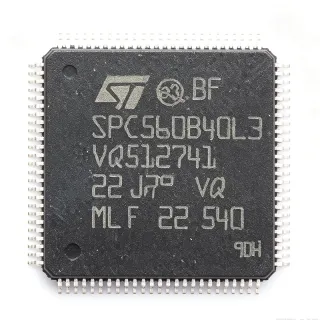
STM32H7B0VBT6 - 280MHz Cortex-M7 MCU, 128KB Flash | STMicroelectronics
MPN: STM32H7B0VBT6 ✓ 啟用中STM32H7B0VBT6 概覽
A microcontroller (MCU) is a compact integrated circuit designed to govern a specific operation in an embedded system. It contains a processor core, memory, and programmable input/output peripherals on a single chip. The STM32H7B0VBT6 belongs to the high-performance MCU category, positioned above mainstream MCUs like the STM32F4 series, and is part of the broader STM32 family from STMicroelectronics. Its Cortex-M7 core with double-precision FPU and DSP instructions enables efficient handling of complex algorithms, making it suitable for real-time control, signal processing, and AI edge applications.
Key features include a 280 MHz ARM Cortex-M7 core with double-precision FPU, 128 KB of flash memory, and 1.4 MB of SRAM. The device supports external memory interfaces via FMC and OCTOSPI, enabling expansion of code and data storage. It integrates a rich set of peripherals including multiple 16-bit and 32-bit timers, 12-bit ADCs, DACs, and advanced communication interfaces such as USART, SPI, I2C, CAN FD, USB OTG, and Ethernet. The device operates from a 1.62V to 3.6V supply and is available in a 100-pin LQFP package with a temperature range of -40°C to +85°C.
The STM32H7B0VBT6 is built on a high-performance architecture with a 32-bit multi-AHB bus matrix, enabling concurrent access to memory and peripherals. It includes a Chrom-ART Accelerator for 2D graphics, a cryptographic acceleration unit, and a true random number generator. The device supports various low-power modes, including Sleep, Stop, and Standby, with typical power consumption in the microamp range in standby mode. The advanced memory protection unit (MPU) and secure access modes enhance system security.
Typical applications include industrial control systems, motor control, smart home gateways, audio processing, and high-end consumer electronics. The high clock speed and rich peripherals make it ideal for real-time control and edge AI inference. The device also supports external memory expansion, making it suitable for applications requiring large data buffers or code storage.
When designing with this MCU, ensure proper decoupling of the power supply pins with 100nF capacitors placed close to each VDD pin. The VDDA pin requires a dedicated 1uF capacitor for analog performance. For high-speed communication interfaces, pay attention to PCB layout to minimize signal integrity issues. The device supports in-circuit programming and debugging via SWD and JTAG interfaces, facilitating development.
直接替換替代品,適用於 STM32H7B0VBT6 — 相同封裝,腳位對腳位相容。需重新設計 PCB 的不同封裝零件不列入。
此系列的變體
與下列產品可直接替換的同系列型號: STM32H7B0VBT6 (相同外形與佔位) — 差異在於 Communication Interfaces, Operating Temperature, Package, RoHS Status, SRAM.
STM32H750VBT6
✅ 直接替換 ⚠️ 規格未經驗證✓ 有庫存
$5.25 / 單位
查看資料表 →STM32H7B0VBT6TR
✅ 直接替換 ⚠️ 規格未經驗證📋 參考替代品(不在目錄中)
STM32H7B0VBT6Q
✅ 直接替換 ⚠️ 規格未經驗證📋 參考替代品(不在目錄中)
STM32H743VIT6
⚡ 相同封裝 ⚠️ 規格未經驗證✓ 有庫存
$7.98 / 單位
查看資料表 →STM32H753VIT6
⚡ 相同封裝 ⚠️ 規格未經驗證📋 參考替代品(不在目錄中)
STM32H7B0VBT6 最大額定值與電氣特性
| Core | ARM Cortex-M7 |
| Max Clock Speed | 280 MHz |
| Flash Memory | 128 KB |
| SRAM | 1.4 MB |
| 供應電壓 | 1.62 V to 3.6 V |
| 封裝 | LQFP-100 (14x14 mm) |
| 工作溫度 | -40C to +85C |
| GPIO Pins | 80 |
| ADC | 3x 12-bit, up to 3.6 MSPS |
| DAC | 2x 12-bit |
| Timers | 20x (16-bit and 32-bit) |
| Communication Interfaces | USART, SPI, I2C, CAN FD, USB OTG, Ethernet |
| External Memory Interface | FMC, OCTOSPI |
| DMA | 2x DMA controllers with 16 streams each |
| Cryptographic Acceleration | AES, DES, 3DES, SHA-1, SHA-256 |
| RoHS 狀態 | Compliant |
STM32H7B0VBT6 腳位配置
| 腳位 1 | VBAT — Backup battery supply |
| 腳位 2 | PC13 — GPIO / RTC output |
| 腳位 3 | PC14 — GPIO / OSC32_IN |
| 腳位 4 | PC15 — GPIO / OSC32_OUT |
| 腳位 5 | PF0 — GPIO / OSC_IN |
| 腳位 6 | PF1 — GPIO / OSC_OUT |
| 腳位 7 | NRST — Reset (active low) |
| 腳位 8 | PC0 — GPIO / ADC input |
| 腳位 9 | PC1 — GPIO / ADC input |
| 腳位 10 | PC2 — GPIO / ADC input |
| 腳位 11 | PC3 — GPIO / ADC input |
| 腳位 12 | VDD — Digital power supply |
| 腳位 13 | VSS — Ground |
| 腳位 14 | PC4 — GPIO / ADC input |
| 腳位 15 | PC5 — GPIO / ADC input |
| 腳位 16 | PB2 — GPIO / BOOT1 |
| 腳位 17 | PE7 — GPIO / FMC data |
| 腳位 18 | PE8 — GPIO / FMC data |
| 腳位 19 | PE9 — GPIO / FMC data |
| 腳位 20 | PE10 — GPIO / FMC data |
| 腳位 21 | PE11 — GPIO / FMC data |
| 腳位 22 | PE12 — GPIO / FMC data |
| 腳位 23 | PE13 — GPIO / FMC data |
| 腳位 24 | PE14 — GPIO / FMC data |
| 腳位 25 | PE15 — GPIO / FMC data |
| 腳位 26 | PB10 — GPIO / I2C2_SCL / USART3_TX |
| 腳位 27 | PB11 — GPIO / I2C2_SDA / USART3_RX |
| 腳位 28 | VDD — Digital power supply |
| 腳位 29 | VSS — Ground |
| 腳位 30 | PB12 — GPIO / SPI2_NSS / I2C2_SMBA |
| 腳位 31 | PB13 — GPIO / SPI2_SCK |
| 腳位 32 | PB14 — GPIO / SPI2_MISO |
| 腳位 33 | PB15 — GPIO / SPI2_MOSI |
| 腳位 34 | PD8 — GPIO / USART3_TX / FMC data |
| 腳位 35 | PD9 — GPIO / USART3_RX / FMC data |
| 腳位 36 | PD10 — GPIO / USART3_CK / FMC data |
| 腳位 37 | PD11 — GPIO / USART3_CTS / FMC data |
| 腳位 38 | PD12 — GPIO / USART3_RTS / FMC data |
| 腳位 39 | PD13 — GPIO / FMC data |
| 腳位 40 | PD14 — GPIO / FMC data |
| 腳位 41 | PD15 — GPIO / FMC data |
| 腳位 42 | PC6 — GPIO / I2S2_MCK / SDMMC1_CK |
| 腳位 43 | PC7 — GPIO / I2S2_MCK / SDMMC1_CMD |
| 腳位 44 | PC8 — GPIO / SDMMC1_D0 |
| 腳位 45 | PC9 — GPIO / SDMMC1_D1 |
| 腳位 46 | PA8 — GPIO / MCO1 / I2C3_SCL |
| 腳位 47 | PA9 — GPIO / USART1_TX / USB_OTG_FS_VBUS |
| 腳位 48 | PA10 — GPIO / USART1_RX / USB_OTG_FS_ID |
| 腳位 49 | PA11 — GPIO / USART1_CTS / USB_OTG_FS_DM |
| 腳位 50 | PA12 — GPIO / USART1_RTS / USB_OTG_FS_DP |
| 腳位 51 | PA13 — GPIO / SWDIO |
| 腳位 52 | VDD — Digital power supply |
| 腳位 53 | VSS — Ground |
| 腳位 54 | PA14 — GPIO / SWCLK |
| 腳位 55 | PA15 — GPIO / JTDI |
| 腳位 56 | PC10 — GPIO / SDMMC1_D2 |
| 腳位 57 | PC11 — GPIO / SDMMC1_D3 |
| 腳位 58 | PC12 — GPIO / SDMMC1_CK |
| 腳位 59 | PD0 — GPIO / FMC_D2 |
| 腳位 60 | PD1 — GPIO / FMC_D3 |
| 腳位 61 | PD2 — GPIO / SDMMC1_CMD |
| 腳位 62 | PD3 — GPIO / USART2_CTS / FMC_CLK |
| 腳位 63 | PD4 — GPIO / USART2_RTS / FMC_NOE |
| 腳位 64 | PD5 — GPIO / USART2_TX / FMC_NWE |
| 腳位 65 | PD6 — GPIO / USART2_RX / FMC_NWAIT |
| 腳位 66 | PD7 — GPIO / USART2_CK / FMC_NE1 |
| 腳位 67 | PE0 — GPIO / TIM4_ETR / FMC_NBL0 |
| 腳位 68 | PE1 — GPIO / TIM4_CH1 / FMC_NBL1 |
| 腳位 69 | PE2 — GPIO / SAI1_CK1 / FMC_A23 |
| 腳位 70 | PE3 — GPIO / SAI1_SD_A / FMC_A19 |
| 腳位 71 | PE4 — GPIO / SAI1_FS_A / FMC_A20 |
| 腳位 72 | PE5 — GPIO / SAI1_SCK_A / FMC_A21 |
| 腳位 73 | PE6 — GPIO / SAI1_D1 / FMC_A22 |
| 腳位 74 | VDD — Digital power supply |
| 腳位 75 | VSS — Ground |
| 腳位 76 | PB0 — GPIO / ADC1_IN9 / TIM1_CH2N |
| 腳位 77 | PB1 — GPIO / ADC1_IN5 / TIM1_CH3N |
| 腳位 78 | PB3 — GPIO / SPI1_SCK / JTDO |
| 腳位 79 | PB4 — GPIO / SPI1_MISO / NJTRST |
| 腳位 80 | PB5 — GPIO / SPI1_MOSI / I2C1_SMBA |
| 腳位 81 | PB6 — GPIO / I2C1_SCL / USART1_TX |
| 腳位 82 | PB7 — GPIO / I2C1_SDA / USART1_RX |
| 腳位 83 | BOOT0 — Boot mode selection |
| 腳位 84 | PB8 — GPIO / I2C1_SCL / CAN1_RX |
| 腳位 85 | PB9 — GPIO / I2C1_SDA / CAN1_TX |
| 腳位 86 | PE7 — GPIO / TIM1_ETR / FMC_D4 |
| 腳位 87 | PE8 — GPIO / TIM1_CH1N / FMC_D5 |
| 腳位 88 | PE9 — GPIO / TIM1_CH1 / FMC_D6 |
| 腳位 89 | PE10 — GPIO / TIM1_CH2N / FMC_D7 |
| 腳位 90 | PE11 — GPIO / TIM1_CH2 / FMC_D8 |
| 腳位 91 | PE12 — GPIO / TIM1_CH3N / FMC_D9 |
| 腳位 92 | PE13 — GPIO / TIM1_CH3 / FMC_D10 |
| 腳位 93 | PE14 — GPIO / TIM1_CH4 / FMC_D11 |
| 腳位 94 | PE15 — GPIO / TIM1_CH4N / FMC_D12 |
| 腳位 95 | PA0 — GPIO / ADC1_IN0 / TIM2_CH1 |
| 腳位 96 | PA1 — GPIO / ADC1_IN1 / TIM2_CH2 |
| 腳位 97 | PA2 — GPIO / ADC1_IN2 / TIM2_CH3 / USART2_TX |
| 腳位 98 | PA3 — GPIO / ADC1_IN3 / TIM2_CH4 / USART2_RX |
| 腳位 99 | VDD — Digital power supply |
| 腳位 100 | VSS — Ground |
典型應用
STM32H7B0VBT6 適用於 6 應用s: Industrial Control, IoT Gateway, Motor Control, Audio Processing, Smart Home Hub, Edge AI.
Industrial Control
The STM32H7B0VBT6 is ideal for industrial control systems due to its 280 MHz Cortex-M7 core, rich timer set, and multiple communication interfaces. It can handle real-time control loops, PLCs, and motor control with high precision. The device's 1.4 MB SRAM allows for large data buffers and complex state machines. Its wide supply voltage range and industrial temperature grade make it suitable for harsh environments. The FMC and OCTOSPI interfaces enable external memory expansion for data logging or code storage. The cryptographic acceleration unit ensures secure communication in industrial networks. The device's low-power modes help reduce energy consumption in battery-powered industrial sensors. The 12-bit ADCs with up to 3.6 MSPS provide accurate analog signal acquisition for process control. The CAN FD interface supports robust communication in industrial automation. The Ethernet MAC enables connectivity to industrial Ethernet protocols like EtherCAT and PROFINET. The device's high performance allows for advanced algorithms such as predictive maintenance and machine vision.
推薦
IoT Gateway
The STM32H7B0VBT6 serves as a powerful IoT gateway processor, handling multiple protocols and edge computing tasks. Its Ethernet MAC and USB OTG interfaces enable connectivity to wired and wireless networks. The 280 MHz core can run protocol stacks like MQTT, CoAP, and TLS with hardware acceleration. The 1.4 MB SRAM supports large packet buffers and multiple concurrent connections. The device's low-power modes are crucial for battery-powered gateways. The cryptographic acceleration unit ensures secure data transmission. The OCTOSPI interface allows connection to external flash for firmware updates and data storage. The device can aggregate data from various sensors via its multiple USART, SPI, and I2C interfaces. The Chrom-ART Accelerator enables efficient GUI rendering for local displays. The device's high performance enables edge AI inference for anomaly detection. The FMC interface can connect to external SDRAM for large data buffering. The device's rich peripherals reduce the need for external components, lowering BOM cost.
推薦
Motor Control
The STM32H7B0VBT6 is well-suited for motor control applications, including brushless DC (BLDC) and permanent magnet synchronous motors (PMSM). Its 280 MHz Cortex-M7 core with DSP instructions can execute complex field-oriented control (FOC) algorithms in real time. The device features multiple advanced timers with complementary PWM outputs and dead-time insertion, essential for driving three-phase inverters. The 12-bit ADCs with up to 3.6 MSPS provide fast and accurate current sensing. The device's 1.4 MB SRAM allows for storing motor control lookup tables and diagnostic data. The CAN FD interface enables communication with higher-level controllers. The device's high performance supports sensorless control algorithms and predictive maintenance. The cryptographic acceleration unit can secure firmware updates. The device's low-power modes help reduce energy consumption in battery-powered motor applications. The FMC interface can connect to external memory for data logging. The device's rich peripheral set reduces external component count, improving reliability and reducing cost.
推薦
Audio Processing
The STM32H7B0VBT6 is an excellent choice for audio processing applications, such as audio effects processors, voice recognition, and high-fidelity audio systems. Its 280 MHz Cortex-M7 core with double-precision FPU and DSP instructions can handle complex audio algorithms like FIR filters, FFT, and audio codecs. The device's 1.4 MB SRAM provides ample space for audio buffers and processing. The I2S interface supports high-quality audio data transfer to external DACs and ADCs. The device's SAI (Serial Audio Interface) supports multiple audio protocols. The Chrom-ART Accelerator can enhance GUI for audio equipment. The device's low-power modes are beneficial for portable audio devices. The cryptographic acceleration unit can secure audio content. The device's high performance enables real-time audio processing with low latency. The FMC interface can connect to external SDRAM for large audio buffers. The device's rich peripherals allow integration with user interfaces and connectivity options.
推薦
Smart Home Hub
The STM32H7B0VBT6 can serve as the central processor in a smart home hub, managing various sensors, actuators, and communication protocols. Its multiple USART, SPI, and I2C interfaces allow connection to Zigbee, Z-Wave, and Bluetooth modules. The Ethernet MAC enables wired connectivity to the home network. The 280 MHz core can run complex automation rules and local AI for voice control. The 1.4 MB SRAM supports multiple concurrent tasks and data logging. The device's low-power modes are essential for always-on hubs. The cryptographic acceleration unit ensures secure communication with cloud services. The OCTOSPI interface can connect to external flash for firmware and configuration storage. The device's rich peripherals reduce the need for external MCUs. The Chrom-ART Accelerator enables a graphical user interface on a local display. The device's high performance allows for real-time sensor fusion and event processing.
推薦
Edge AI
The STM32H7B0VBT6 is capable of running edge AI inference for applications like anomaly detection, predictive maintenance, and image classification. Its 280 MHz Cortex-M7 core with DSP instructions can execute small neural network models using frameworks like TensorFlow Lite Micro. The 1.4 MB SRAM provides sufficient memory for model weights and activations. The device's 12-bit ADCs can interface with analog sensors for data acquisition. The cryptographic acceleration unit ensures secure model updates. The device's low-power modes are beneficial for battery-powered edge devices. The OCTOSPI interface can connect to external flash for storing larger models. The device's high performance enables real-time inference with low latency. The FMC interface can connect to external SDRAM for larger models. The device's rich peripherals allow integration with various sensors and actuators. The device's high performance makes it suitable for on-device decision-making without cloud dependency.
推薦
推薦產品摘要
工程參考資料,適用於 STM32H7B0VBT6 — 比較、設計指引及合規資訊。
選型指南
與替代品比較
| 參數 | 本產品 | STM32H750VBT6 | STM32H7B0VBT6TR | STM32H7B0VBT6Q | STM32H743VIT6 | STM32H753VIT6 | i.MX RT1052 |
|---|---|---|---|---|---|---|---|
| Package | LQFP-100 | LQFP-100 - same | LQFP-100 - same | LQFP-100 - same | LQFP-100 - same | LQFP-100 - same | BGA-196 - different |
| Brand | STMicroelectronics | STMicroelectronics | STMicroelectronics | STMicroelectronics | STMicroelectronics | STMicroelectronics | NXP Semiconductors |
| Core Clock | 280 MHz | 280 MHz | 280 MHz | 280 MHz | 480 MHz | 480 MHz | 600 MHz |
| Flash Memory | 128 KB | 128 KB | 128 KB | 128 KB | 2 MB | 2 MB | 0 KB (external flash) |
| SRAM | 1.4 MB | 1 MB | 1.4 MB | 1.4 MB | 1 MB | 1 MB | 512 KB |
| Ethernet MAC | Yes | Yes | Yes | Yes | Yes | Yes | Yes |
| Cryptographic Acceleration | Yes | Yes | Yes | Yes | Yes | Yes | No |
| Price (1pc) | $12.50 | $11.80 | $12.50 | $13.20 | $15.40 | $16.10 | $9.90 |
主要差異化特點
- Larger SRAM (1.4 MB) compared to STM32H750VBT6 (對比STM32H750VBT6)
- Higher clock speed than STM32F7 series (對比STM32F767VIT6)
- Integrated cryptographic acceleration (對比i.MX RT1052)
設計說明
Decouple each VDD pin with a 100nF ceramic capacitor placed as close as possible to the pin. Additionally, place a 4.7uF capacitor on the main VDD rail. The VDDA pin requires a dedicated 1uF capacitor to ground for analog performance. For the VBAT pin, connect a 100nF capacitor if using a backup battery. Ensure the power supply can handle the peak current of the MCU, which can be up to 200mA at 280MHz.
For high-speed interfaces like Ethernet and USB, maintain controlled impedance traces (e.g., 90 ohms differential for USB). Keep traces short and use ground planes to minimize EMI. For the crystal oscillator, place the crystal and load capacitors close to the OSC_IN/OSC_OUT pins and avoid routing other signals nearby. Use a solid ground plane under the MCU to reduce noise.
Ensure the BOOT0 pin is correctly configured to boot from flash. If using external memory via FMC, verify the timing parameters in the reference manual. Do not exceed the absolute maximum ratings for supply voltage (3.6V) and I/O pins (VDD+0.3V). When using the ADC, ensure the sampling time is sufficient for the source impedance. For low-power modes, configure the RTC and wakeup sources correctly to avoid unexpected resets.
合規資訊
RoHS and REACH compliant per STMicroelectronics product page. Not AEC-Q100 qualified; for automotive use, consider STM32H7A3 or STM32H7B3 variants.