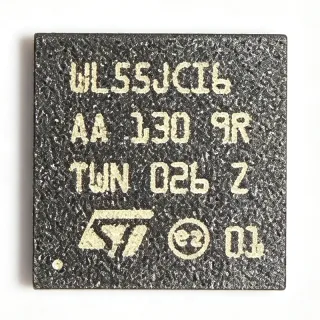
VSC7437XMT - 8-Port Carrier Ethernet Switch 324-BGA | Microchip
MPN: VSC7437XMT ✓ 啟用中VSC7437XMT 概覽
A carrier Ethernet switch is a network switching IC designed to deliver carrier-grade services at the network edge. Within the network IC hierarchy, it belongs to the Ethernet switch family of communication ICs, which in turn sits under telecom and networking semiconductors. Carrier Ethernet switches add service-oriented features such as MEF CE 2.0 compliance, hardware timestamping, and precise synchronization that standard enterprise switches do not provide.
The VSC7437 integrates Microchip's VeriTime technology for hardware-assisted IEEE 1588-style timestamping, targeting IP edge demarcation, access equipment, enterprise, and mobile backhaul deployments. The two integrated copper PHYs reduce bill-of-materials count by removing external PHY devices on the 1G ports, while the integrated DPLL supports synchronization-critical designs such as SyncE and timing demarcation without a separate timing IC.
The Serval-TE10 architecture is optimized for MEF CE 2.0 service delivery, giving equipment makers a market-ready solution for carrier Ethernet service activation, performance monitoring, and service OAM at the IP edge. The 10G uplink ports allow aggregation toward metro networks, and the compact 19x19 mm 324-BGA footprint supports high port density in space-constrained access platforms.
Typical applications include IP edge demarcation units, mobile backhaul aggregation, enterprise access switches, and fiber/copper access MTU (multi-tenant unit) equipment.
When designing with this device, consult the Microchip datasheet for supply-rail sequencing, thermal design for the BGA package, and MAC/PHY configuration options before committing the PCB layout.
This page adds value beyond the datasheet by consolidating distributor availability signals, drop-in alternatives, design notes, and a selection guide in one reference for sourcing and design engineers.
直接替換替代品,適用於 VSC7437XMT — 相同封裝,腳位對腳位相容。需重新設計 PCB 的不同封裝零件不列入。
VSC7435XMT
✅ 直接替換聯絡詢價
查看資料表 →VSC7437XMT 最大額定值與電氣特性
| Product Family | Serval-TE10 Carrier Ethernet Switch |
| Total Ports | 8 |
| 1G Ports | 6 |
| 10G Ports | 2 |
| Integrated Copper PHYs | 2 |
| Integrated DPLL | Yes |
| Timestamping Technology | VeriTime |
| Service Standard | MEF CE 2.0 |
| Target Applications | IP Edge demarcation, access, enterprise, mobile backhaul |
| 封裝 | 324-BGA (19x19 mm) |
| 安裝類型 | Surface Mount |
| 生命週期狀態 | Active |
VSC7437XMT 324-bga (19x19 mm) 腳位配置指南
VSC7437XMT(324-bga (19x19 mm) 封裝)的腳位配置。 腳位編號、功能與連接圖定義於製造商資料手冊中。請參閱該手冊以取得確切的封裝尺寸與焊接指引。

無詳細腳位定義資料: VSC7437XMT.
請參閱 資料表 以查看完整腳位配置。
典型應用
VSC7437XMT 適用於 6 應用s: IP Edge Demarcation, Mobile Backhaul, Enterprise Access Switching, Fiber Access and MTU Equipment, Industrial and Utility Ethernet, Timing and Synchronization Platforms.
IP Edge Demarcation
The VSC7437XMT is purpose-built for IP edge demarcation, the network handoff point where a service provider's responsibility begins and subscriber traffic must be policed, classified, and measured. Microchip positions the Serval-TE10 switch with VeriTime timestamping specifically for this role, targeting enterprise and mobile backhaul demarcation equipment. The 6x1G subscriber-side ports terminate access loops (two supported by integrated copper PHYs, reducing external PHY count and board cost), while the 2x10G ports carry aggregated traffic toward the metro network. The integrated DPLL supports timing demarcation, and MEF CE 2.0 hardware features enable service OAM, performance monitoring, and per-service SLA enforcement in hardware rather than software. This hardware offload is critical at the edge, where line-rate processing of multiple service instances must be sustained without CPU intervention.
推薦
Mobile Backhaul
Mobile backhaul equipment carries 4G/5G radio traffic from cell sites toward the core, and the VSC7437XMT addresses this with its Serval-TE10 architecture optimized for synchronization-heavy transport. Microchip explicitly targets mobile backhaul with the VSC7437, combining VeriTime hardware timestamping for precise phase and time alignment with an integrated DPLL that supports Synchronous Ethernet timing chains without an external timing IC. The 6x1G ports terminate cell-site traffic (including eNB/gNB fronthaul or backhaul links, two served by integrated copper PHYs), and the 2x10G ports uplink toward aggregation rings. MEF CE 2.0 compliance enables carrier Ethernet services with defined SLA characteristics across the backhaul network. The 19x19 mm 324-BGA package fits the compact, temperature-constrained enclosures typical of outdoor and cell-site equipment.
推薦
Enterprise Access Switching
For enterprise access platforms, the VSC7437XMT provides a compact 8-port switching solution with a subscriber-friendly 6x1G plus 2x10G profile. Microchip lists enterprise as a primary target for the VSC7437 Serval-TE10 switch. In a typical design, six 1G ports serve desktop or wireless-access-point connectivity - two of them using the integrated copper PHYs, which lowers bill-of-materials cost by eliminating standalone PHY devices on those ports - while the two 10G ports connect to campus aggregation switches. The carrier-grade feature set (MEF CE 2.0 service delivery, hardware OAM, VeriTime timestamping) also lets enterprise platforms deliver managed services or act as demarcation in multi-tenant buildings. The single-chip integration of switch fabric, PHYs, and DPLL simplifies power tree and clock design relative to multi-chip switch solutions.
推薦
Fiber Access and MTU Equipment
Multi-tenant unit (MTU) and fiber access aggregation equipment benefits directly from the VSC7437XMT's mixed copper/fiber port capability. The two integrated copper PHYs on the 1G ports serve in-building copper runs to tenant equipment, while the SerDes-based ports support optical modules (SFP/SFP+) on the 1G and 10G lanes for fiber links toward the provider network. Microchip's carrier Ethernet switch family, which includes the VSC7437, is marketed as a market-ready solution for MEF CE 2.0 service delivery - the service framework used in commercial fiber access offerings. Hardware service OAM and performance monitoring enable per-tenant SLA reporting without external processors, and the integrated DPLL maintains timing through the access node. The 19x19 mm BGA footprint supports the high-density port cards used in MTU access shelves.
推薦
Industrial and Utility Ethernet
Industrial automation and utility substation networks increasingly demand carrier-style service assurance, deterministic timing, and hardened hardware. The VSC7437XMT contributes an integrated DPLL and VeriTime hardware timestamping, enabling time synchronization across industrial Ethernet segments in the same manner as telecom timing demarcation. Microchip's description of the Serval-TE10 family as targeting access and demarcation equipment extends naturally to industrial aggregation nodes that must transport protection-relay traffic, process data, and management VLANs with per-service policing and monitoring - functions the MEF CE 2.0 feature set provides in hardware. The 6x1G plus 2x10G configuration suits a ring-aggregation switch with copper device ports and fiber ring uplinks. Designers should review the datasheet operating temperature rating for the target industrial environment before finalizing enclosure thermal design.
推薦
Timing and Synchronization Platforms
Network timing platforms - boundary clocks, telecom grandmaster aids, and timing demarcation units - exploit the VSC7437XMT's integrated DPLL and VeriTime timestamping directly. Because the DPLL is on-chip, a design can build a SyncE-capable timing chain without a separate PLL IC, shortening the clock tree and improving phase noise budget allocation across the board. VeriTime provides hardware-level timestamp capture on Ethernet frames, which is the foundation for precision time protocol operation at line rate, as required in mobile backhaul timing deployments. Microchip identifies VeriTime integration as the distinguishing feature of the Serval-TE10 family for demarcation equipment. The 2x10G ports allow a timing platform to participate in both 1G access timing chains and 10G aggregation links simultaneously within one 324-BGA device.
推薦
推薦產品摘要
工程參考資料,適用於 VSC7437XMT — 比較、設計指引及合規資訊。
選型指南
與替代品比較
| 參數 | 本產品 | VSC7435XMT |
|---|---|---|
| Brand | Microchip Technology | Microchip Technology |
| Service Standard | MEF CE 2.0 | MEF CE 2.0 (Serval family) |
| Timestamping | VeriTime | VeriTime (Serval family) |
主要差異化特點
- Two 10G aggregation uplinks on-chip (對比VSC7435XMT)
- Integrated copper PHYs reduce BOM (對比VSC7435XMT)
- Integrated DPLL for timing demarcation (對比VSC7435XMT)
設計說明
The VSC7437XMT uses a 324-ball BGA on a 19x19 mm body. Plan the PCB stack-up for BGA escape routing early: a minimum of 6 layers is typical for a device combining 1G copper PHYs and 10G SerDes lanes. Use the ball-mapping table in the Microchip datasheet to assign fanout before placing decoupling capacitors, and reserve inner layers for the high-speed SerDes escape so 1G PHY routing does not block 10G lane breakout. Confirm the exact ball grid pitch from the datasheet mechanical drawing before generating the land pattern.
The two 10G SerDes ports on the VSC7437XMT require controlled-impedance differential routing (100 ohm differential is the common Ethernet SerDes target - verify the exact impedance in the Microchip datasheet). Keep the 10G lane pairs length-matched within the tolerance stated by the manufacturer, route them on adjacent layers with a solid reference plane, and avoid crossing plane splits. For the SFP/SFP+ connections, include AC-coupling capacitors per the datasheet reference design and keep stubs on the receive path short.
Estimated: a carrier Ethernet switch of this class can dissipate several watts under full traffic; with a 19x19 mm BGA, junction temperature depends strongly on board-level heat spreading. Verify the actual typical power dissipation figure from the Microchip datasheet and compute junction rise using the package theta_JA given there. Provide a solid ground-plane array of thermal vias under the BGA center ball field connected to internal copper planes, and validate airflow requirements in the enclosure thermal simulation before finalizing the mechanical design.
The VSC7437XMT integrates the switch fabric, two copper PHYs, SerDes, and a DPLL, which implies multiple supply rails with different voltage and sequencing requirements. Obtain the complete rail list, core voltage values, and power-up sequencing order from the Microchip datasheet, then select a PMIC or sequencing controller that guarantees the specified rail order. Place bulk and high-frequency decoupling capacitors on each rail close to the BGA ball assignments indicated in the datasheet power-ball map.
Do not assume Serval family members (such as the VSC7435XMT) are pin-for-pin interchangeable with the VSC7437XMT: the port maps differ within the family, so a board designed around one variant cannot simply be re-populated with another without schematic and layout review. Also confirm firmware/configuration compatibility through Microchip's documentation, since register maps and feature availability can differ between family members even when the package appears similar.
合規資訊
Compliance details were not stated in the referenced listings; consult the official Microchip product page and datasheet for RoHS/REACH status of the VSC7437XMT.