The WGI210AT-SLJXR is the ordering code for Intel's I210-AT single-chip Gigabit Ethernet controller, integrating a 10/100/1000 Mbps MAC and PHY in a 9x9 mm QFN-64 surface-mount package. It connects to the host through a PCIe v2.1 (5 GT/s) x1 interface, runs from 3.3 V main and 0.9 V core rails, and is specified for 0 °C to +70 °C commercial operation. Verified features include jumbo-frame support up to 9.5 KB, IEEE 802.3az Energy Efficient Ethernet, and IEEE 802.1AS / Audio-Video Bridging for time-synchronized networks. The part is in active lifecycle status with 26,000 units in stock on XAIPART, MOQ 1, priced from $8.4375 at single units down to $4.9219 at 1,000 units as of 2026-10-19. For designs that must operate from -40 °C to +85 °C, the pin-compatible WGI210AT-SLJXQ industrial variant covers the same QFN-64 footprint.
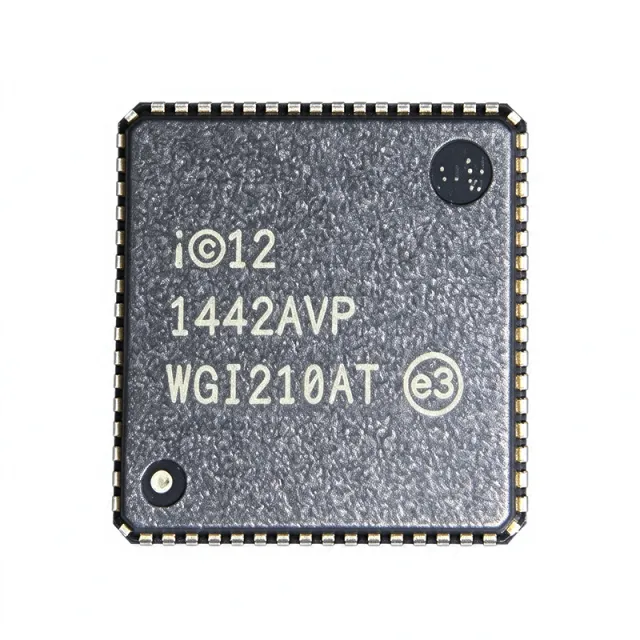
What Is the WGI210AT-SLJXR and Which Specifications Define It?
The WGI210AT-SLJXR is Intel's mainstream single-chip Gigabit Ethernet MAC+PHY controller from the Intel I210 series, categorized as an Interface IC. It handles MAC framing, PHY termination, and protocol offload, bridging a PCIe host to copper media (10BASE-T, 100BASE-TX, 1000BASE-T) through MDI differential pairs that connect to magnetics and an RJ45 jack. An Ethernet controller like this one is essential wherever a deterministic, low-latency wired connection is required without burdening the host CPU with physical-layer processing.
The verified specification set covers:
| Parameter | Verified Value |
|---|---|
| Product Type | Ethernet Controller (MAC + PHY) |
| Series | Intel I210 |
| Ethernet Speed | 10/100/1000 Mbps (GbE) |
| Supported Standards | 10BASE-T, 100BASE-TX, 1000BASE-T |
| Host Interface | PCIe v2.1 (5 GT/s) x1 |
| Secondary Interfaces | SGMII, SPI, JTAG, I2C, SMBus/NC-SI |
| Supply Voltage (Main) | 3.3 V |
| Core Voltage | 0.9 V |
| Operating Temperature | 0 °C to +70 °C (commercial) |
| Package | QFN-64 (9x9 mm), surface mount |
| Jumbo Frame Support | Yes, up to 9.5 KB |
| IEEE 802.3az EEE | Yes |
| IEEE 802.1AS / AVB | Yes |
| Manageability | NC-SI / SMBus |
| RoHS Status | Compliant |
| Lifecycle Status | Active |
Takeaway: If your design needs a self-contained GbE port with standard PCIe hosting and industrial manageability features, the verified spec set of the SLJXR covers all three requirements in one 9x9 mm footprint.
How Do You Design In the WGI210AT-SLJXR?
Design-in succeeds or fails on four areas: power, PCIe routing, MDI magnetics, and management/firmware connectivity.
Power Architecture
The controller requires two rails: 3.3 V main (VDD33) and 0.9 V core (VDD09), plus a VDD_AUX auxiliary rail for manageability functions. Follow Intel's reference decoupling guidance: 4.7 µF + 0.1 µF near each power pin with a solid ground return. The exposed thermal pad (pin 64, EP) must be soldered to the ground plane for proper thermal dissipation — do not treat it as optional on the QFN-64 footprint.
PCIe and Clock Routing
Route the PCIe v2.1 x1 lane (PETp0/PETn0 transmit, PERp0/PERn0 receive, pins 8–9 and 5–6) length-matched within 1 mm. The differential reference clock pair REF_CLK+/REF_CLK- (pins 11–12) deserves the same care. At 5 GT/s, impedance discontinuities on these pairs are the most common root cause of link-training failures at bring-up.
MDI and Magnetics
Four MDI differential pairs (MDI0 through MDI3, pins 14–22) carry the 10/100/1000BASE-T signals to the magnetics and RJ45. Designers using AVB/802.1AS features should consult the Intel I210 reference schematic for MDI and external magnetics recommendations rather than substituting generic transformer choices.
Management and Firmware
The SPI interface (SPI_CS, SPI_CLK, SPI_MOSI, SPI_MISO, pins 39–42) attaches the firmware flash for autonomous boot. SMBus/NC-SI pins (SMB_CLK, SMB_DAT, SMB_ALRT, pins 24–26) provide out-of-band manageability for server-class platforms. JTAG (pins 33–37) supports boundary scan during production test. Four GPIO lines (pins 28–31) and four LED outputs (pins 46–49) cover status signaling. Active-low RESET on pin 50 requires a defined power-on reset circuit.
Firmware and Driver Expectations
Peak throughput depends on the PCIe link (typically x1 Gen 2.1) and the host software driver — the mature e1000e/igb stacks in Linux, Windows, and VMware. MAC address pre-programming and platform firmware resiliency are built into the I210 platform, reducing one-time manufacturing steps.
Takeaway: Budget your design effort on the 0.9 V rail sequencing, PCIe length matching within 1 mm, and thermal-pad soldering — these three items determine first-silicon success more than any other layout decision.
What Does the WGI210AT-SLJXR Pinout Look Like?
The QFN-64 package follows the Intel I210 standard pinout. The functionally critical pins for bring-up are power, PCIe, MDI, and management pins listed below; the complete 64-pin table lives on the WGI210AT-SLJXR product page.
Power and Ground
- Pin 2, 27, 43, 62: VDD33 — 3.3 V main supply (verified from pinout table, database)
- Pin 3, 44, 61: VDD09 — 0.9 V core supply (verified from pinout table, database)
- Pin 4: VDD_AUX — auxiliary supply for manageability (verified from pinout table, database)
- Pin 64: EP — exposed thermal pad, connect to GND (verified from pinout table, database)
PCIe and Clocks
- Pins 5/6: PERp0/PERn0 — PCIe receive pair, lane 0 (verified from pinout table, database)
- Pins 8/9: PETp0/PETn0 — PCIe transmit pair, lane 0 (verified from pinout table, database)
- Pins 11/12: REF_CLK+/REF_CLK- — PCIe reference clock (verified from pinout table, database)
Network and Management
- Pins 14–22: MDI0+/−, MDI1+/−, MDI2+/−, MDI3+/− — MDI differential pairs (verified from pinout table, database)
- Pins 24–26: SMB_CLK, SMB_DAT, SMB_ALRT — SMBus/NC-SI (verified from pinout table, database)
- Pins 39–42: SPI_CS, SPI_CLK, SPI_MOSI, SPI_MISO — firmware SPI (verified from pinout table, database)
- Pin 50: RESET — active-low device reset (verified from pinout table, database)
- Pins 52–55: SGMII+, SGMII−, SGMII_CLK+, SGMII_CLK− — SGMII serial data and clock (verified from pinout table, database)
- Pins 57/58: I2C_SCL, I2C_SDA (verified from pinout table, database)
- Pins 33–37: JTAG_TCK, TMS, TDI, TDO, TRST (verified from pinout table, database)
Takeaway: Verify pin 4 (VDD_AUX) and pin 64 (EP) are connected in your layout — both are easy to miss, and both are mandatory per the Intel pinout definition.
What Are the Main Applications for the WGI210AT-SLJXR?
Seven verified application scenarios define where this controller earns its place on the BOM:
- Desktop and workstation GbE connectivity. The integrated PHY eliminates a separate 10/100/1000BASE-T transceiver, cutting board area and BOM cost versus MAC-only designs. The PCIe v2.1 host interface provides up to 5 GT/s of host-to-NIC bandwidth, sufficient for full-line-rate GigE with headroom for 9.5 KB jumbo frames.
- Industrial PCs and factory automation. SMBus/NC-SI manageability supports line-card monitoring, and AVB/802.1AS enables deterministic Ethernet for motion-control networks. For -40 °C to +85 °C environments, the SLJXQ variant drops onto the identical footprint.
- NAS and server edge NICs. Jumbo frames up to 9.5 KB reduce CPU overhead on sequential transfers; NC-SI enables out-of-band monitoring in racks. Multiple SLJXR chips can share one PCIe root complex for multi-port designs.
- Embedded routers and IoT gateways. The 9x9 mm QFN-64 fits dense layouts; 3.3 V/0.9 V rails derive cleanly from standard PoE or USB-C supplies; 802.3az EEE trims link power in thermally constrained enclosures.
- Pro-audio AVB / TSN equipment. IEEE 802.1AS precision-time-protocol support, paired with Linux ptp4l or the Intel igb driver on Windows, delivers time-synchronized Ethernet for mixing consoles, broadcast routers, and stage boxes.
- Medical imaging capture nodes. Deterministic, low-latency GbE with a mature cross-platform driver stack simplifies regulatory submissions, and 802.1AS synchronization supports multi-modal image capture.
- Defense and aerospace SBCs. Intel-supported GbE with confirmed long-term driver support; the QFN-64 footprint is denser than rad-hard BGAs for non-rad-hard applications.
Takeaway: Match the variant to the enclosure, not the datasheet maximum: commercial SLJXR for indoor/desktop, SLJXQ for factory floors, vehicles, and outdoor cabinets.
Which Alternatives Are Drop-In Compatible with the WGI210AT-SLJXR?
Three verified alternatives exist in the database. All share the QFN-64 (9x9 mm) footprint and pinout.
| Parameter | WGI210AT-SLJXR | WGI210AT-SLJXQ | WGI210AT S LJXR | WGI211AT-SLJXR |
|---|---|---|---|---|
| Die / Series | Intel I210-AT | Intel I210-AT (identical die) | Intel I210-AT (identical silicon) | Intel I211 die |
| Operating Temperature | 0 °C to +70 °C | -40 °C to +85 °C | Same as SLJXR | [Specified per I211 ordering information] |
| Package | QFN-64 (9x9 mm) | QFN-64 (9x9 mm) | QFN-64 (9x9 mm) | QFN-64 (9x9 mm), identical footprint |
| Ethernet Speeds | 10/100/1000 Mbps | Unchanged (PCIe/SGMII/SPI identical) | Unchanged | Same 10/100/1000 Mbps and PCIe host interface |
| Pinout Compatibility | Reference | Identical pinout — 100% drop-in | Identical — order-code spelling only | Identical footprint, pin-compatible |
| Feature Tradeoff | Full manageability + AVB/TSN | None — temperature grade only | None | Reduced manageability feature set (~5–10% lower cost) |
| Price (qty 1, as of 2026-10-19) | $8.4375 | Not listed in this database | Not listed in this database | Not listed in this database |
Selection logic: choose the SLJXQ when ambient conditions fall below 0 °C or above +70 °C — it is 100% functional at room temperature and a pure temperature upgrade. Choose the WGI211AT-SLJXR when the manageability feature delta is acceptable and a 5–10% cost reduction matters; consult Intel's ordering information for the precise feature delta before committing. Note that "WGI210AT S LJXR" is the same part as "WGI210AT-SLJXR" with only a whitespace difference in the order-code spelling — no parametric difference exists.
Takeaway: Treat variant selection as a temperature decision first and a cost decision second; all four order codes share the same PCB footprint, so layout investment is protected either way.
How Much Does the WGI210AT-SLJXR Cost and What Is the Supply Situation?
Verified XAIPART pricing tiers as of 2026-10-19:
| Quantity | Unit Price (USD) |
|---|---|
| 1+ | $8.4375 |
| 10+ | $6.0938 |
| 100+ | $5.3906 |
| 500+ | $5.1563 |
| 1000+ | $4.9219 |
That is a 42% unit-price reduction from qty 1 to qty 1,000. XAIPART currently shows 26,000 units in stock with MOQ 1. Distributor context: Mouser lists the part in stock as of 2026-10-11, LCSC lists 220 units from USD 5.13, and authorized Intel distributors DigiKey and Arrow also carry it. Lead time at authorized distributors is typically same-day to 2 weeks; independent channels can extend to 4–6 weeks depending on reel availability, and industrial SLJXQ variants may run longer because they serve niche embedded customers.
Takeaway: At 26,000 units in stock and MOQ 1, prototype-to-production sourcing is frictionless; lock the 1000+ tier at $4.9219 for volume builds, quoting as of 2026-10-19.
Where Does the I210 Family Stand in the Market and Its Lifecycle?
The verified lifecycle status is active, and the I210 series is in active volume production, which is why the part is widely available across authorized distributors. Intel positions the I210-AT as its mainstream GbE controller for non-server applications, while the family also serves defense and aerospace SBCs that need a vendor-supported, low-power GbE MAC+PHY. The mature e1000e/igb driver stack across Linux, Windows, and VMware is itself a supply-chain asset: software integration risk stays near zero for the life of the product. For any Intel-announced discontinuation or last-time-buy date, check the latest Intel product change notification before a multi-year program commit — this article reflects the active status in the XAIPART database as of 2026-10-19.
Takeaway: Active status plus multi-distributor stock makes the SLJXR a low-obsolescence-risk selection for designs with 5–10 year service lives.
What Should Buyers and Engineers Watch Next for the WGI210AT-SLJXR?
Three signals matter, all anchored to verified specs:
- Temperature-grade demand. Because the SLJXQ shares the identical die, pinout, and footprint, demand shifts between the two order codes as industrial automation volumes change. If your BOM allows, dual-source the footprint across both grades to hedge allocation risk.
- Price-tier optimization. The step from qty 100 ($5.3906) to qty 500 ($5.1563) saves $0.2343 per unit; the step to 1,000 ($4.9219) saves another $0.2344. Consolidating two small releases into one 500-unit PO is free margin.
- TSN/AVB software readiness. The silicon supports IEEE 802.1AS and AVB, but PTP functionality requires driver integration — typically Linux igb plus ptp4l — and correct firmware configuration. If your roadmap includes deterministic Ethernet (pro-audio, broadcast, motion control), validate the software stack early because the hardware capability is already on the die.
Related engineering reading on XAIPART: our guide to the STM32F103RET6 covers embedded MCU pairing for gateway designs, the XCKU035 Kintex UltraScale guide covers high-bandwidth host platforms, and the XAIPART blog tracks component-market pricing movements. The full verified spec sheet, stock, and tier pricing live on the WGI210AT-SLJXR product page, and the complete component catalog covers the rest of the Interface ICs category.
Takeaway: Watch pricing tiers, temperature-grade availability, and your own TSN software schedule — all three are within your control with this part because the hardware feature set is already verified and stable.
评论
成为第一个评论的人。
🔐 请 登录 即可发表评论。
还没有账户? 注册