产品(20,000+)

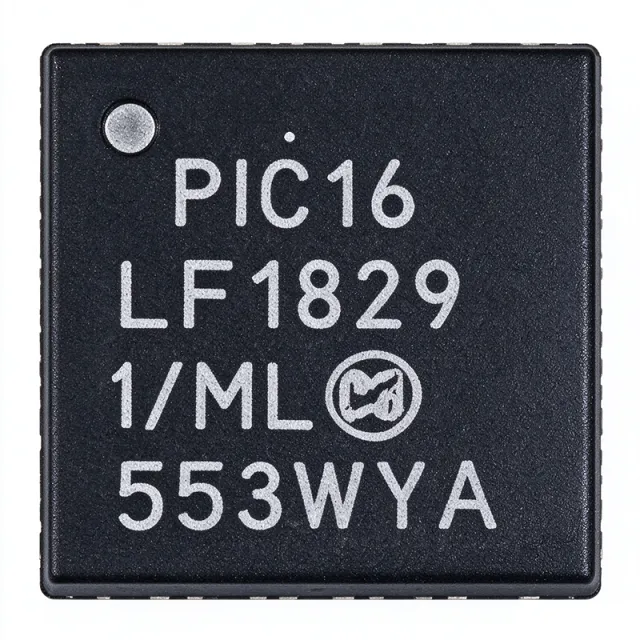
PIC16LF1827T-I/ML - 7KB Flash 8-bit MCU 32MHz 28-QFN | Microchip
PIC16LF1827T-I/ML

PIC16LF1827T-I/ML - 7KB Flash 8-bit MCU 32MHz 28-QFN | Microchip

The Microchip Technology PIC16LF1827T-I/ML is a low-power 8-bit PIC microcontroller from the PIC16F/LF182x enhanced mid-range family, built on nanoWatt XLP technology and offering 7 KB of Flash program memory, 384 bytes of RAM, and 32 MHz internal oscillator performance in a 28-pin QFN (6x6 mm) package with an exposed pad. What is a PIC microcontroller? A PIC (Peripheral Interface Controller) is a family of 8-bit, 16-bit, and 32-bit microcontrollers built on a Harvard RISC architecture by Microchip Technology. Within the PIC portfolio the LF (low-voltage) sub-family operates from 1.8 V to 3.6 V and is optimized for battery-powered applications. The PIC16LF1827 sits in the enhanced mid-range core family (PIC16), offering 49 instructions, 16-level hardware stack, and C-compiler friendly architecture with up to 32 MHz operation. It belongs to the broader semiconductor hierarchy: microcontroller -> embedded MCU -> power management integrated circuit (system context). Key features include 7 KB Flash program memory, 384 bytes RAM, 256 bytes EEPROM, 16 I/O pins, 12-channel 10-bit ADC, two 8-bit timers and one 16-bit timer, an Enhanced Universal Synchronous Asynchronous Receiver Transmitter (EUSART), two MSSP blocks supporting SPI and I2C (both Master and Slave), a 32 MHz internal oscillator, and mTouch capacitive-touch sensing peripherals. The device supports In-Circuit Serial Programming (ICSP) via two pins and offers nanoWatt XLP sleep currents as low as 30 nA typical. Architecturally, the PIC16LF1827 integrates a high-performance RISC CPU with a hardware multiplier, CWG (Complementary Waveform Generator), configurable logic cells, and 2 x PWM modules with independent time bases. The integrated 32 MHz internal oscillator eliminates the need for an external crystal in most cost-sensitive designs and supports factory-calibrated accuracy within +/- 2 percent across the industrial temperature range. Typical applications include low-power sensor nodes, capacitive-touch user interfaces, LED lighting controllers, consumer appliances, IoT edge devices, and battery-powered instrumentation. The combination of XLP sleep current, mTouch peripherals, and integrated peripherals makes it ideal for human-machine interface nodes that must operate for years on a single coin cell. When designing with this part, place a 0.1 uF decoupling capacitor as close as possible to the VDD pin and a 1 uF bulk capacitor near the exposed thermal pad (EP), which must be soldered to a low-impedance ground plane for electrical and thermal performance. The internal oscillator is sufficient for most UART and SPI applications up to 32 MHz; only timing-critical designs (USB, high-precision PWM) need an external crystal.

询价 联系我们
PIC16LF1827T-I/MV - 8-bit MCU, 7KB Flash, 32MHz XLP | Microchip
PIC16LF1827T-I/MV

PIC16LF1827T-I/MV - 8-bit MCU, 7KB Flash, 32MHz XLP | Microchip

The Microchip Technology PIC16LF1827T-I/MV is a low-power 8-bit PIC microcontroller in the PIC16F/LF1826/27 family featuring 7KB Flash program memory, 384 bytes SRAM, and 32MHz internal oscillator speed, housed in a 28-pin UQFN EP (4x4mm) package. It belongs to the eXtreme Low Power (XLP) family with mTouch capacitive touch peripherals and is supplied in tape and reel (T/R) packaging for high-volume SMT assembly. An 8-bit microcontroller (MCU) is a single-chip computer that integrates a CPU, program memory (Flash/ROM), data memory (RAM), and peripherals such as timers, ADC, communication interfaces, and I/O onto one silicon die. The PIC16 family uses Microchip's enhanced mid-range 8-bit RISC architecture, with single-cycle instruction execution at 200ns and 49 instruction opcodes that simplify code generation. Positioned in the hierarchy as PIC16 -> PIC mid-range -> 8-bit MCU -> microcontroller -> semiconductor, the LF (low-power F) variant is optimized for battery-operated designs through nanoWatt XLP technology offering sleep currents as low as 20nA. Key features include 7KB (4K x 14 words) Flash program memory, 384 bytes RAM, 256 bytes EEPROM, 16 I/O pins, integrated capacitive touch (mTouch) sensing, 10-bit ADC with up to 12 channels, two 8-bit and two 16-bit timers, two comparators, and master I2C/SPI/EUSART peripherals. The device supports 1.8V to 3.6V operation with active current of approximately 4 mA at 32 MHz, enabling direct Li-Ion or 2xAA battery connection without external regulation. The PIC16LF1827T-I/MV uses Microchip's enhanced mid-range core with hardware multiplier, providing deterministic interrupt response and code-compatible migration to larger PIC16 variants. The internal 32MHz oscillator eliminates the need for an external crystal in cost-sensitive designs, while the nanoWatt XLP technology enables years of operation from a single coin cell in sleep-dominated applications. Typical applications include consumer touch-interface products (appliance controls, toys, remote controls), portable battery-powered instrumentation, sensor nodes for IoT, low-end wearable devices, and capacitive touch user interface panels. The wide 1.8V-3.6V operating range makes it well-suited for direct connection to single-cell Li-Ion or two-AA battery stacks. When designing with this part, leverage the XLP sleep modes to maximize battery life, and place a 0.1uF decoupling capacitor within 5mm of the VDD pin. The UQFN EP package requires thermal pad soldering for proper thermal and electrical performance. This page synthesizes distributor pricing, drop-in pin-compatible alternatives within the PIC16 family, and practical design notes not consolidated in the manufacturer datasheet.

询价 联系我们
PIC16LF1827T-I/SO - 8-bit 32MHz 7KB Flash MCU | Microchip | SOIC-18
PIC16LF1827T-I/SO

PIC16LF1827T-I/SO - 8-bit 32MHz 7KB Flash MCU | Microchip | SOIC-18

The Microchip Technology PIC16LF1827T-I/SO is a low-power 8-bit PIC16F microcontroller (MCU) based on the enhanced mid-range PIC® core, delivering 32 MIPS at 32 MHz and integrating 7 KB of Flash program memory, 384 bytes of RAM and 256 bytes of EEPROM in an 18-pin SOIC package supplied on tape-and-reel. An 8-bit microcontroller is a single-chip computer that integrates a CPU, non-volatile program memory (Flash), working RAM, EEPROM data memory and a rich set of peripherals (ADC, PWM, timers, communications, I/O) onto one silicon die. PIC microcontrollers sit within the broader taxonomy: microcontroller -> embedded controller -> semiconductor -> integrated circuit. The PIC16F family uses a RISC architecture that executes most instructions in a single clock cycle, giving the PIC16LF1827 a deterministic instruction time of 125 ns at 32 MHz. Key specifications include a 32 MHz maximum operating frequency, 12 KBytes of addressable Flash (used as 7 KB / 4K x 14 words), an internal 32 kHz-32 MHz oscillator, an integrated 12-channel 10-bit ADC, two 8-bit timers, one 16-bit timer, enhanced PWM, mTouch™ capacitive-touch peripherals, and an XLP™ (eXtreme Low Power) design that drops the sleep current into the nanoampere region. The integrated Core Independent Peripherals (CIPs) reduce CPU load and code size for sensor and control loops. The device targets 1.8V-3.6V operation from the F-version (LF) silicon, with brown-out-reset, watchdog timer and on-chip debug via the In-Circuit Serial Programming (ICSP) interface. The 18-pin SOIC footprint offers a wide SOIC land pattern that is hand-solder-friendly and breadboard-compatible. Peripherals include I2C/SPI/UART with EUSART, mTouch capacitive sensing, PWM, comparators and 12-bit ADC, all configurable through Microchip's MPLAB X IDE and XC8 compiler. Typical applications include low-power IoT sensor nodes that wake periodically to take readings, capacitive touch button/gesture interfaces using mTouch, battery-powered home automation nodes running on 2xAA cells, portable consumer devices (grooming, kitchen scales, remote controls) and industrial sensor transmitters. The wide supply range and ultra-low sleep current make the device a strong fit when system standby lifetime on a primary cell exceeds years. When designing with this MCU, place a 100 nF decoupling capacitor as close as possible to VDD/VSS and use the internal 32 MHz HFINTOSC at start-up to minimise external component count. For noise-sensitive analog work, use the dedicated analog supply AVdd/AVss pair and configure the ADC in the appropriate acquisition mode. This page synthesizes distributor pricing, parametric drop-in alternatives, and practical design notes beyond what the manufacturer datasheet provides, supporting both procurement and engineering decisions.

询价 联系我们
PIC16LF1827T-I/SS - 8-Bit 32MHz XLP MCU 7KB Flash 20-SSOP | Microchip
PIC16LF1827T-I/SS

PIC16LF1827T-I/SS - 8-Bit 32MHz XLP MCU 7KB Flash 20-SSOP | Microchip

The Microchip Technology PIC16LF1827T-I/SS is an 8-bit PIC microcontroller from the PIC16F/LF1826/27 family, featuring nanoWatt XLP (eXtreme Low Power) technology and mTouch capacitive touch capability, delivered in a 20-pin SSOP package with 32 MHz internal oscillator, 7 KB Flash program memory (4K x 14 words), and 384 bytes of RAM. The LF prefix denotes the wide-voltage F-variant operating range from 1.8 V to 3.6 V, while the related part T-I/SS variant ships in tape-and-reel packaging qualified for the industrial temperature range of -40C to +85C. A microcontroller (MCU) is a single-chip computer that integrates a CPU core, program and data memory, and configurable peripherals. Within the broader semiconductor taxonomy, the PIC16LF1827 belongs to the 8-bit microcontroller family -> PIC16 family -> PIC mid-range architecture -> embedded microcontroller -> semiconductor IC. The nanoWatt XLP technology lineage traces back to Microchip's PIC16F platform, which uses a 14-bit instruction set and Harvard architecture with separate program and data buses. The mTouch peripheral enables capacitive touch sensing without external components, simplifying user-interface designs. Key features include up to 32 MHz operation from an internal oscillator, 12-bit ADC with computation, multiple communication peripherals (I2C, SPI, EUSART), 16-bit PWM/timer/capture modules, on-chip temperature indicator, and ultra-low-power sleep current in the nanoAmpere range. The 20-SSOP (Shrink Small Outline Package) offers a compact footprint suitable for space-constrained PCB designs while still allowing hand-soldering and visual inspection. The I-grade temperature rating supports industrial environments including factory automation, sensor nodes, and outdoor instrumentation. Typical applications span battery-powered IoT sensor nodes, capacitive touch user interfaces, low-power remote controls, HVAC controls, white goods, and portable medical peripherals. The combination of XLP sleep currents below 100 nA and rapid wake-up from sleep makes this MCU particularly suited to energy-harvesting applications. The 32 MHz core provides enough computational headroom for sensor-fusion loops and basic communication stacks (e.g. Modbus, SMBus, or proprietary RF protocols paired with an external transceiver). When designing with the PIC16LF1827, ensure the supply voltage remains within 1.8 V to 3.6 V for the LF variant - applying 5 V will damage the part. Decouple each VDD pin with a 100 nF ceramic capacitor placed as close as possible to the IC, and follow Microchip's recommended ICSP programming header layout for in-circuit serial programming. This page synthesizes distributor pricing, drop-in pin-compatible alternatives from the same PIC16 family, comparison data, and practical design notes that are not aggregated on the manufacturer datasheet alone.

询价 联系我们
PIC16LF1828-E/GZ - 8-bit MCU, 7KB Flash, 32MHz, 20-UQFN | Microchip
PIC16LF1828-E/GZ

PIC16LF1828-E/GZ - 8-bit MCU, 7KB Flash, 32MHz, 20-UQFN | Microchip

The Microchip Technology PIC16LF1828-E/GZ is an 8-bit PIC16 family flash microcontroller with nanoWatt XLP (eXtreme Low Power) technology, 7 KB of Flash program memory, 256 bytes of RAM, and 256 bytes of EEPROM, packaged in a 20-pin UQFN (4x4 mm). It runs at up to 32 MHz instruction clock with a 200 ns instruction cycle and operates from 1.8 V to 3.6 V, drawing as little as 20 nA in sleep mode for battery-powered designs. The device integrates 18 general-purpose I/O, 12 channels of 10-bit ADC, two 8-bit timers, one 16-bit timer, Enhanced Capture/Compare/PWM (ECCP), MSSP for I2C/SPI, EUSART, mTouch capacitive sensing, and on-chip temperature indicator. The -E suffix denotes the -40C to +125C extended industrial temperature range. What is an 8-bit microcontroller? An 8-bit MCU is a small computer-on-a-chip that processes data in 8-bit chunks and is the foundational building block of embedded systems. The PIC16LF1828 belongs to the enhanced mid-range PIC16 architecture, sitting in the hierarchy: microcontroller -> 8-bit MCU -> enhanced mid-range PIC16 -> nanoWatt XLP family -> semiconductor. Its Harvard RISC core with 49 instructions and 16-level hardware stack delivers deterministic, low-latency interrupt response valued in safety-critical loops. Key features include 7 KB (4K x 14) self-programmable Flash with read-while-write, 256 B RAM, 256 B EEPROM, on-chip FRC oscillator with PLL, and ultra-low-power sleep modes (down to ~20 nA typical). The mTouch capacitive-touch peripheral enables capacitive buttons and sliders without external components, while the ADC operates with an internal fixed-voltage reference for ratiometric measurements. Typical applications include low-power IoT sensor nodes, wearable health bands, capacitive-touch user interfaces, remote controls, battery-powered HVAC sensors, and consumer white goods requiring USB-friendly 3.3 V rails. The 1.8 V minimum rail makes it compatible with single-cell alkaline or Li-Ion coin-cell designs. Design with the PIC16LF1828 using MPLAB X IDE and the XC8 compiler; debug via PICkit 3 or MPLAB ICD 3 on the ICSP pins. Place a 100 nF decoupling capacitor directly on VDD and route the ICSP lines away from switching nodes.

询价 联系我们
PIC16LF1828-E/SO - 8-Bit XLP MCU 32MHz 7KB Flash SOIC-20 | Microchip
PIC16LF1828-E/SO

PIC16LF1828-E/SO - 8-Bit XLP MCU 32MHz 7KB Flash SOIC-20 | Microchip

The Microchip Technology PIC16LF1828-E/SO is an 8-bit PIC16 microcontroller from the PIC® XLP™ mTouch™ 16F family, delivering 32 MHz CPU performance with 7 KB (4K x 14) of Flash program memory in a 20-pin SOIC (0.295 inch / 7.50 mm width) package. It operates from a wide 1.8 V to 3.6 V supply range and integrates 256 bytes of RAM, an internal 32 MHz oscillator, and an mTouch capacitive touch-sensing peripheral. The "LF" prefix denotes the low-power (XLP eXtreme Low Power) variant, while the "E" suffix designates the extended (-40 °C to +125 °C) operating-temperature range. A PIC microcontroller is a compact programmable processor that combines CPU core, Flash program memory, RAM, EEPROM, and a rich set of peripherals (ADC, timers, communication interfaces) into a single IC. PIC microcontrollers sit at the hierarchy of embedded controller -> microcontroller -> microprocessor-based semiconductor, providing deterministic real-time control for sensor interfacing, motor control, user-interface, and battery-powered applications. The 8-bit PIC16 architecture uses an enhanced mid-range RISC core with a 14-bit instruction set, optimized for low power and code density. Key features include 7 KB self-programmable Flash with device longevity, 256 bytes RAM, 256 bytes EEPROM, a 10-bit ADC with up to 12 channels, two 8-bit and two 16-bit timers, EUSART, MSSP (SPI/I2C), enhanced PWM modules, and the mTouch capacitive-sensing peripheral that enables touch-button or slider user interfaces without dedicated hardware. The integrated nanoWatt XLP technology provides ultra-low sleep currents suitable for battery-powered or energy-harvesting designs. Architecturally, the PIC16LF1828 employs a Harvard RISC core with a hardware multiplier, a 16-level hardware stack, and a vectored interrupt controller supporting up to 32 interrupts. Its instruction pipeline provides deterministic 1-cycle execution for most instructions at 32 MHz (8 MHz instruction rate), and the integrated capacitive-sensing engine uses charge-time measurement for robust touch acquisition. Peripherals are routed through Microchip's Peripheral Pin Select (PPS) module, which remaps digital functions to any user-selected I/O pin, simplifying PCB layout and BOM reuse across PIC16/18 product lines. Typical applications include consumer-electronics user interfaces (touch buttons, sliders, proximity sensing), low-power IoT sensor nodes, battery-powered metering, small home appliances, USB-to-UART bridges, and industrial sensor signal conditioning. The combination of XLP sleep currents below 1 µA in RTCC + Sleep mode and the mTouch peripheral makes the device especially suitable for sealed-keypad or battery-powered capacitive-touch products. When designing with this part, allocate adequate decoupling (100 nF plus 1-10 µF bulk) on VDD and place the 32 kHz low-power crystal close to the SOSC pins if accurate RTCC timing is required. Program memory endurance is rated for 100 K erase/write cycles typical, so use EEPROM for parameter storage and wear-level high-frequency writes across the array. This page synthesizes distributor pricing, drop-in same-package alternatives from the PIC16 family, and practical design notes not found in the standalone manufacturer datasheet.

询价 联系我们
PIC16LF1828-E/SS - 8-bit XLP MCU, 7KB Flash, 32MHz | Microchip
PIC16LF1828-E/SS

PIC16LF1828-E/SS - 8-bit XLP MCU, 7KB Flash, 32MHz | Microchip

The Microchip Technology PIC16LF1828-E/SS is a low-power, high-performance 8-bit CMOS flash microcontroller built on an enhanced mid-range PIC16 core, delivering 32 MHz / 200 ns instruction speed with 7 KB Flash program memory and 256 B RAM in a 20-pin SSOP package. The 'LF' prefix denotes the 1.8V–3.6V wide operating range that enables nanoWatt XLP sleep currents as low as 20 nA, while the 'E' suffix indicates the -40C to +125C extended industrial temperature grade. A microcontroller (MCU) is a single-chip computer that integrates a CPU, non-volatile program memory (Flash), volatile data memory (RAM), and a rich set of peripherals (timers, ADC, communications, I/O) onto one silicon die. Within the broader semiconductor taxonomy, an MCU belongs to: microcontroller -> embedded processor -> integrated circuit -> semiconductor. The PIC16LF1828 family sits at the low-power / mixed-signal node of that tree, prioritizing active performance per milliwatt and deep-sleep retention for battery and energy-harvesting designs. Key features include 7 KB self-programmable Flash, 256 B SRAM, 256 B EEPROM, an internal 32 MHz oscillator with PLL, an on-chip 10-bit ADC with up to 12 channels, two 8-bit timers plus one 16-bit timer, enhanced PWM, configurable logic cells (CLC), mTouch capacitive touch sensing, and EUSART / I2C / SPI serial interfaces. The device provides 17 general-purpose I/O pins with individual pull-up, interrupt-on-change, and weak pull-up control. This combination delivers high analog/mixed-signal integration in a footprint smaller than most discrete plus-MCU solutions. Architecturally, the part uses a 14-bit instruction word modified Harvard pipeline with a hardware multiplier and a hardware CLC fabric that lets designers route peripheral signals without external gates. The internal 32 MHz oscillator factory-calibrated to within 1% supports USB-style timing tolerances via Fosc postscaler while still allowing low-power 31 kHz LF operation. The nanoWatt XLP technology uses dynamic peripheral gating so unused modules contribute <50 nA bias current. Typical applications include low-power wireless sensor nodes, IoT battery-powered edge devices, consumer remote controls, mTouch capacitive touch keypads, LED lighting controllers, and portable medical monitors. Designers also deploy it in sensor hubs, smart thermostats, and low-end motor-control auxiliaries. The wide 1.8V–3.6V range allows direct Li-ion / 2xAA battery operation, while extended temperature parts serve automotive under-hood and industrial control environments. When designing with this device, prioritize pin assignment early - the EUSART, I2C, and PWM outputs are remappable, while the ICSP/ICD pins (RB6/RB7) and the Vpp/MCLR must remain accessible for programming. Use the internal 32 MHz HFINTOSC to reduce external component count, but verify USB orlin tolerance for your protocol stack. Decouple VDD/VSS with at least 100 nF plus 1 uF bulk, and use the on-chip LDO regulator with a 10 uF tank cap for noise-sensitive analog rails.

询价 联系我们
PIC16LF1828-I/GZ - 8-Bit XLP MCU, 7KB Flash, 20-UQFN | Microchip
PIC16LF1828-I/GZ

PIC16LF1828-I/GZ - 8-Bit XLP MCU, 7KB Flash, 20-UQFN | Microchip

The Microchip Technology PIC16LF1828-I/GZ is an 8-bit PIC16 family RISC microcontroller with 7KB Flash, 32MHz CPU, and 2.5V/3.3V operating voltage in a 20-pin UQFN EP (4x4) package. The 'LF' suffix indicates a low-power (XLP) variant optimized for battery-operated and energy-harvesting designs, drawing nanoWatt XLP sleep currents. The 20-UQFN-EP package includes an exposed thermal pad, enabling compact PCB layouts with enhanced thermal performance for space-constrained applications. A microcontroller (MCU) is a single-chip computer that integrates a CPU, RAM, Flash program memory, EEPROM, and peripherals such as timers, ADC, comparators, and communication interfaces. The PIC16LF1828 belongs to Microchip's enhanced mid-range PIC16 family, which uses a 14-bit instruction word, 200ns instruction execution time, and a Harvard architecture separating program and data buses. MCUs are foundational building blocks of embedded systems, sitting below microprocessors (which need external memory) in the semiconductor hierarchy: transistor -> CMOS logic gate -> CPU core -> MCU -> SoC. XLP technology positions this device in the ultra-low-power MCU category alongside competing low-power families from TI MSP430 and ST STM32L. Key features include 7KB self-programmable Flash with 10K erase/write cycles, 256 bytes RAM, 256 bytes EEPROM, 14 I/O pins, 12-channel 10-bit ADC, two 8-bit timers, one 16-bit timer, enhanced PWM/CCP module, mTouch capacitive sensing peripheral, EUSART, I2C, SPI, and 16 internal interrupts. The device supports 1.8V-3.6V operation (LF variant) versus the 1.8V-5.5V range of the standard PIC16F1828, making it ideal for 2x AA battery applications where extended battery life outweighs the need for 5V tolerance. Technical depth: the PIC16LF1828 implements the PIC16 enhanced mid-range core with a hardware multiplier, CWG (Complementary Waveform Generator), NCO (Numerically Controlled Oscillator), and HFINTOSC factory-calibrated internal oscillator accurate to ±1% across voltage and temperature. The XLP nanoWatt technology includes multiple power-managed sleep modes (doze, idle, sleep) with wake-on-change, watchdog timer, and ultra-low-power RTCC (Real-Time Clock/Calendar) suitable for years of operation from a single CR2032 coin cell. Typical applications include consumer remote controls, wireless sensor nodes, IoT edge devices, low-power instrumentation, and battery-powered human-interface devices (HID) with capacitive touch buttons. The 20-UQFN package suits compact form factors such as wearables, hearing aids, and miniaturized sensor modules. Design consideration: ensure decoupling capacitors (100nF plus 10uF bulk) are placed within 3mm of VDD/AVDD, and that the exposed pad is soldered to a continuous ground plane for both thermal dissipation and electrical grounding. Program/debug is via ICSP (In-Circuit Serial Programming) on pins ICSPCLK/ICSPDAT, eliminating the need for a pre-programmed socket. This page synthesizes distributor pricing, drop-in alternatives, and practical design notes not found in the manufacturer datasheet, providing engineering value beyond raw spec repetition.

询价 联系我们
PIC16LF1828-I/ML - 8-bit 32MHz MCU, 7KB Flash, XLP | Microchip
PIC16LF1828-I/ML

PIC16LF1828-I/ML - 8-bit 32MHz MCU, 7KB Flash, XLP | Microchip

The Microchip Technology PIC16LF1828-I/ML is an 8-bit flash microcontroller in the PIC® XLP™ mTouch™ 16F family, delivering 32 MHz CPU performance with 7 KB (4K x 14) of program Flash and 256 bytes of SRAM in a 20-pin QFN 4x4 mm package. The 'LF' variant runs from a wide 1.8V to 3.6V supply, the 'I' suffix denotes the -40C to +85C industrial temperature grade, and 'ML' specifies the QFN-20 (4x4) package with matte tin plating. Background: An 8-bit microcontroller (MCU) is a single-chip computer that integrates a CPU, non-volatile program memory, RAM, and peripherals. The PIC16F/LF1828 belongs to Microchip's enhanced mid-range PIC16 family, which uses a 14-bit instruction word and RISC architecture. Compared with older baseline PICs, the enhanced mid-range core adds C-friendly instructions, a deeper hardware stack, and richer peripherals. Microcontrollers sit at the lowest tier of embedded computing, below microprocessors, and form the brains of virtually every sensor node, household appliance, and battery-powered IoT device. Key features include nanoWatt XLP™ extreme low-power technology with sleep currents down to the nA range, an integrated 10-bit ADC with up to 17 channels, mTouch™ capacitive touch sensing hardware, two PWM modules, Enhanced Universal Synchronous Asynchronous Receiver Transmitter (EUSART), Master I²C/SPI interfaces, and an internal 32 MHz oscillator that eliminates the external crystal in many designs. The device also integrates a configurable 32 kHz low-power oscillator for low-power sleep modes and a Digital Signal Modulator. Technical depth: The CPU executes most instructions in a single 125 ns cycle at 32 MHz, and supports interrupt-on-change on multiple ports, a hardware 8-bit/16-bit timer architecture, and an on-chip temperature indicator. The LF low-voltage silicon supports 1.8V minimum operation, enabling single-cell alkaline or lithium chemistries with boost or direct supply. The 20-QFN package offers a small 4x4 mm footprint with an exposed thermal pad for improved dissipation and is suitable for reflow-only assembly. Typical applications include capacitive touch user interfaces, low-power IoT sensor nodes, battery-powered remote keyless entry, small home appliances, LED lighting controls, and 5V/3.3V mixed-rail consumer products where the wide operating voltage and mTouch sensing eliminate mechanical buttons and reduce BOM cost. The QFN-20 footprint is also friendly to space-constrained wearables and handheld instruments. Design consideration: Place a 100 nF decoupling capacitor as close as possible to VDD and another on AVDD, plus a 10 µF bulk cap on the rail. Configure the configuration words for the desired oscillator, watchdog timer, low-voltage programming, and code protection before any firmware is downloaded; MCLR must be pulled up through a resistor for proper reset behavior. This page synthesizes distributor pricing and inventory from DigiKey, Mouser, LCSC and Octopart, pin-compatible drop-in alternatives from the same PIC16 family, and practical design notes not found in the manufacturer datasheet, providing information gain beyond the datasheet alone.

询价 联系我们
PIC16LF1828-I/P - 8-bit MCU 7KB 32MHz XLP 20-DIP | Microchip
PIC16LF1828-I/P

PIC16LF1828-I/P - 8-bit MCU 7KB 32MHz XLP 20-DIP | Microchip

The Microchip Technology PIC16LF1828-I/P is an 8-bit enhanced mid-range PIC16 microcontroller featuring 7 KB of Flash program memory, 256 bytes of RAM, and a 32 MHz internal oscillator, housed in a 20-pin PDIP through-hole package. It operates from 2.5 V to 3.6 V with the LF (low-power) variant tuned for ultra-low-power XLP applications consuming nanoWatt sleep currents. The device integrates a 12-channel 10-bit ADC, two comparators, four 8-bit timers, two capture/compare/PWM modules, and an mTouch capacitive-touch sensing peripheral. A microcontroller (MCU) is a single-chip computer containing a CPU core, non-volatile program memory, working RAM, and a mix of analog and digital peripherals designed to be embedded inside a larger electronic system. The PIC16F/LF182x family belongs to Microchip's enhanced mid-range 8-bit PIC architecture, which extends the baseline PIC instruction set with additional addressing modes and peripherals while remaining easy to program in C or assembly. The 'LF' suffix designates the low-voltage, low-power silicon revision optimized for battery-powered and energy-harvesting designs. Key features of the PIC16LF1828-I/P include 256 bytes of EEPROM, an I2C/SPI/EUSART configurable serial interface block, 18 digital I/O pins with peripheral pin-select (PPS) routing, an on-chip 32 kHz to 32 MHz HF oscillator that eliminates the external crystal in most designs, and a power-managed sleep mode with sub-microamp wake-up current. The 20-pin PDIP package is intentionally retained for breadboard-friendly through-hole prototyping, hobbyist projects, and legacy industrial control boards that still favor socketed or hand-solderable parts. Typical applications include battery-powered sensor nodes, capacitive-touch user interfaces, low-cost motor control loops, industrial sensor transmitters, and educational microcontroller kits. The integrated 10-bit ADC and mTouch peripheral also suit it for portable measurement instruments where PCB area and BOM cost are critical. When designing with this part, take advantage of the integrated 32 MHz oscillator to remove the external crystal and verify that the LF voltage range (2.5 V to 3.6 V) covers the intended supply rail; for 5 V designs use the PIC16F1828-I/P variant instead. Ensure the PPS register configuration is committed before enabling peripherals to avoid spurious pin states at startup. This page consolidates distributor pricing, true 20-pin PDIP drop-in alternates from the PIC16LF182x family, and practical design notes compiled from Microchip's datasheet and pin-compatibility documentation - content beyond the raw datasheet spec table.

询价 联系我们
PIC16LF1828-I/SO - 8-bit XLP MCU 7KB Flash 32MHz 20-SOIC | Microchip
PIC16LF1828-I/SO

PIC16LF1828-I/SO - 8-bit XLP MCU 7KB Flash 32MHz 20-SOIC | Microchip

The Microchip Technology PIC16LF1828-I/SO is a low-power 8-bit PIC16 enhanced mid-range microcontroller with 7 KB Flash program memory, 256 bytes RAM, and an integrated 32 MHz internal oscillator, housed in a 20-pin SOIC package. The "LF" prefix indicates the extended battery-life XLP variant, supporting a wide operating voltage range from 1.8V to 3.6V with nanoWatt XLP technology for sleep currents in the tens of nanoamperes. A microcontroller (MCU) is a single-chip computer containing a CPU core, program and data memory, timers, communication peripherals, and I/O pins. The PIC16 enhanced mid-range core is a RISC architecture with 49 instructions and 200 ns instruction execution time at 20 MHz (16 MIPS). PIC16 MCUs sit in the taxonomy: microcontroller -> embedded MCU -> 8-bit MCU -> PIC family -> PIC16 enhanced mid-range -> XLP (eXtreme Low Power) family. These devices are designed for battery-powered and energy-harvesting designs where low sleep current and peripheral flexibility outweigh raw CPU throughput. Key features of the PIC16LF1828-I/SO include 7 KB (4K x 14) Flash program memory, 256 bytes of RAM, 256 bytes of EEPROM, 18 general-purpose I/O pins, 12 channels of 10-bit ADC, one Enhanced USART (EUSART), two SPI/I2C MSSP peripherals, four 8/16-bit timers, and a 32 MHz internal oscillator accurate to within ±1% (HFINTOSC). The device integrates mTouch capacitive-touch sensing hardware and a Complementary Waveform Generator (CWG) for driving power-conversion stages. An on-chip temperature indicator, in-circuit debugger (ICD), and nanoWatt XLP sleep modes (down to ~20 nA typical) complete the feature set. Typical applications include capacitive-touch user interfaces, IoT sensor nodes, battery-powered remote controls, low-power medical wearables, energy-harvesting wireless sensor endpoints, and general-purpose embedded control. The 20-pin SOIC package is a JEDEC-standard wide-body surface-mount outline with hand-solderable leads and reliable reflow characteristics for industrial and consumer designs. Pin-compatibility across the PIC16LF182x family allows upgrade/downgrade without PCB redesign. When designing with this MCU, note that the LF voltage range (1.8V to 3.6V) differs from the F variant (1.8V to 5.5V); mixing the two in mixed-voltage rails requires level translation. Use the MPLAB X IDE with XC8 compiler for code development; debug requires a PICkit 3, MPLAB ICD 3/4, or Curiosity development board. The integrated ICD eliminates the need for an external debug header on most pins.

询价 联系我们
PIC16LF1828T-I/GZ - 7KB Flash 8-bit MCU 32MHz UQFN-20 | Microchip
PIC16LF1828T-I/GZ

PIC16LF1828T-I/GZ - 7KB Flash 8-bit MCU 32MHz UQFN-20 | Microchip

The Microchip Technology PIC16LF1828T-I/GZ is an 8-bit PIC16 family CMOS flash microcontroller in the PIC16LF1828 sub-family, offering 7 KB (4K x 14) of program memory, 256 bytes of data EEPROM, and 256 bytes of SRAM, operating up to 32 MHz in a 20-pin UQFN (4x4 mm) exposed-pad package with 18 digital I/O lines. It supports an industrial-grade -40C to +85C temperature range and is part of the PIC16F/LF1824/1828 family, which adds nanoWatt XLP ultra-low-power modes and mTouch capacitive-sensing peripherals alongside standard PIC16 mid-range resources such as timers, PWM, ADC, comparators, EUSART, and I2C/SPI. The 'LF' prefix denotes the low-voltage F variant (1.8 V to 3.6 V supply), the 'T' suffix denotes tape-and-reel packaging, 'I' is the industrial temperature grade, and 'GZ' identifies the 20-pin UQFN (4x4) package. An 8-bit microcontroller (MCU) is a small, self-contained computer-on-a-chip integrating a CPU, program and data memory, and configurable peripherals used to read sensors and drive outputs in embedded systems. Within the broader taxonomy, the PIC16LF1828 sits at the following hierarchy: PIC16 family -> 8-bit MCU -> microcontroller -> embedded processing IC -> semiconductor device. The XLP nanoWatt technology puts this part in the ultra-low-power tier of PIC16 devices, with sleep currents on the order of nanoamps and active run currents on the order of microamps, enabling years of battery life in duty-cycled applications. Key differentiating features include 7 KB self-programmable flash with ICD (in-circuit debug), 256 B data EEPROM emulation, integrated mTouch capacitive sensing, 10-bit ADC with computation, enhanced PWM, multiple Enhanced USART, MSSP (I2C/SPI) ports, and on-board 32 kHz oscillator for low-power timekeeping. The UQFN-20 exposed-pad package provides a small PCB footprint while the thermal pad aids heat dissipation. CIP (Core Independent Peripherals) such as the ADC-with-computation engine and configurable logic cells allow peripheral-to-peripheral interaction without waking the CPU, extending battery life. Typical applications include battery-powered sensor nodes, capacitive touch user interfaces, low-power remote controls, wearable health patches, consumer white goods UI, and IoT end nodes where on-board touch or ADC measurement is required. The wide peripheral set lets one device replace multiple discrete analog components, reducing BOM and PCB area. When designing with this device, ensure the LF supply (1.8 V - 3.6 V) range is respected and that decoupling capacitors are placed close to VDD/VSS pins. Programming is performed via MPLAB X IDE using PICkit 3, MPLAB ICD 3, or MPLAB SNAP; no debug header is required because debug is integrated on-device. This page synthesizes distributor pricing, same-brand and cross-brand drop-in alternatives, application circuits, and practical design notes not found in the manufacturer datasheet alone, providing engineers with a single reference for evaluating the PIC16LF1828T-I/GZ against peer 8-bit MCUs.

询价 联系我们
PIC16LF1828T-I/ML - 8-bit XLP MCU 32MHz 7KB Flash | Microchip
PIC16LF1828T-I/ML

PIC16LF1828T-I/ML - 8-bit XLP MCU 32MHz 7KB Flash | Microchip

The Microchip Technology PIC16LF1828T-I/ML is an 8-bit PIC® XLP™ mTouch™ 16F-series microcontroller (MCU) with 32 MHz CPU, 7 KB (4K x 14) Flash program memory, 256 bytes SRAM and 256 bytes EEPROM, housed in a 20-pin QFN (4x4 mm) package with exposed pad. The 'LF' suffix designates the low-voltage (F) variant operating down to 1.8 V supply, while 'T' indicates tape-and-reel packaging and 'I' denotes the industrial -40 °C to +85 °C temperature range. A microcontroller (MCU) is a single-chip computer that integrates a CPU core, non-volatile program memory (Flash), volatile data memory (SRAM), EEPROM, and a rich set of peripherals on one die. Within the taxonomy, PIC16LF1828 sits at microcontroller -> 8-bit MCU -> enhanced mid-range MCU -> PIC16 family -> nanoWatt XLP low-power MCU. It belongs to the broader semiconductor / integrated-circuit hierarchy and is used wherever deterministic real-time control, ultra-low standby power, or capacitive-touch sensing is required. Key differentiating features include 12 channels of 10-bit ADC, a 5-bit DAC, mTouch capacitive-touch hardware, nanoWatt XLP technology with claimed standby currents in the tens of nanoamperes, an integrated 32 MHz internal oscillator, and on-chip debugging via PICkit™ / MPLAB® ICD. The 20-QFN package is the smallest footprint variant of the family and includes an exposed thermal pad for improved power dissipation. The architecture combines a RISC-style PIC16 enhanced core (200 ns instruction execution), an 8-level hardware stack, and peripherals such as enhanced USART, MSSP (SPI/I²C), timer/counters with PWM, comparators, and a fixed-voltage reference (FVR). The XLP technology allows battery-powered designs to extend operating life by spending most of their time in sleep with peripherals waking the CPU on demand. Typical applications include capacitive touch key pads in consumer appliances, low-power sensor nodes with battery or energy harvesting, IoT edge nodes (BLE / LoRa companion designs), small appliances and white goods with touch interfaces, handheld medical or fitness devices, and automotive interior accessory modules where the LF variant's wider voltage tolerance is valuable. When designing with this part, ensure the exposed pad of the QFN is soldered to a sufficient copper pour to meet thermal and electrical performance, and verify the chosen programmer (PICkit 3 / MPLAB ICD 3 / PICkit 4) supports the LF voltage range. Use the AC244043 / AC244044 debug-header accessories only if you are not relying on the ICSP pins. This page synthesizes distributor pricing, drop-in same-brand and cross-brand alternatives, pinout, and practical design notes that are not assembled in any single manufacturer datasheet.

询价 联系我们
PIC16LF1828T-I/SO - 7KB Flash 32MHz 8-bit MCU | Microchip
PIC16LF1828T-I/SO

PIC16LF1828T-I/SO - 7KB Flash 32MHz 8-bit MCU | Microchip

The Microchip Technology PIC16LF1828T-I/SO is an 8-bit PIC microcontroller featuring 7KB (4K x 14) of Flash program memory, 256 bytes of RAM, and a 32 MHz internal oscillator, housed in a 20-pin SOIC (300 mil) package. As a member of the PIC16F/LF182x family built on the enhanced mid-range 8-bit CPU core, it delivers 49 instructions, 16-level hardware stack with overflow/underflow reset, and integrated nanoWatt XLP extreme-low-power technology for battery-friendly designs. A microcontroller (MCU) is a single-chip computer containing a CPU, program and data memory, and configurable peripherals. The PIC16LF1828 sits in the 8-bit MCU segment of the broader microcontroller hierarchy, a category that bridges simple logic ICs and 32-bit microprocessors. Within Microchip's taxonomy it belongs to the PIC16 family (8-bit), specifically the mid-range enhanced core with XLP power management. The 'LF' prefix denotes the low-voltage (1.8V-3.6V) variant that uses Flash program memory, optimized for ultra-low-power embedded applications. Key features include 256B RAM, 128B EEPROM, an internal 32 MHz oscillator with 4x PLL option, 5-bit DAC, 2 analog comparators, 4 PWM channels, 5 timers, mTouch capacitive sensing peripheral, and serial interfaces (I2C, SPI, USART). The XLP technology provides sleep currents below 50 nA typical and active currents around 50 uA at 1 MHz, making it ideal for energy-harvesting and battery-powered sensor nodes. The 20-pin SOIC package supports through-hole-style prototyping footprints with surface-mount manufacturing. Architecturally, the PIC16LF1828 uses a Harvard RISC core with separate program and data buses, executing one instruction per clock cycle (except branches). The peripheral pin select (PPS) allows remapping of digital peripherals to different I/O pins, simplifying PCB layout. Integrated debug via ICD and 49-instruction instruction set balance code density and execution speed for embedded control loops. Typical applications include battery-powered IoT sensor nodes, low-power wireless transmitters, capacitive touch user interfaces, LED lighting controllers, and consumer handheld devices. The wide 1.8V to 3.6V supply range allows direct operation from a single Li-ion or 2x AA cell stack. When designing, ensure VDD decoupling is placed within 3 mm of the VDD pin, and consider enabling the internal voltage regulator mode. For ultra-low standby, route unused peripherals to their lowest-power state via the PMD module. This page synthesizes distributor pricing, verified drop-in alternatives, and practical design notes for the PIC16LF1828T-I/SO, including parametric comparisons and engineering selection guidance not found on a single distributor page.

询价 联系我们
PIC16LF1828T-I/SS - 8-bit 32MHz 7KB Flash MCU 20-SSOP
PIC16LF1828T-I/SS

PIC16LF1828T-I/SS - 8-bit 32MHz 7KB Flash MCU 20-SSOP

The Microchip PIC16LF1828T-I/SS is an 8-bit PIC16 family CMOS flash microcontroller in a 20-pin SSOP package, featuring a 32MHz internal oscillator, 7KB (4K x 14) of program Flash memory, 256 bytes of SRAM, and 256 bytes of data EEPROM. It is a member of Microchip's nanoWatt XLP (eXtreme Low Power) family and integrates an mTouch capacitive-sensing peripheral. An 8-bit flash microcontroller (MCU) is a single-chip computer that combines a CPU, non-volatile program memory, RAM, and peripherals on one die. The PIC16 family uses a RISC-based Harvard architecture with 14-bit instructions, where each instruction cycle takes 4 clock cycles. Within the broader semiconductor hierarchy, this device sits as: 8-bit MCU -> microcontroller -> embedded processor -> semiconductor IC. The 'LF' prefix denotes the low-voltage F-version operating range (1.8V-3.6V), enabling battery-powered and energy-harvesting applications. Key features of the PIC16LF1828T-I/SS include up to 32MHz operation from a 3.0V-3.6V supply (16MHz from 1.8V), 12 ADC channels with 10-bit resolution, two 8-bit timers and one 16-bit timer, enhanced PWM modules, an mTouch capacitive-sensing peripheral, a configurable logic cell (CLC), and an EUSART with auto-baud detection. The XLP technology delivers sleep currents in the nanoamp range, extending battery life in always-on designs. The internal architecture uses a dual-clock system with a high-frequency 32MHz oscillator (HFINTOSC) and a 32kHz low-power oscillator (LFINTOSC) for sleep-mode timing, plus a software-selectable system clock prescaler. The 10-bit ADC is Successive Approximation Register (SAR) type with acquisition time programmable in ADC clock cycles. Internal voltage reference options include a fixed 1.024V, 2.048V, and 4.096V reference, plus a bandgap reference. Typical applications for the PIC16LF1828T-I/SS include low-power IoT sensor nodes (battery and energy-harvesting), capacitive-touch human-interface panels, remote controls, LED lighting controls, low-end motor control loops, sensor conditioning, and small appliances. The combination of low sleep current, ample analog peripherals, and mTouch makes it well suited for always-on capacitive user-interface designs. Designers should note that the 'T' suffix denotes tape-and-reel packaging, the 'I' indicates the industrial temperature range (-40C to +85C), and '/SS' specifies the SSOP-20 package. For hand prototyping or low-volume builds, the non-T variant PIC16LF1828I/SS is supplied in tubes. Firmware development uses Microchip's free MPLAB X IDE with the XC8 compiler and the MPLAB Snap programmer/debugger. This page synthesizes verified distributor pricing, drop-in same-package alternatives drawn from the PIC16F/LF1824/1828 family, and practical design notes drawn from the manufacturer datasheet that go beyond the bare part number listing.

询价 联系我们
PIC16LF1829-E/GZ - 14KB Flash 32MHz 8-bit MCU | Microchip
PIC16LF1829-E/GZ

PIC16LF1829-E/GZ - 14KB Flash 32MHz 8-bit MCU | Microchip

The Microchip Technology PIC16LF1829-E/GZ is an 8-bit PIC microcontroller from the PIC16F/LF182X family, featuring 14KB (8K x 14 words) of Flash program memory, 1KB of RAM, and a 32MHz internal oscillator in a 20-pin UQFN (GZ) 4x4mm package with extended (-40C to +125C) operating temperature range. The part is branded under Microchip's nanoWatt XLP eXtreme Low Power technology platform, with the LF prefix indicating the low-voltage F-variant that operates from 1.8V to 3.6V VDD, and the E suffix denoting the extended industrial temperature grade. A PIC microcontroller is a Harvard-architecture RISC CPU optimized for embedded control. The PIC16F/LF182X family extends the baseline PIC16 architecture with a 16-level hardware stack, 49 instruction set, and peripheral-rich silicon that integrates capacitive-touch (mTouch) sensing, multiple 10-bit ADC channels, PWM, EUSART, MSSP (SPI/I2C), and on-chip EEPROM emulation into a single low-pin-count package. The "LF" variant trades absolute speed for sub-uA sleep currents, making it suitable for battery-powered sensor nodes and energy-harvesting designs. Key features of the PIC16LF1829-E/GZ include 18 general-purpose I/O pins, an internal 32MHz oscillator (8MHz HFINTOSC + 4x PLL selectable), 256-byte data EEPROM, an on-chip temperature indicator, and a 10-bit ADC with up to 12 channels. The device supports in-circuit serial programming (ICSP) via two pins plus /MCLR, eliminating the need for an external programming header and enabling field firmware updates. The 20-UQFN (4x4mm) exposed-pad package minimizes PCB footprint while providing adequate thermal dissipation for the small die. The architecture combines a 14-bit instruction word with single-cycle execution (except branches), delivering approximately 8 MIPS at the 32MHz FOSC. Internal peripherals include up to four 10-bit PWM modules, two analog comparators, a fixed-voltage reference (FVR) of 1.024V/2.048V/4.096V, and configurable logic cells (CLC) that implement simple state machines in hardware without CPU intervention. The mTouch peripheral supports capacitive proximity and touch-button sensing through the charge-time measurement unit (CTMU). Typical applications include low-power IoT sensor nodes, capacitive touch user interfaces, LED lighting controllers, battery chargers, remote controls, consumer appliances, and wearable medical devices. The 14KB Flash accommodates firmware stacks up to 8K instruction words, sufficient for Bluetooth LE profile handling, sensor fusion, or small RTOS implementations. Design consideration: the LF variant requires VDD between 1.8V and 3.6V. For 5V systems, choose the PIC16F1829 (F variant) instead. Decouple VDD with a minimum 0.1uF ceramic capacitor placed within 5mm of the pin, and connect the exposed pad to the ground plane for thermal relief and electrical reference. This page synthesizes distributor inventory, drop-in alternatives drawn from Microchip's PIC16F/LF182X family, and practical design notes not bundled in the manufacturer's datasheet, giving the engineer a one-stop reference for sourcing and substitution decisions.

询价 联系我们
PIC16LF1829-E/P - 8-Bit 32MHz XLP MCU 14KB Flash 20-PDIP | Microchip
PIC16LF1829-E/P

PIC16LF1829-E/P - 8-Bit 32MHz XLP MCU 14KB Flash 20-PDIP | Microchip

The Microchip Technology PIC16LF1829-E/P is an 8-bit PIC16-family microcontroller built on the enhanced mid-range core, offering 14KB (8K x 14 words) of self-programmable Flash program memory and 32MHz internal oscillator operation in a 20-pin PDIP (through-hole) package. This 'LF' variant is optimized for low-voltage, low-power operation between 1.8V and 3.6V, making it suitable for battery-powered and energy-harvesting designs. It integrates 1KB SRAM, 256B EEPROM, mTouch capacitive sensing, nanoWatt XLP power management, and a rich peripheral set including ADC, DAC, comparators, PWM, and multiple communication interfaces. What is a microcontroller? A microcontroller (MCU) is a single-chip computer containing a CPU core, program memory (Flash/ROM), data memory (RAM), and integrated peripherals such as timers, ADCs, and communication interfaces. Within the broader taxonomy: microcontroller -> embedded controller -> semiconductor IC. The PIC16F/LF182x family belongs to Microchip's enhanced mid-range 8-bit PIC architecture, widely used for cost-sensitive embedded control in consumer, industrial, and IoT applications. Key features include Core Independent Peripherals (CIPs) such as Configurable Logic Cells (CLC), Numerically Controlled Oscillator (NCO), and Complementary Waveform Generator (CWG), enabling complex control sequences without CPU intervention. The 'E' suffix denotes the extended (-40C to +125C) industrial operating temperature range, while the 'P' suffix indicates the 20-pin PDIP package with 300-mil (7.62 mm) row spacing suitable for through-hole prototyping, hobbyist, and legacy designs. The LF1829 architecture uses a 14-bit instruction word with a single-cycle ALU and a hardware multiplier, delivering up to 32MHz operation (8 MIPS) from its internal 32MHz HFINTOSC. It supports multiple clock sources (HFINTOSC, LFINTOSC, external crystal, EC mode) with active clock switching for ultra-low-power sleep modes below 50 nA. The peripheral pin select (PPS) feature allows flexible remapping of digital peripheral signals to multiple I/O pins. Typical applications include capacitive touch user interfaces (keyboards, sliders, proximity sensors), battery-powered sensor nodes with sleep currents under 1 uA, small motor control via the PWM/CWG peripherals, LED lighting controllers with smooth dimming, and general-purpose logic replacement using CLC blocks. Designers also use the LF1829 in safety-critical sensor conditioning thanks to the on-chip 10-bit ADC and rail-to-rail comparators. When designing with this device, ensure decoupling capacitors of 100 nF and 10 uF are placed close to VDD pins. For low-power designs, leverage the multiple deep-sleep modes (Sleep, Deep Sleep, and Power-Down with RTCC) and use the nanoWatt XLP features to extend battery life. The 20-pin PDIP package is ideal for breadboarding and educational use; for volume production, migrate to the equivalent SOIC, SSOP, or QFN variants in the same PIC16LF1829 family. This page synthesizes distributor pricing, parametric drop-in alternatives in the same PDIP-20 footprint, and practical low-power design notes that complement the manufacturer datasheet for engineers evaluating 8-bit PIC MCUs.

询价 联系我们
PIC16LF1829-E/SO - 14KB Flash, 32MHz 8-bit MCU | Microchip
PIC16LF1829-E/SO

PIC16LF1829-E/SO - 14KB Flash, 32MHz 8-bit MCU | Microchip

The Microchip Technology PIC16LF1829-E/SO is an 8-bit PIC® XLP™ microcontroller with 14KB Flash program memory, 1KB RAM, and a 32 MHz internal oscillator, housed in a 20-pin SOIC package. Designed for ultra-low-power applications, it integrates mTouch™ capacitive touch peripherals, 12 I/O pins, a 10-bit ADC, and Enhanced nanoWatt XLP technology that reduces active current draw to microampere levels. The PIC16F/LF182x family sits within the broader PIC16 microcontroller architecture: PIC16 -> 8-bit MCU -> microcontroller -> embedded controller -> semiconductor. LF variants use an advanced process node optimized for lower core voltage operation from 1.8V to 3.6V, while the F variants operate from 1.8V to 5.5V. Both share the same instruction set, peripheral set, and pinout, enabling design reuse with only a supply-rail adjustment. Key features include 14KB (8K x 14) Flash with self-programmability, 1KB RAM, 256B EEPROM, a 32 MHz internal oscillator (8 MHz user-trimmable), 10-bit ADC with up to 12 channels, 5-bit DAC, two comparators, PWM modules, EUSART, MSSP (SPI/I2C), and mTouch™ capacitive sensing hardware. The XLP sleep current is typically below 50 nA, allowing multi-year battery life in duty-cycled applications. The device is built on Microchip's enhanced mid-range core (49 instructions, 16-bit instruction word, hardware stack, hardware multiplier via core-independent peripherals), with CIPs that handle timing, PWM, and communication without CPU intervention. The 20-pin SOIC package exposes 12 general-purpose I/O plus dedicated oscillator, MCLR, VDD, and VSS pins. Typical applications include capacitive touch user interfaces, battery-powered IoT sensor nodes, low-power wireless sensor end nodes, consumer remote controls, and small home appliances. The SOIC package and wide operating temperature range (-40C to +125C) also suit industrial control modules with modest GPIO counts. When designing with this part, ensure the LDO or DC-DC feeding the VDD rail can deliver the burst current demanded during Flash programming, and use the MPLAB X IDE with MPLAB Snap / PICkit 3 for ICSP and in-circuit debugging. The E suffix indicates the -40C to +125C extended temperature grade. This page synthesizes distributor pricing, drop-in same-package alternatives, design considerations, and lifecycle data into a single source not available in the manufacturer datasheet alone.

询价 联系我们
PIC16LF1829-E/SS - 8-bit PIC MCU, 14KB Flash, 32MHz, 20-SSOP | Microchip
PIC16LF1829-E/SS

PIC16LF1829-E/SS - 8-bit PIC MCU, 14KB Flash, 32MHz, 20-SSOP | Microchip

The Microchip PIC16LF1829-E/SS is a low-power 8-bit PIC16 microcontroller from the PIC® XLP™ mTouch™ 16F family, integrating 14KB (8K x 14 words) of Flash program memory, 32MHz internal oscillator, and capacitive touch (mTouch™) peripherals in a 20-pin SSOP package with 0.209 inch (5.30 mm) body width. The "LF" prefix denotes the wide-voltage 1.8V-3.6V operating range, and the "E" suffix identifies the -40C to +125C extended industrial temperature grade. A PIC microcontroller is a compact 8-bit RISC processor with on-chip Flash, RAM, EEPROM, and peripherals aimed at embedded control. PIC16 parts sit in the mid-range PIC16 enhanced mid-range core family (PIC16 -> 8-bit PIC -> PIC microcontroller -> embedded MCU -> semiconductor). The LF1829 adds Microchip's eXtreme Low Power (XLP™) technology and mTouch™ capacitive-sensing hardware, making it suitable for battery-powered touch-interface products. Key features include 32MHz maximum CPU clock (8MHz internal, 4x PLL option), 1KB RAM, 256B EEPROM, 18 I/O pins, 12-channel 10-bit ADC, 2 comparators, 4 PWM modules with complementary outputs, and the mTouch™ hardware peripheral for capacitive buttons and sliders. The part also provides EUSART, MSSP (I2C/SPI), and multiple timer modules. Core-independent peripherals (CIPs) like the configurable logic cell (CLC) and signal measurement timer (SMT) allow tasks to run without waking the CPU. The PIC16LF1829 uses a 14-bit instruction word Harvard architecture with a 32-level hardware stack and 49 instructions. The XLP™ implementation typically achieves sub-1µA sleep current and active currents in the tens-of-µA/MHz range, supporting years of operation on coin cells. In-Circuit Serial Programming (ICSP™) and low-voltage programming are supported for in-field firmware updates. Typical applications include capacitive touch user interfaces, IoT sensor nodes, battery-powered consumer products, low-cost motor and lighting controllers, and industrial HMI front panels. The 20-SSOP footprint matches the rest of the PIC16F182x family, enabling PCB reuse across F/LF variants and pin-compatible family members like PIC16F1829 and PIC16LF1828. When designing with the PIC16LF1829, observe the 3.6V absolute maximum on VDD - the LF variant does NOT support 5V operation. Use the internal 32kHz LF oscillator for sleep current benchmarks, and consult the device's "DC and AC Characteristics" graphs in the manufacturer datasheet for actual I/O drive strength versus VDD. This page synthesizes distributor pricing, drop-in alternatives drawn from the PIC16F/LF182x family, and practical design notes not consolidated in the manufacturer datasheet.

询价 联系我们
PIC16LF1829-I/GZ - 8-Bit MCU, 14KB Flash, 32MHz, 20-UQFN | Microchip
PIC16LF1829-I/GZ

PIC16LF1829-I/GZ - 8-Bit MCU, 14KB Flash, 32MHz, 20-UQFN | Microchip

The Microchip Technology PIC16LF1829-I/GZ is an 8-bit PIC microcontroller from the PIC16F/LF182X family, featuring 14KB of Flash program memory, 1KB of RAM, and 256 bytes of EEPROM, packaged in a 20-pin UQFN (4x4 mm) format. It operates at up to 32 MHz, supporting 2.5V and 3.3V supply rails typical of low-power XLP (eXtreme Low Power) designs, and integrates 18 digital I/O pins with mTouch capacitive touch sensing peripherals. What is an 8-bit microcontroller? An 8-bit MCU is a microprocessor core that processes data in 8-bit wide chunks, paired with on-chip Flash, RAM, and peripherals for embedded control. The PIC16 family falls into the hierarchy: 8-bit MCU -> PIC16 family -> PIC16F/LF182X sub-family -> PIC16LF1829 part number, representing Microchip's mid-range XLP line optimized for battery and energy-harvesting designs. Key features include 14KB (8K x 14 words) of self-programmable Flash, an integrated 10-bit ADC with up to 12 channels, mTouch capacitive touch support, multiple communication peripherals (I2C, SPI, EUSART), and nanoWatt XLP sleep currents as low as [DATA_NEEDED: sleep current]. The 20-UQFN (GZ) package provides a compact 4x4 mm footprint with an exposed pad for thermal dissipation, suitable for space-constrained IoT and sensor node designs. The PIC16LF1829 employs a Harvard RISC architecture with a 14-bit instruction word, achieving up to 32 MHz core speed (8 MIPS typical). Its enhanced mid-range core supports C-optimized compilers via MPLAB XC8, and the device includes a configurable logic cell (CLC), complementary waveform generator (CWG), and numerically controlled oscillator (NCO) for advanced peripheral synthesis without external components. Typical applications include capacitive touch user interfaces, low-power IoT sensor nodes, battery-powered remote controls, LED lighting control with PWM, and small consumer appliances. The 18 I/O count accommodates keypad scanning, sensor reading, and PWM-driven LED or motor control within a single chip. When designing with this MCU, account for the 20-UQFN's exposed pad which must be soldered to a copper pour for reliable operation, and verify that the chosen programmer supports ICSP (In-Circuit Serial Programming) on the LF (low-voltage) variant - some legacy programmers default to high-voltage ICSP. Consider using MPLAB Code Configurator (MCC) for rapid peripheral setup. This page synthesizes distributor stock levels from DigiKey and Mouser, parametric alternatives from the same PIC16 family, and practical design notes for low-power embedded applications beyond what is found in the standalone datasheet.

询价 联系我们
PIC16LF1829-I/ML - 8-bit XLP MCU, 14KB Flash, 20-QFN | Microchip
PIC16LF1829-I/ML

PIC16LF1829-I/ML - 8-bit XLP MCU, 14KB Flash, 20-QFN | Microchip

The Microchip Technology PIC16LF1829-I/ML is an 8-bit PIC16 enhanced mid-range microcontroller built on the nanoWatt XLP (eXtreme Low Power) technology platform, delivering 32 MHz CPU performance with 14 KB Flash program memory and 1024 bytes of RAM in a 20-pin QFN (4x4 mm, ML) package with exposed pad. Operating from 1.8 V to 3.6 V, it provides rich connectivity through I2C/SPI/UART with mTouch capacitive sensing peripherals and 17 channels of 10-bit ADC. What is a PIC microcontroller? PIC (Peripheral Interface Controller) is a family of 8-bit RISC microcontrollers from Microchip built around a Harvard architecture with separate program and data buses, enabling single-cycle instruction execution. The PIC16 LF subfamily integrates the XLP nanoWatt technology, dramatically reducing active and sleep currents to extend battery life in energy-harvesting and portable applications. Within the broader taxonomy, PIC16LF1829 belongs to the PIC16F182x family, sitting between PIC12/16 baseline MCUs (general purpose) and PIC24/dsPIC (16-bit DSP-capable). It is widely deployed in consumer, IoT, sensor interface, and low-power embedded applications. Key features include up to 32 MHz internal oscillator, 256 bytes EEPROM, 14 KB self-programmable Flash, 4 PWM modules, 5 timers, 2 comparators, and the mTouch capacitive-touch sensing peripheral. Internal peripherals include a temperature indicator, brown-out reset, power-on reset, and programmable weak pull-ups. The 20-QFN ML package with exposed thermal pad provides efficient heat dissipation in compact surface-mount designs. Architecturally, the PIC16LF1829 uses an enhanced mid-range 8-bit core with a 14-bit instruction word, 8-level hardware stack, and interrupt controller supporting context saving. The integrated 32 MHz oscillator with 4x PLL option allows accurate timing without external crystals, while the nanoWatt XLP technology provides down to sub-microamp sleep currents with multiple low-power modes (Idle, Sleep, Deep Sleep). Typical applications include capacitive touch user interfaces, battery-powered IoT sensor nodes, consumer appliances with mTouch buttons, low-power wireless sensor hubs, and industrial control subsystems where low quiescent current and small footprint are critical. Designers also use this part for portable medical devices, remote controls, and energy-harvesting designs. When designing with the PIC16LF1829, ensure proper decoupling with 100 nF and bulk capacitors close to VDD, use the exposed pad for thermal and ground integrity, and configure the CONFIG words for the chosen oscillator and watchdog settings before code development. This page synthesizes distributor pricing, verified drop-in alternatives from the PIC16 family, and practical design notes for capacitive-touch and low-power applications, going beyond the manufacturer datasheet.

USD $2.45 有现货
PIC16LF1829-I/SO - 8-bit MCU 14KB Flash 32MHz XLP SOIC-20
PIC16LF1829-I/SO

PIC16LF1829-I/SO - 8-bit MCU 14KB Flash 32MHz XLP SOIC-20

The Microchip Technology PIC16LF1829-I/SO is an 8-bit PIC microcontroller from the PIC16F/LF182X family, integrating 14 KB Flash program memory, 1 KB RAM, 256 bytes of EEPROM and a 32 MHz internal oscillator in a 20-pin SOIC (SO) wide-body package. It operates from 1.8 V to 3.6 V, with the PIC16LF1829 specifically tuned for low-voltage nanoWatt XLP applications while a sibling PIC16F1829 variant extends to 5.5 V. The device offers 12 enhanced I/O pins, a 10-bit ADC with automatic threshold scanning, a 5-bit DAC, comparators, mTouch capacitive touch hardware, and serial interfaces including EUSART, I2C and SPI. An 8-bit microcontroller (MCU) is a single-chip computer that combines a CPU core, non-volatile program memory (Flash), volatile data memory (RAM) and configurable peripherals such as timers, ADCs and communication interfaces. PIC microcontrollers use a RISC Harvard architecture with a separate program and data bus, optimized for deterministic real-time control. They occupy the position of microcontrollers -> embedded controllers -> microprocessors in the broader system hierarchy, and the 'LF' prefix denotes a low-voltage variant optimized for battery-powered designs, while 'XLP' (eXtreme Low Power) refers to Microchip's nanoWatt technology family delivering deep-sleep currents down to the tens of nA range. Key features of the PIC16LF1829 include 14 KB Flash (8K x 14 instruction words), 1 KB RAM, mTouch capacitive touch sensing, an enhanced 16-bit PWM with complementary outputs for power-conversion control, peripheral pin select (PPS) for flexible routing, and two ICSP programming pins plus an integrated debug interface that eliminates the need for an external debug header. The 10-bit ADC supports hardware averaging and threshold-triggered wake-up, while the ECCP module can drive half-bridges or full H-bridges directly. Architecturally, the PIC16LF1829 uses Microchip's enhanced mid-range 8-bit core with a 14-bit instruction word and an 8x8 hardware multiplier. Its deep-sleep mode with RTCC keeps the device below 50 nA typical while still allowing periodic wake-up, and PPS allows digital peripherals to be mapped to almost any I/O pin, simplifying PCB layout. Typical applications include battery-powered sensor nodes, capacitive touch user interfaces, low-energy IoT edge devices, IR/consumer remote controls and small kitchen appliances. The rich peripheral set and low-power operation make it well-suited for always-on designs running from coin cells or harvested energy. When designing with this part, place a 0.1 uF decoupling capacitor as close as possible to VDD and use PPS to map peripheral functions to convenient pins. For ultra-low standby power, disable unused peripherals and use the deep-sleep mode with RTCC for scheduled wake-up. This page synthesizes distributor pricing, drop-in alternatives, and practical design notes not found in the manufacturer datasheet alone.

询价 联系我们
PIC16LF1829-I/SS - 8-bit XLP MCU 14KB Flash 32MHz SSOP-20 | Microchip
PIC16LF1829-I/SS

PIC16LF1829-I/SS - 8-bit XLP MCU 14KB Flash 32MHz SSOP-20 | Microchip

The Microchip PIC16LF1829-I/SS is an 8-bit PIC microcontroller built on the enhanced mid-range core with XLP (eXtreme Low Power) technology and an integrated mTouch capacitive touch sensing oscillator. It operates at up to 32 MHz, delivers 14 KB (8K x 14) of self-programmable Flash program memory, 1 KB of RAM, and 256 bytes of EEPROM, all in a 20-pin SSOP package rated -40C to +85C. A microcontroller (MCU) is a single-chip computer that integrates a CPU core, program and data memory, peripherals, and I/O on one die. Within the embedded-system taxonomy the PIC16LF1829 sits at: MCU -> 8-bit MCU -> PIC16 family -> enhanced mid-range core -> Microchip mid-range portfolio. The 'LF' prefix denotes the low-voltage F-series variant optimized for 1.8-3.6 V supply operation, while the 'F' counterpart (PIC16F1829) extends the supply to 5.5 V. The '1829' family brings mTouch capacitive sensing hardware, a numerically controlled oscillator (NCO), complementary waveform generators, and multiple Enhanced Universal Synchronous Asynchronous Receiver Transmitter (EUSART) ports. Key features include: 32 MHz internal oscillator, 12 I/O pins, 10-bit ADC with up to 12 channels, two 8-bit timers plus one 16-bit timer, two comparators, an 8-bit DAC, an mTouch hardware oscillator for capacitive touch, and 49 instruction word-set. Power consumption is among the lowest in the class: 1.8 V operation at 32 kHz standby draws under 1.3 µA, and sleep currents below 20 nA make it suitable for battery-powered sensor nodes. The enhanced mid-range architecture adds interrupt context saving, a hardware multiplier, and a deeper stack, supporting deterministic real-time response for motor, lighting, and IoT edge workloads. The mTouch block performs capacitive measurement without external active components, eliminating the BOM cost of dedicated touch ICs. Typical applications include battery-powered IoT sensor nodes, capacitive touch user interfaces, portable consumer electronics, LED lighting controllers, and low-power wireless sensor nodes. It also fits as a co-processor for housekeeping and wake-up functions in larger systems. When designing with this part, ensure the supply is decoupled with 100 nF plus 10 µF ceramic capacitors within 5 mm of VDD; use the LF variant when the rail stays under 3.6 V to gain maximum XLP benefit. For firmware, MPLAB X IDE with XC8 compiler and PICkit 5 in-circuit debugger provides full debug support. This page synthesizes distributor pricing, drop-in alternatives, and practical design notes not found in the manufacturer datasheet alone.

询价 联系我们
PIC16LF1829T-I/GZ - 8-bit MCU, 14KB Flash, 32MHz, 20-UQFN | Microchip
PIC16LF1829T-I/GZ

PIC16LF1829T-I/GZ - 8-bit MCU, 14KB Flash, 32MHz, 20-UQFN | Microchip

The Microchip Technology PIC16LF1829T-I/GZ is an 8-bit RISC PIC® XLP™ mTouch™ microcontroller delivering 32 MIPS at 32 MHz, with 14 KB of Flash program memory, 1 KB of RAM, and 256 bytes of EEPROM, housed in a 20-pin UQFN (GZ) 4x4 mm package with 18 user I/O pins. It belongs to the PIC16F/LF182X family and integrates Microchip's eXtreme Low Power (XLP) technology for battery-friendly operation, with nanoWatt sleep modes that typically draw sub-uA currents. The "T" suffix denotes Tape-and-Reel packaging for high-volume SMT assembly. An 8-bit microcontroller (MCU) is a single-chip processor that integrates CPU, RAM, non-volatile program memory, and peripherals on one silicon die. Compared with 32-bit Cortex-M MCUs, 8-bit PIC MCUs prioritize predictable interrupt latency, low unit cost, and ultra-low standby power - making them a staple in consumer appliances, sensor nodes, and battery-powered devices where BOM cost dominates. Within Microchip's hierarchy, the PIC16F/LF1829 family sits at the upper end of the mid-range 8-bit lineup: more memory and peripherals than PIC12, simpler and cheaper than dsPIC or PIC32. Key feature differentiators include 14 KB self-programmable Flash, an integrated mTouch™ capacitive-touch sensing peripheral, 12 channels of 10-bit ADC, enhanced PWM with up to 6 outputs, multiple serial interfaces (EUSART, I2C, SPI), and on-chip mTouch capacitive touch hardware that eliminates many external components. The "LF" prefix denotes the wide-voltage 1.8V-3.6V variant versus the "F" 1.8V-5.5V variant, an important selection lever for cell-powered designs. Typical applications include capacitive touch buttons and sliders (mTouch), low-power sensor nodes, lithium-cell IoT endpoints, simple motor control (BLDC ceiling-fan commutation, small DC pumps), and consumer white-goods HMI panels. The 32 MHz core, 8 K x 14 Flash array, and robust peripherals also suit LED-driving strips and remote control units. When designing with the PIC16LF1829T-I/GZ, verify your vector table against the specific device header file in MPLAB X and consider the larger-footprint 28/40-pin PIC16F1829 siblings if you need more I/O or ADC channels. A 0.1 uF decoupling capacitor within 5 mm of VDD is essential for ADC accuracy. This page synthesizes distributor pricing from DigiKey and Mouser, drop-in Microchip-package alternatives, and practical design notes drawn from the manufacturer's datasheet and MPLAB development environment - a curated combination not available on any single distributor or manufacturer page.

询价 联系我们