产品(18706)

STM32L162VET6 - 512KB Flash Ultra-Low-Power MCU | STMicroelectronics
STM32L162VET6

STM32L162VET6 - 512KB Flash Ultra-Low-Power MCU | STMicroelectronics

The STM32L162VET6 is an ultra-low-power 32-bit microcontroller from STMicroelectronics, based on the ARM Cortex-M3 core running at up to 32 MHz. It integrates 512 KB of Flash memory and 80 KB of SRAM, along with a rich set of peripherals including USB, LCD controller, AES encryption, and multiple communication interfaces. Housed in a 100-pin LQFP package, this device is designed for battery-powered and energy-efficient applications. An ultra-low-power microcontroller (MCU) is a system-on-chip that combines a processor core, memory, and peripherals while minimizing power consumption to extend battery life. The STM32L1 series is STMicroelectronics' flagship ultra-low-power family, positioned within the broader hierarchy of microcontrollers -> 32-bit MCUs -> ARM Cortex-M based MCUs -> STM32 family. These devices are essential in IoT, wearable, and portable medical devices where energy efficiency is critical. Key features include multiple low-power modes (Sleep, Low-power Run, Low-power Sleep, Stop with RTC, Standby with RTC), a 12-bit ADC with hardware oversampling, a 12-bit DAC, an LCD driver supporting up to 8x40 segments, and an AES-128 hardware encryption engine. The device operates from 1.8V to 3.6V and supports a wide temperature range of -40°C to +85°C. Its ultra-low-power design achieves 230 µA/MHz in Run mode and 0.3 µA in Standby mode with RTC, making it ideal for energy-harvesting and long-life battery applications. The STM32L162VET6 is built on a 130nm ultra-low-leakage process technology, enabling industry-leading power efficiency. The Cortex-M3 core includes a memory protection unit (MPU) and supports single-cycle multiplication and hardware division. The device features a flexible clock tree with multiple internal and external oscillators, including a 32 kHz RTC oscillator and a 16 MHz HSI RC oscillator, allowing designers to optimize performance versus power consumption. Typical applications include smart meters, medical devices such as glucose monitors and hearing aids, industrial sensors, and portable consumer electronics. The integrated LCD controller and AES encryption make it particularly suitable for secure, display-equipped battery-powered devices. The USB 2.0 full-speed interface with internal PHY enables direct connectivity to hosts for data logging and firmware updates. When designing with this MCU, careful attention to the power supply decoupling and clock configuration is essential. Use a 1 µF and 100 nF capacitor pair on each VDD pin, and select the appropriate low-power mode based on wake-up latency requirements. The STM32L162VET6 supports in-application programming (IAP) via USART, SPI, or USB, facilitating field firmware updates.

询价 联系我们
STM32L162ZD - 384KB Flash Cortex-M3 MCU w/ LCD | STMicro
STM32L162ZD

STM32L162ZD - 384KB Flash Cortex-M3 MCU w/ LCD | STMicro

The STMicroelectronics STM32L162ZD is an ultra-low-power Arm Cortex-M3 microcontroller with 384 Kbytes of Flash memory, 32 MHz CPU, integrated LCD driver, USB 2.0 full-speed, three operational amplifiers, and hardware AES-128 encryption, packaged in a 144-pin LQFP (20x20 mm). It belongs to the STM32L1 series, designed for energy-sensitive applications where sleep-mode current and active-mode efficiency are critical design parameters. A microcontroller (MCU) is a single-chip computer integrating a CPU core, Flash program memory, SRAM data memory, and a rich set of peripherals such as timers, ADC/DAC, communication interfaces (UART/SPI/I2C/USB/CAN), and I/O ports. The STM32L1 family is built around the Cortex-M3 core and is positioned as an ultra-low-power platform — sitting in the broader hierarchy of ARM Cortex-M MCUs -> 32-bit microcontrollers -> embedded processors. The STM32L162ZD specifically adds USB, AES, LCD segment driver, three rail-to-rail op-amps, and 12 Kbytes of true EEPROM emulation on top of 48 Kbytes SRAM. Key features include 384 Kbytes of Flash, 48 Kbytes of SRAM, 12 Kbytes of EEPROM, Cortex-M3 with FPU-less MPU running up to 32 MHz, up to 114 general-purpose I/Os, a 12-bit ADC (1 Msps), two 12-bit DACs, two comparators, two op-amps (plus one more for signal conditioning), a segment LCD driver supporting up to 8x40 segments, USB FS device, three I2C, two SPI, three USART plus two UARTs, one CAN, AES-128 hardware crypto, and a real-time clock with calendar. The seven main low-power modes (Sleep, Low-power sleep, Stop with RTC, Standby with RTC, Stop without RTC, Standby without RTC, and Power-down) draw as little as a few microamperes with RTC retention. The STM32L162 line uses a 1.8 V to 3.6 V supply range and is engineered around the ST ultra-low-leakage 130 nm process with on-chip voltage scaling. The integrated op-amps and comparators remove the need for external analog front-end circuitry in sensor-conditioning applications, while the AES block accelerates encrypted communication without loading the CPU. The flexible static memory controller (FSMC) enables external SRAM/NOR/NAND expansion when design requirements exceed the on-chip 384 Kbytes. Typical applications include battery-powered IoT nodes, portable medical monitors, smart meters, industrial sensor hubs, USB peripherals, and LCD-keypad user-interface modules. The combination of op-amps, ADC, DAC, and AES makes it especially suitable for secure wireless sensor nodes (paired with an external RF transceiver) and battery-backed metering systems with segmented LCD displays. When designing with this MCU, provide a clean 3.3 V LDO and place decoupling capacitors (100 nF + 4.7 uF bulk) within 5 mm of every VDD/VSS pair. The BOOT0 pin must be pulled correctly for production firmware boot, and unused I/Os should be configured as analog inputs to minimize leakage. Note that operating frequency at full 32 MHz requires VDD >= 2.1 V to stay within the voltage-scaling range. This page consolidates distributor pricing for the STM32L162ZD, identifies verified drop-in alternatives in the STM32L1 family and across-brand second sources, and packages practical design notes (decoupling, low-power mode entry/exit, op-amp biasing) that go beyond what the manufacturer datasheet alone provides.

询价 联系我们
STM32L162ZDT6 - 32MHz Cortex-M3 MCU 384KB Flash USB AES | STMicroelectronics
STM32L162ZDT6

STM32L162ZDT6 - 32MHz Cortex-M3 MCU 384KB Flash USB AES | STMicroelectronics

The STMicroelectronics STM32L162ZDT6 is an ultra-low-power ARM Cortex-M3 32-bit microcontroller with 384KB Flash, 32 MHz CPU, USB 2.0 full-speed, hardware AES-128, segment LCD driver, RTC and 144-pin LQFP package. According to ST product documentation, the part integrates 384 KB of Flash, 48 KB of SRAM, 12-bit ADC, 12-bit DAC, multiple comparators, USB, USART, SPI, I2C, timers and AES, all in a 20x20 mm 144-LQFP. What is an ultra-low-power microcontroller? An ultra-low-power microcontroller is a category of embedded MCU optimized to consume the least energy in active and sleep modes. It belongs to the broader taxonomy microcontroller -> embedded processor -> semiconductor device. The STM32L1 family positions itself for battery-powered applications where every microamp counts, including metering, medical portables, IoT sensors and wearable electronics. Key features include 7 low-power modes, RTC with backup registers, integrated LCD driver up to 8x40, AES-128 hardware accelerator, USB 2.0 full-speed device with on-chip PHY, 12-bit ADC and DAC, multiple comparators, and up to 114 general-purpose I/Os on the 144-LQFP variant. The ARM Cortex-M3 core runs at 32 MHz, providing 1.25 DMIPS/MHz while drawing roughly 230 uA/MHz active, an order of magnitude lower than legacy Cortex-M3 microcontrollers. The device is built on a 130 nm ultra-low-leakage CMOS process with embedded Flash, and supports 1.8 V to 3.6 V supply operation. The architecture includes a nested vectored interrupt controller, bit-banding, MPU, and JTAG/SWD debug interfaces. Hardware AES-128 accelerates encryption with zero CPU load, while the LCD controller with charge pump drives segment displays directly. Typical applications include battery-powered medical instruments, wireless sensor nodes, smart metering, industrial control with HMI segment displays, asset tracking, and USB-enabled data loggers. The 384 KB Flash supports rich application firmware with over-the-air upgrade capability and protocol stacks such as USB, BLE through SPI, or LoRaWAN via external transceiver. When designing with the STM32L162ZDT6, carefully select the appropriate low-power mode (Stop, Standby, Sleep) based on wake-up latency and residual current budget. The USB peripheral requires a 1.5 kohm pull-up and proper PCB stack-up for signal integrity; the AES engine uses 128-bit key only. This page synthesizes distributor pricing, parametric comparison, and drop-in alternatives not found in the manufacturer datasheet. Engineers should cross-check the latest datasheet revision and errata before committing to a design.

询价 联系我们
STM32L412C8T6 - 80MHz Cortex-M4 MCU 64KB LQFP-48 | STMicroelectronics
STM32L412C8T6

STM32L412C8T6 - 80MHz Cortex-M4 MCU 64KB LQFP-48 | STMicroelectronics

The STMicroelectronics STM32L412C8T6 is an ultra-low-power 32-bit Arm Cortex-M4 microcontroller with FPU, operating at up to 80 MHz and packaged in a 48-pin LQFP (T6) form factor. It integrates 64 Kbytes of Flash, 40 Kbytes of SRAM, and the STM32L4 family's signature FlexPowerControl architecture with an operating voltage range of 1.71 V to 3.6 V. What is an ultra-low-power Cortex-M4 MCU? This category of microcontroller combines a high-performance 32-bit Arm processing core (Cortex-M4 with single-precision FPU and DSP extensions) with extensive power-saving modes that allow it to draw microamps or even nanoamps in standby. In the broader semiconductor taxonomy, it sits below MCU > microcontroller > 32-bit embedded controller > semiconductor. STM32L412 parts target battery-powered and energy-harvesting designs where the M4's DSP/Math throughput is required but quiescent current must remain in the nA range. Key features of the STM32L412C8T6 include a USB 2.0 Full-Speed device interface (no host/OTG), up to 12 timers, a 12-bit ADC with up to 16 channels (5 Msps), two 12-bit DACs, two comparators, two operational amplifiers, a real-time clock with calendar, and 32x32-bit backup registers. ST's Chrom-GRC advanced peripherals also include an AES-256 hardware crypto accelerator and a true random number generator (TRNG) for IoT security. The architecture pairs a Cortex-M4 core running at 80 MHz (100 DMIPS / 273 CoreMark) with ST's low-power process technology. Seven low-power modes (including Shutdown at 16 nA typical, Standby at 300 nA typical, and VBAT mode at 300 nA for RTC retention) let system designers trade wake-up latency against quiescent current. The on-chip voltage regulator scales dynamically with load, and VBAT mode retains RTC and backup registers directly from a coin cell. Typical applications include battery-powered IoT sensor nodes, USB-C HID interfaces, wearable health monitors, industrial wireless sensors, asset tracking beacons, smart metering, and human-machine interface (HMI) controllers. The FPU and DSP extensions make it well suited for compact digital signal processing such as sensor fusion and predictive maintenance algorithms. When designing with this part, prioritize decoupling the VDDA supply with a 100 nF X5R ceramic placed within 2 mm of the pin. Ensure SWDIO/SWDCLK lines are routed short and away from switching nodes to avoid debug-acquisition noise. This page synthesizes real distributor pricing, drop-in compatible alternatives (same-brand STM32L4 family and cross-brand pin-compatible parts), and design notes not aggregated on a single manufacturer page.

询价 联系我们
STM32L412CBU6 - 80MHz Cortex-M4 128KB Flash MCU | STMicroelectronics
STM32L412CBU6

STM32L412CBU6 - 80MHz Cortex-M4 128KB Flash MCU | STMicroelectronics

The STMicroelectronics STM32L412CBU6 is an ultra-low-power 32-bit ARM Cortex-M4 microcontroller with FPU, operating at up to 80 MHz, integrating 128 KB of Flash and 40 KB of SRAM in a 48-pin UFQFPN (7x7 mm) package. It targets battery-powered and energy-harvesting applications where every microamp counts, featuring FlexPowerControl with a 1.71V to 3.6V supply range and a 16 nA Shutdown current with four wakeup pins. An ARM Cortex-M4 microcontroller is a 32-bit RISC processor core designed for embedded systems, combining high computational performance with low power consumption. The Cortex-M4 specifically adds a single-precision floating-point unit (FPU) and DSP extensions, making it suitable for signal-processing tasks. The STM32L4 family further extends the architecture with ultra-low-power techniques (FlexPowerControl), placing it in the broader hierarchy of microcontroller -> embedded processor -> semiconductor device, optimized for IoT and wearable segments. Key features include a Cortex-M4 core with FPU delivering 100 DMIPS, 128 KB Flash with ECC, 40 KB SRAM, USB 2.0 Full-Speed with crystal-less operation, two DACs, one 12-bit ADC (5 Msps), two comparators, two operational amplifiers, and a built-in SMPS step-down converter for internal core supply. The UFQFPN-48 footprint integrates 38 GPIO pins supporting I2C, SPI, USART, LPUART, USB and CAN interfaces. The SMPS bypass mode enables direct core supply from a coin-cell or super-capacitor backup domain, while the VBAT mode retains 32x32-bit backup registers and the RTC drawing only 300 nA. Housed in a UFQFPN-48 package with a small 7x7 mm body, the device also features a true random number generator (TRNG), 128-bit AES hardware accelerator, and capacitive touch sensing support. Typical applications include wearable health sensors, low-end smart watches, industrial sensor nodes, USB-powered devices, smart metering, and battery-powered IoT endpoints. The combination of Cortex-M4 performance and sub-microamp standby modes makes the part particularly suited to products that wake briefly to perform a measurement, then return to deep sleep. When laying out the PCB, ensure the UFQFPN-48 exposed pad is soldered to a properly sized ground plane with thermal vias to limit junction temperature. Decouple VDD with 100 nF + 1 uF ceramics close to each supply pin, and follow ST reference designs for the SMPS inductor selection if the internal regulator is used.

询价 联系我们
STM32L412K8T6 - 80MHz Cortex-M4 64KB MCU | STMicroelectronics
STM32L412K8T6

STM32L412K8T6 - 80MHz Cortex-M4 64KB MCU | STMicroelectronics

The STMicroelectronics STM32L412K8T6 is an ultra-low-power 32-bit microcontroller built around an Arm Cortex-M4 processor operating up to 80 MHz, with 64 KB of Flash and a 32-LQFP 7 x 7 mm package. It operates from a 1.71 V to 3.6 V supply and supports temperature ranges of -40 °C to 85 °C or -40 °C to 125 °C, depending on the ordering variant. The STM32L412K8T6 combines low-power operation, USB connectivity, and a compact 32-pin surface-mount footprint for embedded control designs. What is an ultra-low-power microcontroller? An MCU is an integrated semiconductor that contains a processor core, Flash memory, RAM, peripherals, and communication interfaces on one device. An ultra-low-power MCU adds optimized sleep, shutdown, and low-current operating modes to extend battery life in portable, sensor, and industrial monitoring systems. The STM32L412K8T6 belongs to the STM32L4 microcontroller family and is designed for applications requiring low power consumption and efficient real-time control. The STM32L412K8T6 provides an Arm Cortex-M4 core with floating-point capability, operating at up to 80 MHz. The verified product data identifies 64 KB Flash memory and a 32-LQFP package. Its supply range of 1.71 V to 3.6 V supports low-voltage designs, while the documented VBAT mode consumes 300 nA for RTC and backup-register operation. Shutdown mode is specified at 16 nA with four wakeup pins, making the device suitable for applications that spend most of their time in low-power states. Typical embedded applications include low-power sensor nodes, USB-connected control devices, industrial monitoring systems, portable instrumentation, and connected battery-powered products. The Arm Cortex-M4 platform provides a broad software ecosystem and supports efficient control workloads, while USB connectivity enables data exchange with a host device. Exact peripheral details, flash programming requirements, package dimensions, and electrical limits should be confirmed in the STMicroelectronics STM32L412xx datasheet before final schematic and PCB release. The principal design consideration is matching the device voltage range and low-power mode requirements to the battery or supply topology. Designers should confirm USB transceiver requirements, clock and reset implementation, decoupling, exposed programming access, and thermal conditions against the manufacturer documentation. For replacement decisions, verify pin compatibility, memory capacity, peripheral availability, temperature grade, and firmware support rather than relying on nominal Cortex-M4 equivalence alone. This product record combines verified distributor identity, manufacturer device information, pricing references, application guidance, and explicit uncertainty markers. It is intended to support engineering selection and sourcing while avoiding assumptions about unprovided electrical, package, or lifecycle details.

询价 联系我们
STM32L412RBT6P - 80MHz Cortex-M4 MCU 128KB Flash LQFP-64 | STMicroelectronics
STM32L412RBT6P

STM32L412RBT6P - 80MHz Cortex-M4 MCU 128KB Flash LQFP-64 | STMicroelectronics

The STMicroelectronics STM32L412RBT6P is an ultra-low-power 32-bit Arm Cortex-M4 microcontroller operating at up to 80 MHz with FPU and 100 DMIPS, integrating 128 KB of single-bank Flash memory and 40 KB of SRAM in a 64-pin LQFP (10x10 mm) package. The 'P' suffix denotes a specific tape-and-reel orientation variant offered in the same silicon and footprint as the standard STM32L412RBT6. The Cortex-M4 core is paired with a single-precision floating-point unit, an external SMPS support rail, and ST's ultra-low-power family peripherals. A microcontroller (MCU) is a complete computer-on-a-chip that integrates a CPU core, volatile and non-volatile memory, programmable I/O, timers, communication peripherals, and analog blocks into a single IC. MCU sits within the hierarchy: microcontroller -> embedded processor -> semiconductor -> integrated circuit. The Cortex-M4 family specifically targets mixed-signal and DSP-capable embedded applications where deterministic real-time performance is required, and the STM32L4 sub-family adds ultra-low-power operating modes for battery-powered products. Key features of the STM32L412RBT6P include 1.71 V to 3.6 V supply range, a 12-bit ADC with 5 Msps, two 12-bit DAC channels, three I2C, three SPI, three USART, one UART, one USB 2.0 full-speed device (with dedicated 48 MHz oscillator), one CAN 2.0B, and a True Random Number Generator (TRNG). On-chip peripherals also include four general-purpose 16-bit timers, two 16-bit low-power timers, two watchdog timers, RTC with calendar and alarm, and SysTick timer. The device supports four low-power modes: Shutdown (30 nA typical), Standby (120 nA), Stop with RTC (420 nA), and Sleep, all wake-up latency is under 8 us. The architecture uses ST's 90 nm ultra-low-leakage CMOS process with the ART Accelerator prefetch buffer that allows the core to operate at full 80 MHz even with low Flash access time. An integrated SMPS step-down converter and LDO regulator allow the device to internally generate Vcore while accepting a single supply input, reducing external BOM. The dedicated VBAT input enables RTC and backup-register retention from a coin cell when main VDD is removed. Typical applications include wearable fitness bands, IoT sensor nodes, smart metering, medical insulin pumps, industrial HMI panels, asset tracking modules, and USB-C powered human-interface devices. The 64-pin LQFP footprint is well-suited for hand-solderable prototypes and small-run industrial modules. Designers should configure unused I/O pins as analog inputs to minimize leakage and select the right low-power mode (Sleep, Low-Power Sleep, Stop 0/1/2, Standby, Shutdown) to balance wake-up latency against quiescent draw. Decoupling: place 100 nF + 4.7 uF bulk within 3 mm of the VDD pins, route VDD12 (SMPS output) with 2 oz copper to minimize ripple. The internal SMPS must be enabled via option bytes and requires a ferrite bead or filter on its VDD12 pin for clean operation. This page synthesizes distributor pricing, parametric drop-in alternatives, and practical low-power design notes that are not consolidated in the manufacturer datasheet, including same-package STM32L412R family variants and competitor options.

询价 联系我们
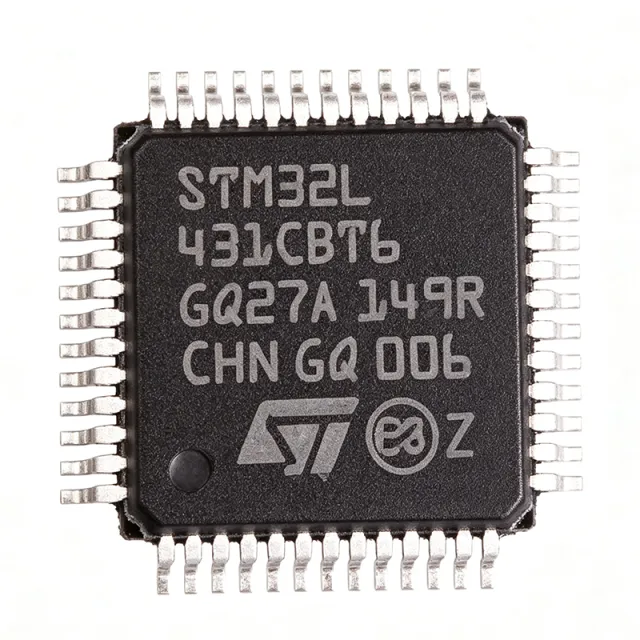
STM32L431CBT6 - ARM Cortex-M4 80MHz MCU | STMicroelectronics
STM32L431CBT6

STM32L431CBT6 - ARM Cortex-M4 80MHz MCU | STMicroelectronics

The STM32L431CBT6 is a 32-bit ARM Cortex-M4 microcontroller from STMicroelectronics, featuring a floating-point unit (FPU) and operating at a maximum frequency of 80 MHz. It is part of the STM32L4 series, designed for ultra-low-power applications with a rich set of peripherals. The device is housed in a 48-pin LQFP package (7x7 mm) and offers 128 KB of flash memory and 64 KB of SRAM. What is a microcontroller? A microcontroller (MCU) is a compact integrated circuit designed to govern a specific operation in an embedded system. It contains a processor core, memory (flash and SRAM), and programmable input/output peripherals on a single chip. Microcontrollers are the brains of countless electronic devices, from automotive engine control units to IoT sensors and wearable health monitors. The STM32L431CBT6 belongs to the STM32L4 family, which is optimized for low power consumption without compromising performance, making it ideal for battery-powered and energy-harvesting applications. Key features of the STM32L431CBT6 include an ARM Cortex-M4 core with FPU, 80 MHz maximum clock speed, 128 KB flash, 64 KB SRAM, and a comprehensive set of peripherals such as multiple USARTs, SPIs, I2Cs, ADCs, DACs, timers, and a real-time clock. It also integrates a true random number generator (RNG), a CRC calculation unit, and a memory protection unit (MPU). The device supports a wide supply voltage range from 1.71V to 3.6V and operates over a temperature range of -40°C to +85°C. Technically, the STM32L431CBT6 leverages the ARM Cortex-M4 architecture with DSP instructions and a single-precision FPU, enabling efficient digital signal processing. The STM32L4 series is built on a low-power process technology, achieving ultra-low power consumption in run, sleep, and standby modes. The device includes multiple low-power modes, such as Sleep, Low-power run, Low-power sleep, Stop 0/1/2, and Standby, allowing designers to optimize energy usage based on application requirements. Typical applications include industrial sensors, IoT devices, smart home controllers, portable medical devices, and battery management systems. The combination of low power, high performance, and rich peripherals makes it suitable for applications requiring both computational capability and energy efficiency. When designing with this MCU, pay attention to power supply decoupling and proper grounding. Use a 100nF capacitor close to each VDD pin and a 4.7uF bulk capacitor. For low-power modes, configure the clock system and peripheral clocks appropriately to minimize current consumption. The STM32L431CBT6 supports in-circuit programming and debugging via SWD, facilitating firmware development. This page synthesizes distributor pricing, drop-in alternatives, and practical design notes not found in the ST datasheet, providing a comprehensive resource for engineers evaluating the STM32L431CBT6.

询价 联系我们
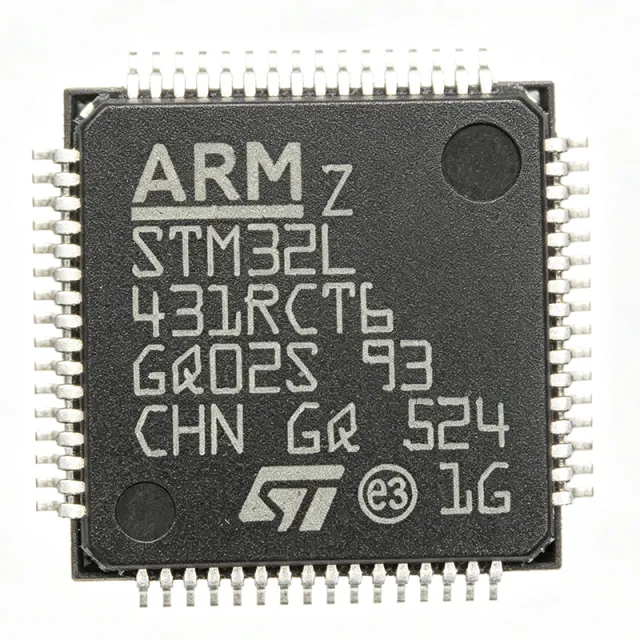
STM32L431RCT6 - Ultra-Low-Power Cortex-M4 MCU 80MHz 256KB Flash | STMicroelectronics
STM32L431RCT6

STM32L431RCT6 - Ultra-Low-Power Cortex-M4 MCU 80MHz 256KB Flash | STMicroelectronics

The STM32L431RCT6 is an ultra-low-power 32-bit microcontroller from STMicroelectronics, based on the high-performance Arm® Cortex®-M4 32-bit RISC core with floating-point unit (FPU). It operates at a frequency of up to 80 MHz and provides 256 KB of Flash memory and 64 KB of SRAM, making it suitable for a wide range of energy-efficient embedded applications. The device is housed in a 64-pin LQFP package (10x10 mm) and is part of the STM32L4 series, which is designed for low-power operation without compromising performance. A microcontroller (MCU) is a compact integrated circuit designed to govern a specific operation in an embedded system. It contains a processor core, memory, and programmable input/output peripherals. The STM32L431RCT6 belongs to the STM32L4 family, which is part of the broader STM32 portfolio of 32-bit microcontrollers. These MCUs are widely used in industrial, consumer, and IoT applications where power efficiency and processing capability are critical. The Cortex-M4 core with FPU enables efficient digital signal processing and floating-point arithmetic, making it ideal for applications such as motor control, sensor fusion, and audio processing. Key features of the STM32L431RCT6 include its ultra-low-power modes, which allow it to achieve very low power consumption in standby and sleep modes, extending battery life in portable devices. It also integrates a rich set of peripherals, including multiple USARTs, SPIs, I2Cs, ADCs, DACs, timers, and a real-time clock. The device supports a wide operating voltage range of 1.71V to 3.6V, making it compatible with standard battery chemistries. Additionally, it features a 12-bit ADC with up to 16 channels, a 12-bit DAC, and an operational amplifier, enabling analog signal processing without external components. From a technical perspective, the STM32L431RCT6 leverages ST's advanced 90nm process technology, which contributes to its low power consumption and high performance. The core runs at up to 80 MHz, delivering 100 DMIPS (Dhrystone 2.1) performance. The device includes a memory protection unit (MPU) and a nested vectored interrupt controller (NVIC) for efficient interrupt handling. It also supports a wide range of communication interfaces, including USB 2.0 full-speed, CAN 2.0B, and SAI (serial audio interface), making it versatile for connectivity applications. Typical applications for the STM32L431RCT6 include industrial sensors, smart meters, portable medical devices, and IoT nodes. Its low-power characteristics make it particularly well-suited for battery-powered devices that require long operational lifetimes. The device also supports a variety of development tools, including STM32CubeIDE, STM32CubeMX, and the STM32CubeL4 firmware package, which simplifies software development and reduces time-to-market. When designing with the STM32L431RCT6, it is important to consider the power supply decoupling and PCB layout to ensure stable operation. The device requires a 100nF capacitor on each power pin and a 4.7uF capacitor on the main supply. Additionally, the VDDA pin should be connected to a clean analog supply to minimize noise in analog peripherals. Proper grounding and layout are essential to achieve the specified performance and low-power operation.

询价 联系我们
STM32L432KCU6 - 80MHz Cortex-M4 MCU 256KB Flash | STMicroelectronics
STM32L432KCU6

STM32L432KCU6 - 80MHz Cortex-M4 MCU 256KB Flash | STMicroelectronics

The STMicroelectronics STM32L432KCU6 is an ultra-low-power 32-bit microcontroller based on the Arm Cortex-M4 core with FPU and DSP instructions, operating at up to 80 MHz, with 256 KB of Flash memory and 64 KB of SRAM, housed in a 32-pin UFQFPN (5x5 mm) package. An Arm Cortex-M4 microcontroller is a 32-bit RISC processor that integrates a floating-point unit (FPU), single-cycle DSP multiply-accumulate instructions, and a memory protection unit (MPU), positioning it in the hierarchy: Cortex-M4 MCU -> 32-bit microcontroller -> embedded processor -> semiconductor. Microcontrollers of this class combine CPU, memory, and peripherals on a single die, making them the default choice for compact, energy-conscious embedded systems. Key differentiating features include industry-leading low-power modes: 100 nA in Shutdown mode, 3.4 uA in Stop 2 with RTC running, and a Low-power run mode down to 1.71V supply. The device integrates a 12-bit ADC with hardware oversampling (up to 5.33 Msps), a 12-bit DAC, two op-amps, comparators, and a true random number generator (TRNG), providing a complete analog signal chain on chip. Technically, the STM32L432KCU6 uses STMicroelectronics' ultra-low-power process technology with the ART Accelerator enabling zero-wait-state execution from Flash, sustaining 100 DMIPS and 273 CoreMark at 80 MHz. Flexible clocking includes a multi-speed internal oscillator (MSI) from 100 kHz to 48 MHz, plus 4 MHz HSI, 32 kHz LSE and an external oscillator option. Communication interfaces include USB 2.0 full-speed device, three USARTs, one UART, two SPI, and two I2C. Typical applications include battery-powered IoT sensor nodes, wearable health devices, and portable medical instrumentation, where the combination of 3.4 uA Stop 2 current and integrated analog peripherals directly extends battery life and reduces BOM count. Design consideration: exploit the MSI oscillator calibrated against the LSE to eliminate the external crystal in UART or USB-light designs, saving board area and cost; place 100 nF decoupling capacitors at each VDD/VDDA pin per ST layout guidance. This page synthesizes distributor pricing, pin-compatible alternatives, design notes, and FAQ content not found in the manufacturer datasheet, verified as of 2026-09-06.

询价 联系我们
STM32L433RCT6 - Ultra-Low-Power ARM Cortex-M4 MCU | STMicroelectronics
STM32L433RCT6

STM32L433RCT6 - Ultra-Low-Power ARM Cortex-M4 MCU | STMicroelectronics

The STM32L433RCT6 is an ultra-low-power 32-bit microcontroller from STMicroelectronics, based on the ARM Cortex-M4 core with FPU. It operates at a maximum frequency of 80 MHz and provides 256 KB of flash memory and 64 KB of SRAM. The device is housed in a 64-pin LQFP package (LQFP64) and is designed for a wide range of battery-powered and energy-efficient applications. What is an ARM Cortex-M4 microcontroller? It is a 32-bit processor core designed for embedded systems, offering a balance of performance, power efficiency, and rich peripheral integration. The Cortex-M4 includes a floating-point unit (FPU) and DSP instructions, making it suitable for signal processing and control applications. In the system hierarchy, a microcontroller (MCU) integrates a processor core, memory, and programmable peripherals on a single chip, enabling standalone operation in embedded designs. Key features of the STM32L433RCT6 include an ultra-low-power mode with current consumption as low as 100 nA in standby mode, a 12-bit ADC with hardware oversampling, a 12-bit DAC, multiple communication interfaces (USART, SPI, I2C, USB), and a real-time clock (RTC). The device also integrates a flexible power management unit with multiple low-power modes, including Sleep, Low-power Run, and Stop modes, allowing designers to optimize energy consumption for their specific application. Technically, the STM32L433RCT6 is built on ST's advanced 40 nm process technology, which contributes to its low power consumption. The Cortex-M4 core with FPU accelerates mathematical computations, while the ART Accelerator enables zero-wait-state execution from flash memory, improving overall system performance. The device supports a wide operating voltage range from 1.71 V to 3.6 V, making it compatible with standard battery chemistries. Typical applications include smart meters, wearable devices, medical monitoring equipment, industrial sensors, and IoT nodes. Its ultra-low-power features make it ideal for battery-powered devices that require long operational lifetimes, such as wireless sensor networks and portable health monitors. When designing with this MCU, careful attention should be paid to power supply decoupling and PCB layout to minimize noise and ensure reliable operation. The device's multiple low-power modes require proper configuration of wake-up sources and clock sources to achieve optimal energy savings.

询价 联系我们
STM32L443RCI6 - 80MHz Cortex-M4 MCU, 256KB, 64-UFBGA
STM32L443RCI6

STM32L443RCI6 - 80MHz Cortex-M4 MCU, 256KB, 64-UFBGA

The STMicroelectronics STM32L443RCI6 is an ultra-low-power 32-bit Arm Cortex-M4 microcontroller with floating-point unit, 80 MHz maximum clock, 256 KB Flash memory, 64 KB RAM, and a 64-UFBGA package measuring 5 x 5 mm. Verified distributor listings also identify USB, LCD, AES-256, and DFSDM support, making this MCU suitable for compact control, communications, security, and low-power embedded systems. A microcontroller is a programmable semiconductor that integrates a processor core, memory, and peripherals on one integrated circuit. The STM32L4 family belongs to the microcontroller hierarchy and targets applications where energy efficiency, real-time control, and peripheral integration are important. In this device, the Cortex-M4 core provides 32-bit execution with hardware floating-point capability, while the STM32L4 platform combines conventional embedded control with USB, display, and data-conversion functions. The verified feature set includes an 80 MHz operating frequency, 256 KB Flash organized as 256K x 8, and 64 KB RAM. The distributor descriptions also list LCD support, USB, AES-256 encryption, and DFSDM. These peripherals can reduce external component count by supporting human-machine interfaces, USB-connected equipment, hardware-assisted secure data handling, and digital signal acquisition. The 64-UFBGA package supports compact, high-density PCB designs but requires careful escape-routing and assembly planning. Technically, the Cortex-M4F architecture provides a practical balance between processing capability and low-power operation. Floating-point hardware is useful for sensor conditioning, control calculations, and digital signal processing without relying entirely on software arithmetic. The exact operating voltage, current, peripheral pin map, memory interfaces, and temperature limits are not supplied in the retrieved snippets, so those specifications remain subject to verification in the manufacturer datasheet before design release. Typical applications include low-power sensor nodes, industrial condition-monitoring equipment, USB-connected embedded controls, compact human-machine interfaces, security-aware portable products, and DFSDM-based audio or acquisition systems. Selection should prioritize the 64-UFBGA footprint, 256 KB Flash requirement, 64 KB RAM requirement, Cortex-M4 instruction compatibility, and required peripheral mix. Firmware, bootloader, pin multiplexing, clock configuration, and peripheral errata must also be reviewed. For a new PCB, route all 64 package balls according to the official pinout and land pattern rather than relying solely on the short distributor descriptions. Confirm USB transceiver requirements, decoupling, clock stability, exposed-ball assembly, and peripheral sharing before schematic release. This page synthesizes verified distributor data, package and feature information, replacement constraints, and engineering-oriented design guidance for STM32L443RCI6.

询价 联系我们
STM32L443RCT6 - 80MHz Cortex-M4 MCU 256KB Flash | STMicroelectronics
STM32L443RCT6

STM32L443RCT6 - 80MHz Cortex-M4 MCU 256KB Flash | STMicroelectronics

The STMicroelectronics STM32L443RCT6 is an ultra-low-power 32-bit Arm Cortex-M4 microcontroller with FPU, 256KB Flash, 64KB SRAM, and integrated AES-256 hardware crypto, packaged in a 64-pin LQFP. It operates at up to 80 MHz delivering 100 DMIPS while maintaining the STM32L4 family's signature ultra-low-power performance. An Arm Cortex-M4 microcontroller is a 32-bit RISC processor core with DSP extensions and an optional single-precision floating-point unit, designed for deterministic real-time embedded control with low interrupt latency. Microcontrollers integrate the CPU core, Flash program memory, SRAM, and a rich set of peripherals into a single IC, forming the smallest complete compute subsystem for IoT and industrial designs. The STM32L4 series in particular extends this architecture with ST's ultra-low-power platform, embedding multiple voltage domains and dedicated low-power peripherals so the part can run from a coin cell for years. Key features of the STM32L443RCT6 include the Cortex-M4 core with FPU running at 80 MHz, 256 KB of Flash memory, 64 KB of SRAM, USB Full-Speed with Type-C Power Delivery support, an integrated LCD driver (4x44 or 8x40 segments), a 12-bit ADC (5 Msps), two 12-bit DACs, two operational amplifiers, and the AES-256 hardware cryptographic accelerator. It also includes the standard STM32 peripheral set: CAN 2.0B, I2C, SPI, USART, LPUART, timers, and an RTC with calendar. The architecture pairs an ART Accelerator with a multi-channel DMA, a 4 KB SRAM-based instruction cache, and ST's ultra-low-power voltage scaling core. This combination allows the part to wake from STANDBY in roughly 1.4 ms and remain in sleep modes drawing microamp-level currents while preserving register/RTC state, which is critical for battery-powered sensor nodes. Typical applications include ultra-low-power wireless sensor nodes, portable medical and wearable devices, smart meters, industrial HMI panels with LCD, USB-C powered accessories with Power Delivery negotiation, and secured IoT edge nodes leveraging the on-chip AES engine. Designers also deploy the device in audio front-ends, asset trackers, and battery-backed instrumentation. When designing with this MCU, plan the power tree carefully using ST's CubeMX tool to assign each rail (VDD, VDDA, VDD_USB, VBAT) to its required decoupling network. Pay particular attention to unused-pin handling: every GPIO must be set to a defined state to avoid parasitic current paths that can erode the low-power budget. This page synthesizes distributor pricing, same-family and cross-brand drop-in alternatives, and practical design notes that go beyond the manufacturer datasheet, giving embedded engineers an actionable reference for BOM selection.

询价 联系我们
STM32L451CEU6 - 80MHz Cortex-M4 MCU 512KB Flash | STMicroelectronics
STM32L451CEU6

STM32L451CEU6 - 80MHz Cortex-M4 MCU 512KB Flash | STMicroelectronics

The STMicroelectronics STM32L451CEU6 is an ultra-low-power 32-bit ARM Cortex-M4 microcontroller with FPU operating at up to 80 MHz, packaged in a 48-pin UFQFPN (7x7 mm). It integrates 512 KB of Flash memory and 160 KB of SRAM, providing substantial headroom for embedded applications that combine an RTOS with rich peripheral stacks. An ultra-low-power microcontroller (MCU) is a class of 32-bit microcontroller optimized for battery-powered and energy-harvesting systems where average current draw over sleep-active duty cycles is the dominant design constraint. Within the broader taxonomy, the STM32L4 sits between general-purpose Cortex-M4 MCUs and the lower-power Cortex-M0+ families, occupying the ultra-low-power branch alongside the Cortex-M33 STM32L5 and Cortex-M0+ STM32L0. Its FPU and DSP extensions place it above M0+ parts in compute density, while its multi-domain power architecture (separate Core, peripheral, and memory voltage domains) places it above classical Cortex-M4 in energy efficiency. Key differentiating specifications include the 80 MHz Cortex-M4 core with single-precision FPU and DSP instructions, 1.71 V to 3.6 V operating supply range, five low-power modes (Sleep, Low-Power Sleep, Stop 0/1/2, Standby, Shutdown) with Shutdown current under 30 nA typical, and an integrated 12-bit ADC with hardware oversampling. The device also provides two DAC channels, three I2C, three SPI, one CAN 2.0B, one USB 2.0 Full-Speed device/host, and an integrated DFSDM digital filter for sigma-delta modulation. Architecturally, the STM32L451CEU6 uses ST's 90 nm ultra-low-leakage process with an adaptive voltage scaling loop that scales the core domain between 1.0 V and 1.2 V based on operating frequency. This allows RUN-mode current to track load and yields approximately 100 uA/MHz active efficiency. The 160 KB SRAM is split into multiple independent banks to allow retention-only sleep configurations that keep selected peripherals alive while the core domain is powered down. Typical applications include wearable health monitors, battery-powered sensor hubs, industrial 4-20 mA loop-powered transmitters, smart metering, BLE/Zigbee host controllers, and low-end audio processing using the on-board DFSDM. The 48-pin UFQFPN package is the right density point for designs needing CAN or USB plus a 12-bit analog front-end without paying for the larger 64-pin variants. When designing with this device, prioritize decoupling close to each VDD pin pair (one 100 nF X7R per domain plus one 4.7 uF bulk) and respect the UFQFPN exposed-pad solder process to keep junction temperature rise within datasheet limits. The Cortex-M4 FPU is single-precision only - use double-precision math in firmware will trap. This page synthesizes distributor pricing, drop-in alternatives, and practical design notes not found in the manufacturer datasheet.

询价 联系我们
STM32L451RET6 - Ultra-Low-Power Cortex-M4 MCU 512KB Flash | STMicroelectronics
STM32L451RET6

STM32L451RET6 - Ultra-Low-Power Cortex-M4 MCU 512KB Flash | STMicroelectronics

The STM32L451RET6 is an ultra-low-power 32-bit microcontroller from STMicroelectronics, based on the high-performance Arm® Cortex®-M4 32-bit RISC core with floating-point unit (FPU). It operates at a frequency of up to 80 MHz, delivering 100 DMIPS, and is designed for a wide range of battery-powered and energy-efficient applications. The device features 512 KB of Flash memory and 160 KB of SRAM, providing ample storage and execution space for complex firmware. It is housed in a 64-pin LQFP package (10x10 mm), making it suitable for space-constrained designs. A microcontroller (MCU) is a compact integrated circuit designed to govern a specific operation in an embedded system. It contains a processor core, memory, and programmable input/output peripherals. The STM32L451RET6 belongs to the STM32L4 series, which is part of the broader STM32 family of 32-bit microcontrollers. This series is optimized for ultra-low-power consumption, making it ideal for IoT devices, wearables, and industrial sensors. The Cortex-M4 core with FPU enhances performance for digital signal processing (DSP) tasks, while the rich set of analog and digital peripherals enables versatile system integration. Key features of the STM32L451RET6 include a 12-bit ADC with 5 MSPS, two 12-bit DACs, an operational amplifier, a comparator, and a digital filter for sigma-delta modulators (DFSDM). It also supports multiple communication interfaces: I2C, SPI, USART, UART, LPUART, SAI, and CAN. The device integrates a real-time clock (RTC), several timers, and a true random number generator (TRNG). Its ultra-low-power modes, including Sleep, Low-power run, Low-power sleep, Stop 0/1/2, and Standby, allow designers to minimize energy consumption in battery-operated systems. From a technical perspective, the STM32L451RET6 is built on a 40 nm process technology, which contributes to its low power consumption. It operates from a 1.71 V to 3.6 V power supply, and its GPIOs are 5V-tolerant, simplifying interfacing with legacy logic. The device includes a memory protection unit (MPU) and a hardware cryptographic accelerator (AES) for secure applications. The flexible power management with multiple voltage scaling options (Range 1, 2, and 3) allows the core to run at lower voltages to save power when performance is not critical. Typical applications for the STM32L451RET6 include smart meters, medical devices, industrial sensors, portable instrumentation, and IoT edge nodes. Its combination of low power, high performance, and rich analog peripherals makes it a preferred choice for applications requiring long battery life and precise analog measurements. For example, in a smart meter, the MCU can handle metering calculations, communication protocols, and display control while consuming minimal power in standby mode. When designing with this MCU, it is essential to pay attention to the power supply decoupling: place a 100 nF capacitor close to each VDD pin and a 4.7 uF capacitor at the main power input. Additionally, the VDDA pin must be connected to a clean analog supply, and the VREF+ pin should be decoupled with a 1 uF capacitor for accurate ADC conversions. Proper layout of the crystal oscillator (if used) is critical for reliable clock operation.

询价 联系我们
STM32L451VEI6 - 80MHz 512KB Cortex-M4 MCU | STMicroelectronics
STM32L451VEI6

STM32L451VEI6 - 80MHz 512KB Cortex-M4 MCU | STMicroelectronics

The STMicroelectronics STM32L451VEI6 is an ultra-low-power 32-bit Arm Cortex-M4 microcontroller with a floating-point unit, operating up to 80 MHz and providing 512 KB of Flash memory and 160 KB of SRAM. The device is supplied in a 100-pin UFBGA package measuring 7 mm by 7 mm. Its combination of fast Cortex-M4 processing, analog peripherals, audio support, and low-power design makes it suitable for energy-sensitive embedded systems, connected sensors, industrial controls, and portable instruments. A microcontroller such as the STM32L451VEI6 integrates a processor core, memory, communication peripherals, analog interfaces, timers, and GPIO into one compact device. The STM32L4 family belongs to the broader embedded-controller hierarchy: Cortex-M4 processor core, 32-bit microcontroller, embedded semiconductor, and electronic control system. This integration reduces component count and allows firmware to coordinate sensing, control, communications, and real-time timing in one controller. The verified manufacturer information identifies an Arm Cortex-M4 32-bit RISC core, up to 80 MHz operation, 512 KB of Flash, and 160 KB of SRAM. The device also supports digital filtering and analog features identified by the manufacturer as DFSDM, analog, and audio capabilities. These resources support mixed-signal designs where a low-power MCU must acquire sensor data, perform signal conditioning, and communicate results without relying on a separate processor. The STM32L451VEI6 is positioned for embedded applications requiring more processing performance than a basic low-power MCU while retaining a compact package and energy-conscious architecture. Its Cortex-M4 core supports general-purpose control, communications, and floating-point-oriented workloads, while the integrated analog and audio peripherals can reduce system complexity. Exact peripheral assignments, voltage limits, current consumption, package pin functions, and production lifecycle details must be confirmed in the STMicroelectronics datasheet before final design release. Typical applications include industrial sensor nodes, low-power data loggers, connected measurement equipment, portable medical or diagnostic instruments, motor and actuator controllers, and compact IoT gateways. The 80 MHz core is useful for protocol handling, sampling workflows, control loops, and user-interface logic. Selection should begin with the required memory map, package footprint, peripheral set, operating voltage, clock tree, and low-power target. For PCB implementation, use the manufacturer package drawing and land pattern for the 100-UFBGA package rather than a generic BGA footprint. Confirm ball assignments, exposed-pad requirements, decoupling, power routing, and programming access in the datasheet. Also verify startup, clock, reset, and firmware-library support before committing the design to volume production. This product page combines verified manufacturer and distributor information, application-oriented engineering guidance, procurement context, and strict data-gap markers for specifications not present in the supplied sources. It is intended to support early component selection and sourcing, not to replace the complete STMicroelectronics reference documentation.

询价 联系我们
STM32L452RET6 - Ultra-Low-Power Cortex-M4 MCU 80MHz 512KB | ST
STM32L452RET6

STM32L452RET6 - Ultra-Low-Power Cortex-M4 MCU 80MHz 512KB | ST

The STMicroelectronics STM32L452RET6 is an ultra-low-power 32-bit microcontroller based on the Arm Cortex-M4 core with FPU, operating at up to 80 MHz with 512 KB of Flash and 160 KB of SRAM in a 64-pin LQFP (10x10 mm) package. It features a wide 1.71 V to 3.6 V supply range, USB Device, DFSDM, and integrated SMPS support, while consuming as little as 22 nA in Shutdown mode and 145 nA in VBAT mode. What is an ultra-low-power ARM Cortex-M4 microcontroller? It is a 32-bit processor core designed for embedded systems that balances computational performance with exceptionally low energy consumption. The Cortex-M4 includes a single-precision floating-point unit (FPU) and DSP extensions, enabling efficient math-intensive workloads. In the system hierarchy, a microcontroller (MCU) is a complete computer-on-a-chip integrating CPU, memory, and peripherals, and belongs to the embedded processor category within the broader semiconductor landscape. The STM32L4 series specifically targets energy-constrained applications, extending battery life in portable, wearable, and IoT devices. Key features of the STM32L452RET6 include seven low-power modes (Sleep, Low-power run, Low-power sleep, Stop 0/1/2, Standby, Shutdown), a 12-bit ADC with hardware oversampling, a 12-bit DAC, two comparators, and an operational amplifier. The device also integrates a true random number generator (TRNG), AES-256 hardware crypto accelerator, secure firmware install, and a 96-bit unique ID. Communication interfaces include USB 2.0 Full-Speed Device, three USARTs, two UARTs, three I2C, three SPI, one CAN, and one SDMMC. Technically, the STM32L452RET6 is built on a low-leakage 90 nm process and supports up to 100 DMIPS / 273 CoreMark. The integrated SMPS step-down converter generates the core voltage internally, further reducing active current. A flexible memory protection unit (MPU), FSMC external memory controller, and Quad-SPI (in higher-density siblings) support external memories. The device operates across -40 C to +85 C (or +125 C with the '6' high-temp suffix variant). Typical applications include industrial sensors, smart meters, healthcare devices, wearable electronics, asset trackers, and IoT endpoints. Its combination of ultra-low quiescent current, Cortex-M4 DSP performance, and rich analog peripherals makes it ideal for battery-powered metering, medical wearables, and remote sensor nodes. When designing, leverage Stop 2 mode with RTC for periodic wake-up duty cycles, place 100 nF decoupling on every VDD/VSS pair, and use STM32CubeMX + STM32CubeIDE for clock tree configuration, peripheral init, and power-mode tuning. This page synthesizes distributor pricing, drop-in alternatives, and practical design notes not found in the manufacturer datasheet.

询价 联系我们
STM32L452RET6P - 80MHz Cortex-M4 MCU, 512KB Flash | STMicroelectronics
STM32L452RET6P

STM32L452RET6P - 80MHz Cortex-M4 MCU, 512KB Flash | STMicroelectronics

The STMicroelectronics STM32L452RET6P is an ultra-low-power Arm Cortex-M4 32-bit microcontroller plus FPU, operating at up to 80 MHz with 100 DMIPS, integrating 512 KB of Flash and 160 KB of SRAM in a 64-pin LQFP (10x10 mm) package. It supports a 1.71 V to 3.6 V supply and is offered in -40 C to 85/125 C temperature grades for industrial and portable designs. An ultra-low-power MCU (ULP-MCU) is a microcontroller class engineered to minimise active and standby energy consumption through FlexPowerControl, multiple low-power modes (Shutdown, Standby, Stop, VBAT), and fast wakeup times. The STM32L4 family sits in ST's low-power hierarchy as Cortex-M4F -> STM32L4 series -> ultra-low-power MCU -> 32-bit microcontroller -> embedded MCU, balancing DSP capability, analog integration and energy efficiency for battery-powered edge devices. Key features include: Cortex-M4 with FPU and 100 DMIPS throughput; 512 KB single-bank Flash plus 160 KB SRAM; integrated SMPS step-down converter for core supply; USB 2.0 Full-Speed Device with embedded PHY and dedicated DFS (dedicated oscillator); two 12-bit ADCs, two 12-bit DACs, two op-amps and two comparators; rich connectivity including CAN 2.0B, two I2C, three SPI, four USART, two UART and one LPUART; plus 8x40 (4x40-segment) LCD driver and AES-256 hardware encryption. Shutdown current is 22 nA (5 wakeup pins), VBAT mode draws 145 nA, and Stop mode with RTC reaches about 1.1 uA typical. The device integrates a Cortex-M4F core with single-precision FPU, MPU and DSP extensions, plus ST's proprietary ART Accelerator for zero-wait-state Flash execution at full 80 MHz. Embedded SMPS, low-power voltage regulator, and independent RTC supply domain are partitioned to support advanced run/sleep/shutdown state machines without losing backup registers. Typical applications are fitness/wearable sensor hubs, smart-meter and asset-tracking endpoints, industrial sensor nodes, medical wearables, low-power PC peripherals with USB, audio playback paths leveraging the on-chip DFSDM and SAI, and home appliances with LCD display panels. When designing with STM32L452RET6P, prefer BOR-enabled power-up sequencing, route the SMPS inductor carefully on a 4-layer PCB to minimise radiated noise, and use ST's STM32CubeMX and HAL/LL libraries to accelerate peripheral configuration. Consider the higher-density STM32L4R/4A part if the application needs 1 MB Flash. This page synthesises distributor pricing, drop-in LQFP-64 alternatives and practical design notes not collated on the manufacturer datasheet, helping procurement and embedded engineers evaluate the STM32L452RET6P against contemporary ARM Cortex-M4F peers.

询价 联系我们
STM32L452RET6TR - 80MHz 512KB Flash MCU | STMicroelectronics
STM32L452RET6TR

STM32L452RET6TR - 80MHz 512KB Flash MCU | STMicroelectronics

The STMicroelectronics STM32L452RET6TR is an ultra-low-power Arm Cortex-M4 32-bit microcontroller with FPU running at up to 80 MHz, featuring 512 KB of Flash memory and 160 KB of SRAM in a 64-pin LQFP (10x10 mm) package. It delivers 100 DMIPS at 80 MHz while drawing only 84 uA/MHz in run mode, making it one of the most power-efficient Cortex-M4 devices in the STM32L4 series. An ultra-low-power microcontroller (MCU) is a single-chip computer that integrates a processor core, non-volatile program memory (Flash), volatile data memory (SRAM), and a broad set of peripherals such as ADCs, DACs, timers, and serial interfaces. The STM32L452RET6TR sits in the STM32L4 family, which is part of the broader STM32 32-bit MCU portfolio, itself a member of the Arm Cortex-M ecosystem. Ultra-low-power MCUs are designed for battery-powered and energy-harvesting systems where every microamp matters, while still providing enough compute throughput for real-time control and signal processing. Key features include FlexPowerControl with a 1.71 V to 3.6 V supply range, 145 nA in VBAT mode for RTC and 32x32-bit backup registers, 22 nA in Shutdown mode with 5 wakeup pins, and a 12-bit ADC with hardware oversampling. The device also integrates a USB Device controller, DFSDM (digital filter for sigma-delta modulators), and multiple low-power timers, enabling always-on sensing with minimal energy cost. The STM32L452RET6TR is built on ST's ultra-low-leakage 90 nm process and uses a proprietary adaptive real-time memory accelerator to achieve 100 DMIPS at 80 MHz without wait states. Its analog peripherals include two 12-bit ADCs, one 12-bit DAC, and two ultra-low-power comparators, allowing direct interfacing with sensors and eliminating external signal-conditioning components in many designs. Typical applications include portable medical monitors, industrial IoT sensor nodes, smart metering, wearable fitness trackers, and battery-operated asset trackers. The combination of 512 KB Flash, 160 KB SRAM, and a rich analog front end makes it suitable for edge processing tasks such as filtering, FFT, and motor control. When designing with this device, pay close attention to the VDD/VBAT power architecture and the decoupling network. The 64-pin LQFP package provides 52 user I/O pins, so plan pin allocation carefully to avoid conflicts between the USB, ADC, and timer functions. This page synthesizes distributor pricing, drop-in alternatives, and practical design notes not found in the manufacturer datasheet, giving engineers a single reference for selection, second-sourcing, and layout decisions.

询价 联系我们
STM32L452REY6TR - Ultra-low-power ARM Cortex-M4 MCU | STMicroelectronics
STM32L452REY6TR

STM32L452REY6TR - Ultra-low-power ARM Cortex-M4 MCU | STMicroelectronics

The STM32L452REY6TR is an ultra-low-power 32-bit microcontroller from STMicroelectronics, based on the ARM Cortex-M4 core with FPU. It operates at a maximum frequency of 80 MHz and delivers 100 DMIPS with 1.25 DMIPS/MHz, making it suitable for a wide range of battery-powered and energy-efficient applications. The device features 512 KB of Flash memory and 160 KB of SRAM, providing ample storage for complex firmware and data buffering. What is an ARM Cortex-M4 microcontroller? It is a 32-bit processor core designed for embedded systems, offering a balance of performance, power efficiency, and rich peripheral integration. The Cortex-M4 includes a floating-point unit (FPU) and DSP instructions, enabling efficient handling of mathematical and signal-processing tasks. In the system hierarchy, the STM32L452REY6TR sits at the application processor level, managing sensors, communication interfaces, and control loops, while interfacing with memory, power management, and external peripherals. Key features include an operating voltage range of 1.71V to 3.6V, multiple low-power modes (Sleep, Low-power run, Low-power sleep, Stop 0/1/2, Standby, and Shutdown) with current consumption as low as 28 µA in Stop 2 mode, and a rich set of peripherals including multiple USARTs, SPIs, I2Cs, USB 2.0 FS, CAN, and 12-bit ADCs/DACs. The device also integrates a true random number generator (TRNG), a CRC calculation unit, and a 12-channel DMA controller. The STM32L452REY6TR is built on ST's ultra-low-power technology, featuring a flexible power architecture with internal regulators and a low-power RTC. It supports a wide temperature range of -40°C to +85°C and is available in a 64-pin UFBGA package (Y6 suffix), which is ideal for space-constrained designs. The package measures 4.0 x 4.0 mm with a 0.5 mm pitch, offering excellent thermal performance and compactness. Typical applications include industrial sensors, smart meters, wearable devices, medical monitoring equipment, and IoT edge nodes. The combination of low power consumption, high performance, and extensive connectivity makes it a versatile choice for battery-operated systems that require advanced processing capabilities. When designing with this MCU, careful attention to power supply decoupling and PCB layout is essential to achieve the specified low-power performance. Use multiple decoupling capacitors close to the power pins and follow the layout guidelines in the datasheet to minimize noise and ensure reliable operation.

询价 联系我们
STM32L452VCT6 - Ultra-Low-Power ARM Cortex-M4 MCU | STMicroelectronics
STM32L452VCT6

STM32L452VCT6 - Ultra-Low-Power ARM Cortex-M4 MCU | STMicroelectronics

The STM32L452VCT6 is an ultra-low-power 32-bit microcontroller from STMicroelectronics, based on the ARM Cortex-M4 core with FPU. It operates at a maximum frequency of 80 MHz and delivers 100 DMIPS with 1.25 DMIPS/MHz, making it suitable for a wide range of battery-powered and energy-efficient applications. The device features 256 KB of Flash memory and 160 KB of SRAM, providing ample storage for complex firmware and data buffering. What is an ARM Cortex-M4 microcontroller? It is a 32-bit processor core designed for embedded systems, offering a balance of performance, power efficiency, and rich peripheral integration. The Cortex-M4 includes a floating-point unit (FPU) and DSP instructions, enabling efficient handling of mathematical and signal-processing tasks. In the system hierarchy, a microcontroller (MCU) integrates a processor core, memory, and programmable peripherals on a single chip, serving as the 'brain' of embedded systems. The STM32L4 series specifically targets ultra-low-power applications, extending battery life in portable and IoT devices. Key features of the STM32L452VCT6 include multiple low-power modes (Sleep, Low-power run, Low-power sleep, Stop 0/1/2, Standby, and Shutdown) with current consumption as low as 28 µA in Stop 2 mode with SRAM retention. It integrates a 12-bit ADC with 5 Msps, two 12-bit DACs, two comparators, and two operational amplifiers. Communication interfaces include I2C, SPI, USART, UART, LPUART, SAI, and CAN, along with USB 2.0 full-speed device/host/OTG. The device also features a true random number generator (TRNG), a CRC calculation unit, and a 96-bit unique ID. The STM32L452VCT6 is built on ST's ultra-low-power technology with an adaptive voltage scaling and a flexible power architecture. It includes a multi-speed internal RC oscillator (16 MHz) and a low-power internal oscillator (32 kHz), reducing external component count. The device supports external crystal oscillators for high-accuracy timing and includes a real-time clock (RTC) with calendar and alarm functions. The integrated LCD driver supports up to 8x40 segments, enabling direct connection to segment LCDs without external drivers. Typical applications include industrial sensors, smart meters, healthcare devices, wearable fitness trackers, and IoT edge nodes. Its ultra-low-power modes and rich analog peripherals make it ideal for battery-operated systems that require long operational life. The device also supports secure firmware updates with its read-out protection and memory protection unit, enhancing system security. When designing with the STM32L452VCT6, pay attention to the power supply decoupling: place a 100 nF capacitor close to each VDD pin and a 4.7 µF capacitor on the main VDD rail. Use the internal LDO or external SMPS step-down converter for optimal power efficiency. The VBAT pin should be connected to a backup battery or tied to VDD if not used. For low-power operation, configure unused GPIOs as analog inputs to minimize leakage current.

询价 联系我们
STM32L471RET6 - ARM Cortex-M4F 80MHz MCU | STMicroelectronics
STM32L471RET6

STM32L471RET6 - ARM Cortex-M4F 80MHz MCU | STMicroelectronics

The STMicroelectronics STM32L471RET6 is a high-performance ARM Cortex-M4F based microcontroller with floating-point unit (FPU) running at up to 80 MHz. It is part of the STM32L4 series, designed for ultra-low-power applications without compromising performance. The device integrates 512 KB of flash memory and 128 KB of SRAM, along with a rich set of peripherals including multiple 12-bit ADCs, DACs, comparators, op-amps, and advanced communication interfaces such as USART, SPI, I2C, CAN, and USB OTG FS. It is available in a 64-pin LQFP package (LQFP64) with a 10x10 mm body and 0.5 mm pitch. What is a microcontroller? A microcontroller (MCU) is a compact integrated circuit designed to govern a specific operation in an embedded system. It contains a processor core, memory (flash and SRAM), and programmable input/output peripherals on a single chip. Microcontrollers are the brains of countless electronic devices, from automotive engine control units to wearable health monitors. In the system hierarchy, a microcontroller is a type of embedded processor, which falls under the broader category of integrated circuits (ICs) and semiconductors. The STM32L471RET6 is a mid-range MCU in the STM32L4 family, positioned between the lower-power STM32L0/L1 series and the higher-performance STM32F4 series, offering a balance of energy efficiency and processing capability. Key features of the STM32L471RET6 include its ultra-low-power modes (Sleep, Low-power run, Low-power sleep, Stop 0/1/2, Standby, and Shutdown) with current consumption as low as 100 nA in Shutdown mode. The device supports a wide supply voltage range of 1.71V to 3.6V, making it suitable for battery-powered applications. It also features a 12-bit ADC with hardware oversampling, a 12-bit DAC, and a true random number generator (TRNG). The FPU accelerates mathematical computations, which is beneficial for signal processing and control algorithms. The MCU is manufactured using ST's 90 nm process technology, enabling low dynamic power consumption. Technical depth: The STM32L471RET6 is built around the ARM Cortex-M4F core with DSP instructions and a single-precision FPU. It includes a memory protection unit (MPU) for enhanced security and reliability. The device supports up to 8x32-bit timers, including a low-power timer (LPTIM) that can operate in Stop mode. Communication peripherals include 3x USART, 3x SPI, 3x I2C, 1x CAN, 1x USB OTG FS, and 1x SAI (serial audio interface). The ADC has a resolution of 12 bits with up to 16 external channels and can operate at up to 5 Msps. The DAC has two channels with 12-bit resolution. The device also includes a flexible memory controller (FMC) for external memory expansion, supporting SRAM, PSRAM, NOR, and NAND flash. Typical applications include industrial sensors and actuators, smart meters, medical devices (e.g., glucose monitors, infusion pumps), wearable fitness trackers, IoT nodes, and portable instrumentation. The ultra-low-power modes and rich analog peripherals make it ideal for battery-operated devices that require long battery life and precise analog measurements. For example, in a smart meter, the STM32L471RET6 can handle metrology calculations, communication protocols, and display control while consuming minimal power in sleep mode between measurements. Design consideration: When designing with the STM32L471RET6, pay attention to the power supply decoupling. Place a 100 nF ceramic capacitor close to each VDD pin and a 4.7 uF capacitor at the main power input. For the VDDA pin, use a dedicated 1 uF capacitor to ensure stable analog performance. Also, configure the clock system carefully: the device can run from an internal 16 MHz HSI oscillator, but for precise timing, use an external 8 MHz crystal with appropriate load capacitors. The boot pins (BOOT0 and BOOT1) must be set correctly for the desired boot mode (flash, system memory, or SRAM).

询价 联系我们
STM32L471ZGT6 - 1MB Flash 80MHz Cortex-M4 MCU | STMicroelectronics
STM32L471ZGT6

STM32L471ZGT6 - 1MB Flash 80MHz Cortex-M4 MCU | STMicroelectronics

The STMicroelectronics STM32L471ZGT6 is an ultra-low-power 32-bit microcontroller based on the high-performance Arm Cortex-M4 RISC core with FPU, operating at frequencies up to 80 MHz, packaged in a 144-pin LQFP. The device integrates 1 MB of Flash, 128 KB of SRAM, and a rich peripheral set including CAN, USB, multiple UART/SPI/I2C interfaces, 12-bit ADCs, and a real-time clock for energy-sensitive embedded control applications. An ultra-low-power microcontroller (MCU) is a class of microprocessor that minimizes active and standby current consumption through techniques such as voltage scaling, multiple low-power operating modes, peripheral clock gating, and integrated DC-DC converters. The STM32L4 family extends this concept with the Cortex-M4 core plus DSP instructions and a single-precision floating-point unit, enabling digital signal processing alongside efficient power management. Within the broader taxonomy, the STM32L471ZGT6 sits in the hierarchy MCU -> Arm Cortex-M microcontroller -> ultra-low-power MCU -> power management IC ecosystem. Key features include a 1.8 V to 3.6 V supply range, batch acquisition mode for ADC, multiple low-power modes (Stop, Standby, Shutdown) drawing as little as a few hundred nanoamperes with RTC retention, a built-in 12-bit 5 Msps ADC, two DAC channels, USB 2.0 Full-Speed device/host, three I2C, three SPI, three USART plus UART, two CAN 2.0B, SDMMC, and a Crypt/AES-256 hardware accelerator. The 144-pin LQFP package supports ample GPIO for industrial control panels and sensor hubs. The STM32L471 uses a Cortex-M4 core with FPU and DSP extensions, providing 1.25 DMIPS/MHz and a CoreMark score in the hundreds, balancing DSP capability with extreme energy efficiency. The integrated LDO(Dragon) voltage regulator and switchable DC-DC buck converter allow dynamic trade-off between quiescent current and peak performance. Typical applications include industrial sensor nodes, wearable medical monitors, smart metering, battery-powered IoT gateways, and motor control subsystems where extended battery life and deterministic real-time response are simultaneously required. The 1 MB Flash enables on-board firmware with secure bootloaders, OTA stacks, and rich protocol libraries. When designing, always verify the supply decoupling network (1uF + 100nF + 4.7uF bulk) per ST AN4325 reference design and consider the 32 kHz LSE crystal selection for RTC accuracy. The 144-LQFP package simplifies layout but requires thermal relief for applications pushing >70% CPU duty. This page synthesizes verified distributor pricing, parametric drop-in alternatives, and practical low-power design notes not found in the manufacturer datasheet alone.

询价 联系我们
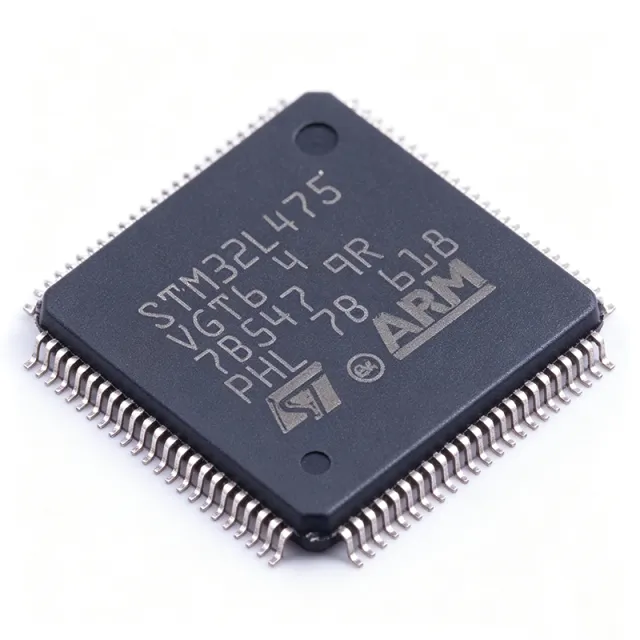
STM32L475VGT6 - 1MB Flash Cortex-M4 MCU, 100-LQFP | STMicroelectronics
STM32L475VGT6

STM32L475VGT6 - 1MB Flash Cortex-M4 MCU, 100-LQFP | STMicroelectronics

The STMicroelectronics STM32L475VGT6 is an ultra-low-power 32-bit ARM Cortex-M4 microcontroller with FPU, 1 MB of Flash, 128 KB of SRAM, and 80 MHz maximum CPU clock, housed in a 100-pin LQFP (14x14 mm) package. It targets battery-powered and energy-harvesting embedded systems where both DSP-class performance and microamp-level quiescent current are required. A microcontroller (MCU) is a single-chip integrated circuit containing a processor core, program/data memory, and programmable peripherals that govern a specific embedded function. The STM32L475VGT6 is a member of the STM32L4 ultra-low-power family, which sits within the broader STM32 32-bit MCU portfolio and is engineered around ST's 110 nm ultra-low-leakage process with adaptive real-time (ART) accelerator. The Cortex-M4 core implements the ARMv7-M architecture with single-precision FPU and DSP extensions, making the part a member of the ARM Cortex-M family that is hierarchically classed as an embedded microcontroller -> 32-bit MCU -> semiconductor IC. Key features include a wide 1.71 V to 3.6 V supply range, batch-collecting 12-bit 5 Msps ADC, two 12-bit DACs, two op-amps, two comparators, USB 2.0 OTG full-speed (with internal PHY), CAN 2.0B, SDMMC, SAI, DFSDM, multiple timers, and a true random number generator (TRNG) for security. Seven main low-power modes (Low-power Run, Sleep, Low-power Sleep, Stop 0/1/2, Standby, Shutdown) bring the typical Stop-mode current down to the microampere range and Standby/Shutdown to the nanoampere range, enabling multi-year battery life when paired with an energy-aware application design. The architecture combines the Cortex-M4 DSP+FPUs with ST's ART Accelerator (instruction cache + pre-fetch) and an MPU, allowing sustained 100 DMIPS performance while maintaining ultra-low dynamic power. An embedded voltage regulator supports dynamic voltage scaling through the PDR1 (power-down) and LP regulator paths, decoupling core voltage from the external supply. Typical applications include wearable fitness/health monitors, smart-metering and home/building automation nodes, industrial sensor hubs, medical point-of-care devices, low-power wireless IoT gateways, asset trackers, and USB-powered human-interface peripherals. The integrated USB OTG FS removes the need for an external PHY in many HID/CDC designs. When designing with the STM32L475VGT6, follow the reference manual's decoupling and layout guidance (one 100 nF per VDD pair, one bulk 4.7 uF on the regulator input) and place the HSE crystal traces within the documented loading and guard-band limits. Selecting the right low-power pair must also consider whether the application can tolerate the wake-up latency of Stop 2 / Standby modes versus the higher autonomy of Low-power Run.

询价 联系我们