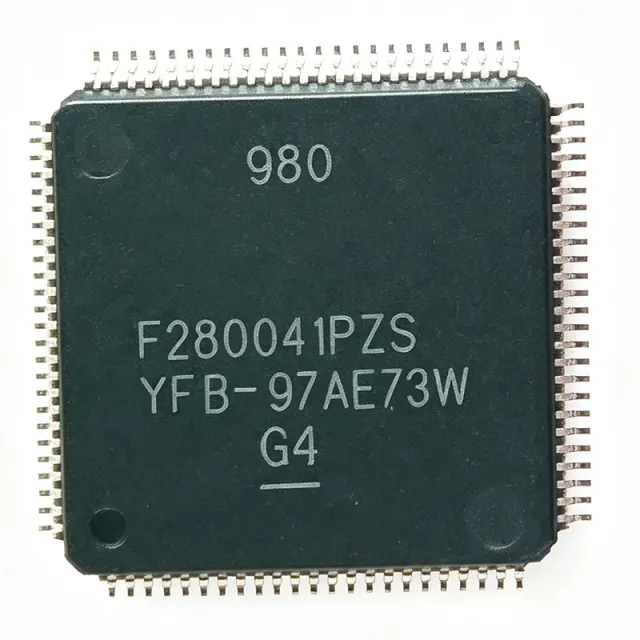
TMS320F241PG
TMS320F241PG - 16-Bit 20MHz DSP with Flash | Texas Instruments
The Texas Instruments TMS320F241PG is a 16-bit fixed-point digital signal processor with a 20 MHz C2xx CPU, 16 KB of on-chip flash memory, and a 64-pin QFP package measuring 14 mm by 20 mm. It combines fixed-point signal-processing performance with embedded flash memory in a surface-mount controller package designed for real-time control and DSP applications.
A digital signal processor, or DSP, is a semiconductor optimized to execute mathematical operations on sampled data efficiently. A fixed-point DSP represents numerical values as integers and scaled fractional quantities, making it well suited to control loops, filtering, waveform generation, motor regulation, and industrial automation. The TMS320F241 belongs to the C2000 family of DSP controllers, which combines signal-processing capability with embedded control peripherals.
The verified device description identifies a 16-bit architecture operating at 20 MHz, with 16 KB of flash organized as 8K by 16 words. Its 64-QFP package supports compact surface-mount assembly while providing a larger pin count than the QFP packages commonly used for small microcontrollers. The exact instruction-cycle time is stated in the retrieved technical material as 50 ns, which is consistent with a 20 MHz operating rate.
The C2xx CPU core provides the computational foundation for digital filtering, control calculations, and fixed-point algorithms. Because the device includes embedded flash, a complete application can store its program code on the DSP itself rather than depending on an external program-memory device. This integration can simplify hardware and firmware organization in dedicated control equipment, although memory-intensive, multi-stage signal-processing designs must still evaluate the available 16 KB capacity carefully.
Typical applications include digital motor control, industrial power conversion, servo and position control, embedded instrumentation, and real-time signal conditioning. Its 20 MHz rate and fixed-point architecture are especially useful in control loops where deterministic arithmetic and compact embedded code are more important than floating-point performance or a large general-purpose software ecosystem.
Designers should review the manufacturer datasheet for the exact pin assignments, peripheral allocation, electrical limits, timing requirements, and external interface configuration. PCB layout should provide suitable decoupling at the supply pins and preserve clean signal routing, particularly when the DSP drives converters, sensors, or communication interfaces. Legacy software and peripheral differences must also be evaluated before migration to a newer C2000 device.
This page combines the verified distributor and manufacturer references with practical guidance for controller selection, replacement assessment, PCB reuse, and real-time DSP implementation. It distinguishes confirmed specifications from data that still requires confirmation, helping engineers make sourcing and design decisions without relying on unverified parametric claims.
询价
联系我们