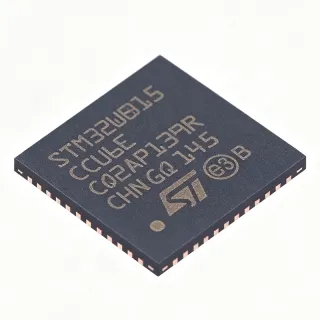
88MW320 - 802.11n Wi-Fi+BT MCU SoC, M4F | NXP
料号: 88MW320 ✓ 量产中| 数量 | 单价 | 小计 |
|---|---|---|
| 1 | $4.17 | $4.17 |
| 10 | $3.96 | $39.60 |
| 100 | $3.54 | $354.00 |
| 500 | $3.19 | $1,595.00 |
| 1,000 | $2.87 | $2,870.00 |
88MW320 概述
A Wi-Fi microcontroller SoC is a single-chip solution that merges a general-purpose microcontroller, RF transceiver, baseband MAC, memory subsystem, and power management into one device. It sits within the broader hierarchy of wireless connectivity ICs under system-on-chip (SoC) and embedded wireless MCU categories, eliminating the need for a separate host processor and discrete radio module in connected devices.
Key features include the full-featured Arm Cortex-M4F core with hardware floating point for signal processing and application code, dual 2.4 GHz radios covering IEEE 802.11n/g/b and Bluetooth, and a low-power architecture designed for battery-operated and always-on smart devices. NXP provides a complete software ecosystem, and the die is supported by SEGGER debugging tools, accelerating embedded development.
The device integrates the Wi-Fi MAC/baseband/RF chain on-die, reducing BOM cost and board area versus two-chip MCU-plus-module solutions. The 68-pin VFQFN exposed-pad package improves thermal performance and RF grounding for the 2.4 GHz front end. According to NXP product documentation, the family also includes the 88MW322 in an 88-pin QFN with expanded I/O, and commercial, extended, industrial and extended-industrial temperature grades in tray and tape-and-reel configurations.
Typical applications include smart home devices, enterprise and industrial automation nodes, smart accessories, and smart energy products that require 802.11 b/g/n connectivity plus embedded compute in a compact, power-conscious footprint.
A key design consideration is RF layout: the exposed pad must be soldered to a solid ground plane with adequate via stitching, and the antenna matching network should follow the NXP reference design to pass regulatory certification.
This page synthesizes distributor pricing, order-code variants, application guidance, and supply-chain data not consolidated in the manufacturer datasheet.
直接替换替代料: 88MW320 ——相同封装,引脚兼容。需要 PCB 改动的不同封装料号已排除。
快速对比工具——选择替代料号进行并排对比:
88MW320-A0-NAPE/AZ
✅ 直接替换📋 参考替代料(不在目录中)
88MW320-A0-NAPI/AK
✅ 直接替换📋 参考替代料(不在目录中)
88MW320-A0-NAPC/AZ
✅ 直接替换📋 参考替代料(不在目录中)
88MW320-A0-NAP2C000-P123
✅ 直接替换📋 参考替代料(不在目录中)
88MW320-A0-NAPI/AZ
✅ 直接替换📋 参考替代料(不在目录中)
88MW320 最大额定值与电气特性
| Product Type | Wi-Fi Microcontroller SoC (RF TxRx + MCU) |
| CPU Core | Arm Cortex-M4F |
| Wi-Fi Standard | IEEE 802.11 b/g/n (2.4 GHz) |
| Bluetooth | Bluetooth 2.4 GHz (BR/EDR) |
| Frequency Band | 2.4 GHz |
| 封装 | 68-VFQFN Exposed Pad |
| 安装类型 | Surface Mount |
| Packing | Tray or Tape & Reel (per NXP order codes) |
| Development Tool Support | SEGGER debug tools supported |
88MW320 68-vfqfn exposed pad 引脚配置指南
88MW320(68-vfqfn exposed pad 封装)的引脚配置。 该数字 IC 包含 GPIO、通信接口(UART、SPI、I2C)和电源引脚。请参阅制造商数据手册以了解复用引脚功能和配置选项。对嵌入式系统设计和 PCB 布局至关重要。

暂无详细引脚数据: 88MW320.
请参阅 数据手册 以查看完整引脚配置。
典型应用
88MW320 适用于 6 应用s: Smart Home Devices, Industrial Automation Nodes, Smart Accessories, Smart Energy Products, Enterprise Networking Accessories, Embedded Development and Prototyping.
Smart Home Devices
The 88MW320 fits smart home products such as connected plugs, sensors, and controllers because it integrates the application processor (Arm Cortex-M4F with hardware FPU) and the IEEE 802.11 b/g/n radio in one 68-VFQFN chip, eliminating a separate Wi-Fi module and host MCU. NXP designed the 88MW320/322 explicitly for smart devices for home use. In a typical design the Cortex-M4F runs the application and TCP/IP stack while the on-chip RF front end drives a 2.4 GHz antenna through the NXP reference matching network. Because the whole connectivity stack lives on-die, board area and BOM cost drop versus two-chip solutions, and power-managed sleep modes support always-on voice or sensor duty cycles in wall-powered and battery-backup products.
推荐
Industrial Automation Nodes
Factory and building automation nodes benefit from the 88MW320's single-chip Wi-Fi and compute integration: the Arm Cortex-M4F handles protocol translation, local control loops, and OTA update management while the 802.11 b/g/n radio links to plant infrastructure. NXP lists industrial automation among the target markets for the 88MW320/322 family. The device's industrial temperature-grade order codes (e.g., 88MW320-A0-NAPI/AK, 88MW320-A0-NAPI/AZ) support harsh enclosure environments, and SEGGER tool support simplifies firmware certification workflows. Using the bare SoC instead of a certified module lowers per-node cost at volume, provided the design team implements the NXP reference RF layout and manages regulatory testing for the final product.
推荐
Smart Accessories
Smart accessories such as connected wearables' hubs, smart tags, and personal devices use the 88MW320 because its low-power architecture combines Bluetooth 2.4 GHz and 802.11 b/g/n Wi-Fi connectivity with the Cortex-M4F application core on a single compact die. NXP specifically names smart accessories as a target application for the 88MW320/322. The dual-radio capability lets a product offer both direct phone pairing (Bluetooth) and infrastructure networking (Wi-Fi) without a second chip. In a typical accessory, the M4F runs sensor fusion and UI logic, Wi-Fi handles firmware updates and cloud sync, and Bluetooth handles provisioning and low-latency phone communication - all from one 68-VFQFN package, minimizing size and battery drain.
推荐
Smart Energy Products
Smart energy devices - connected meters, energy monitors, and load controllers - leverage the 88MW320's integration of 802.11 b/g/n Wi-Fi with the Arm Cortex-M4F, per NXP's stated target markets for the family. The M4F's hardware floating-point unit accelerates metering computations such as RMS power and harmonic analysis on sampled current/voltage waveforms, while the Wi-Fi stack reports usage to home energy management systems or utility clouds. Single-chip integration reduces the bill of materials for cost-sensitive utility-deployed hardware, and industrial order codes cover outdoor and panel installations. Designs should follow the NXP reference RF layout to maintain compliance when the radio operates inside metal-enclosed meter cabinets with external antennas.
推荐
Enterprise Networking Accessories
NXP positions the 88MW320/322 for enterprise smart devices, and the chip suits enterprise accessories such as access-control readers, conference-room sensors, and networked badge terminals. The Arm Cortex-M4F provides enough headroom for TLS-based security stacks required in enterprise Wi-Fi (WPA2-Enterprise) authentication, while the integrated 802.11 b/g/n radio handles the corporate 2.4 GHz infrastructure connection. On-chip integration means the accessory vendor avoids managing a separate module supply chain. The 68-VFQFN exposed-pad package provides the solid RF grounding needed for reliable radio performance in dense enterprise RF environments, and commercial-grade order codes reduce cost for indoor office deployments.
推荐
Embedded Development and Prototyping
The 88MW320 is a practical platform for embedded Wi-Fi product development because it is supported by SEGGER debug tools (per SEGGER's supported-devices listing for the MW300/88MW320 family) and NXP's SDK and reference designs. The Cortex-M4F core supports standard ARM debugging workflows - flash download, live watchpoints, and RTOS-aware debugging - so teams can bring up custom hardware quickly. Prototype boards typically pair the SoC with a 2.4 GHz chip antenna or U.FL connector and follow the NXP reference design for the RF matching network. Because the production die and the development silicon are identical, firmware validated on the prototype transfers directly to volume manufacturing without radio re-qualification of a different part.
推荐
推荐产品汇总
工程参考数据: 88MW320 ——对比、设计指导和合规信息。
选型指南
与替代料对比
| 参数 | 本产品 | 88MW320-A0-NAPE/AZ | 88MW320-A0-NAPI/AK | 88MW320-A0-NAPC/AZ | 88MW322 |
|---|---|---|---|---|---|
| Package | 68-VFQFN Exposed Pad | 68-VFQFN EP - same | 68-VFQFN EP - same | 68-VFQFN EP - same | 88-QFN (not drop-in) |
| Brand | NXP Semiconductors | NXP Semiconductors | NXP Semiconductors | NXP Semiconductors | NXP Semiconductors |
| CPU Core | Arm Cortex-M4F | Arm Cortex-M4F | Arm Cortex-M4F | Arm Cortex-M4F | Arm Cortex-M4F |
| Wi-Fi Standard | 802.11 b/g/n (2.4 GHz) | 802.11 b/g/n | 802.11 b/g/n | 802.11 b/g/n | 802.11 b/g/n |
| Bluetooth | Bluetooth 2.4 GHz | Bluetooth 2.4 GHz | Bluetooth 2.4 GHz | Bluetooth 2.4 GHz | Bluetooth 2.4 GHz |
| Pin Count | 68 | 68 | 68 | 68 | 88 |
| Packing | Tray or Tape & Reel | Tray | Tape & Reel | Tray | Tray or Tape & Reel |
关键差异点
- Single-chip Wi-Fi + Bluetooth + application MCU (对比 88MW322)
- Broad temperature-grade and packing coverage (对比 88MW320-A0-NAPC/AZ)
- Mature tool ecosystem (对比 88MW320-A0-NAP2C000-P123)
设计说明
RF layout is the dominant risk when using the bare 88MW320 SoC instead of a certified module. Solder the exposed pad to a continuous ground plane with a dense via array (stitching vias within 1-2 mm of the pad) to provide both thermal relief and a low-inductance RF ground for the 2.4 GHz front end. Copy the antenna matching network component values and placement directly from the NXP reference design for the 88MW32X family; deviations typically shift the 2.4 GHz match and can fail FCC/CE spurious-emission limits. Keep the crystal and RF traces away from switching regulators.
Order-code confusion is the most common sourcing error for this part. The suffixes (NAPE/AZ, NAPI/AK, NAPC/AZ, NAP2C000-P123) encode temperature grade and packing, and per NXP/Marvell documentation the family spans commercial, extended, industrial, and extended-industrial ranges in tray and tape-and-reel. Specifying a commercial-grade code for an industrial enclosure design leads to field failures, while ordering tray packing on an automated SMT line forces manual handling. Verify the full order code against the NXP ordering guide and your pick-and-place requirements before release.
Wi-Fi transmit bursts create high transient current demand on the 3.3 V-class supply rail. Decouple the SoC power pins with a network of bulk capacitance (tens of microfarads) close to the package plus local 0.1 uF ceramics at each supply pin, per the NXP datasheet power-supply recommendations. Size the upstream DC-DC converter for peak TX current, not average, or rail sag during transmit slots will degrade EVM and cause retries. Estimated: budget for the datasheet peak TX current figure plus 30% margin when selecting the main buck converter.
The 68-VFQFN exposed-pad package places RF, crystal, and high-speed digital pins in close proximity. Route the 32 kHz/typical crystal traces as short as possible with guard ground, and keep the antenna feedline as a controlled-impedance (50 ohm) microstrip with no stubs. SEGGER tooling support for the 88MW320 means standard SWD/J-Link debugging applies; route the debug header away from the RF section and series-terminate long SWD traces to avoid corrupting debug traffic during radio operation.
合规信息
Standard active NXP production part; per-order-code RoHS/REACH declarations should be obtained from the NXP compliance portal for the exact suffix used. Not verified in provided web data, therefore marked unknown.