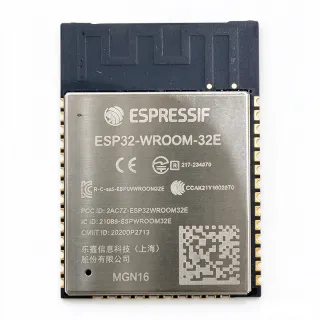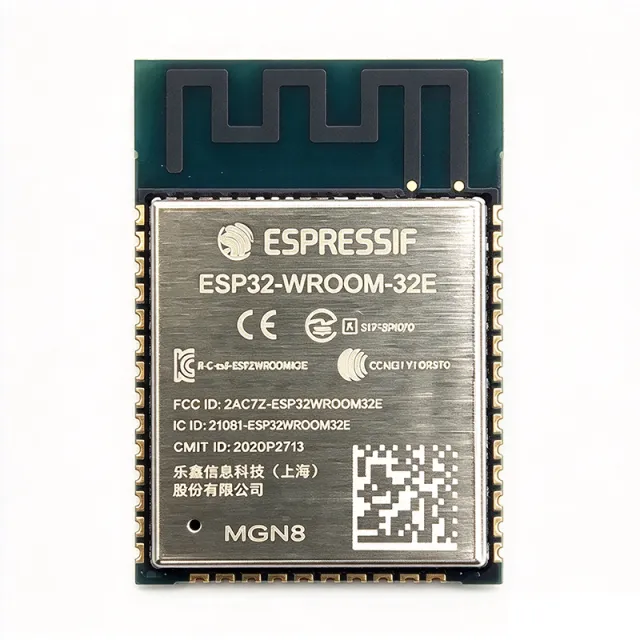
ESP32-WROOM-32E-N8 - WiFi/BT4.2 Module, 8MB Flash | Espressif
料号: ESP32-WROOM-32E-N8 ✓ 量产中| 数量 | 单价 | 小计 |
|---|---|---|
| 1 | $6.4688 | $6.47 |
| 10 | $4.6719 | $46.72 |
| 100 | $4.1328 | $413.28 |
| 500 | $3.9531 | $1,976.55 |
| 1,000 | $3.7734 | $3,773.40 |
ESP32-WROOM-32E-N8 概述
A Wi-Fi/BT module is an RF transceiver subsystem that integrates the radio, antenna, crystal, flash memory, and power management into a certified, ready-to-embed unit. Within the wireless connectivity hierarchy, it sits above bare SoCs (which require external RF design) and below finished development boards, serving as the standard connectivity building block for IoT products.
Key features include 802.11 b/g/n Wi-Fi with Class 1, 2 and 3 Bluetooth transmit capability, 26 usable GPIOs, a rich peripheral set (SPI, I2C, UART, I2S, CAN, touch sensors, ADC/DAC), and support for simultaneous Wi-Fi and Bluetooth operation. The 8 MB SPI flash supports large application images, OTA updates, and embedded assets.
Technically, the module integrates the ESP32-D0WD-V3 silicon revision 3 chip, which fixes earlier RF spectral spur issues for a cleaner Wi-Fi spectrum. The ESP32-WROOM-32E family offers 4/8/16 MB flash options; the -N8 variant is the 8 MB member. The PCB antenna is tuned for the 2.400-2.4835 GHz ISM band.
Typical applications include IoT sensor nodes and smart-home devices, industrial wireless control and monitoring, and wearable or battery-powered connected products.
Design consideration: keep at least 5 mm of clearance around the PCB antenna region on the host board and follow the Espressif layout guidelines to avoid detuning RF performance; supply 3.0-3.6 V with adequate peak-current capability for Wi-Fi TX bursts.
This page synthesizes distributor pricing, drop-in alternatives within the same footprint, and practical design notes not found in the manufacturer datasheet.
直接替换替代料: ESP32-WROOM-32E-N8 ——相同封装,引脚兼容。需要 PCB 改动的不同封装料号已排除。
本系列中的变体
可与以下型号直接替换的同系列型号: ESP32-WROOM-32E-N8 (相同外形与封装尺寸) ——差异在于 Antenna, Bluetooth, CPU, Core SoC, Flash Memory.
快速对比工具——选择替代料号进行并排对比:
ESP32-WROOM-32E-N16
📋 参考替代料(不在目录中)
ESP32-WROOM-32E-N4
📋 参考替代料(不在目录中)
ESP32-WROOM-32UE-N8
📋 参考替代料(不在目录中)
ESP32-WROOM-32D-N8
📋 参考替代料(不在目录中)
ESP32-WROOM-32E-N8 规格参数(制造商发布)
| Core SoC | ESP32-D0WD-V3 |
| CPU | Xtensa dual-core 32-bit LX6 |
| Wi-Fi Standard | 802.11 b/g/n, 2.4 GHz to 2.5 GHz |
| Bluetooth | v4.2 +EDR, Class 1, 2 and 3 |
| Flash Memory | 8 MB SPI |
| 电源电压 | 3.0 V to 3.6 V |
| GPIO Count | 26 |
| Antenna | Onboard PCB antenna |
| 安装类型 | Surface Mount |
| Package Dimensions | 18 x 25.5 x 3.1 mm |
| 引脚数 | 38 |
| Frequency Band | 2.4 GHz ISM |
| RoHS 状态 | Compliant |
ESP32-WROOM-32E-N8 引脚配置
| 引脚 1 | GND — Ground |
| 引脚 2 | 3V3 — Power supply, 3.0-3.6 V |
| 引脚 3 | EN — Chip enable, active high |
| 引脚 4 | SENSOR_VP — ADC preamplifier positive input |
| 引脚 5 | SENSOR_VN — ADC preamplifier negative input |
| 引脚 6 | IO34 — GPIO34, input only, ADC1_CH6 |
| 引脚 7 | IO35 — GPIO35, input only, ADC1_CH7 |
| 引脚 8 | IO32 — GPIO32, ADC1_CH4, XTAL_32K_P |
| 引脚 9 | IO33 — GPIO33, ADC1_CH5, XTAL_32K_N |
| 引脚 10 | IO25 — GPIO25, DAC1, ADC2_CH8 |
| 引脚 11 | IO26 — GPIO26, DAC2, ADC2_CH9 |
| 引脚 12 | IO27 — GPIO27, ADC2_CH7, TOUCH7 |
| 引脚 13 | IO14 — GPIO14, ADC2_CH6, TOUCH6, HSPI_CLK |
| 引脚 14 | IO12 — GPIO12, ADC2_CH5, TOUCH5, HSPI_MISO (strapping) |
| 引脚 15 | GND — Ground |
| 引脚 16 | IO13 — GPIO13, ADC2_CH4, TOUCH4, HSPI_MOSI |
| 引脚 17 | SD2 — SDIO data 2 / GPIO9 |
| 引脚 18 | SD3 — SDIO data 3 / GPIO10 |
| 引脚 19 | CMD — SDIO command |
| 引脚 20 | CLK — SDIO clock |
| 引脚 21 | SD0 — SDIO data 0 |
| 引脚 22 | SD1 — SDIO data 1 |
| 引脚 23 | IO15 — GPIO15, ADC2_CH3, TOUCH3, HSPI_CS (strapping) |
| 引脚 24 | IO2 — GPIO2, ADC2_CH2, TOUCH2 (strapping) |
| 引脚 25 | IO0 — GPIO0, ADC2_CH1, TOUCH1 (strapping, boot mode) |
| 引脚 26 | IO4 — GPIO4, ADC2_CH0, TOUCH0 |
| 引脚 27 | IO16 — GPIO16, HSPI ready |
| 引脚 28 | IO17 — GPIO17, HSPI host |
| 引脚 29 | IO5 — GPIO5, VSPI_CS0 (strapping) |
| 引脚 30 | IO18 — GPIO18, VSPI_CLK |
| 引脚 31 | IO19 — GPIO19, VSPI_MISO |
| 引脚 32 | NC — Not connected (per datasheet) |
| 引脚 33 | IO21 — GPIO21, I2C SDA, VSPI ready |
| 引脚 34 | RXD0 — UART0 receive / GPIO3 |
| 引脚 35 | TXD0 — UART0 transmit / GPIO1 |
| 引脚 36 | IO22 — GPIO22, I2C SCL, VSPI host |
| 引脚 37 | IO23 — GPIO23, VSPI_MOSI |
| 引脚 38 | GND — Ground |
功率与热特性
| 功率输入 | 3.0 V to 3.6 V |
ESP32-WROOM-32E-N8 的功率输入和热参数(由制造商发布)。
典型应用
ESP32-WROOM-32E-N8 适用于 6 应用s: IoT Sensor Nodes and Smart Home Devices, Industrial Wireless Control and Monitoring, Wearables and Battery-Powered Connected Products, Home Automation Hubs and Voice-Controlled Devices, Security and Camera Systems, Prototyping and Maker / STEM Education.
IoT Sensor Nodes and Smart Home Devices
The ESP32-WROOM-32E-N8 fits IoT sensor nodes and smart-home endpoints because its 802.11 b/g/n Wi-Fi provides direct cloud or LAN connectivity while Bluetooth 4.2 +EDR enables commissioning via smartphone apps. The 26 GPIOs interface directly with I2C and SPI sensors (temperature, humidity, PIR, air quality), and the 8 MB flash comfortably holds firmware plus an OTA update partition - essential for maintaining deployed devices for years. Used typically with the module running FreeRTOS-based ESP-IDF or Arduino firmware, the device sleeps between wake cycles to conserve battery. A key performance consideration is supplying 3.3 V at 500 mA peak to support Wi-Fi TX bursts of several hundred milliamps without brownout; bulk capacitance near the 3V3 pin is required. This makes the module the standard connectivity engine for plugs, bulbs, thermostats, and sensor hubs.
推荐
Industrial Wireless Control and Monitoring
In industrial environments, the ESP32-WROOM-32E-N8 serves as a low-cost wireless gateway connecting machines, meters, and controllers to supervisory systems over Wi-Fi. The ESP32-D0WD-V3 dual-core LX6 handles protocol stacks (Modbus TCP, MQTT, HTTP) on one core while the second core manages deterministic I/O timing. The 3.0-3.6 V supply integrates easily with industrial 3.3 V logic, and the castellated 38-pin SMD footprint supports reliable reflow assembly on industrial PCBs. Where the control cabinet is metallic, the ESP32-WROOM-32UE-N8 with an external antenna via U.FL cable solves RF propagation challenges. The 8 MB flash supports logging buffers and redundant OTA images for field updates without service visits. Engineers should verify operating temperature requirements and consider conformal coating for humid or dusty industrial enclosures.
推荐
Wearables and Battery-Powered Connected Products
The ESP32-WROOM-32E-N8 suits battery-powered wearables and portable connected products thanks to its compact 18 x 25.5 x 3.1 mm footprint, 3.3 V single-rail operation compatible with Li-ion + LDO architectures, and Bluetooth Classic + BLE for phone pairing. The onboard PCB antenna eliminates external antenna cost and BOM complexity in plastic housings. Wi-Fi is used for bulk sync or firmware updates while BLE handles low-duty background communication, extending battery life. The 8 MB flash allows richer wearable applications including cached UI assets and on-device analytics. Power design is the critical consideration: Wi-Fi TX bursts of several hundred milliamps demand efficient DC-DC conversion and sleep-mode management (deep sleep at microamp-level currents between activities). Designers should follow Espressif antenna keep-out guidelines to preserve RF efficiency in tight enclosures.
推荐
Home Automation Hubs and Voice-Controlled Devices
As a home-automation hub, the ESP32-WROOM-32E-N8 aggregates multiple wired sensors and actuators and bridges them to Wi-Fi LAN and cloud services. The dual-core ESP32-D0WD-V3 concurrently runs the wireless stack and local control logic; simultaneous Wi-Fi and Bluetooth operation enables phone-app control while maintaining cloud connectivity. The 8 MB flash supports ESPHome, Tasmota, or custom MQTT firmware with generous OTA headroom and file-system storage for device configurations. Peripherals (I2S, UART, SPI) support audio front-ends and RS-485 bridges respectively. Performance consideration: hubs forwarding continuous traffic should budget the 500 mA peak supply current and provide thermal copper area, since sustained Wi-Fi TX raises module temperature. The PCB antenna performs well in open plastic enclosures typical of hub form factors.
推荐
Security and Camera Systems
For IP cameras, doorbells, and security sensors, the ESP32-WROOM-32E-N8 provides Wi-Fi video/telemetry transport plus BLE for setup. The 8 MB flash accommodates camera driver frameworks, TLS certificates, and OTA partitions used by security products that must receive firmware patches throughout their service life. GPIO and I2C interfaces connect PIR sensors, door contacts, and sirens, while I2S supports two-way audio. The ESP32-D0WD-V3's clean Wi-Fi RF spectrum (relative to earlier ESP32 silicon) improves video streaming reliability in congested 2.4 GHz environments. Design consideration: metal security housings detune the PCB antenna, so the ESP32-WROOM-32UE-N8 with an external antenna is usually the correct choice for camera enclosures; keep the 32E variant for plastic-bodied sensors where its integrated antenna minimizes cost.
推荐
Prototyping and Maker / STEM Education
The ESP32-WROOM-32E-N8 is the de facto standard module for prototyping boards, maker projects, and STEM education kits. It is fully supported by the Arduino IDE, ESP-IDF, PlatformIO, MicroPython, and CircuitPython, with an enormous ecosystem of libraries, tutorials, and carrier boards. The 8 MB flash is generous for educational projects combining Wi-Fi web servers, BLE, and sensor logging simultaneously - no flash-budget compromises during learning. Its castellated pads allow hand soldering on simple carrier PCBs or breadboard adapters, and low unit cost (~$3.60) makes classroom and club deployment affordable. A practical tip for beginners: use a development board with USB-serial and auto-reset circuitry rather than wiring boot straps manually, and remember to pull EN/IO0 correctly when designing custom carriers for flashing.
推荐
推荐产品汇总
工程参考数据: ESP32-WROOM-32E-N8 ——对比、设计指导和合规信息。
选型指南
与替代料对比
| 参数 | 本产品 | ESP32-WROOM-32E-N16 | ESP32-WROOM-32E-N4 | ESP32-WROOM-32UE-N8 | ESP32-WROOM-32D-N8 |
|---|---|---|---|---|---|
| Package | 38-pin SMD, 18 x 25.5 x 3.1 mm, castellated | 38-pin SMD, 18 x 25.5 x 3.1 mm - same | 38-pin SMD, 18 x 25.5 x 3.1 mm - same | 38-pin SMD, 18 x 25.5 x 3.1 mm - same | 38-pin SMD, 18 x 25.5 x 3.1 mm - same |
| Brand | Espressif Systems | Espressif Systems | Espressif Systems | Espressif Systems | Espressif Systems |
| Flash Memory | 8 MB SPI | 16 MB SPI | 4 MB SPI | 8 MB SPI | 8 MB SPI |
| SoC / Silicon | ESP32-D0WD-V3 | ESP32-D0WD-V3 | ESP32-D0WD-V3 | ESP32-D0WD-V3 | ESP32-D0WD (older revision) |
| Wi-Fi / Bluetooth | 802.11 b/g/n + BT 4.2 +EDR | 802.11 b/g/n + BT 4.2 +EDR | 802.11 b/g/n + BT 4.2 +EDR | 802.11 b/g/n + BT 4.2 +EDR | 802.11 b/g/n + BT 4.2 +EDR |
| Antenna | Onboard PCB antenna | Onboard PCB antenna | Onboard PCB antenna | U.FL connector for external antenna | Onboard PCB antenna |
| Supply Voltage | 3.0 V to 3.6 V | 3.0 V to 3.6 V | 3.0 V to 3.6 V | 3.0 V to 3.6 V | 3.0 V to 3.6 V |
| RF Spectrum Quality | Clean (ESP32-D0WD-V3 revision 3 silicon) | Clean (V3 silicon) | Clean (V3 silicon) | Clean (V3 silicon) | Older silicon, more RF spurs |
关键差异点
- Balanced 8 MB flash capacity (对比 ESP32-WROOM-32E-N4)
- Integrated PCB antenna at lower BOM cost (对比 ESP32-WROOM-32UE-N8)
- Current silicon revision (ESP32-D0WD-V3) (对比 ESP32-WROOM-32D-N8)
- Trade-off: fixed antenna limits enclosure flexibility (对比 ESP32-WROOM-32UE-N8)
设计说明
Size the 3.3 V rail for peak RF current, not average. Wi-Fi transmission bursts on the ESP32 platform draw several hundred milliamps; a supply rated only for the ~100 mA average will cause brownout resets during TX. Place at least 10 uF of low-ESR bulk capacitance plus 0.1 uF ceramic decoupling within 2 mm of the module's 3V3 (pin 2) and GND (pin 1) pads. For battery designs, use a buck converter or LDO rated at 500 mA minimum and verify the regulator does not droop below 3.0 V during bursts.
Respect the antenna keep-out: no copper, traces, ground plane, battery, or plastic with metal filler should extend into the PCB antenna region and at least 5 mm beyond the module edge where the antenna sits. Place the module at the board edge with the antenna overhanging or pointing outward. Follow Espressif's hardware design guidelines for the module footprint land pattern with castellated half-holes. Violating the keep-out detunes the antenna, cutting range and link margin significantly in deployed products.
Handle strapping pins correctly at power-up: IO0, IO2, IO12 (MTDI), IO15 and IO5 determine boot mode and flash voltage. IO12 pulled high at reset selects 1.8 V flash voltage and will brick booting on this 3.3 V module - keep it low or leave floating with care. Provide access to IO0 and EN (via test points or buttons) for serial flashing. Pins IO34/IO35 are input-only and lack internal pull-ups, so external resistors are needed if used as switch inputs.
Estimated: sustained Wi-Fi operation at typical ESP32 TX levels dissipates roughly 0.3-0.5 W in the module. The PCB module package relies on copper pour for heat spreading; provide a ground plane under the module body (excluding antenna keep-out) and thermal vias to inner layers. Continuous high-throughput applications (video streaming, MQTT relays) in sealed enclosures should verify module surface temperature stays within datasheet limits via bench testing.
合规信息
RoHS compliance confirmed via LCSC product listing (flagged ROHS) and JAK Electronics comparison data. REACH, halogen-free and conflict-minerals status require the Espressif environmental certificate.