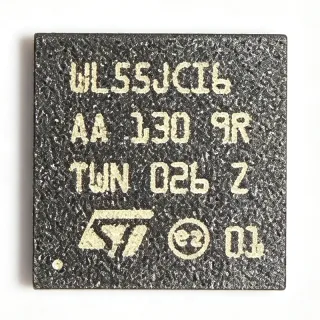
SIM7000G - Cat-M/NB-IoT/GPRS/GNSS LPWA Module | SIMCom
料号: SIM7000G ✓ 量产中| 数量 | 单价 | 小计 |
|---|---|---|
| 1 | $34.97 | $34.97 |
| 10 | $33.22 | $332.20 |
| 100 | $31.47 | $3,147.00 |
| 500 | $29.72 | $14,860.00 |
| 1,000 | $27.97 | $27,970.00 |
SIM7000G 概述
An LPWA (Low Power Wide Area) module is a type of cellular transceiver optimized for low-latency, low-throughput machine-to-machine communication rather than bandwidth. Within the wireless hierarchy - transceiver, RF module, cellular modem, IoT connectivity layer - LPWA modules like the SIM7000G bridge battery-powered sensors to carrier networks over Cat-M (LTE-M), NB-IoT (Cat-NB), and the legacy 2G GPRS/EDGE fallback used where LTE coverage is unavailable.
Key features include Power Save Mode (PSM) and extended Discontinuous Reception (eDRX) that enable battery life of up to 10 years, deep coverage enhancement relative to GSM, and abundant interfaces: UART, USB, GPIO, I2C, ADC, PCM, and SIM card. The integrated GNSS receiver provides positioning without a separate GPS module, reducing BOM cost and board area.
Technically, the SIM7000 series is designed for varied radio propagation conditions, and the G variant is the global/regional-frequency version covering B1, B2, B3, B4 and additional bands per SIMCom documentation. The 24x24 mm LCC castellation footprint is pad-compatible with the SIM900/SIM800F footprint, and AT command sets are largely compatible with SIM800F, easing migration from 2G designs.
Typical applications include smart metering, asset tracking, smart parking, smart city sensors, and industrial M2M telemetry - all scenarios where low data volume, deep indoor coverage, and multi-year battery life dominate.
Design consideration: supply the module from a 3.3 V to 4.2 V source (Li-ion directly or a buck regulator) with low-ripple capability, since cellular TX bursts draw significant peak current; a single Li-ion cell within the 3.0 V to 4.3 V window is the standard approach.
This page synthesizes distributor pricing, drop-in SIM7000-family alternatives, and practical design notes not consolidated in the manufacturer datasheet.
直接替换替代料: SIM7000G ——相同封装,引脚兼容。需要 PCB 改动的不同封装料号已排除。
本系列中的变体
可与以下型号直接替换的同系列型号: SIM7000G (相同外形与封装尺寸) ——差异在于 Mounting Type, Antenna, GNSS, Interfaces, Technology.
快速对比工具——选择替代料号进行并排对比:
SIM7000E
✅ 直接替换 ⚠️ 规格未核验✓ 有现货
$17.59 / 个
查看数据手册 →SIM7000A
✅ 直接替换 ⚠️ 规格未核验✓ 有现货
$16.2 / 个
查看数据手册 →SIM7000
✅ 直接替换📋 参考替代料(不在目录中)
SIM7000G 规格参数
| Technology | LTE Cat-M, NB-IoT (Cat-NB), GPRS, EDGE, LPWA |
| Frequency Bands | 850 MHz, 900 MHz, 1800 MHz, 1900 MHz |
| Supported LTE Bands | B1, B2, B3, B4 |
| GNSS | Integrated GNSS receiver |
| 电源电压 | 3.0 V to 4.3 V |
| PSM Current | 9 uA (Power Save Mode) |
| Interfaces | UART, USB, GPIO, I2C, ADC, PCM, SIM card |
| Antenna | Antenna not included |
| 封装 | LCC surface mount, 24 x 24 mm |
| 安装类型 | Surface Mount (SMD) |
| 工作温度 | -40C to +85C |
| Battery Life (PSM/eDRX) | Up to 10 years |
| RoHS 状态 | Compliant |
| MSL 等级 | 3 (168 hours) |
| REACH | Compliant |
SIM7000G lcc surface mount, 24 x 24 mm 引脚配置指南
SIM7000G(lcc surface mount, 24 x 24 mm 封装)的引脚配置。 引脚编号、功能和连接图在制造商数据手册中定义。请参阅该手册以了解确切的封装尺寸和焊接指南。

暂无详细引脚数据: SIM7000G.
请参阅 数据手册 以查看完整引脚配置。
典型应用
SIM7000G 适用于 6 应用s: Asset Tracking, Smart Metering, Smart City and Smart Parking, Industrial M2M Telemetry, Wearables and Portable IoT Devices, Vehicle and Fleet Telematics.
Asset Tracking
The SIM7000G's integrated GNSS receiver plus Cat-M/NB-IoT connectivity makes it a single-chip solution for battery-powered asset trackers that must report position and status for years. With 9 uA PSM current and eDRX scheduling, a 3000 mAh Li-ion cell can theoretically sustain up to 10 years of operation per SIMCom's claims, assuming low reporting frequency. The 3.0 V to 4.3 V supply range accepts a Li-ion cell directly, eliminating a regulator stage. Trackers typically wake via motion sensor interrupt, acquire GNSS fix, transmit a short position packet over Cat-M, then re-enter PSM. The 24x24 mm LCC footprint keeps tracker PCBs compact, and UART AT-command control suits a low-cost MCU host. Multi-band support (850/900/1800/1900 MHz, B1/B2/B3/B4) enables global fleet deployments on a single hardware variant.
推荐
Smart Metering
Utility smart meters (water, gas, electricity) demand deep-indoor coverage, decade-long battery life and negligible standby draw - exactly the SIM7000G's design envelope. NB-IoT's coverage enhancement gives roughly 20 dB better link budget than GPRS, allowing meters in basements and metal cabinets to reach the network, while the GPRS/EDGE fallback covers networks without NB-IoT. The 9 uA PSM current means a meter reading hourly over 10+ years is feasible from a primary lithium cell. Interfaces simplify metering electronics: UART for the host MCU, I2C for peripheral sensors, ADC for analog battery/current monitoring, and GPIO for tamper switches. The abundant interface set named by SIMCom (UART, GPIO, PCM, I2C) also supports DLMS/COSEM gateway designs. Deep coverage plus PSM makes this module a de-facto standard in meter deployments.
推荐
Smart City and Smart Parking
Smart parking sensors, streetlight controllers and environmental nodes deploy by the thousands and must survive 5-10 years on battery or small solar. The SIM7000G fits because its low-throughput Cat-M/NB-IoT link is sufficient for occupancy status and telemetry, while 9 uA PSM current keeps solar-buffered designs small. SIMCom positions the SIM7000 series for 'low latency, low throughput data communication' in varied radio propagation conditions - relevant for sensors mounted under vehicles or in street furniture where signal is marginal, aided by NB-IoT coverage enhancement versus GSM. The 24x24 mm LCC SMD package supports automated assembly at volume, and MSL 3 (168 hours) suits standard reflow lines. Global band support (B1/B2/B3/B4 plus 850/900/1800/1900 MHz) lets one SKU serve multiple cities.
推荐
Industrial M2M Telemetry
For industrial M2M equipment monitoring - pumps, compressors, HVAC, tanks - the SIM7000G provides reliable low-rate telemetry where 4G data plans and power budgets are overkill. SIMCom explicitly targets the module at M2M applications needing security and flexibility. The PCM audio interface supports voice-capable alarm panels, while I2C and ADC allow direct sensor integration without extra converters. Operating from -40C to +85C, it survives unconditioned cabinets. Migration is a major practical benefit: the package footprint is compatible with SIM900/SIM800F and AT commands are largely compatible with SIM800F, so legacy 2G telemetry designs can move to Cat-M/NB-IoT with minimal firmware rework before carrier 2G sunsets complete. Reserve Cat-M bandwidth for control-plane messaging such as SMS and small MQTT publishes typical in SCADA edge nodes.
推荐
Wearables and Portable IoT Devices
Connected badges, pet trackers, medical adherence devices and personal safety pendants benefit from the SIM7000G's combination of positioning and LPWA connectivity at milliwatt standby power. The 9 uA PSM draw means a wearable's small cell (500-1000 mAh) can idle for months between charges, and the integrated GNSS avoids a separate GPS receiver that would add both cost and quiescent current. The 3.0-4.3 V VBAT range pairs with single-cell Li-poly packs charged over USB, which the module natively supports. At 24x24 mm the LCC module fits wrist-worn and pocketable enclosures when paired with a compact chip antenna (antenna is not included with the module). Note the peak transmit current during cellular bursts - size the battery and decoupling so voltage stays above the 3.0 V minimum under load.
推荐
Vehicle and Fleet Telematics
Basic fleet telematics - position reporting, geofencing, driver-id beacons - is a natural fit for the SIM7000G because it unifies GNSS reception and Cat-M/NB-IoT uplink in one 24x24 mm package, keeping tracker PCBs small enough for covert installation. The G-variant's global band coverage (850/900/1800/1900 MHz, B1/B2/B3/B4) supports cross-border fleets on one hardware build, avoiding regional SKUs. Supply from the vehicle 12 V rail requires a buck regulator into the 3.0-4.3 V window with adequate burst-current headroom for GSM/GPRS fallback transmission. The -40C to +85C rating covers under-dash and engine-bay-adjacent mounting. Community designs such as the LilyGO T-SIM7000G, which pairs the module with an ESP32, demonstrate the typical architecture: host MCU on UART issuing AT commands, GNSS NMEA parsing, and MQTT over Cat-M.
推荐
推荐产品汇总
工程参考数据: SIM7000G ——对比、设计指导和合规信息。
选型指南
与替代料对比
| 参数 | 本产品 | SIM7000E | SIM7000A | SIM7000 |
|---|---|---|---|---|
| Package | LCC 24 x 24 mm | LCC 24 x 24 mm - same | LCC 24 x 24 mm - same | LCC 24 x 24 mm - same |
| Brand | SIMCom | SIMCom | SIMCom | SIMCom |
| Technology | Cat-M / NB-IoT / GPRS / EDGE | Cat-M / NB-IoT / GPRS / EDGE | Cat-M / NB-IoT / GPRS / EDGE | Cat-M / NB-IoT / GPRS / EDGE |
| Supply Voltage | 3.0 V to 4.3 V | 3.0 V to 4.3 V | 3.0 V to 4.3 V | 3.0 V to 4.3 V |
| PSM Current | 9 uA | 9 uA | 9 uA | 9 uA |
| Operating Temperature | -40C to +85C | -40C to +85C | -40C to +85C | -40C to +85C |
| Primary Market | Global | EMEA / Asia | North America | Base series |
关键差异点
- Integrated GNSS in the same package (对比 SIM7000)
- Global band coverage on one SKU (对比 SIM7000A)
- 10-year battery life via PSM/eDRX (对比 SIM808 (2G legacy))
设计说明
The 3.0 V to 4.3 V supply window matches a single Li-ion cell, but cellular transmit bursts draw substantial peak current. Estimated: if a GPRS burst draws up to ~2 A for 577 us slots, source impedance including PCB traces, connector and decoupling must keep VBAT ripple small enough that the minimum instantaneous voltage stays above 3.0 V. Place at least one bulk capacitor (100 uF to 470 uF, low ESR) plus 100 nF ceramics directly at the VBAT pads. For 5 V systems use a buck regulator rated well above burst current; never feed 5 V into VBAT.
Use SIMCom's recommended land pattern for the 24x24 mm LCC castellated footprint from the SIM7000 hardware design guide. Route the RF pad as 50-ohm controlled impedance with a pi-network (series 0-ohm plus two shunt pads) reserved for antenna matching during certification. Keep the GNSS antenna separate from the primary cellular antenna and away from switching regulators. MSL 3 (168 hours) requires floor-life control before reflow; bake if the tray exceeds 168 h exposure.
Verify carrier certifications per variant: community reports note the global SIM7000G does not carry the same regional certifications as SIM7000A/E, so a G-variant design may fail carrier acceptance in some countries. Also confirm 2G sunset status if relying on GPRS/EDGE fallback, and remember the antenna is not included - an unmatched antenna is the most common cause of failed first-site network registration in new SIM7000G designs.
合规信息
RoHS and REACH compliant per PartGenie part data; MSL 3 (168 hours). JLCPCB listing confirms ROHS.