دوائر المضخم المتكاملة
المنتجات (1,100+)

OPA234E - 36V Precision Operational Amplifier | Texas Instruments
The Texas Instruments OPA234E is a low-power, precision operational amplifier in an 8-VSSOP package, specified for single-supply operation up to +36V and dual-supply operation up to ±18V. The device provides two amplifier channels, 250 uA per amplifier quiescent current, 25 nA maximum input bias current, 100 uV maximum offset voltage, and operation characterized at +2.7V, +5V, and ±15V. Its 8-VSSOP package supports compact analog signal-chain designs. An operational amplifier is a voltage-feedback analog IC used to amplify the difference between two input voltages while providing high input impedance and low output impedance. The OPA234E belongs to the precision operational-amplifier hierarchy, combining low offset, low bias current, and low quiescent current for instrumentation, sensor, and signal-conditioning applications. Its dual-channel architecture reduces package count when a design needs two matched amplifier functions. Key features include a wide supply range, low power consumption, low input bias current, and low offset voltage. The 250 uA-per-amplifier quiescent current is suitable for battery-powered and low-power systems, while the maximum 25 nA input bias current helps preserve sensor accuracy. The device is intended for precision signal conditioning where low bias and offset matter more than very high bandwidth. The verified product data identifies OPA234E as a single circuit in an 8-VSSOP package from the distributor listing, while the related OPA234 family data describes it as a dual operational-amplifier family member. The available source does not provide a verified gain-bandwidth figure, slew rate, noise density, common-mode range, output swing, or complete pinout, so those values must be confirmed from the manufacturer datasheet before design release. Typical applications include low-power sensor interfaces, precision current measurements, instrumentation signal conditioning, battery-powered equipment, and industrial control systems. The low quiescent current helps limit supply demand, but input bias current and offset errors still require careful source-impedance and calibration analysis. For PCB implementation, keep input traces short, provide stable bypassing at the supply pins, and avoid routing sensitive high-impedance inputs beside switching nodes. Verify the exact VSSOP pin mapping, supply limits, input common-mode range, and output swing against the authoritative OPA234 datasheet. This page combines verified distributor descriptions, available family specifications, and engineering guidance while clearly identifying missing parameters. This product data is synthesized from the supplied manufacturer-family and distributor sources rather than a complete manufacturer datasheet specification set.

OPA234P - Low-Power Precision Dual Op Amp | Texas Instruments
The Texas Instruments OPA234P is a low-power, precision dual operational amplifier in an 8-pin PDIP package. It operates from a single supply as high as +36 V or from dual supplies of ±18 V, with guaranteed performance specified at +2.7 V, +5 V, and ±15 V. Each amplifier consumes 250 µA of quiescent current, making the device suitable for low-power precision signal-conditioning systems that require two amplifiers in one through-hole package. An operational amplifier is a voltage-controlled differential amplifier used to amplify, buffer, filter, compare, or drive analog signals. The OPA234 belongs to the operational-amplifier hierarchy and is positioned as a low-power, precision single-supply amplifier. Its dual-channel configuration reduces component count when an application needs matched amplifier stages, while the wide supply range permits operation from low-voltage systems through conventional analog laboratory rails. The verified manufacturer data identifies three principal advantages: a wide supply range, guaranteed performance at +2.7 V, +5 V, and ±15 V, and low quiescent current of 250 µA per amplifier. The exact offset, bandwidth, slew-rate, input-noise, common-mode-range, and output-current figures are not included in the supplied excerpts and therefore require confirmation from the manufacturer datasheet before precision sizing. OPA234P uses the OPA234-series architecture intended for low-cost, low-voltage, and low-power applications. According to the supplied TI application material, the series combines low offset voltage, high common-mode rejection, high power-supply rejection, and a wide supply range. These characteristics make the device applicable to precision current sensing, instrumentation, sensor signal conditioning, buffering, and active filtering where low supply current and usable single-supply operation are important. Typical applications include battery-powered instrumentation, temperature and pressure sensor interfaces, low-level analog signal conditioning, audio and communication buffers, and active filters. In each case, the OPA234P supplies two amplifier channels in one package, allowing a compact dual-stage architecture without requiring two separate amplifier packages. Designers should verify the complete input common-mode range, output swing, input bias current, offset voltage, frequency response, and stability requirements against the exact operating supply and load. Decoupling and layout should follow the datasheet recommendations, particularly when driving capacitive loads or operating close to the output-swing limits. This product record combines verified source details, application guidance, replacement analysis, and practical design cautions. It clearly separates confirmed specifications from unavailable parameters so engineers can review the manufacturer datasheet before making precision signal-chain decisions.
OPA2350UA/2K5 - Dual 38MHz Rail-to-Rail Op Amp | Texas Instruments
The Texas Instruments OPA2350UA/2K5 is a dual, single-supply, rail-to-rail CMOS operational amplifier featuring 38 MHz gain-bandwidth, 22 V/µs slew rate, and 5 nV/√Hz input-noise density in an 8-pin SOIC package. The two amplifiers share a common package while providing independent input, output, and supply connections for dual-channel signal conditioning. According to the verified TI product information, the device is optimized for low-voltage operation and is intended for high-speed, low-noise analog signal chains. What is a rail-to-rail operational amplifier? A rail-to-rail input amplifier accepts input voltages across nearly the entire supply range, while a rail-to-rail output amplifier can swing its output close to the positive and negative supply rails. The OPA2350 combines these capabilities with high-speed small-signal performance and low noise. In the broader electronics hierarchy, it is a CMOS operational amplifier within the linear-amplifier and signal-conditioning categories. The verified feature set emphasizes 38 MHz bandwidth, 22 V/µs slew rate, 5 nV/√Hz noise density, and rail-to-rail output operation within 10 mV. These figures make the device suitable for applications that require fast settling or low-noise amplification, including sampling analog-to-digital converter input stages. The family is also identified for cell-phone power-amplifier control loops and 75-ohm video-processing drive applications. OPA2350UA/2K5 is specified as a dual amplifier in an 8-pin SOIC (D) package. The verified operating-temperature entry is -40°C to +85°C for this ordering variant. Rail-to-rail input and output behavior is particularly useful in low-voltage systems where the usable signal range is close to the supply limits and where conventional non-rail-to-rail amplifiers would clip or compress the signal. Typical circuit roles include ADC signal conditioning, video-buffer or drive functions, control-loop amplification, and other high-speed analog front-end stages. The dual configuration can process two related channels, such as a differential or paired sensor signal, without requiring two separate packages. Designers should verify the supply voltage, load, stability, and output-swing requirements against the complete manufacturer datasheet before finalizing the analog path. A key design consideration is to preserve the amplifier’s high-speed behavior by minimizing parasitic capacitance and using short, well-routed traces. Decoupling capacitors should be placed close to the supply pins, and sensitive input nodes should avoid proximity to switching nodes and high-current return paths. Because the verified data does not provide a complete electrical parameter table for every operating condition, consult the TI datasheet for precise limit values. This page combines verified TI product facts, distributor availability references, practical design guidance, and structured comparison information. It is intended to help engineers identify whether the OPA2350UA/2K5 matches the required bandwidth, slew-rate, noise, supply, and package constraints.

OPA2375 - Dual 10MHz Low-Noise CMOS Op Amp | Texas Instruments
The Texas Instruments OPA2375 is a dual-channel, general-purpose CMOS operational amplifier delivering a 10 MHz gain-bandwidth product, an ultra-low broadband noise of 4.6 nV/rtHz (per-channel typical at 10 kHz), and a maximum input offset voltage of 500 uV. It operates from a single 2.2V to 5.5V supply with rail-to-rail output (RRO) and is supplied in an 8-pin TSSOP package (OPA2375IPWR). An operational amplifier is a high-gain voltage amplifier with differential inputs, foundational to the analog signal-chain hierarchy: op amp -> amplifier IC -> analog front end -> semiconductor. The OPA2375 belongs to the OPAx375 family, which includes the single-channel OPA375 and quad-channel OPA4375, all sharing the same core CMOS silicon and specifications. Key features include low broadband noise (3.5 nV/rtHz family figure, 4.6 nV/rtHz for the dual at specified conditions), a wide 10 MHz bandwidth suited to active filters and transimpedance stages, rail-to-rail output swing that maximizes dynamic range on 3.3V and 5V rails, and low offset of 500 uV maximum that reduces DC error without needing auto-zero calibration. CMOS construction gives low input bias current, important for high-impedance sources. Architecturally, the OPA2375 uses a CMOS input pair with a precision trim at wafer test, achieving a strong noise-bandwidth-offset balance that makes the OPAx375 family attractive for precision applications requiring good AC performance at low cost. Unity-gain stability and rail-to-rail output simplify buffer and driver designs. Typical applications include sensor signal conditioning, active anti-aliasing filters ahead of precision ADCs, transimpedance amplifiers for photodiodes, and medical or portable instrumentation where low noise and wide bandwidth on a single 5V rail are required. The dual channel halves board area versus two singles. Design consideration: keep source impedance below approximately 1 kOhm to preserve the nV-level noise floor, and decouple each supply pin with 0.1 uF ceramics placed close to the device.

OPA2375IDDFR - Dual 10MHz 4.6nV Op Amp, TSOT-23-8 | TI
The Texas Instruments OPA2375IDDFR is a dual-channel, 10-MHz, low-noise (4.6 nV per root-hertz) rail-to-rail output (RRO) CMOS operational amplifier operating from a 2.2 V to 5.5 V single supply, housed in an 8-pin TSOT-23-8 (DDF) surface-mount package. An operational amplifier (op amp) is a high-gain voltage amplifier with differential inputs, and it sits at the core of the analog signal chain hierarchy: op amp -> amplifier IC -> analog integrated circuit -> signal-conditioning subsystem. Within this hierarchy, low-noise precision CMOS amplifiers such as the OPA2375 bridge the gap between general-purpose and precision instrumentation amplifiers, conditioning sensor and transducer signals before analog-to-digital conversion. Key features of the OPA2375IDDFR include a 10 MHz gain-bandwidth, an input-referred broadband noise of only 4.6 nV per root-hertz, a maximum input offset voltage of 500 uV, and rail-to-rail output swing that maximizes dynamic range on low-voltage rails. The CMOS input provides high input impedance and low bias current, important for high-impedance sensor interfaces. Architecturally, the OPAx375 family (OPA375 single, OPA2375 dual, OPA4375 quad) uses a CMOS input stage with a rail-to-rail output stage (RRO). This combination delivers wide bandwidth and low noise simultaneously, a pairing usually traded off against each other, and the low offset of 500 uV maximum keeps DC accuracy acceptable in precision signal chains without system-level trimming. Typical applications include sensor signal conditioning for pressure and temperature transducers, active filter stages ahead of precision ADCs, and transimpedance or buffer amplification in portable and battery-powered instrumentation where the 5.5 V maximum supply and small TSOT-23-8 footprint save board area. Design consideration: the OPA2375 provides rail-to-rail output only (RRO), not rail-to-rail input. Keep the common-mode input range within the specified limits, typically about 1.5 V from either rail, or verify linearity in your operating region before committing the layout. This page synthesizes distributor pricing from DigiKey, Mouser, LCSC and Octopart, drop-in alternative analysis, and practical design notes not found in the manufacturer datasheet, giving engineers a single citable reference for the OPA2375IDDFR.
OPA2375IDGKR - Dual 10MHz Rail-to-Rail Op Amp | TI
The Texas Instruments OPA2375IDGKR is a dual-channel, 10 MHz CMOS operational amplifier with rail-to-rail output (RRO), 4.6 nV/√Hz low broadband noise, and 500 µV maximum input offset voltage, housed in an 8-pin VSSOP (DGK) surface-mount package. An operational amplifier (op amp) is a high-gain voltage amplifier with differential inputs that, when combined with external feedback networks, performs amplification, filtering, buffering, and signal conditioning. Within the signal-chain hierarchy, the op amp sits between sensors and data converters: it is a core analog building block of the amplifiers and buffer amplifiers category, and the OPA2375 belongs to the OPAx375 general-purpose CMOS family that also includes the single OPA375 and quad OPA4375. Key differentiating features include the extremely low 4.6 nV/√Hz broadband noise figure, a wide 10 MHz gain-bandwidth, a fast 4.6 V/µs slew rate (per distributor package data), and rail-to-rail output swing that maximizes dynamic range in low-voltage systems. The maximum 500 µV offset and only 3 pA input bias current make the device suitable for high-impedance sources. Technically, the OPA2375 uses a CMOS input architecture with a rail-to-rail output stage, which allows output swings to within millivolts of either supply rail. This CMOS design delivers low noise without the input bias currents of bipolar alternatives, and the low-voltage 5.5 V maximum supply rating aligns the amplifier directly with 3.3 V and 5 V single-supply systems, ADC drivers, and portable designs. Typical applications include sensor signal conditioning and transimpedance amplification for photodiodes (enabled by the 3 pA bias current), active anti-alias filters ahead of SAR and delta-sigma ADCs, and general-purpose precision amplification in industrial and portable instrumentation. The dual channel integration saves board area versus two single amplifiers. When designing, account for supply decoupling with 0.1 µF ceramics close to each V+ pin, and verify that closed-loop gain and load capacitance keep the amplifier comfortably within its 10 MHz bandwidth and phase-margin limits for stability. This page synthesizes distributor pricing, drop-in alternatives, design notes, and pin-to-pin replacement guidance not found in the manufacturer datasheet alone.

OPA2375IDSGR - 10MHz Dual CMOS Op Amp RRO | Texas Instruments
The Texas Instruments OPA2375IDSGR is a dual-channel, 10-MHz, low-noise (3.5 nV/sqrtHz broadband, 4.6 nV/sqrtHz per the TI product page) CMOS operational amplifier with rail-to-rail output (RRO), supplied in an 8-pin WSON (DSG) 2x2 mm surface-mount package. It operates from a supply up to 5.5 V and draws only 990 uA per channel. An operational amplifier (op amp) is a high-gain differential voltage amplifier that forms the core building block of analog signal conditioning. Within the power-management and signal-chain hierarchy, op amps sit in the amplifier IC category alongside instrumentation amplifiers and buffer amplifiers, conditioning sensor outputs, filtering signals, and driving ADC inputs. The OPA2375 belongs to the OPAx375 family, which includes the single OPA375, dual OPA2375, and quad OPA4375. Key differentiating features include an extremely low broadband noise figure of 3.5 nV/sqrtHz, a maximum input offset voltage of only 500 uV, very low distortion (THD+N of 0.00015%), a 10 MHz gain bandwidth, and unity-gain stability. These combine to deliver precision performance rarely found in general-purpose CMOS op amps at this quiescent current level. Technically, the OPA2375 uses a CMOS input architecture that achieves near-zero input bias current together with low 1/f noise, while the rail-to-rail output stage maximizes dynamic range on low single-supply rails such as 3.3 V and 5 V. The output swing within millivolts of either rail allows the full ADC input range to be exploited in compact battery-powered designs. Typical applications include sensor signal conditioning for battery-powered devices, active filter and transimpedance stages in portable medical instruments, and driving precision successive-approximation ADCs such as the ADS131M08 in industrial data-acquisition systems. Design consideration: the 2x2 mm WSON (DSG) package has a small thermal pad and fine 0.5 mm pitch, so inspect the PCB land pattern carefully and use a ground plane for heat spreading and stable high-frequency performance. Input and output RC filtering is recommended when driving heavily capacitive loads. This page synthesizes distributor availability, drop-in alternative analysis, pinout details, and practical design notes not consolidated in the manufacturer datasheet, with pricing as of 2026-09-03.

OPA2375IPWR - 10MHz 4.6nV/√Hz Dual CMOS Op Amp | TI
The Texas Instruments OPA2375IPWR is a dual-channel general-purpose CMOS operational amplifier delivering a 10 MHz gain-bandwidth product, an ultra-low 4.6 nV/√Hz broadband noise figure, and a maximum 500 μV input offset voltage, housed in an 8-pin TSSOP (PW) surface-mount package with rail-to-rail output (RRO). An operational amplifier (op amp) is a high-gain differential-input voltage amplifier that forms the fundamental building block of analog signal conditioning. Within the voltage regulator-to-amplifier-to-precision-analog hierarchy, the op amp sits between sensors and data converters, conditioning weak signals before digitization. The OPA2375 belongs to the OPAx375 precision CMOS op amp family, which includes the single-channel OPA375 and quad-channel OPA4375 siblings, all sharing the same core amplifier design and RRO output stage. Key differentiating features include the combination of low noise and wide bandwidth rarely found in general-purpose CMOS op amps, a 500 μV maximum offset voltage enabling precision DC-accurate designs, and rail-to-rail output swing that maximizes dynamic range in low-voltage 5 V and 3.3 V systems. The low-cost CMOS process yields very low input bias currents, suitable for high-impedance sensor front ends. Architecturally, the OPAx375 family uses a CMOS input stage with a precision-trimmed offset and an output stage that swings to within millivolts of the rails under light load. The 10 MHz bandwidth supports closed-loop gain configurations above 10 V/V while preserving adequate loop gain for low-distortion operation at audio and intermediate frequencies. Supply operation up to 5.5 V suits single-supply portable and industrial logic-level systems. Typical applications include transducer and photodiode sensor amplifiers, active filter networks, precision current sensing, and buffered analog outputs in industrial automation, medical instrumentation, and battery-powered portable devices. The dual-channel integration saves board area in multi-stage filter and TIA designs. Design consideration: keep source impedance low to exploit the 4.6 nV/√Hz noise figure, use 0.1 μF decoupling per supply pin, and add an isolation resistor if driving capacitive loads above a few hundred pF in unity gain. This page synthesizes distributor availability data, same-family drop-in alternatives, and practical design notes not found in the manufacturer datasheet. Pricing shown as of 2026-09-03.

OPA2375SIRUGR - Dual 10MHz RRO CMOS Op Amp | TI
The Texas Instruments OPA2375SIRUGR is a dual-channel, 5.5 V, 10 MHz low-noise CMOS operational amplifier with rail-to-rail output (RRO), a maximum offset voltage of 500 uV, and a noise density of 4.6 nV per root hertz, housed in a 10-pin X2QFN (RU) package measuring only 1.5 mm x 2.0 mm. An operational amplifier is an analog building block that amplifies the voltage difference between its two inputs and is foundational to every signal chain, sitting in the hierarchy of amplifiers -> op amps -> precision amplifiers -> analog integrated circuits. Dual op amps such as the OPA2375 integrate two matched amplifier circuits in one package, halving board area and improving channel-to-channel matching versus discrete solutions. Key differentiating features include the 10 MHz gain-bandwidth combined with a 4.6 V/us slew rate, which supports demanding general-purpose precision applications; the extremely low 500 uV maximum input offset voltage, which preserves DC accuracy without system-level calibration; and the rail-to-rail output stage, which maximizes dynamic range on low-voltage 2.2 V to 5.5 V supplies. The CMOS input delivers low bias current and low broadband noise, a combination attractive for sensor front ends and active filters. Architecturally, the OPAx375 family uses a general-purpose CMOS process with a rail-to-rail output (RRO) stage rather than a full rail-to-rail input. The family includes the single OPA375, dual OPA2375, and quad OPA4375, so designs can scale channel count while keeping identical electrical characteristics - useful when migrating from a prototype dual to a production quad. Typical applications include active filter stages in data acquisition systems, transimpedance and buffer amplification for precision sensors, and signal conditioning ahead of ADCs such as the ADS131M08 delta-sigma converters. The 10 MHz bandwidth supports audio-range and sub-MHz instrumentation circuits with margin. A key design consideration: the output swings rail-to-rail but the input common-mode range does not, so verify input headroom in low-supply designs. X2QFN leadframes also need a well-defined PCB land pattern for reliable soldering. This page synthesizes distributor pricing, alternative cross-reference guidance, application pairings, and design notes not consolidated in the manufacturer datasheet.

OPA2670 - 700mA VDSL2 Line Driver Op Amp | Texas Instruments
The Texas Instruments OPA2670 is a dual wideband, high-output-current current-feedback operational amplifier with power control, optimized as a single-port line driver for VDSL2, xDSL, and Power Line Communication (PLC) modem applications. Operating on a single +12V supply, it consumes only 30.5mA total quiescent current (21mA per port) while delivering up to 700mA of output current, exceeding the >450mA minimum demand of the most stringent xDSL line-driving requirements. The device comes in a 16-pin VQFN (RGV, 4x4 mm) package. A line driver is a high-current power operational amplifier positioned at the output of a modem AFE (analog front end) to drive low-impedance telephone or power-line networks through a transformer. Within the signal-chain hierarchy, it sits under amplifier ICs > operational amplifiers > high-output-current/DSL line driver amplifiers, where linearity and output current, not just bandwidth, define system performance. Key features include the exceptional AC performance of a current-feedback topology combined with a highly linear, high-power output stage, enabling low distortion into heavy loads. The output swings to within 1V of either supply rail, maximizing usable voltage headroom on a +12V rail. Power-control pins allow the amplifier to be disabled or operated at reduced bias for power saving during idle line conditions - critical for battery-backed or thermally constrained CPE (customer premises equipment). Architecturally, the current-feedback input stage provides bandwidth largely independent of closed-loop gain, sustaining low distortion at DSL frequencies (up to 30MHz VDSL2 profiles) while the robust output stage maintains linearity at high peak currents. The power-save pin lets designers trade bias current for idle power. Typical applications include VDSL2/xDSL CO and CPE line drivers, HomePlug/PLC differential drivers, high-current ADC output buffers, and transformer-coupled line transmitters. Design consideration: ensure adequate PCB copper on the exposed pad for thermal dissipation at sustained high output current, and use the power-save feature to limit junction temperature during idle periods.
OPA277P - 36V Precision Operational Amplifier | Texas Instruments
Texas Instruments OPA277P is a precision bipolar operational amplifier with a 36 V maximum supply voltage, 10 µV input offset voltage, 0.1 µV/°C input offset drift, and 1 MHz gain-bandwidth product, housed in an 8-pin PDIP package. It is designed for instrumentation and test-and-measurement circuits requiring low offset, low drift, and stable dc amplification. An operational amplifier is a high-gain differential amplifier used to amplify small voltage signals while rejecting common-mode disturbances. The OPA277 belongs to the precision operational amplifier hierarchy, which sits below the broader amplifier and analog semiconductor categories. Its bipolar input stage supports accurate amplification across industrial signal chains where rail-to-rail input performance is not essential, but low offset and drift are important. The primary specifications distinguish the OPA277 from general-purpose amplifiers. The 10 µV offset limit reduces output error in low-level instrumentation, while the 0.1 µV/°C maximum drift limits sensitivity to temperature changes. Its 1 MHz gain-bandwidth product supports moderate closed-loop bandwidth, and the verified distributor specifications identify a 0.8 V/µs slew rate and a 2 V to 18 V supply specification in addition to the 5 V to 15 V operating range shown for the device. OPA277P is a single-amplifier circuit in an 8-pin PDIP package, even though the manufacturer product-page search result describes the broader OPA277 family as dual-channel. The P suffix identifies the PDIP configuration. Because this is a through-hole precision part, it is particularly suitable for laboratory prototypes, educational instruments, legacy industrial equipment, and custom measurement modules where PCB real estate is not the primary constraint. Typical uses include precision current-to-voltage conversion, low-level sensor amplification, bridge-transducer signal conditioning, laboratory reference buffers, and general feedback-control circuits. Its low offset and drift are valuable when the system must preserve small signals over temperature, while its 1 MHz bandwidth is adequate for instrumentation and control paths that do not require high-speed signal processing. Designers should verify the exact input common-mode range, output swing, input bias current, noise specifications, shutdown behavior, and absolute maximum ratings in the manufacturer datasheet before finalizing a design. Decoupling, grounding, input bias-current return paths, and output-load stability remain important even for a precision amplifier operating at relatively low bandwidth. This page consolidates verified manufacturer information, distributor pricing, same-package replacement information, application guidance, and practical design notes. It also distinguishes confirmed replacement data from engineering parameters that remain unavailable in the supplied search results, helping engineers make a more defensible selection.
OPA277U - 1MHz Precision Op Amp | Texas Instruments
The Texas Instruments OPA277U is a single-circuit, precision bipolar operational amplifier with a 36 V maximum supply rating, 10 µV offset voltage, 0.1 µV/°C drift, 1 MHz gain-bandwidth product, and 0.8 V/µs slew rate. The device is supplied in an 8-pin SOIC package and operates from ±2 V to ±18 V. It is the single-amplifier ordering option associated with the OPA277 family, whose dual amplifier is offered separately. A precision operational amplifier is a voltage-input, differential signal amplifier whose internal gain and feedback network are designed to minimize error introduced by input offset voltage, bias current, noise, and drift. Within the broader semiconductor hierarchy, an operational amplifier belongs to the amplifier IC family and is used in instrumentation, control, measurement, conversion, and analog signal-conditioning systems. The OPA277U is intended for precision rather than high-speed or rail-to-rail applications. The most important feature is its 10 µV offset voltage, supported by a specified drift characteristic of 0.1 µV/°C. These parameters make the device useful where DC accuracy must remain stable as temperature changes. Its 1 MHz gain-bandwidth product and 0.8 V/µs slew rate provide adequate bandwidth for many precision feedback networks while retaining the slow, low-noise characteristics associated with a bipolar precision amplifier. The OPA277U operates across ±2 V to ±18 V supplies, corresponding to the documented 36 V maximum rating. This supply range supports conventional dual-supply instrumentation systems and higher-voltage bipolar rails where appropriate. Because it is not identified as a rail-to-rail input or output device in the supplied product information, system designers should verify signal-swing and common-mode limits against the manufacturer datasheet before operation. Typical uses include precision instrumentation, low-level sensor signal conditioning, bridge and transducer amplification, laboratory measurement equipment, and analog control loops. The device can also serve as a high-gain error amplifier when its bandwidth, slew rate, output swing, and stability requirements suit the selected feedback network. Its low offset and drift are particularly valuable when the measurement path must distinguish small signals from temperature-dependent errors. Designers should verify the exact pin functions, common-mode range, output swing, input bias current, noise density, and recommended compensation values in the manufacturer datasheet before layout. Decoupling should follow the datasheet guidance, and precision feedback traces should be kept short and away from noisy switching nodes. Stable operation also depends on selecting the correct closed-loop gain and avoiding saturation. This product record combines verified Texas Instruments specifications, current distributor pricing, package information, sourcing links, and substitution guidance. It also separates documented drop-in candidates from options that require package or electrical verification, helping engineers identify a true replacement without treating merely similar amplifiers as interchangeable.
OPA27GP - 4.5nV/√Hz, 8MHz, 8-PDIP Amplifier | Texas Instruments
The Texas Instruments OPA27GP is a single-circuit, ultra-low-noise precision operational amplifier with 4.5 nV/√Hz noise, 100 µV maximum offset, 117 dB minimum open-loop gain, and an 8-pin PDIP package. It is unity-gain stable and operates from -40°C to +85°C. The device combines low-voltage noise with high DC precision for instrumentation, audio, and signal-conditioning systems where signal integrity remains important at both AC and DC. An operational amplifier is a voltage-controlled, high-gain analog building block used to amplify or buffer signals. The OPA27 belongs to the precision-operational-amplifier hierarchy, which is part of the broader amplifier-IC and semiconductor categories. Its differential input stage compares two voltages and drives an output according to feedback, allowing engineers to configure stable gain, filtering, summing, and current-control circuits. The OPA27's 4.5 nV/√Hz maximum noise at 1 kHz, 100 µV maximum offset, and 0.4 µV/°C maximum offset drift support accurate measurement of low-level signals. Its 117 dB minimum open-loop gain, 100 dB minimum common-mode rejection, and 94 dB minimum power-supply rejection improve rejection of unwanted common-mode and supply-related disturbances. Unity-gain stability removes the minimum-gain constraint associated with the decompensated OPA37. Texas Instruments describes the OPA27 as a precision monolithic amplifier using bias-current cancellation and laser-trimmed thin-film resistors. Those techniques support low offset and stable long-term behavior. The amplifier has an 8 MHz bandwidth and a 3.4 V/µs slew rate, allowing it to process small signals while preserving useful large-signal dynamics. The manufacturer datasheet states that bias and offset-current specifications are maintained over the full -40°C to +85°C range. Typical uses include low-noise audio preamplification, bridge-based sensor interfaces, precision current measurement, low-level transducer amplification, laboratory instrumentation, and buffer stages following high-impedance sensors. Noise and offset determine the smallest useful input, while input bias current, common-mode range, output swing, supply voltage, and stability determine whether the selected operating point is electrically suitable. When replacing an existing OP-05, AD510, or AD517 socket design, verify pin mapping and all electrical limits rather than relying only on package shape. Decouple each power pin locally, avoid placing high-impedance input traces beside noisy output or compensation paths, and use guarding if leakage or surface contamination can disturb the input. This page combines verified manufacturer data, sourcing information, replacement constraints, and application guidance for design review and procurement.
OPA27GU - Ultra-Low-Noise Precision Op Amp | Texas Instruments
Texas Instruments OPA27GU is an ultra-low-noise, precision operational amplifier with 4.5 nV/√Hz input noise, 100 µV maximum offset voltage, and 8 MHz gain-bandwidth product, supplied in an 8-pin SOIC package. It combines low-voltage noise with precision DC performance for instrumentation, audio, measurement, and signal-conditioning circuits. The amplifier is unity-gain stable and is designed for applications requiring both AC and DC accuracy. An operational amplifier is an analog integrated circuit that amplifies the voltage difference between its inverting and non-inverting inputs. Precision operational amplifiers add low offset, low drift, high open-loop gain, and strong common-mode and power-supply rejection. The OPA27 belongs to the operational-amplifier hierarchy, which sits within analog ICs and broader semiconductor signal-conditioning systems. Key features include 4.5 nV/√Hz maximum noise at 1 kHz, 100 µV maximum offset voltage, 0.4 µV/°C maximum input offset drift, 117 dB minimum open-loop gain, 100 dB minimum common-mode rejection, and 94 dB minimum power-supply rejection. Its unity-gain stability supports direct use as a non-inverting buffer, while the precision architecture is useful for low-level sensor and instrumentation signals. The OPA27GU uses an 8-SOIC package and is identified by DigiKey as a single-circuit standard general-purpose amplifier. The verified part data also associates the family with operation from -40°C to +85°C and an 8 MHz gain-bandwidth product. These characteristics make the device suitable for audio preamplifiers, sensor interfaces, precision filters, measurement front ends, and low-noise analog signal chains. Designers should verify the complete supply-voltage range, input common-mode limits, output swing, bias current, and stability requirements in the manufacturer datasheet before final circuit release. Decoupling capacitors should be placed close to the supply pins, and the PCB should minimize parasitic capacitance and feedback-loop coupling. The low-noise benefit is realized only when the surrounding resistors, references, layout, and signal source do not dominate the system noise. This page combines verified manufacturer and distributor information with practical selection, application, and design guidance. It distinguishes the OPA27GU from broader OP27-family alternatives and identifies where a footprint-compatible replacement requires confirmation of electrical and pin-level details before substitution.

OPA333AIDBVR - 1.8V 17uA Zero-Drift Op Amp | TI
The Texas Instruments OPA333AIDBVR is a 1.8 V, 17 uA, single-channel zero-drift CMOS operational amplifier with a SOT-23-5 package. It provides a maximum input offset voltage of 10 uV, rail-to-rail input and output capability, and high-impedance inputs whose common-mode range extends 100 mV beyond the supply rails. The device is intended for precision, low-power analog signal chains where offset and drift must remain small over time and temperature. An operational amplifier is a voltage-gain element used in amplifier, comparator, buffer, integrator, and sensor-conditioning circuits. The OPAx333 family belongs to the precision amplifier hierarchy, using CMOS construction and proprietary auto-calibration to combine low offset with near-zero drift. Its rail-to-rail input and output characteristics help preserve usable signal range in low-voltage systems, while the 17 uA supply current supports battery-powered and portable equipment. The OPA333AIDBVR combines a 10 uV maximum offset voltage, near-zero drift, rail-to-rail operation, and low quiescent current in one compact five-pin package. According to the Texas Instruments product page, the common-mode input range reaches 100 mV beyond the rails, and the output swings rail-to-rail. These features make the amplifier useful when the measured signal is small, the supply voltage is limited, and system power budget is important. The zero-drift architecture periodically corrects the amplifier's offset through auto-calibration. This improves long-term stability compared with a conventional amplifier whose offset changes with temperature and aging, although calibration behavior and noise should still be considered in the complete signal chain. The CMOS process and low-power design also make the part suitable for precision instrumentation, sensor interfaces, and low-voltage analog systems. Typical applications include battery-powered sensor conditioning, portable measurement equipment, low-current analog interfaces, precision current sensing, and general low-voltage signal amplification. OPA333AIDBVR is particularly appropriate when the application requires low offset, low supply current, and operation from a 1.8 V class supply. The amplifier's compact SOT-23-5 footprint simplifies board-level integration in space-constrained designs. Designers should verify the complete supply range, input common-mode limits, output swing, noise, settling behavior, and calibration requirements against the manufacturer datasheet. Decoupling capacitors should be placed close to the supply pins, and sensitive analog signals should be routed away from switching nodes and high-current paths. This page combines verified manufacturer and distributor information with practical engineering guidance for selecting and integrating the device. This OPA333AIDBVR data sheet is available through Texas Instruments' product page and authorized distributor listings, while alternative selection and package compatibility should be checked against the specific design requirements.
OPA335AIDBVR - Zero-Drift 5uV Op Amp, 2MHz, SOT-23-5 | TI
The Texas Instruments OPA335AIDBVR is a single-channel, zero-drift CMOS operational amplifier housed in a 5-pin SOT-23 (DBV) package that delivers 5uV maximum offset voltage, 0.05uV/C maximum offset drift, 2 MHz gain-bandwidth product, and 1.6 V/us slew rate on a single 2.7 V to 5.5 V supply. The rail-to-rail output swing, near-zero 1/f noise corner, and integrated EMI/RFI rejection filter make this amplifier appropriate for high-precision signal conditioning where long-term stability outweighs absolute bandwidth. The OPA335 omits the shutdown pin found on its sibling OPA334, simplifying firmware logic in always-on applications. A zero-drift operational amplifier is a type of precision analog amplifier that uses internal auto-zeroing or chopper-stabilization techniques to continuously cancel the input-offset voltage and its variation with temperature. Within the broader signal-chain hierarchy, an op amp functions as the fundamental active building block for amplification, filtering, and signal translation; precision zero-drift variants sit at the top of that taxonomy (precision op amp -> operational amplifier -> amplifier -> analog IC -> semiconductor). Compared to conventional CMOS op amps whose offset can drift tens of microvolts over temperature, the OPA335 holds sub-microvolt drift over the full -40C to +125C range, eliminating periodic calibration in many instrumentation paths. Key features include 285 uA typical quiescent current, 2 kV HBM ESD on the input pins, unity-gain stable operation with 1 nF capacitive loads, and rail-to-rail output that swings within 30 mV of either supply at 10 kohm loading. The TI proprietary auto-zero architecture produces no chopping artifacts in the audio band, allowing clean thermopile and strain-gauge signal chains. Internal RFI/EMI rejection filtering at the inputs suppresses out-of-band interference from cellular, Wi-Fi, or motor-drive sources without external RC networks. The OPA335 pairs an internal precision oscillator with switched-capacitor nulling to dynamically measure and correct offset every clock cycle. This architecture removes the 1/f noise that dominates low-frequency CMOS amplifiers and creates a flat noise spectral density down to DC. Because the device operates from a single supply, designers can omit the negative rail that traditional bipolar precision amplifiers require, saving PCB area and BOM cost. Typical applications include thermocouple and RTD front-ends, load-cell conditioning for weighing scales, precision current sensing for battery monitors, medical instrumentation such as glucose meters, and handheld industrial test equipment. The 2.7 V minimum supply also enables direct 3.3 V system integration with MCUs and ADCs. When laying out the OPA335, keep input traces short and guarded, route the high-impedance nodes away from switching nodes, and place the 0.1 uF supply bypass within 3 mm of the V+ pin. Designers should avoid placing large capacitive loads directly at the output - the amplifier remains stable with up to 1 nF but rapidly loses phase margin above that. This page synthesizes distributor pricing, drop-in SOT-23-5 alternatives, and practical layout notes from the manufacturer datasheet, providing comparison and selection context not available on a single-line distributor listing.
OPA336P - 20uA, 125uV Offset CMOS Op Amp | Texas Instruments
The Texas Instruments OPA336P is a single, rail-to-rail operational amplifier with 20 uA typical quiescent current per amplifier, 125 uV maximum input offset voltage, 1 pA input bias current, and an 115 dB typical open-loop gain, housed in an 8-pin PDIP package. It belongs to the MicroAmplifier series and is designed for low-power, precision analog signal conditioning when supply current, offset, and bias current are important design constraints. What is a CMOS operational amplifier? A CMOS operational amplifier uses complementary metal-oxide-semiconductor input and power structures to provide high input impedance, low input bias current, and low static power consumption. The OPA336P is a single-supply, micropower amplifier intended for portable instrumentation, sensor interfaces, battery-powered systems, and precision analog measurement. Its rail-to-rail input and output behavior helps preserve signal range near the supply rails, subject to the detailed datasheet limits. According to the Texas Instruments OPA336 product information, the single, dual, and quad family versions have identical specifications for design flexibility. Verified highlights include 20 uA typical quiescent current per amplifier, 125 uV maximum offset voltage, 1 pA input bias current, and 115 dB high open-loop gain. The device is identified by distributors as a single amplifier in an 8-PDIP package. The low 1 pA bias current is particularly useful with high-impedance sources because it reduces source-loading error. The 125 uV maximum offset is valuable for low-level sensor and current-feedback measurements where input-referred error affects accuracy. Its micropower architecture supports longer battery life, while the 8-pin PDIP package remains straightforward for through-hole prototypes and manually assembled boards. Typical uses include battery-powered sensor interfaces, medical and industrial instrumentation, low-current signal conditioning, photodiode preamplification, portable measurement systems, and general low-power analog filtering. The circuit role is usually a voltage amplifier, buffer, or active-filter element. Designers should verify supply range, input common-mode limits, output swing, stability, noise, slew rate, and temperature limits against the manufacturer datasheet before production release. A key design consideration is that micropower does not eliminate all layout and signal-integrity requirements. Keep feedback components close to the amplifier, maintain a low-impedance return path, and account for input-bias-current error and output-capacitance stability. This page combines verified manufacturer and distributor information with practical selection guidance, while missing numerical parameters are explicitly marked for engineering follow-up.
OPA336U - 2.1V MicroPower CMOS Op Amp | Texas Instruments
Texas Instruments OPA336U is a single-supply, microPower CMOS operational amplifier with operation down to 2.1V, rail-to-rail output, 20uA quiescent current per amplifier, 125uV maximum offset voltage, 1pA input bias current, and 115dB open-loop gain in an 8-SOIC package. It is designed for battery-powered and portable instrumentation where low power, low offset, and rail-to-rail signal handling are important. An operational amplifier, or op amp, is a high-gain differential amplifier used to amplify, buffer, filter, or compare small voltage signals. The OPA336 belongs to the microPower CMOS operational-amplifier hierarchy and is optimized for low-voltage, single-supply systems. Its common-mode input range extends to the negative supply, making it suitable for systems whose signals are referenced near ground without requiring a bipolar supply. The OPA336 family's principal advantages are low power consumption and precision input characteristics. Quiescent current is 20uA per amplifier, maximum input offset voltage is 125uV, input bias current is 1pA, and open-loop gain is 115dB. The output is rail-to-rail and swings to within 3mV of the supply with a 100kOhm load. Single, dual, and quad versions share identical specifications, allowing design flexibility when channel count changes. OPA336U is the single-amplifier 8-SOIC ordering variant. Its CMOS input architecture supports low-bias-current measurement and avoids the comparatively high input currents associated with conventional bipolar transistor input stages. The 115dB open-loop gain provides useful DC precision, while the rail-to-rail output improves usable dynamic range in compact systems constrained to a single low-voltage supply. Typical uses include battery-powered sensor interfaces, portable medical instruments, low-current data acquisition, electrochemical sensor conditioning, smart sensors, and low-leakage measurement circuits. Its low 20uA-per-amplifier supply demand is especially valuable when the complete amplifier must operate from a small cell or energy-harvesting supply. High-impedance sources can benefit from the 1pA input bias current specification. Designers should verify the complete operating range of the selected OPA336 variant, including supply voltage, common-mode range, output swing, load capability, temperature range, and stability requirements. Capacitive loading and noise-gain configuration can affect output behavior, so the manufacturer datasheet and application guidance should be consulted before finalizing a high-gain or heavy-load design. This page combines verified Texas Instruments product information, distributor availability references, package details, drop-in ordering alternatives, comparison parameters, and practical selection guidance. It is designed to help engineers identify whether OPA336U fits a low-power, single-supply precision-amplifier design and to evaluate compatible alternatives without assuming unverified specifications.
OPA378AIDBV - Zero-Drift 900kHz RRIO Op Amp | TI
The Texas Instruments OPA378AIDBV is a low-noise, 900 kHz, rail-to-rail input/output (RRIO), zero-drift precision operational amplifier in a 5-pin SOT-23 (DBV) package. It features 20 uV maximum input offset voltage, 0.1 uV/°C offset voltage drift, and 150 uA maximum quiescent current, with a gain bandwidth product of 900 kHz and a low input voltage noise density suitable for precision signal conditioning. A zero-drift operational amplifier (also called a chopper-stabilized or auto-calibrated amplifier) is a precision amplifier topology that uses internal switching and correction to continuously null its input offset voltage, eliminating the 1/f (flicker) noise and offset drift that limit DC accuracy in conventional CMOS or bipolar op amps. The OPA378 belongs to the broader family of operational amplifiers -> precision amplifiers -> amplifiers -> analog signal-chain ICs -> semiconductor devices. This category is critical whenever a circuit needs to amplify or buffer microvolt-level DC signals without drift across temperature. Key specifications include a 900 kHz gain bandwidth product (GBW), 2.5 V/us typical slew rate, RRIO operation from a 2.7 V to 5.5 V single supply, 150 uA maximum quiescent current, and an input bias current of 200 pA. The combination of low offset (20 uV), near-zero drift (0.1 uV/°C), low noise, and micropower consumption enables high DC accuracy in battery-powered and bridge-sensor applications without auto-zero cycle latency. Internally, the OPA378 uses a proprietary auto-calibration technique that continuously samples and corrects the input stage offset, achieving picoampere-level effective input bias drift over time and temperature. Rail-to-rail input and output stages allow the part to operate with signals that approach either supply rail, maximizing dynamic range in low-voltage single-supply systems. The 5-pin SOT-23 package is footprint-compatible with industry-standard SOT-23-5 single-channel op amps, supporting PCB-level drop-in replacement. Typical applications include precision strain-gauge and thermocouple signal conditioning, transducer excitation amplifiers, battery-powered sensor front-ends, medical instrumentation, handheld test equipment, and current-sense amplifiers. Designers select the OPA378 specifically when sub-100 uV DC error and sub-uV/°C drift are required in systems that cannot tolerate the noise and quiescent current of legacy precision op amps. When designing with this device, ensure the input common-mode range includes the expected signal excursion, since RRIO operation only guarantees linear behavior within the specified input voltage range. Use low-impedance drive sources or a series input resistor to attenuate switching transients from the chopper front-end, and add a small RC filter at the output if any residual clock feedthrough is unacceptable in the target application. This page synthesizes distributor pricing, drop-in alternatives, and practical design notes not found in the manufacturer datasheet, giving engineers an actionable reference for sourcing and second-sourcing decisions.
OPA37GP - 63MHz Ultra-Low-Noise Precision Op Amp | Texas Instruments
The Texas Instruments OPA37GP is a single, decompensated precision operational amplifier with 4.5 nV/√Hz input noise, 100 µV offset, 63 MHz gain-bandwidth product, and 11.9 V/µs slew rate, supplied in an 8-pin PDIP package. It is designed for precision signal-processing systems that require low noise, low distortion, high speed, and accurate DC behavior. An operational amplifier is an analog integrated circuit that amplifies the voltage difference between its inverting and non-inverting inputs while using negative feedback to set closed-loop gain. Precision operational amplifiers add low offset, low bias current, and stable voltage-noise performance. The OPA37 belongs to the broader hierarchy of operational amplifier, analog amplifier, signal-conditioning IC, and semiconductor. The OPA37GP combines a 63 MHz gain-bandwidth product with a decompensated architecture, allowing operation at higher closed-loop gains than a unity-gain-stable device. Its 4.5 nV/√Hz noise and 100 µV offset make it suitable for precision audio, instrumentation, sensor-interface, and low-level signal-chain applications. The 11.9 V/µs slew rate supports faster signal transitions while preserving low distortion. The device accepts dual supplies identified in the verified product data as approximately ±4 V to ±22 V, giving a broad operating range for laboratory, industrial, and communications equipment. The OPA37GP is specified for a -40 °C to 85 °C temperature range and is offered in the P package with 8 pins. The manufacturer describes the family as ultra-low-noise and precision, with laser-trimmed thin-film resistor technology cited in retrieved technical material. Typical uses include low-level audio amplification, precision measurement front ends, current-voltage conversion, active filters, and instrumentation signal conditioning. The amplifier is particularly appropriate when low noise and accurate DC performance matter more than minimum power consumption or minimum cost. When laying out an OPA37GP circuit, keep the feedback network and input connections short, preserve the required supply decoupling, and avoid placing long copper paths beside high-gain input nodes. Because this is a decompensated amplifier, verify the minimum stable closed-loop gain before substituting it into a unity-gain circuit. This page combines verified manufacturer and distributor information with practical selection guidance, application context, and replacement checks.
OPA37GU - 63MHz Ultra-Low-Noise Precision Op Amp | TI
The Texas Instruments OPA37GU is a single, decompensated precision operational amplifier with a 63 MHz gain-bandwidth product, 11.9 V/µs slew rate, and input-voltage noise density of 4.5 nV/√Hz at 1 kHz, housed in an 8-pin SOIC package. It is designed for precision signal-processing applications that require low noise, low offset, and accurate dynamic performance. An operational amplifier is an analog integrated circuit that amplifies the voltage difference between its inverting and non-inverting inputs. Precision operational amplifiers add low offset, low bias current, high open-loop gain, and common-mode rejection for instrumentation, audio, sensor, and measurement systems. The OPA37 is a decompensated amplifier, so its stable operating-gain requirement must be considered when selecting feedback values. Key verified features include 4.5 nV/√Hz maximum input noise at 1 kHz, 100 µV maximum input offset voltage, 0.4 µV/°C offset drift, 117 dB minimum open-loop gain, 100 dB minimum common-mode rejection, and 94 dB minimum power-supply rejection. The supplied product information identifies a ±4 V to ±22 V supply range and a 59 A device-level rating in distributor search data, although the exact application limits should be confirmed against the manufacturer datasheet. OPA37 family devices use a decompensated architecture intended for higher closed-loop gain than a unity-gain-stable amplifier. The 63 MHz gain-bandwidth product and 11.9 V/µs slew rate support wideband small-signal and precision signal paths, while the low-noise specification is particularly relevant to audio and measurement front ends. Stable feedback-network design remains essential because decompensated amplifiers may require a minimum closed-loop gain. Typical applications include professional audio equipment, low-noise microphone preamplifiers, instrumentation amplifiers, precision measurement front ends, active filters, and signal-conditioning circuits. The 8-pin SOIC package supports conventional surface-mount PCB assembly, while its low offset and noise help reduce calibration burden when the signal source is close to the input noise floor. When laying out an OPA37GU circuit, place input, feedback, and decoupling components close to the relevant pins, maintain short ground-return paths, and verify the required minimum closed-loop gain. Use the manufacturer datasheet for complete electrical limits, compensation guidance, common-mode range, output-drive capability, and package drawings. This page combines verified source data with selection and design guidance intended to support engineering comparison rather than replace the datasheet.
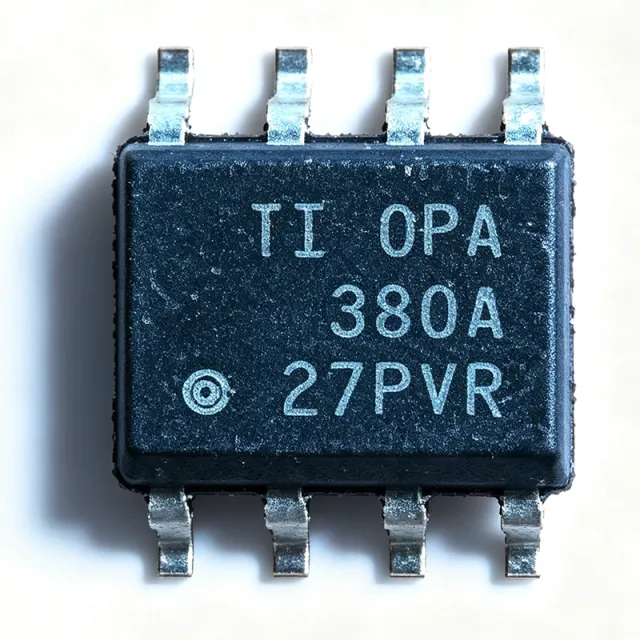
OPA380AID - 90MHz Precision Transimpedance Amplifier | TI
The Texas Instruments OPA380AID is a precision, high-speed transimpedance amplifier in an 8-pin SOIC (D) package, combining a 90MHz gain bandwidth product with extremely high DC precision for fast photodiode applications. It converts photodiode currents up to 1mA into voltage signals with transimpedance bandwidth exceeding 1MHz. A transimpedance amplifier (TIA) is a specialized current-to-voltage converter built on an operational amplifier with a feedback resistor, forming the analog front end of optical receivers, barcode scanners, and photodiode-based instruments. Within the signal-chain hierarchy, the TIA sits between the photodetector and the ADC or comparator, and its noise, bandwidth, and offset set the dynamic range of the whole optical link. Key features include 50pA maximum input bias current, 25uV maximum offset voltage, and 0.1uV/C maximum drift, giving 4 to 5 decades of dynamic range. The very low 1/f noise and excellent long-term Vos stability result from an internal auto-zero amplifier cascaded with a high-speed amplifier, rather than a traditional composite approach, improving overload recovery and settling time. The auto-zero plus high-speed composite architecture eliminates the usual precision-versus-speed trade-off: DC accuracy typical of chopper amplifiers is retained while delivering >1MHz transimpedance bandwidth. Quiescent current is 6.5mA per amplifier. Typical applications include high-speed photodiode receivers for optical communications, laser rangefinders and LiDAR receivers, barcode and medical CT scanner photodiode front ends, and precision optical power meters. For stable operation, keep the photodiode capacitance and feedback resistor within the datasheet stability region; a small feedback capacitor is usually required, and the output may need a pull-down resistor to include 0V in the output swing.

OPA380AID - 90MHz Precision Transimpedance Amplifier | TI
The Texas Instruments OPA380AID is a precision, high-speed transimpedance amplifier delivered in an 8-pin SOIC package. It combines a 90MHz gain bandwidth (GBW) with extremely high DC precision, providing transimpedance bandwidth above 1MHz for photodiode currents up to 1mA. A transimpedance amplifier (TIA) is a specialized operational amplifier circuit that converts a sensor current, most commonly from a photodiode, into a proportional output voltage. Within the signal-chain hierarchy, the TIA sits between the optical or current-output sensor and the ADC or comparator, and its bandwidth, input bias current, and offset voltage set the system's dynamic range. The OPA380 belongs to the wider family of precision amplifiers and analog front-end ICs in power management of optical receivers. Key features include a maximum input bias current of 50pA, a maximum offset voltage of 25uV with only 0.1uV/degC drift, and 4 to 5 decades of dynamic range. These specs allow direct interface with high-impedance photodiodes without external cancellation circuitry. Architecturally, the OPA380 results from an internal auto-zero amplifier combined with a high-speed amplifier. This composite topology delivers very low 1/f noise and excellent long-term VOS stability while TI's design improves overload recovery and settling time over a traditional discrete composite approach. Typical applications include high-speed photodiode receivers for optical data links, photodiode-based instrumentation such as spectrophotometers and lab photoreceivers, and barcode or LiDAR-style pulse detection where >1MHz transimpedance bandwidth matters. Design tip: the feedback resistor and photodiode capacitance set stability - use the datasheet's feedback capacitor guidance, and note the output swings to within millivolts of ground only on a single supply with load returned to a negative rail or virtual ground.

OPA396 - 1MHz 24uA Precision RRIO Op Amp | Texas Instruments
The Texas Instruments OPA396 is a single, micropower precision operational amplifier featuring rail-to-rail input and output (RRIO) operation. It combines a 1 MHz gain-bandwidth product with an ultra-low quiescent current of 23.5 uA (24 uA typ), packaged in the tiny SC-70-5 (DCK) surface-mount package for space-constrained portable designs. An operational amplifier (op amp) is a high-gain voltage amplifier with differential inputs and a single-ended output, and is a fundamental building block of analog signal conditioning used for amplification, filtering, and buffering. The OPA396 belongs to the precision op amp category, which prioritizes low offset voltage, low drift, and low input bias current. Within the amplifier hierarchy it is a micropower precision op amp, positioned between general-purpose op amps and ultra-low-power nanopower devices, and its RRIO capability maximizes dynamic range in low-voltage systems. Key differentiating specifications include an ultra-low input bias current of 10 fA (CMOS input stage), a maximum offset voltage of 100 uV, and a low offset drift of 1.2 uV/C over temperature. These parameters deliver high DC accuracy in sensor interfaces and transimpedance applications. The device operates from a 1.7 V to 5.5 V single supply and is specified from -40C to +125C, supporting both single-cell battery systems and industrial environments. Technically, the OPA396 uses a CMOS input stage responsible for its femtoampere-level bias current, and a class-AB rail-to-rail output stage providing solid drive at low supply current. Its high speed-to-power ratio (1 MHz bandwidth at 23.5 uA) is exceptional for battery-powered equipment, and unity-gain stability simplifies design-in. It is a member of the OPAx396 family, which includes single (OPA396), dual (OPA2396), and quad (OPA4396) versions for scalable designs. Typical applications include battery-powered instrumentation, photodiode transimpedance amplification where the 10 fA bias current minimizes dark-current error, portable medical devices, and low-power active filters. The rail-to-rail output swings fully at 1.7 V supplies, allowing direct interfacing with ADCs in IoT sensor nodes and wearable electronics. For design-in, decouple the supply with a 0.1 uF capacitor placed close to the supply pin, and account for the noise-gain versus bandwidth trade-off in high-gain configurations. Prices as of 2026-08-30 reflect distributor single-unit and volume pricing shown below.