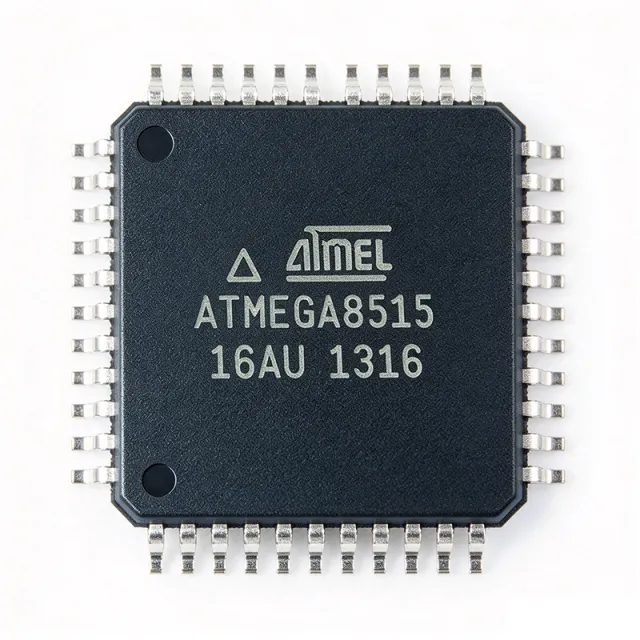
ATMEGA8515-16AU - 8-bit AVR MCU 16MHz 8KB Flash 44-TQFP
MPN: ATMEGA8515-16AU ✓ نشط| الكمية | سعر الوحدة | الإجمالي |
|---|---|---|
| 1 | $4.37 | $4.37 |
| 10 | $4.05 | $40.50 |
| 100 | $3.62 | $362.00 |
| 500 | $3.2 | $1,600.00 |
| 1,000 | $2.85 | $2,850.00 |
ATMEGA8515-16AU نظرة عامة
Background Knowledge: An 8-bit microcontroller (MCU) is a single-chip computer integrating a CPU core, program memory, data memory, and peripherals around an 8-bit data bus. The ATmega8515 belongs to the AVR enhanced RISC family — a Harvard-architecture core that executes most instructions in a single clock cycle, achieving roughly 1 MIPS per MHz. Within the broader taxonomy, it sits as: 8-bit microcontroller -> microcontroller -> embedded processor -> semiconductor. The RISC (Reduced Instruction Set Computer) approach trades a larger, fixed-length instruction set for simpler, faster pipeline execution, making AVR MCUs popular in hobbyist, industrial, and educational designs.
Key differentiating features of this part include: 130 powerful RISC instructions (most single-cycle), 35 programmable I/O lines, two 8-bit timer/counters plus one 16-bit timer/counter, a full-duplex hardware USART, an SPI serial interface, an analog comparator, programmable watchdog timer with on-chip oscillator, and six sleep modes for power optimization. The device operates from 4.5 V to 5.5 V (the “16” speed grade at 16 MHz).
Technical depth: The AVR core uses on-chip Flash for program storage, allowing in-system programming via SPI or parallel modes. The 64 KB external SRAM interface is multiplexed and supports both SRAM and memory-mapped peripherals, enabling designs that require more RAM than the on-chip 512 B can provide. The internal bandgap reference and on-chip calibrated RC oscillator reduce external component count, while the JTAG (IEEE 1149.1-compliant) interface supports on-chip debug via tools such as the AVR JTAGICE or Atmel-ICE.
Typical applications include industrial control systems, sensor interface nodes, human-machine interface (HMI) front panels, building automation controllers, and Arduino-compatible firmware development through community packages such as MCUdude MajorCore. The wide operating voltage and robust I/O drive capability also suit automotive body electronics and white-goods appliance controllers.
When designing with this part, ensure the external SRAM interface traces are kept short and the AVCC pin is properly decoupled (100 nF + 10 µF) to avoid ADC noise coupling — even if the ADC is unused. The reset pin should be pulled up with a 10 kΩ resistor to VCC and fitted with a 100 nF capacitor to ground for noise immunity.
This page synthesizes distributor pricing, drop-in alternatives, design notes, and pin-level information not consolidated on a single manufacturer datasheet — supporting engineers evaluating the ATmega8515 for new designs or as a long-term supply alternative to newer ATmega variants.
بدائل مباشرة لـ ATMEGA8515-16AU — نفس الحزمة، متوافق دبوس بدبوس. تُستثنى القطع ذات الحزم المختلفة التي تتطلب تعديل PCB.
الطرازات في هذه السلسلة
طرازات من نفس السلسلة متوافقة تمامًا مع ATMEGA8515-16AU (نفس عامل الشكل والبصمة) — يختلف في Core Architecture, Package, Operating Temperature, Instruction Set, Communication Interfaces.
أداة المقارنة السريعة — اختر قطعًا بديلة للمقارنة جنبًا إلى جنب:
ATMEGA8515-16JU
تواصل لمعرفة السعر
عرض ورقة البيانات ←ATMEGA8515-16MU
تواصل لمعرفة السعر
عرض ورقة البيانات ←ATMEGA162-16AU
تواصل لمعرفة السعر
عرض ورقة البيانات ←ATMEGA164A-AU
تواصل لمعرفة السعر
عرض ورقة البيانات ←ATMEGA324PV-10AU
تواصل لمعرفة السعر
عرض ورقة البيانات ←ATMEGA162V-8AU
تواصل لمعرفة السعر
عرض ورقة البيانات ←AT90S8515-16AU
📋 بديل مرجعي (غير موجود في الكتالوج)
ATMEGA8515-16AU الحدود القصوى والخصائص الكهربائية
| Core Architecture | AVR enhanced RISC (8-bit) |
| Instruction Set | 130 instructions, mostly single-cycle |
| Maximum CPU Frequency | 16 MHz |
| Throughput | 16 MIPS at 16 MHz |
| Program Memory (Flash) | 8 KB (4K x 16) |
| SRAM | 512 B internal |
| External SRAM Support | Up to 64 KB |
| EEPROM | 512 B |
| Operating Voltage (VCC) | 4.5 V to 5.5 V |
| I/O Pins | 35 programmable |
| Timers/Counters | 2x 8-bit + 1x 16-bit |
| Communication Interfaces | USART, SPI, JTAG |
| Analog Comparator | Yes |
| Watchdog Timer | Yes, with on-chip oscillator |
| العلبة | 44-TQFP (10x10 mm) |
| نوع التركيب | Surface Mount |
| درجة حرارة التشغيل | -40 C to +85 C |
| Speed Grade | -16 (16 MHz @ 5V) |
| حالة RoHS | Compliant |
| Lead-Free | Yes |
تكوين أطراف ATMEGA8515-16AU
| دبوس 1 | PA0 — Port A bit 0 / external memory address bit 8 (AD8) |
| دبوس 2 | PA1 — Port A bit 1 / AD9 |
| دبوس 3 | PA2 — Port A bit 2 / AD10 |
| دبوس 4 | PA3 — Port A bit 3 / AD11 |
| دبوس 5 | PA4 — Port A bit 4 / AD12 |
| دبوس 6 | PA5 — Port A bit 5 / AD13 |
| دبوس 7 | PA6 — Port A bit 6 / AD14 |
| دبوس 8 | PA7 — Port A bit 7 / AD15 |
| دبوس 9 | RESET — Reset input (active low) |
| دبوس 10 | PB0 — Port B bit 0 (T0, timer/counter 0 external input) |
| دبوس 11 | PB1 — Port B bit 1 (T1, timer/counter 1 external input) |
| دبوس 12 | PB2 — Port B bit 2 (AIN0, analog comparator positive input) |
| دبوس 13 | PB3 — Port B bit 3 (AIN1, analog comparator negative input) |
| دبوس 14 | PB4 — Port B bit 4 (SS, SPI slave select) |
| دبوس 15 | PB5 — Port B bit 5 (MOSI, SPI master out) |
| دبوس 16 | PB6 — Port B bit 6 (MISO, SPI master in) |
| دبوس 17 | PB7 — Port B bit 7 (SCK, SPI clock) |
| دبوس 18 | PE0 — Port E bit 0 (INT0, external interrupt 0) |
| دبوس 19 | PE1 — Port E bit 1 (INT1, external interrupt 1) |
| دبوس 20 | GND — Ground |
| دبوس 21 | PC0 — Port C bit 0 / external memory data bit 0 (A8) |
| دبوس 22 | PC1 — Port C bit 1 / A9 |
| دبوس 23 | PC2 — Port C bit 2 / A10 |
| دبوس 24 | PC3 — Port C bit 3 / A11 |
| دبوس 25 | PC4 — Port C bit 4 / A12 |
| دبوس 26 | PC5 — Port C bit 5 / A13 |
| دبوس 27 | PC6 — Port C bit 6 / A14 |
| دبوس 28 | PC7 — Port C bit 7 / A15 |
| دبوس 29 | ALE — Address Latch Enable for external memory |
| دبوس 30 | AVCC — Analog supply voltage (for ADC reference) |
| دبوس 31 | GND — Ground |
| دبوس 32 | PD0 — Port D bit 0 (RXD, USART receive) |
| دبوس 33 | PD1 — Port D bit 1 (TXD, USART transmit) |
| دبوس 34 | PD2 — Port D bit 2 (INT2, external interrupt 2) |
| دبوس 35 | PD3 — Port D bit 3 (OC1B, timer1 compare B) |
| دبوس 36 | PD4 — Port D bit 4 (OC1A, timer1 compare A) |
| دبوس 37 | PD5 — Port D bit 5 (WR, external memory write strobe) |
| دبوس 38 | PD6 — Port D bit 6 (RD, external memory read strobe) |
| دبوس 39 | PD7 — Port D bit 7 (ICP, timer1 input capture) |
| دبوس 40 | VCC — Digital supply voltage |
| دبوس 41 | XTAL2 — Crystal oscillator output |
| دبوس 42 | XTAL1 — Crystal oscillator input |
| دبوس 43 | TOSC1 — Timer oscillator pin 1 (32 kHz crystal) |
| دبوس 44 | TOSC2 — Timer oscillator pin 2 (32 kHz crystal) |
التطبيقات النموذجية
ATMEGA8515-16AU مناسب لـ 7 التطبيقs: Industrial Control Systems, Human-Machine Interface (HMI) Front Panels, Building Automation Controllers, Arduino-Compatible Firmware Development, Sensor Interface Nodes, White-Goods Appliance Controllers, Legacy Parallel-Memory Embedded Designs.
Industrial Control Systems
The ATMEGA8515-16AU fits industrial control because of its 16 MHz throughput (16 MIPS), 35 programmable I/O lines, and external SRAM interface supporting up to 64 KB — sufficient for PLC-style logic, sensor polling, and actuator control loops. Its 4.5–5.5 V VCC matches 5 V industrial backplanes, while six sleep modes support low-duty-cycle remote nodes. Pairing it with an RS-485 transceiver (e.g., ADM1485) on USART enables reliable MODBUS communication across factory floors, and the 16-bit timer/counter delivers precise PWM for motor or valve actuation.
موصى به
Human-Machine Interface (HMI) Front Panels
With 35 I/O pins and an SPI port, the ATMEGA8515-16AU can directly drive character LCDs, keypads, LED matrices, and rotary encoders in HMI front-panel designs. Its 8 KB Flash accommodates menu-state firmware while 512 B SRAM handles input debouncing and display buffers. The hardware USART bridges to a main controller or PLC, and the analog comparator enables backlight dimming via a light sensor. Compared with bit-banged I/O expansion chips, the ATmega8515's hardware peripherals reduce firmware complexity and CPU overhead.
موصى به
Building Automation Controllers
Building automation requires reliable 24/7 operation at low cost — a sweet spot for the ATMEGA8515-16AU. Its industrial temperature range (-40 to +85 °C), low power consumption in sleep modes (<1 µA typical), and 8 KB Flash support HVAC scheduling, lighting control, and security sensor nodes. The USART connects to BACnet or MODBUS networks via RS-485, while the 16-bit timer/counter handles triac zero-crossing dimming. With 35 I/O pins, a single MCU can read multiple thermistors, drive relays, and scan keypads without external I/O expanders.
موصى به
Arduino-Compatible Firmware Development
Through community packages like MCUdude MajorCore, the ATMEGA8515-16AU can be programmed with the Arduino IDE, making it a strong choice for hobbyist projects, rapid prototyping, and educational kits. Its 8 KB Flash is sufficient for typical Arduino sketches, while the 16 MHz clock delivers responsive loop times. The 44-TQFP package exposes more I/O than the typical Arduino UNO ATmega328P, allowing expansion boards to leverage additional pins. JTAG debug via Atmel-ICE is supported for production-grade debugging beyond Arduino's serial monitor.
موصى به
Sensor Interface Nodes
The ATMEGA8515-16AU serves as a sensor aggregation node where 35 I/O pins accept multiple analog and digital sensor inputs. Although it lacks a built-in ADC, the analog comparator paired with an external RC network can implement sigma-delta conversion for thermistor or photodiode readings. USART and SPI interfaces transmit aggregated sensor data to a host controller or gateway. The external SRAM interface (up to 64 KB) supports data buffering during network outages, and the watchdog timer ensures the node recovers from firmware hangs in remote deployments.
موصى به
White-Goods Appliance Controllers
Washing machines, dishwashers, ovens, and refrigerators benefit from the ATMEGA8515-16AU's blend of cost-effectiveness, robust I/O count, and industrial temperature range. Its timers drive triac-controlled heating elements, motor relays, and solenoid valves while the USART connects to display modules or inverter boards. Six sleep modes reduce standby power below 1 mW — important for ENERGY STAR compliance. The 8 KB Flash holds state-machine firmware for wash cycles, while 512 B EEPROM retains user settings and fault logs across power cycles.
موصى به
Legacy Parallel-Memory Embedded Designs
The ATMEGA8515-16AU's distinctive external memory interface (supporting up to 64 KB SRAM) makes it a fit for designs requiring more RAM than the on-chip 512 B can provide — for example, data-logging buffers, character-LCD frame buffers, or protocol stacks with large state tables. The address and data buses on ports A and C support both SRAM and memory-mapped peripherals. Engineers migrating from older AT90S8515 designs benefit from code compatibility while gaining modern AVR enhancements such as the analog comparator and improved interrupt controller.
موصى به
ملخص المنتجات الموصى بها
بيانات مرجعية هندسية لـ ATMEGA8515-16AU — المقارنة وإرشادات التصميم ومعلومات الامتثال.
دليل الاختيار
المقارنة مع البدائل
| المعامل | هذا المنتج | ATMEGA8515-16JU | ATMEGA8515-16MU | AT90S8515-16AU | ATmega162-16AU |
|---|---|---|---|---|---|
| Brand | Microchip Technology | Microchip Technology | Microchip Technology | Microchip Technology (legacy) | Microchip Technology |
| Package | 44-TQFP (10x10 mm) | 44-TQFP (10x10 mm) - same | 44-VQFN (7x7 mm) - same pin function | 44-TQFP (10x10 mm) - same | 44-TQFP (10x10 mm) - same |
| Flash Memory | 8 KB | 8 KB | 8 KB | 8 KB | 16 KB (+100%) |
| SRAM | 512 B | 512 B | 512 B | 512 B | 1 KB (+100%) |
| EEPROM | 512 B | 512 B | 512 B | 512 B | 512 B |
| Max CPU Frequency | 16 MHz | 16 MHz | 16 MHz | 16 MHz | 16 MHz |
| Operating Voltage | 4.5 V to 5.5 V | 4.5 V to 5.5 V | 4.5 V to 5.5 V | 4.5 V to 5.5 V | 2.7 V to 5.5 V (wider range) |
| I/O Pins | 35 | 35 | 35 | 35 | 35 |
| USART Channels | 1 | 1 | 1 | 1 | 2 (dual USART) |
| External Memory Interface | Up to 64 KB SRAM | Up to 64 KB SRAM | Up to 64 KB SRAM | Up to 64 KB SRAM | Up to 64 KB SRAM |
أبرز الفروقات
- External SRAM interface supporting up to 64 KB (مقابلATMEGA328P-AUR)
- Dual 8-bit + one 16-bit timer/counter architecture (مقابلATmega162-16AU)
- Mature, long-term supported AVR core (مقابلATMEGA324PV-10AU)
- Lower unit cost than higher-memory AVR variants (مقابلATmega162-16AU)
ملاحظات التصميم
Decouple the ATMEGA8515-16AU with a 100 nF ceramic capacitor placed within 5 mm of each VCC pin (pin 40) and AVCC pin (pin 30). Add a bulk 10 µF tantalum or aluminum-polymer capacitor on each supply rail. The AVCC pin should be tied to VCC through a ferrite bead or small inductor to isolate analog supply noise from the digital domain. Always tie the AGND pin (pin 31) directly to the ground plane for low-impedance return paths.
For the external memory interface, keep address and data bus traces as short as possible and matched in length (within ±5 mm) to minimize skew. Route the ALE, RD, and WR strobes with controlled impedance and avoid right-angle bends. Place external SRAM chips adjacent to the MCU with the shortest possible bus. Use a 4-layer PCB with dedicated ground and power planes to reduce EMI and crosstalk on the parallel bus.
Do not leave the RESET pin (pin 9) floating — always pull it up to VCC with a 10 kΩ resistor and add a 100 nF capacitor to ground for noise immunity. Brown-out detector (BOD) levels must be configured for 4.5 V operation at 16 MHz; running below 4.5 V without BOD can cause Flash corruption. When using the analog comparator, ensure AIN0/AIN1 traces are short and guarded from digital switching signals to prevent false triggering.
The 44-TQFP package has a thermal resistance of approximately 50 °C/W (theta_JA) on a standard 2-layer PCB. The ATMEGA8515 typically dissipates <100 mW even at full 16 MIPS, so no heatsink is required. However, in enclosed industrial enclosures with elevated ambient temperatures (>60 °C), ensure adequate airflow or thermal vias under the exposed pad to keep junction temperature below 125 °C for reliable long-term operation.
معلومات الامتثال
RoHS compliant per Microchip product page. Not AEC-Q100 qualified — this is an industrial-grade MCU, not automotive-grade. Lead-free TQFP package standard.
