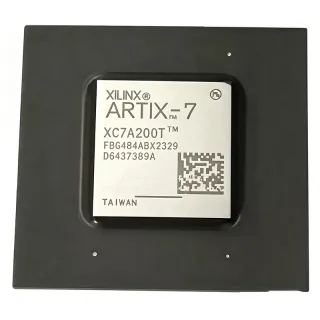
EP4CE30F23I7N - 28,848 LEs, 1.2V Cyclone IV E FPGA | Altera
MPN: EP4CE30F23I7N ✓ نشطEP4CE30F23I7N نظرة عامة
An FPGA is a programmable semiconductor in which the logic fabric and configurable input/output resources can be programmed after manufacture. The Cyclone IV E family combines programmable logic blocks, fixed or soft DSP resources, embedded memory, and general-purpose I/O in a single device. This hierarchy places the EP4CE30F23I7N within programmable logic, digital logic ICs, and the broader FPGA and CPLD category.
The device provides 180 logic array blocks according to the Cyclone IV E comparison data, a maximum operating frequency of 200 MHz, and a 1.2 V operating supply. Its 28,848 logic elements support parallel control, protocol handling, data acquisition, and algorithmic pipelines, while 328 user I/O provide connections to external memory, converters, transceivers, sensors, and industrial interfaces. The industrial-grade ordering option supports designs requiring extended-temperature-oriented industrial qualification.
The EP4CE30F23I7N uses an FBGA-484 package, making careful PCB layout essential. Dense ball pitch requires short escape routes, controlled impedance for high-speed interfaces, multiple ground and supply connections, and adequate thermal spreading beneath the device. The package is listed in tray packaging for this ordering configuration.
Typical uses include programmable industrial controllers, camera and image-processing pipelines, communications gateways, motor-control systems, and low-power embedded test equipment. Designers should verify the voltage requirements, pin allocation, configuration method, clocking resources, and supported I/O standards in the manufacturer Cyclone IV E documentation before schematic capture and PCB release.
A key implementation consideration is that FPGA board design is not interchangeable with ordinary fixed-function IC design. Configuration pins, auxiliary supply rails, decoupling, clock jitter tolerance, and JTAG access must be planned together. Keep sensitive interfaces away from high-speed switching nodes and preserve the Cyclone IV E power and ground-plane topology shown in the manufacturer reference material.
This page combines the exact ordering-number attributes, sourcing structure, and practical implementation considerations for engineers evaluating the EP4CE30F23I7N, including package constraints, FPGA-specific design guidance, and clearly qualified replacement analysis.
بدائل مباشرة لـ EP4CE30F23I7N — نفس الحزمة، متوافق دبوس بدبوس. تُستثنى القطع ذات الحزم المختلفة التي تتطلب تعديل PCB.
الطرازات في هذه السلسلة
طرازات من نفس السلسلة متوافقة تمامًا مع EP4CE30F23I7N (نفس عامل الشكل والبصمة) — يختلف في Logic Elements, Package, Core Voltage, RoHS Status, Embedded Memory Bits.
EP4CE30F23I7
✅ بديل مباشر📋 بديل مرجعي (غير موجود في الكتالوج)
EP4CE30F23C7N
✅ بديل مباشرتواصل لمعرفة السعر
عرض ورقة البيانات ←EP4CE30F23C7N
✅ بديل مباشرتواصل لمعرفة السعر
عرض ورقة البيانات ←EP4CE30F23C6
✅ بديل مباشر📋 بديل مرجعي (غير موجود في الكتالوج)
EP4CE30F23A7N
✅ بديل مباشر📋 بديل مرجعي (غير موجود في الكتالوج)
EP4CE30F23I7N الحدود القصوى والخصائص الكهربائية
| Device Type | Field Programmable Gate Array (FPGA) |
| FPGA Family | Cyclone IV E |
| Logic Elements | 28,848 logic elements |
| Logic Array Blocks | 180 LABs |
| User I/O Pins | 328 I/O pins |
| Package Type | FBGA-484 |
| Total Package Pins | 484 pins |
| جهد التغذية التشغيلي | 1.2 V |
| Maximum Operating Frequency | 200 MHz |
| Product Type | FPGA - Field Programmable Gate Array |
| Temperature Grade | Industrial grade |
| نوع التركيب | Surface mount |
| Packaging | Tray |
| Moisture Sensitivity | Moisture sensitive |
| Factory Pack Quantity | 60 units |
| Subcategory | Programmable Logic ICs |
دليل تكوين أطراف EP4CE30F23I7N 484 pins
تكوين الأطراف لـ EP4CE30F23I7N (حزمة 484 pins). تتضمن هذه الدائرة المتكاملة الرقمية GPIO وواجهات الاتصال (UART وSPI وI2C) وأطراف الطاقة. راجع ورقة بيانات الشركة المصنعة لوظائف الأطراف البديلة وخيارات التكوين. ضرورية لتصميم الأنظمة المدمجة وتخطيط PCB.

لا تتوفر بيانات مفصلة لمخطط التوصيلات لـ EP4CE30F23I7N.
راجع ورقة البيانات للحصول على تكوين الأطراف الكامل.
التطبيقات النموذجية
EP4CE30F23I7N مناسب لـ 6 التطبيقs: Industrial Automation Controller, Communications Gateway, Data Acquisition and Signal Processing, Motor Control and Power Management, Video and Image Processing Pipeline, Embedded Test and Measurement.
Industrial Automation Controller
The EP4CE30F23I7N fits industrial automation controllers that coordinate sensors, actuators, interlocks, and machine sequencing. Its 28,848 logic elements and 180 logic array blocks provide substantial parallel processing capacity, while 328 I/O allow multiple digital interfaces to coexist on one controller. The 200 MHz maximum operating frequency supports event-driven and moderately timed control logic. Use the industrial-grade ordering option for suitable temperature requirements, and isolate external field wiring to protect the FPGA from industrial transients and ground potential differences.
موصى به
Communications Gateway
The EP4CE30F23I7N can implement protocol conversion, packet framing, and interface bridging in communications equipment. Its 180 logic array blocks allow parallel datapaths to be combined with finite-state-machine control, while 328 I/O provide connectivity for serial links, status signals, and memory interfaces. The 1.2 V core architecture suits modern digital subsystems, but the board must separate high-speed transceiver supplies from FPGA core rails and follow Cyclone IV E decoupling and grounding guidance.
موصى به
Data Acquisition and Signal Processing
The EP4CE30F23I7N is suitable for data-acquisition front ends that combine parallel sampling, digital filtering, buffering, and control functions in one programmable device. Its 28,848 logic elements can implement fixed-latency pipelines or parallel processing stages, and 328 I/O supports converters, memory devices, triggers, and synchronization signals. At a 200 MHz maximum operating frequency, timing closure and I/O standards must be checked against the selected Cyclone IV E speed grade and external component timing.
موصى به
Motor Control and Power Management
The EP4CE30F23I7N can serve as the digital control core for motor drives, power-conversion equipment, and sequencing systems. Parallel logic resources support PWM generation, fault handling, current-command processing, and communication protocols, while the 328 I/O pins permit simultaneous connection to gate drivers, position sensors, and supervisory controllers. The FPGA does not directly solve analog power-stage requirements, so current sensing, isolation, gate-drive timing, and fail-safe behavior must be validated separately.
موصى به
Video and Image Processing Pipeline
The EP4CE30F23I7N can implement parallel image acquisition, pixel manipulation, thresholding, and interface conversion where a fixed-function processor would be less flexible. The 28,848 logic elements support concurrent pipelines, while 328 I/O provide connections for image sensors, memory, and downstream processing devices. Practical deployments must ensure that supported I/O standards, clocking resources, and external memory timing match the design; otherwise, additional interface devices or a higher-density FPGA may be required.
موصى به
Embedded Test and Measurement
The EP4CE30F23I7N is well suited to programmable test logic because its logic fabric can implement timing generators, sequencing engines, pattern processors, and communication adapters. Its 1.2 V core supply and 200 MHz maximum operating frequency support digital logic up to the limits established by the selected speed grade and I/O configuration. The FBGA-484 package is appropriate for dense instrumentation, but test-equipment designs should carefully budget power, thermal performance, clock jitter, and differential I/O implementation.
موصى به
ملخص المنتجات الموصى بها
بيانات مرجعية هندسية لـ EP4CE30F23I7N — المقارنة وإرشادات التصميم ومعلومات الامتثال.
دليل الاختيار
المقارنة مع البدائل
| المعامل | هذا المنتج |
|---|---|
| Package | FBGA-484 |
| Brand | Altera |
| FPGA Family | Cyclone IV E |
| Logic Elements | 28,848 |
| Logic Array Blocks | 180 LABs |
| User I/O Pins | 328 I/O pins |
| Operating Supply Voltage | 1.2 V |
| Maximum Operating Frequency | 200 MHz |
| Temperature Grade | Industrial grade |
| Factory Pack Quantity | 60 units |
| Mounting Type | Surface mount |
| Moisture Sensitivity | Moisture sensitive |
أبرز الفروقات
- High logic capacity within the Cyclone IV E F23 device (مقابلEP4CE30F23C7N)
- Dense connectivity in a single FBGA-484 device (مقابلEP4CE30F23C8)
- Industrial-oriented ordering configuration (مقابلEP4CE30F23A7N)
ملاحظات التصميم
Design the FBGA-484 escape routing and power distribution from the manufacturer package drawing rather than estimating pad geometry. Keep high-speed nets short and continuous, provide multiple connections to the appropriate ground and supply planes, and place decoupling capacitors close to their intended power pins. The 484-pin package requires multilayer-board planning, and a manufacturing-capable design should be checked for via-in-pad, solder-mask, and assembly requirements before release.
Treat the 1.2 V core supply as one part of a complete FPGA power tree. Configuration, I/O banks, auxiliary rails, and external interface devices may require separate voltage planning. Derive worst-case current from the selected Cyclone IV E resource utilization and operating mode, then apply the manufacturer sequencing guidance. Add sufficient bulk and high-frequency decoupling and verify startup behavior across the expected input-voltage range before schematic sign-off.
Estimate the FBGA junction-temperature rise from total FPGA dissipation, board thermal resistance, airflow, and the temperature grade. Start with a conservative thermal budget using the actual logic, memory, and I/O utilization because published maximum frequency alone does not define real operating power. Use copper spreading under the package where the board stack-up permits it and monitor the design at the highest expected ambient temperature. Any estimate should remain separate from manufacturer performance limits.
Use the Cyclone IV E I/O standards, timing constraints, and board-design guidelines to select termination, series resistance, and topology. Account for clock jitter, skew, package delay, and external-interface timing rather than relying only on the 200 MHz device frequency. Keep sensitive clocks and interfaces away from switching nodes, and validate edge rates, return paths, and impedance-controlled structures with the intended PCB stack-up.
معلومات الامتثال
The available product information identifies the device as industrial grade but does not provide explicit RoHS, REACH, lead-free, halogen-free, or conflict-minerals statements.