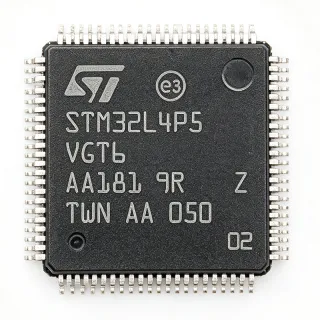
STM32F730V8T6 - 216MHz Cortex-M7 64KB Flash MCU | STMicroelectronics
MPN: STM32F730V8T6 ✓ نشطSTM32F730V8T6 نظرة عامة
A microcontroller is a programmable system-on-chip that integrates a CPU core, flash memory, RAM, and peripherals onto a single die. In the product hierarchy, an MCU contains a processor core, and the STM32F7 line belongs to the STM32 family of 32-bit ARM-based microcontrollers used across industrial, consumer, and automotive-adjacent designs. The STM32F730V8T6 specifically targets designs that need DSP-class math, FPU acceleration, and a rich set of communication peripherals in a cost-effective 100-pin package.
Key features of this device include the 216 MHz Cortex-M7 core with single-precision FPU and DSP instructions, 64 KB of Flash for firmware storage, and a peripheral set that includes CAN, LIN, and USB interfaces as noted in the distributor and product listing data. The part is offered in the industrial temperature grade as the T6 suffix indicates, with a T7 variant covering the extended 105C range. Because the device is specified with a 100-LQFP 14x14 mm body, it suits mainstream external-component designs rather than fine-pitch BGA boards.
Technically, the STM32F730 device line sits between the STM32F7 high-performance family and cost-optimized F7 derivatives, retaining the 216 MHz maximum clock while trimming memory versus larger F7 parts. Its balanced combination of processing throughput, general-purpose timers, and serial connectivity makes it common in motor control, industrial communication gateways, and USB-connected peripherals.
Typical applications include USB-to-serial and USB-to-CAN interface modules, industrial sensor nodes and RS-485/CAN gateways, motor and stepper control boards, audio and general DSP front-ends, and USB-connected human-interface devices.
One key design consideration is that STM32F7 devices are designed to run at 216 MHz with a specific supply range and clock-tree configuration; consult the manufacturer datasheet for the exact voltage window and decoupling requirements before committing the PCB.
This page consolidates distributor pricing, verified package and core specifications, drop-in alternatives, and practical design notes into a single engineering reference that is not duplicated on standard distributor product pages.
بدائل مباشرة لـ STM32F730V8T6 — نفس الحزمة، متوافق دبوس بدبوس. تُستثنى القطع ذات الحزم المختلفة التي تتطلب تعديل PCB.
الطرازات في هذه السلسلة
طرازات من نفس السلسلة متوافقة تمامًا مع STM32F730V8T6 (نفس عامل الشكل والبصمة) — يختلف في Package, Flash Memory.
STM32F730V8T7
✅ بديل مباشر📋 بديل مرجعي (غير موجود في الكتالوج)
STM32F732V8T6
✅ بديل مباشر ⚠️ مواصفات غير مُتحقق منها📋 بديل مرجعي (غير موجود في الكتالوج)
STM32F733V8T6
✅ بديل مباشر ⚠️ مواصفات غير مُتحقق منها📋 بديل مرجعي (غير موجود في الكتالوج)
STM32F746VET6
✅ بديل مباشر ⚠️ مواصفات غير مُتحقق منهاتواصل لمعرفة السعر
عرض ورقة البيانات ←STM32F767VIH6
✅ بديل مباشر ⚠️ مواصفات غير مُتحقق منهاتواصل لمعرفة السعر
عرض ورقة البيانات ←STM32F730V8T6 الحدود القصوى والخصائص الكهربائية
| Core Processor | Arm Cortex-M7 with FPU and DSP instructions |
| Bit Width | 32-bit RISC |
| Maximum CPU Frequency | 216 MHz |
| Flash Memory Size | 64 KB (64K x 8) |
| العلبة | 100-LQFP (14x14 mm) |
| Number of I/O Pins | 100 |
| نوع التركيب | Surface Mount |
| نوع الواجهة | CAN / LIN / USB |
| Application Category | High-performance & DSP with FPU |
| Temperature Grade Code | T6 (industrial, -40C to +85C) |
| نطاق درجة حرارة التشغيل | -40C to +85C (T6 grade) |
| حالة RoHS | Compliant |
| REACH Status | Compliant |
دليل تكوين أطراف STM32F730V8T6 100-lqfp (14x14 mm)
تكوين الأطراف لـ STM32F730V8T6 (حزمة 100-lqfp (14x14 mm)). تتضمن هذه الدائرة المتكاملة الرقمية GPIO وواجهات الاتصال (UART وSPI وI2C) وأطراف الطاقة. راجع ورقة بيانات الشركة المصنعة لوظائف الأطراف البديلة وخيارات التكوين. ضرورية لتصميم الأنظمة المدمجة وتخطيط PCB.

لا تتوفر بيانات مفصلة لمخطط التوصيلات لـ STM32F730V8T6.
راجع ورقة البيانات للحصول على تكوين الأطراف الكامل.
التطبيقات النموذجية
STM32F730V8T6 مناسب لـ 6 التطبيقs: USB-to-CAN and USB-to-LIN Interface Gateways, Industrial Sensor Node with CAN Backbone, Motor and Stepper Motion Control, USB Human Interface and Configuration Dongles, Audio and DSP Front-End Control, Battery-Powered Portable Data Acquisition Unit.
USB-to-CAN and USB-to-LIN Interface Gateways
The STM32F730V8T6 fits gateway designs that must bridge a USB host to an industrial CAN or LIN network. Its 216 MHz Arm Cortex-M7 core with hardware FPU handles protocol framing, filtering, and buffering well beyond what a 72 MHz Cortex-M3 can sustain, while the confirmed CAN, LIN, and USB interfaces remove the need for external transceivers at the digital side. The 100-LQFP 14x14 mm outline gives roughly 100 usable I/O for status LEDs, configuration straps, and discrete logic. Compared with a Cortex-M4 at 120 MHz, the extra clock headroom shortens worst-case USB full-speed frame latency and leaves core time for diagnostics logging over the same bus.
موصى به
Industrial Sensor Node with CAN Backbone
For distributed sensing, the STM32F730V8T6 provides the compute needed to run filtering and compensation close to the sensor rather than pushing raw data over the network. The 216 MHz Cortex-M7 with single-precision FPU accelerates digital filter and least-squares routines, and 64 KB of Flash is adequate for a compact acquisition plus protocol stack. Its 100-LQFP 14x14 mm package keeps the board footprint comparable to the 64-pin alternatives while exposing more I/O for multiple sensor channels, alarm lines, and isolated digital inputs. The T6 industrial grade supports -40C to +85C operation, matching typical enclosure environments.
موصى به
Motor and Stepper Motion Control
The STM32F730V8T6 targets compact stepper and BLDC motion controllers where PWM resolution and control-loop determinism matter. At 216 MHz with dedicated DSP instructions and FPU, the core computes current-loop and position-loop math with lower latency than typical Cortex-M4 solutions, which helps suppress audible torque ripple and reduce following error. The 100-LQFP 14x14 mm package provides the timer and encoder-capture channels needed for multiple axes on a single controller board. A practical trade-off is that 64 KB of Flash limits how much of the stack you can host, so complex motion libraries should be sized before layout is frozen.
موصى به
USB Human Interface and Configuration Dongles
The STM32F730V8T6 suits USB-connected control dongles, configurators, and diagnostic adapters that pair a fast host link with modest local processing. Full-speed USB handling plus a 216 MHz core means the device can parse command frames and run a small state machine without a separate co-processor, and the 64 KB Flash budget is enough for a bootloader plus application. The 100-LQFP 14x14 mm package offers ample I/O for rotary encoders, status LEDs, and button handling while remaining a standard lead-pitch assembly. Compared with an 8-pin or 32-pin option, the larger outline costs board area but removes the need for an I/O expander.
موصى به
Audio and DSP Front-End Control
In audio-adjacent control boards, the STM32F730V8T6's Cortex-M7 with single-precision FPU and DSP instructions performs real-time equalisation, mixing, and envelope computation without an external DSP. The 216 MHz clock allows several fixed-point or floating-point channels of filtering to run concurrently alongside USB or CAN housekeeping. Because the device is a microcontroller rather than a signal-chain part, an external codec handles the analogue stage, while the MCU owns volume control, tone shaping, and metering. Its 64 KB Flash supports a moderate control application but not large audio buffers, so heavy storage should be placed in external memory.
موصى به
Battery-Powered Portable Data Acquisition Unit
Portable acquisition and test-and-measurement instruments benefit from the STM32F730V8T6 because the Cortex-M7 core delivers high arithmetic throughput at 216 MHz while the 100-LQFP 14x14 mm package keeps the board compact enough for handheld formats. The high-performance core shortens acquisition and Fourier-analysis cycles, so a handheld unit can complete a sweep before the operator loses patience. Working alongside a precision converter and reference, the MCU handles calibration tables and UI state management. The honest trade-off is that the 64 KB Flash limit pushes large waveform storage to an external SPI flash, and the LQFP-100 outline is larger than a QFN option.
موصى به
ملخص المنتجات الموصى بها
بيانات مرجعية هندسية لـ STM32F730V8T6 — المقارنة وإرشادات التصميم ومعلومات الامتثال.
دليل الاختيار
المقارنة مع البدائل
| المعامل | هذا المنتج | STM32F730V8T7 | STM32F732V8T6 | STM32F733V8T6 | STM32F746VET6 | STM32F767VIH6 |
|---|---|---|---|---|---|---|
| Package | 100-LQFP (14x14) | 100-LQFP (14x14) - same | 100-LQFP (14x14) - same | 100-LQFP (14x14) - same | 100-LQFP (14x14) - same | 100-LQFP (14x14) - same |
| Brand | STMicroelectronics | STMicroelectronics | STMicroelectronics | STMicroelectronics | STMicroelectronics | STMicroelectronics |
| CPU Core | Arm Cortex-M7 | Arm Cortex-M7 | Arm Cortex-M7 | Arm Cortex-M7 | Arm Cortex-M7 | Arm Cortex-M7 |
| Maximum Frequency | 216 MHz | 216 MHz | 216 MHz | 216 MHz | 216 MHz | 216 MHz |
| Flash Memory | 64 KB (64K x 8) | 64 KB | 64 KB | 256 KB | 512 KB | 512 KB |
| Temperature Grade | -40C to +85C (T6) | -40C to +105C (T7) | -40C to +85C | -40C to +85C | -40C to +85C | -40C to +85C |
| Serial Interfaces | CAN / LIN / USB | CAN / LIN / USB | CAN / LIN / USB | CAN / LIN / USB plus expanded set | Expanded set including SDMMC and display interfaces | Expanded set including Ethernet and camera interfaces |
أبرز الفروقات
- Same-package temperature-grade option with identical core, Flash and pinout (مقابلSTM32F730V8T7)
- Cost-optimised Cortex-M7 at the same speed in the same footprint (مقابلSTM32F732V8T6)
- Memory headroom without a PCB change (مقابلSTM32F733V8T6)
- Connectivity upgrade path on the same footprint (مقابلSTM32F767VIH6)
ملاحظات التصميم
The STM32F730V8T6 runs from a single low-voltage supply rail and draws substantial current at 216 MHz with the FPU and DSP pipelines active. Provide dedicated local decoupling on every VDD pin using 100 nF ceramic capacitors placed within a few millimetres of each pad, plus a bulk 4.7 uF to 10 uF reservoir capacitor close to the device. Estimated: at 3.3 V and roughly 120 mA average running current with peripherals active, dissipation is about 0.4 W, which is a design estimate rather than a datasheet figure. Keep the supply decoupled from switching converter outputs and check the datasheet's supply voltage window against your chosen operating frequency.
At 216 MHz with the cache and active I/O, junction temperature becomes a real constraint in sealed enclosures. Estimated: at 3.3 V supply and 120 mA average core current, junction power dissipation is roughly 0.4 W; with a typical LQFP-100 theta_JA near 30 C/W on a 2-layer board that is about 12C of rise, but a small copper pour or cramped enclosure can push it much higher. Increase the poured copper area under and around the device, keep the LQFP thermal pad region clear of thermal vias unless the land pattern calls for them, and prefer the STM32F730V8T7 grade if the ambient can exceed 85C.
The 100-LQFP 14x14 mm outline gives a 0.5 mm lead pitch, which is comfortable for standard reflow assembly but still demands careful escape routing for the many VDD and VSS pins on the perimeter. Route each decoupling capacitor directly to its own supply pin rather than daisy-chaining through a shared rail segment, and place a via immediately beside each ground pin connection to minimise inductance in the return path. Keep the crystal or clock source and the decoupling network within about 10 mm of the device and keep the area under the package free of copper-crowding features that would trap heat.
The 216 MHz core makes board-level signal integrity a first-order concern: edge rates are far faster than the clock frequency and any long trace between the MCU and the crystal, ADC front end, or external memory can behave as an antenna or a resonator. Keep the 8 MHz or higher-frequency oscillator circuit compact and fully ground-referenced, and avoid routing high-speed clock or debug signals adjacent to antenna or switching-supply routing. Where the MCU drives external connectors such as USB or CAN through an isolation or transceiver stage, match the differential pair over the full run and provide the common-mode and termination network that the transceiver datasheet recommends.
Two substitution errors dominate this part. First, do not confuse the T6 and T7 temperature grades; they are identical silicon with different rating, so a T7 fitted where a T6 was specified is safe but a T6 fitted where a T7 was specified is not. Second, do not treat the STM32F733, STM32F746, and STM32F767 options as transparent upgrades. Although they share the same LQFP-100 14x14 mm footprint and the same Cortex-M7 core at 216 MHz, their Flash sizes and peripheral sets differ, so confirm the pin states of unused pins and re-verify the memory map and startup code before production release.
معلومات الامتثال
RoHS and REACH compliance are reported for the STM32F730V8T6 in distributor comparison data; the industrial T6 grade is not an automotive-qualified variant, so AEC-Q100 status is listed as unknown rather than assumed. Lead-free and halogen-free declarations were not present in the retrieved sources.