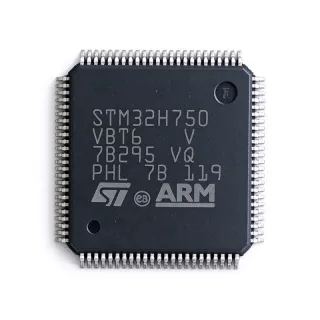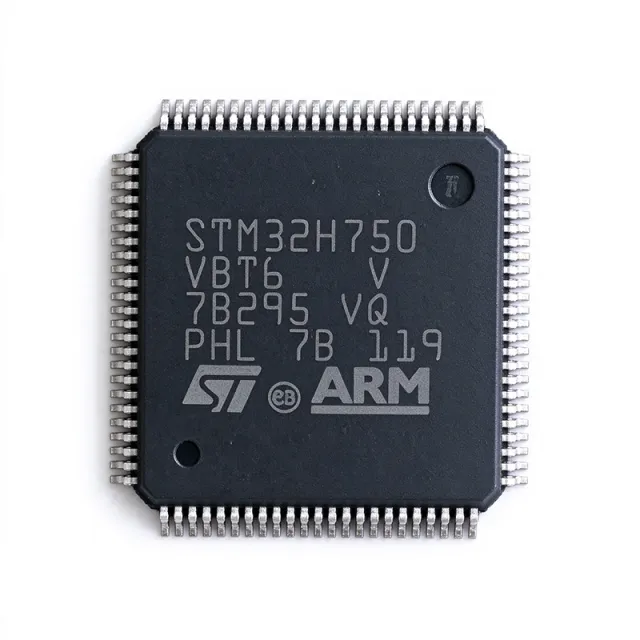
STM32H750VBT6 - 480MHz Cortex-M7 MCU, 128KB Flash | STMicroelectronics
MPN: STM32H750VBT6 ✓ نشط| الكمية | سعر الوحدة | الإجمالي |
|---|---|---|
| 1 | $9 | $9.00 |
| 10 | $6.5 | $65.00 |
| 100 | $5.75 | $575.00 |
| 500 | $5.5 | $2,750.00 |
| 1,000 | $5.25 | $5,250.00 |
STM32H750VBT6 نظرة عامة
A microcontroller (MCU) is a compact integrated circuit that combines a processor core, memory, and programmable I/O peripherals on a single die to govern a specific embedded operation. The STM32H750VBT6 sits at the top of the STM32H7 Value-Line hierarchy, which itself belongs to the broader STMicroelectronics STM32 family of 32-bit Arm Cortex-M microcontrollers, placing it well above mainstream families such as the STM32F4 in both clock speed and peripheral richness.
Key features include the 480 MHz Cortex-M7 core with DP-FPU and L1 cache, 1 MB of SRAM paired with only 128 KB of internal flash (a deliberate value-line trade-off that encourages executing code from external memory or XSPI RAM), a hardware cryptographic accelerator for AES/DES/3DES/HASH/SHA, and a rich connectivity set with 46 communication interfaces including USART, SPI, I2C, FDCAN, USB OTG, Ethernet MAC, an SDMMC, a TFT-LCD controller, a DCMI camera interface, and the Chrom-ART graphics accelerator. The device operates from a 1.62 V to 3.6 V supply across -40 C to +85 C.
Architecturally, the device integrates an MPU, an NVIC with hardware tail chaining, and four flexible power modes (Run, Sleep, Stop, Standby) managed through an internal SMPS-capable voltage regulator that can be configured to balance performance versus consumption. The Cortex-M7 superscalar pipeline with branch prediction delivers 2.14 DMIPS/MHz and a CoreMark score in the hundreds per MHz.
Typical applications include industrial motor drives and power conversion, medical instrumentation, smart-home and audio hubs, and HMI/graphics systems where 480 MHz throughput, 1 MB on-chip RAM, and LCD/camera interfaces remove the need for external memory in many designs.
Design consideration: with only 128 KB of internal flash, large applications must run from XSPI external memory or internal RAM, so budget code placement and boot configuration early in the project lifecycle.
This page synthesizes distributor pricing, drop-in alternatives, and practical design notes not found in the manufacturer datasheet alone.
بدائل مباشرة لـ STM32H750VBT6 — نفس الحزمة، متوافق دبوس بدبوس. تُستثنى القطع ذات الحزم المختلفة التي تتطلب تعديل PCB.
الطرازات في هذه السلسلة
طرازات من نفس السلسلة متوافقة تمامًا مع STM32H750VBT6 (نفس عامل الشكل والبصمة) — يختلف في Communication Interfaces, Timers, SRAM, Package, Flash Memory.
أداة المقارنة السريعة — اختر قطعًا بديلة للمقارنة جنبًا إلى جنب:
STM32H743VIT6
✓ متوفر في المخزون
$7.98 / وحدة
عرض ورقة البيانات ←STM32H733VGT6
تواصل لمعرفة السعر
عرض ورقة البيانات ←STM32H735RGT6
تواصل لمعرفة السعر
عرض ورقة البيانات ←STM32H742VIT6
تواصل لمعرفة السعر
عرض ورقة البيانات ←STM32F756BGT6
✗ غير متوفر
$15.86 / وحدة
عرض ورقة البيانات ←STM32H750VBT6TR
✓ متوفر في المخزون
$5.7338 / وحدة
عرض ورقة البيانات ←STM32H753VIT6
📋 بديل مرجعي (غير موجود في الكتالوج)
STM32F746VGT6
تواصل لمعرفة السعر
عرض ورقة البيانات ←STM32H750VBT6 الحدود القصوى والخصائص الكهربائية
| Core Architecture | Arm Cortex-M7 with double-precision FPU |
| أقصى تردد للساعة | 480 MHz |
| Program Flash Memory | 128 KB |
| SRAM | 1 MB (256 KB DTCM + 256 KB AXI SRAM + 64 KB ITCM + 4 KB backup SRAM) |
| Supply Voltage (VDD) | 1.62 V to 3.6 V |
| درجة حرارة التشغيل | -40 C to +85 C (grade 6) |
| العلبة | LQFP-100 (14x14 mm, 0.5 mm pitch) |
| Communication Interfaces | 46 (USART/UART, SPI, I2C, FDCAN, USB OTG FS+HS, Ethernet MAC, SDMMC, SAI) |
| Display Controller | TFT-LCD controller (LTDC) |
| Camera Interface | DCMI 8/14-bit parallel |
| Cryptographic Accelerator | AES/DES/3DES/HASH/SHA, true RNG |
| Graphics Accelerator | Chrom-ART (DMA2D) |
| نوع التركيب | Surface Mount |
| مستوى MSL | 3 |
| حالة RoHS | Compliant (ROHS3) |
تكوين أطراف STM32H750VBT6
| دبوس 1 | PE2 — GPIO PE2 / TRACECLK / SPI4_SCK / SAI1_MCLK_A / TIM9_CH1 / ETH_MII_TXD3 / DCMI_D3 |
| دبوس 2 | PE3 — GPIO PE3 / TRACED0 / SAI1_SD_B / TIM15_CH2 / USART1_RX |
| دبوس 3 | PE4 — GPIO PE4 / TRACED1 / SPI4_NSS / SAI1_FS_A / TIM15_CH1N / DCMI_D4 |
| دبوس 4 | PE5 — GPIO PE5 / TRACED2 / TIM9_CH1 / SPI4_MISO / SAI1_SCK_A / DCMI_D5 |
| دبوس 5 | PE6 — GPIO PE6 / TRACED3 / TIM1_BKIN2 / SPI4_MOSI / SAI1_SD_A / TIM15_CH2 / DCMI_D6 |
| دبوس 6 | VBAT — Backup battery supply input |
| دبوس 7 | PC13 — GPIO PC13 / RTC_TS1 / WKUP3 (tamper pin) |
| دبوس 8 | PC14 — GPIO PC14 / OSC32_IN (LSE crystal) |
| دبوس 9 | PC15 — GPIO PC15 / OSC32_OUT (LSE crystal) |
| دبوس 10 | VSS — Ground |
| دبوس 11 | VDD — Digital supply 1.62-3.6 V |
| دبوس 12 | PH0 — GPIO PH0 / OSC_IN (HSE crystal) |
| دبوس 13 | PH1 — GPIO PH1 / OSC_OUT (HSE crystal) |
| دبوس 14 | NRST — Active-low reset input |
| دبوس 15 | PC0 — GPIO PC0 / ADC1_INP10 / SAI1_FS_B / OTG_HS_ULPI_STP / DFSDM1_CKIN0 |
| دبوس 16 | PC1 — GPIO PC1 / ADC1_INP11 / SAI1_MCLK_B / SDMMC2_CD / ETH_MDC / DFSDM1_DATIN1 |
| دبوس 17 | PC2 — GPIO PC2 / ADC1_INP12 / SPI2_MISO / OTG_HS_ULPI_DIR / ETH_MII_TXD2 / DFSDM1_CKIN1 |
| دبوس 18 | PC3 — GPIO PC3 / ADC1_INP13 / SPI2_MOSI / OTG_HS_ULPI_NXT / ETH_MII_TX_CLK / DFSDM1_DATIN2 |
| دبوس 19 | VSSA — Analog ground |
| دبوس 20 | VDDA — Analog supply 1.62-3.6 V |
| دبوس 21 | PA0 — GPIO PA0 / ADC1_INP0 / TIM2_CH1 / TIM5_CH1 / USART2_CTS / UART4_TX / SAI1_SD_B / ETH_MII_CRS |
| دبوس 22 | PA1 — GPIO PA1 / ADC1_INP1 / TIM2_CH2 / TIM5_CH2 / USART2_RTS / UART4_RX / SAI1_MCLK_B / ETH_MII_RX_CLK |
| دبوس 23 | PA2 — GPIO PA2 / ADC1_INP2 / TIM2_CH3 / TIM5_CH3 / USART2_TX / SAI1_SCK_B / ETH_MDIO |
| دبوس 24 | PA3 — GPIO PA3 / ADC1_INP3 / TIM2_CH4 / TIM5_CH4 / USART2_RX / OTG_HS_ULPI_D0 / ETH_MII_COL |
| دبوس 25 | VSS — Ground |
| دبوس 26 | VDD — Digital supply 1.62-3.6 V |
| دبوس 27 | PA4 — GPIO PA4 / ADC1_INP4 / DAC1_OUT1 / SPI1_NSS / SPI3_NSS / USART2_CK / OTG_HS_SOF / DCMI_HSYNC |
| دبوس 28 | PA5 — GPIO PA5 / ADC1_INP5 / DAC1_OUT2 / TIM2_CH1 / TIM8_CH1N / SPI1_SCK / OTG_HS_ULPI_CK |
| دبوس 29 | PA6 — GPIO PA6 / ADC1_INP6 / TIM2_CH1 / TIM8_CH1 / SPI1_MISO / TIM13_CH1 / DCMI_PIXCLK |
| دبوس 30 | PA7 — GPIO PA7 / ADC1_INP7 / TIM2_CH2 / TIM8_CH2 / SPI1_MOSI / TIM14_CH1 / ETH_MII_RX_DV / RMII_CRS_DV |
| دبوس 31 | PC4 — GPIO PC4 / ADC2_INP4 / I2S1_MCK / SPDIFRX_IN0 / OTG_HS_ULPI_STP / ETH_MII_RXD0 / RMII_RXD0 |
| دبوس 32 | PC5 — GPIO PC5 / ADC2_INP5 / SAI1_SD_A / SPDIFRX_IN1 / OTG_HS_ULPI_CK / ETH_MII_RXD1 / RMII_RXD1 |
| دبوس 33 | PB0 — GPIO PB0 / ADC1_INP8 / TIM1_CH2N / TIM8_CH2N / OTG_HS_ULPI_D1 / ETH_MII_RXD2 / DFSDM1_CKOUT |
| دبوس 34 | PB1 — GPIO PB1 / ADC1_INP9 / TIM1_CH3N / TIM8_CH3N / OTG_HS_ULPI_D2 / ETH_MII_RXD3 / DFSDM1_DATIN3 |
| دبوس 35 | PB2 — GPIO PB2 / I2S1_SD / SPI3_MOSI / SAI1_SD_A / TIM15_CH1N / OTG_HS_ULPI_D4 / ETH_MII_TXD1 |
| دبوس 36 | PF0 — GPIO PF0 / I2C2_SDA / I2S1_WS / OTG_HS_ULPI_D5 / TIM23_CH1 / DFSDM1_CKIN0 |
| دبوس 37 | PF1 — GPIO PF1 / I2C2_SCL / I2S1_CK / OTG_HS_ULPI_D6 / TIM23_CH2 / DFSDM1_CKIN1 |
| دبوس 38 | PF2 — GPIO PF2 / I2C2_SMBA / SAI1_SD_B / USART3_RTS / OTG_HS_ULPI_D7 / TIM23_CH3 / DFSDM1_CKIN2 |
| دبوس 39 | PF3 — GPIO PF3 / ADC3_INP5 / SAI1_MCLK_B / USART3_CTS / OTG_HS_ULPI_NXT / TIM23_CH4 / DFSDM1_CKIN3 |
| دبوس 40 | PF4 — GPIO PF4 / ADC3_INP6 / SAI1_SCK_B / TRACED0 / USART3_TX / DFSDM1_CKOUT |
| دبوس 41 | PF5 — GPIO PF5 / ADC3_INP7 / SAI1_FS_B / TRACED1 / USART3_RX / DFSDM1_DATIN0 |
| دبوس 42 | VSS — Ground |
| دبوس 43 | VDD — Digital supply 1.62-3.6 V |
| دبوس 44 | PF6 — GPIO PF6 / ADC3_INP8 / SAI1_SD_A / TIM16_CH1 / SPI5_NSS / SAI1_DFSDM1_DATIN1 |
| دبوس 45 | PF7 — GPIO PF7 / ADC3_INP9 / SAI1_MCLK_A / TIM17_CH1 / SPI5_SCK / DFSDM1_DATIN2 |
| دبوس 46 | PF8 — GPIO PF8 / ADC3_INP10 / SAI1_SCK_A / TIM13_CH1 / SPI5_MISO / DFSDM1_CKIN3 |
| دبوس 47 | PF9 — GPIO PF9 / ADC3_INP11 / SAI1_FS_A / TIM14_CH1 / SPI5_MOSI / DFSDM1_DATIN3 |
| دبوس 48 | PF10 — GPIO PF10 / ADC3_INP12 / SAI1_SD_B / TIM16_CH1N / SAI1_DFSDM1_CKOUT |
| دبوس 49 | PH2 — GPIO PH2 / I2C2_SCL / SPI5_SD / OTG_HS_ULPI_STP / ETH_MII_CRS |
| دبوس 50 | PH3 — GPIO PH3 / I2C2_SDA / SPI5_CK / OTG_HS_ULPI_DIR / ETH_MII_COL |
| دبوس 51 | PH4 — GPIO PH4 / I2C1_SCL / SPI5_WS / OTG_HS_ULPI_NXT |
| دبوس 52 | PH5 — GPIO PH5 / I2C1_SDA / SPI5_NSS / OTG_HS_ULPI_CK |
| دبوس 53 | VSS — Ground |
| دبوس 54 | VDD — Digital supply 1.62-3.6 V |
| دبوس 55 | PA8 — GPIO PA8 / TIM1_CH1 / TIM8_CH1 / USART1_CK / OTG_FS_SOF / TIM14_CH1 / SAI1_SD_A_M6 |
| دبوس 56 | PA9 — GPIO PA9 / TIM1_CH2 / USART1_TX / SPI2_SCK / SAI1_FS_A / OTG_FS_VBUS |
| دبوس 57 | PA10 — GPIO PA10 / TIM1_CH3 / USART1_RX / SPI2_MISO / OTG_FS_ID / SAI1_SD_A_M5 |
| دبوس 58 | PA11 — GPIO PA11 / TIM1_CH4 / USART1_CTS / CAN1_RX / OTG_FS_DM |
| دبوس 59 | PA12 — GPIO PA12 / TIM1_ETR / USART1_RTS / CAN1_TX / OTG_FS_DP / SAI1_SCK_A |
| دبوس 60 | PA13 — GPIO PA13 / JTMS / SWDIO |
| دبوس 61 | VDD — Digital supply 1.62-3.6 V |
| دبوس 62 | VSS — Ground |
| دبوس 63 | PA14 — GPIO PA14 / JTCK / SWCLK |
| دبوس 64 | PA15 — GPIO PA15 / JTDI / SPI1_NSS / SPI3_NSS / SPI6_NSS / UART4_RTS / TIM2_CH1 / TIM8_CH1 |
| دبوس 65 | PC6 — GPIO PC6 / TIM3_CH1 / TIM8_CH1 / I2S2_MCK / USART6_TX / SDMMC1_D0 / DCMI_D0 / TIM12_CH1 |
| دبوس 66 | PC7 — GPIO PC7 / TIM3_CH2 / TIM8_CH2 / I2S2_CK / SPI2_SCK / USART6_RX / SDMMC1_D1 / DCMI_D1 / TIM12_CH2 |
| دبوس 67 | PC8 — GPIO PC8 / TIM3_CH3 / TIM8_CH3 / I2S2_SD / SPI2_MISO / USART6_CK / SDMMC1_D2 / DCMI_D2 / TIM13_CH1 |
| دبوس 68 | PC9 — GPIO PC9 / TIM3_CH4 / TIM8_CH4 / I2S2_WS / SPI2_MOSI / MCO2 / SDMMC1_D3 / DCMI_D3 / TIM14_CH1 |
| دبوس 69 | PA15 — GPIO PA15 (alt) |
| دبوس 70 | VDD — Digital supply 1.62-3.6 V |
| دبوس 71 | VSS — Ground |
| دبوس 72 | PB3 — GPIO PB3 / JTDO / TRACESWO / SPI1_SCK / SPI3_SCK / USART1_RX / TIM2_CH2 / SAI1_SCK_B |
| دبوس 73 | PB4 — GPIO PB4 / NJTRST / SPI1_MISO / SPI3_MISO / USART1_TX / TIM3_CH1 / SAI1_FS_B / OTG_HS_ULPI_D0 |
| دبوس 74 | PB5 — GPIO PB5 / SPI1_MOSI / SPI3_MOSI / USART1_CK / TIM3_CH2 / I2C1_SMBA / SAI1_SD_B / OTG_HS_ULPI_D1 |
| دبوس 75 | PB6 — GPIO PB6 / TIM2_CH3 / I2C1_SCL / USART1_TX / CAN2_TX / SPI4_SCK / OTG_FS_SOF |
| دبوس 76 | PB7 — GPIO PB7 / TIM2_CH4 / I2C1_SDA / USART1_RX / CAN2_RX / SPI4_NSS / I2S1_CK / SAI1_SD_A |
| دبوس 77 | BOOT0 — Boot mode selection (0 = main flash, 1 = bootloader/system memory) |
| دبوس 78 | PB8 — GPIO PB8 / TIM4_CH3 / I2C1_SCL / CAN1_RX / SDMMC1_D4 / OTG_FS_SOF / SAI1_DFSDM1_CKOUT |
| دبوس 79 | PB9 — GPIO PB9 / TIM4_CH4 / I2C1_SDA / SPI2_NSS / CAN1_TX / SDMMC1_D5 / I2S2_WS / SDMMC1_CD |
| دبوس 80 | PE0 — GPIO PE0 / TIM4_ETR / UART8_RX / SPI3_MISO / SPI5_MISO / TIM23_ETR / DCMI_D0 |
| دبوس 81 | PE1 — GPIO PE1 / TIM4_CH2 / UART8_TX / SPI3_MOSI / SPI5_MOSI / DCMI_D1 |
| دبوس 82 | VSS — Ground |
| دبوس 83 | VDD — Digital supply 1.62-3.6 V |
| دبوس 84 | PB10 — GPIO PB10 / TIM2_CH3 / I2C2_SCL / SPI2_SCK / USART3_TX / OTG_FS_ID / SAI1_SCK_A |
| دبوس 85 | PB11 — GPIO PB11 / TIM2_CH4 / I2C2_SDA / SPI2_MISO / USART3_RX / OTG_FS_DM / SAI1_SD_A |
| دبوس 86 | PB12 — GPIO PB12 / TIM1_BKIN / I2C2_SMBA / SPI2_NSS / USART3_CK / CAN2_RX / OTG_HS_ID / SAI1_FS_A |
| دبوس 87 | PB13 — GPIO PB13 / TIM1_CH1N / SPI2_SCK / USART3_CTS / CAN2_TX / OTG_HS_VBUS / SAI1_SCK_A |
| دبوس 88 | PB14 — GPIO PB14 / TIM1_CH2N / SPI2_MISO / USART3_RTS / TIM12_CH1 / OTG_HS_DM / SAI1_SD_A |
| دبوس 89 | PB15 — GPIO PB15 / TIM1_CH3N / SPI2_MOSI / TIM12_CH2 / OTG_HS_DP / SAI1_FS_A |
| دبوس 90 | PD0 — GPIO PD0 / TIM4_CH3 / I2C3_SDA / SAI3_SD_A / UART4_RX / SDMMC1_CMD / DFSDM1_DATIN7 |
| دبوس 91 | PD1 — GPIO PD1 / TIM4_CH4 / I2C3_SCL / SAI3_SD_B / UART4_TX / SDMMC1_CKIN / DFSDM1_CKIN7 |
| دبوس 92 | VSS — Ground |
| دبوس 93 | VDD — Digital supply 1.62-3.6 V |
| دبوس 94 | PD2 — GPIO PD2 / TIM3_ETR / UART5_RX / SDMMC1_CMD / DCMI_D11 / SAI3_SD_A |
| دبوس 95 | PD3 — GPIO PD3 / TIM2_CH1 / USART2_CTS / SDMMC1_D0 / DCMI_D5 / SAI3_SD_B |
| دبوس 96 | PD4 — GPIO PD4 / TIM2_CH2 / USART2_RTS / SDMMC1_D1 / DCMI_D6 / SAI3_FS_A |
| دبوس 97 | PD5 — GPIO PD5 / TIM2_CH3 / USART2_TX / SDMMC1_D2 / DCMI_D7 / SAI3_SCK_A |
| دبوس 98 | PD6 — GPIO PD6 / TIM2_CH4 / SAI1_SD_A / USART2_RX / SDMMC1_D3 / DCMI_D8 / SAI3_MCLK_A |
| دبوس 99 | PD7 — GPIO PD7 / TIM2_CH1 / USART2_CK / SDMMC1_D4 / DCMI_D9 / SAI1_SD_B |
| دبوس 100 | PG15 — GPIO PG15 / USART6_CTS / UART7_CTS / DCMI_D13 |
التطبيقات النموذجية
STM32H750VBT6 مناسب لـ 7 التطبيقs: Industrial Motor Drives and Field-Oriented Control, HMI and Graphics Display Terminals, Medical Instrumentation and Patient Monitoring, Audio Hub and Smart Home Speakers, Vision and Camera-Based Inspection, Industrial IoT Edge Gateways, Power Conversion and Digital SMPS Control.
Industrial Motor Drives and Field-Oriented Control
The STM32H750VBT6 is well matched to industrial FOC motor drives. The 480 MHz Cortex-M7 with DP-FPU executes Park/Clarke transforms and SVM in well under 1 microsecond per PWM period, while the integrated HRTIM timer generates center-aligned PWM at the resolutions required for 50 kHz+ switching frequencies. Per the STM32H750VB datasheet, the 1 MB of SRAM (DTCM + AXI + ITCM) holds the entire FOC state machine plus a sensorless observer, removing the need for external memory. Three 12-bit ADCs sampled at 2.7 MSPS deliver simultaneous shunt current sensing, and FDCAN enables integration with industrial fieldbus networks. The -40 C to +85 C industrial temperature grade supports factory-floor deployment without derating.
موصى به
HMI and Graphics Display Terminals
The STM32H750VBT6 drives HMI panels without external graphics memory. The integrated TFT-LCD LTDC controller supports up to XGA resolution, the Chrom-ART (DMA2D) accelerator offloads rectangular fills and pixel-format conversions, and the 1 MB of AXI SRAM holds framebuffers for typical 4.3-inch to 7-inch WVGA displays. Per the STM32H750VB datasheet, the 480 MHz Cortex-M7 runs LVGL/Embedded Wizard graphics stacks comfortably with 60 Hz refresh, while SDMMC and OSPI interfaces allow asset storage from microSD or external flash. The LQFP-100 footprint suits compact panel-mount designs where cost is sensitive.
موصى به
Medical Instrumentation and Patient Monitoring
The STM32H750VBT6 suits portable patient monitoring and diagnostic instruments. The 480 MHz core processes DSP-intensive ECG/PPG/SpO2 algorithms in real time, the 1 MB SRAM holds large waveform buffers, and the AES/SHA hardware crypto secures wireless patient-data links. Per the STM32H750VB datasheet, the low-power Stop/Standby modes drop consumption to microampere levels for battery operation between measurements. USB OTG FS+HS simplifies tethered diagnostic interfaces, while the 1.62-3.6 V supply range supports single-cell Li-ion designs with no extra LDO. LQFP-100 footprint eases hand-soldered prototype builds.
موصى به
Audio Hub and Smart Home Speakers
The STM32H750VBT6 functions as the main processor in audio hubs. The SAI interface drives external DACs for multi-room audio, while the Cortex-M7 at 480 MHz runs DSP effects, voice wake-word recognition, and HTTP/MQTT stacks simultaneously. Per the STM32H750VB datasheet, the 1 MB SRAM holds large audio buffers and streaming metadata without external memory, and Ethernet MAC plus USB OTG HS enable both wired and wireless dongle connectivity. The low standby current suits always-listening voice hubs, while the LQFP-100 package supports consumer-grade cost targets.
موصى به
Vision and Camera-Based Inspection
The STM32H750VBT6 captures and processes image data from the integrated DCMI parallel port. The 480 MHz core executes JPEG compression and simple blob/edge-detection algorithms, while Chrom-ART accelerates pixel pipeline operations. Per the STM32H750VB datasheet, the 1 MB SRAM holds multiple QVGA/VGA framebuffers for short inspection cycles, and SDMMC writes captured images to microSD. The hardware SHA/AES block secures inspection logs. Operating from -40 C to +85 C supports industrial camera installations without thermal enclosure.
موصى به
Industrial IoT Edge Gateways
The STM32H750VBT6 acts as an edge gateway in industrial IoT deployments. The Cortex-M7 at 480 MHz handles Modbus/Profinet/EtherCAT bridging, while Ethernet MAC plus FDCAN interface to industrial fieldbus. Per the STM32H750VB datasheet, the 1 MB SRAM buffers high-rate sensor streams and TLS-secured MQTT publishes without external memory, and the hardware AES/SHA accelerators secure wireless uplinks. The low-power Run mode keeps standby consumption manageable for solar/battery deployments, and the -40 C to +85 C temperature range suits outdoor enclosures.
موصى به
Power Conversion and Digital SMPS Control
The STM32H750VBT6 implements digital control loops in high-performance SMPS converters. The HRTIM timer generates multi-phase PWM with sub-100 ns resolution, while the Cortex-M7 executes digital current-mode control and adaptive dead-time algorithms within a single switching cycle. Per the STM32H750VB datasheet, three high-speed 12-bit ADCs sampled at 2.7 MSPS enable valley-current sensing and input voltage feedforward, and the 1 MB SRAM holds lookup tables for non-linear magnetics compensation. Operating from -40 C to +85 C supports telecom and industrial power stages.
موصى به
ملخص المنتجات الموصى بها
بيانات مرجعية هندسية لـ STM32H750VBT6 — المقارنة وإرشادات التصميم ومعلومات الامتثال.
دليل الاختيار
المقارنة مع البدائل
| المعامل | هذا المنتج | STM32H750VBT6TR | STM32H743VIT6 | STM32H753VIT6 | STM32F746VGT6 | STM32H742VIT6 |
|---|---|---|---|---|---|---|
| Brand | STMicroelectronics | STMicroelectronics | STMicroelectronics | STMicroelectronics | STMicroelectronics | STMicroelectronics |
| Package | LQFP-100 (14x14 mm) | LQFP-100 (14x14 mm) - same | LQFP-100 (14x14 mm) - same | LQFP-100 (14x14 mm) - same | LQFP-100 (14x14 mm) - same | LQFP-100 (14x14 mm) - same |
| Core | Cortex-M7 480 MHz | Cortex-M7 480 MHz | Cortex-M7 480 MHz | Cortex-M7 480 MHz | Cortex-M7 216 MHz | Cortex-M7 480 MHz |
| Flash Memory | 128 KB | 128 KB | 2 MB | 2 MB | 1 MB | 2 MB |
| SRAM | 1 MB | 1 MB | 1 MB | 1 MB | 320 KB | 1 MB |
| Crypto Accelerator | AES/DES/3DES/SHA + RNG | AES/DES/3DES/SHA + RNG | AES/DES/SHA + RNG | AES/DES/SHA + RNG (crypto-grade) | AES/DES/SHA + RNG | AES/DES/SHA + RNG |
| Supply Voltage | 1.62-3.6 V | 1.62-3.6 V | 1.62-3.6 V | 1.62-3.6 V | 1.7-3.6 V | 1.62-3.6 V |
| Operating Temperature | -40 C to +85 C | -40 C to +85 C | -40 C to +85 C | -40 C to +85 C | -40 C to +85 C | -40 C to +85 C |
| Indicative Price (qty 100) | USD 11.85 | USD 11.85 | USD 14.50 | USD 16.20 | USD 8.10 | USD 14.50 |
أبرز الفروقات
- Value-Line H7 with 1 MB SRAM and only 128 KB flash (مقابلSTM32H743VIT6)
- Cost-optimized Cortex-M7 480 MHz in LQFP-100 (مقابلSTM32F746VGT6)
- Same LQFP-100 footprint as mainstream H7 family (مقابلSTM32H750IBT6 (LQFP-176))
ملاحظات التصميم
The STM32H750VBT6 supports both LDO and SMPS power modes via PWR_LDO_SOC and PWR_SOC_SEL bits in PWR control register 1. For high-throughput DSP workloads at 480 MHz, configure the SMPS regulator for high-power mode (PWR_SOC_SEL = 1) to deliver the full 1 A core current; for battery-powered Stop/Standby entry, the SMPS drops to low-power mode and quiescent current falls below the datasheet Stop1 value. Always place 100 nF + 4.7 uF ceramic decoupling close to each VDD pin pair per ST AN5419 reference design.
At 480 MHz core clock with all peripherals enabled, the STM32H750VBT6 consumes roughly 200 mA from VDD core. With theta_JA of approximately 40 C/W for LQFP-100 on a 4-layer JEDEC test PCB, the die rises about 8 C above ambient - comfortably within the -40 C to +85 C industrial range. Estimated: P_core = 0.2 A * 1.0 V = 0.2 W, T_rise = 0.2 W * 40 C/W = 8 C. Add a 10x10 mm copper pour under the exposed pad area for headroom if peripherals are pushed to full bus bandwidth simultaneously.
Layout the XSPI/OSPI interface to external flash with length-matched 50 ohm traces within 25 mm of the LQFP-100 pins to maintain signal integrity at 200 MHz DDR modes per the H7 hardware design recommendations. Route SDMMC1 to a microSD holder with ground-via stitching between data lines, and place the HSE 8 MHz crystal + load caps within 5 mm of PH0/PH1 to avoid start-up failures. Place boot mode 0.x mode pins through 10 kohm pull resistors to keep bootloader selection stable at power-up.
Do not rely on internal flash for large applications - the 128 KB flash on STM32H750VBT6 is sized to hold a bootloader only; user firmware should be linked to execute from XSPI external memory (XIP mode) or copied into AXI SRAM at startup. Configure the boot pins (BOOT0/BOOT1) to select XSPI boot for production, and verify that your flash loader works with the bundled STM32CubeProgrammer. Watch out: using JTAG/SWD while the FDCAN or USB OTG HS lines are active can trigger errata USB reset on first-time programming.
The Ethernet MAC on STM32H750VBT6 requires an external PHY (e.g., LAN8742) and proper 50 ohm impedance on MII/RMII traces. Per the H7 datasheet, RMII is the recommended interface for LQFP-100 designs because it minimizes pin count; route RMII_REF_CLK with controlled impedance within 25 mm of the PHY. The DCMI camera interface benefits from series damping resistors (33 ohm) on each data line when the bus exceeds 50 MHz pixel clock.
معلومات الامتثال
Per ST product page: ROHS3 compliant, REACH compliant, MSL 3 packaging. Industrial-grade -40 C to +85 C only - no AEC-Q100 automotive variant in this MPN suffix.