The OPA380AID is a Texas Instruments precision, high-speed transimpedance amplifier (TIA) in an 8-pin SOIC (D) package that converts photodiode currents up to 1mA into voltage signals with more than 1MHz of transimpedance bandwidth. Its 90MHz gain bandwidth product, 50pA maximum input bias current, and 25uV maximum offset voltage deliver 4 to 5 decades of dynamic range, while 0.1uV/C maximum offset drift keeps thresholds stable from -40C to +125C. The part is active in lifecycle status and available on XAIPART with 99,999 units in stock, MOQ of 1, priced from $3.15 at single-unit quantity down to $1.85 per unit at 1,000-piece volume, as of 2026-08-30. Unlike traditional composite TIAs, the OPA380AID cascades an internal auto-zero amplifier with a high-speed amplifier, eliminating the usual precision-versus-speed trade-off and providing very low 1/f noise plus excellent long-term offset stability.
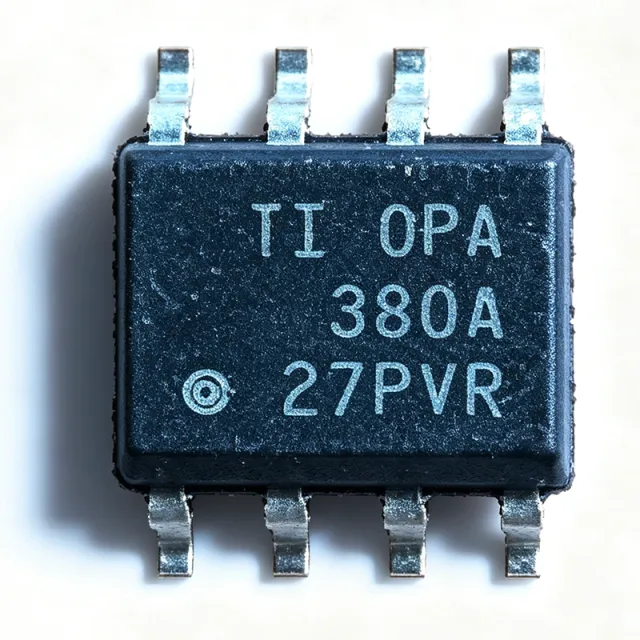
What Is the OPA380AID and Why Do Engineers Choose It?
A transimpedance amplifier is a current-to-voltage converter built on an operational amplifier with a feedback resistor; it forms the analog front end of optical receivers, barcode scanners, and photodiode-based instruments. Within the signal chain, the TIA sits between the photodetector and the ADC or comparator, so its noise, bandwidth, and offset set the dynamic range of the whole optical link.
The OPA380AID from Texas Instruments is purpose-built for fast photodiode applications. Its verified key specifications, per the XAIPART product database, are:
| Parameter | Value |
|---|---|
| Amplifier type | Transimpedance Amplifier (TIA) |
| Channels | 1 |
| Gain bandwidth product | 90 MHz |
| Transimpedance bandwidth | > 1 MHz |
| Input bias current (max) | 50 pA |
| Input offset voltage (max) | 25 uV |
| Offset voltage drift (max) | 0.1 uV/C |
| Input current range | up to 1 mA |
| Dynamic range | 4 to 5 decades |
| Quiescent current | 6.5 mA |
| Supply range | [DATA_NEEDED: exact supply range in V] |
| Operating temperature | -40C to +125C |
| Package / mounting | 8-SOIC (D), surface mount |
| Architecture | Auto-zero + high-speed composite |
What sets this part apart is the auto-zero plus high-speed composite architecture: DC accuracy typical of chopper amplifiers is retained while delivering more than 1MHz of transimpedance bandwidth. This internal arrangement improves overload recovery and settling time compared with traditional composite approaches, which matters directly in receivers that must recover quickly after strong optical events.
How Do You Design the OPA380AID Into a Photodiode Front End?
Designing the OPA380AID in follows the standard TIA topology: the photodiode feeds the inverting input, a single feedback resistor RF sets the transimpedance gain, and a small feedback capacitor CF stabilizes the loop.
Gain selection
Choose RF based on your maximum photocurrent and desired output swing. With the verified input current range of up to 1mA, RF must ensure the output remains within the linear range at full-scale photocurrent. [VERIFY_NEEDED: exact output voltage swing limits versus supply rails per datasheet]
Stability
For stable operation, keep the photodiode capacitance and feedback resistor within the datasheet stability region. A small feedback capacitor is usually required — the combination of photodiode capacitance, RF, and CF defines the closed-loop pole. The TI datasheet (SBOS226) includes a complete stability analysis for photodiode capacitance and feedback resistor selection; consult it before finalizing values.
Reaching 0V output on a single supply
The output stage cannot swing all the way to the negative rail on a single supply, so low photocurrent signals near 0V become compressed. Per the TI product documentation, adding an external pull-down resistor to -5V extends the output voltage range to include 0V, restoring accurate measurement of very low light levels near zero output.
Layout and supply considerations
Keep the photodiode and feedback network leads as short as practical to limit stray capacitance at the summing node — with a 50pA maximum bias current, even small leakage paths on the PCB can degrade the dynamic range. Quiescent current is 6.5mA per amplifier, so thermal design in dense multi-channel boards (such as CT detector arrays) should budget accordingly. [DATA_NEEDED: exact supply range in V, decoupling recommendations, and PSRR figures]
Pinout reference
The 8-SOIC (D) package places the functionally critical pins as follows (full pin table on the product page): Pin 1 is OUT (transimpedance output voltage), Pin 2 is -IN (inverting input, connects to the photodiode node), Pin 3 is +IN (non-inverting reference/bias voltage), Pin 4 is V-, and Pin 8 is V+. Pins 5–7 are N/C or internal nodes — [DATA_NEEDED: exact pin functions 5-7 per datasheet pin configuration].
What Are the Best Alternatives and How Do They Compare?
There is no widely published exact drop-in cross-reference for the OPA380AID. The verified alternatives from the XAIPART database are listed below; all except the OPA2380 require design review:
| Part | Positioning vs OPA380AID | Drop-in? |
|---|---|---|
| OPA2380AID | Dual-channel version of the same TIA in MSOP-8 | No — not pin-compatible with SOIC-8 |
| OPA657ID | 1.6GHz GBW FET-input TIA, much higher speed, different bias/spec profile | No — verify pinout and stability network |
| OPA857ID | 3.3GHz TIA optimized for optical receivers, higher speed, different feedback topology | No — design review required |
| AD8015ARZ | Cross-brand 155Mbps wideband TIA in SOIC-8 | No — different pinout and offset performance |
Choose the OPA380 when DC precision matters most: its 25uV offset and 0.1uV/C drift suit precision optical power measurement. Choose the OPA657 when you need much higher transimpedance bandwidth for fast optical links — the OPA380 offers better long-term Vos stability and lower cost; the OPA657 offers far higher speed at higher price. The OPA2380 shares identical key specifications (90MHz GBW, 50pA max bias current, 25uV max offset, -40C to +125C operation) but its package and pinout differ, so it cannot directly replace the OPA380 on an existing PCB.
What Is the Market and Supply Situation for the OPA380AID?
The OPA380AID is an active product in the Texas Instruments portfolio. On XAIPART, stock stands at 99,999 units with a minimum order quantity of 1, as of 2026-08-30. Pricing tiers verified from the database: $3.15 at qty ≥ 1, $2.84 at qty ≥ 10, $2.45 at qty ≥ 100, $2.10 at qty ≥ 500, and $1.85 at qty ≥ 1,000. The part is RoHS compliant and lead-free per the verified FAQ data. For AEC-Q100 automotive requirements, verify the specific orderable suffix, since the standard OPA380 is an industrial-grade part rather than an automotive-qualified variant. [DATA_NEEDED: forecasted lifecycle status, LTBR/market share data]
What Should Buyers and Designers Watch Next?
Watch three things. First, verify speed headroom against your link budget: the OPA380AID's >1MHz transimpedance bandwidth and 90MHz GBW cover laser rangefinder, barcode, and optical power meter needs, but very fast fiber links push you toward the 1.6GHz OPA657 or 3.3GHz OPA857 — both carry higher price and require stability-network redesign. Second, watch total cost of precision: at $1.85/unit at 1k volume (as of 2026-08-30), the OPA380AID's auto-zero architecture removes the need for external offset calibration or chopper add-ons across 4 to 5 decades of dynamic range. Third, watch thermal budgets in dense arrays: 6.5mA quiescent current per channel and 0.1uV/C drift make multi-channel medical CT and industrial sensor boards feasible without periodic recalibration. When sourcing, purchase only from authorized channels — XAIPART carries 99,999 verified units — to guarantee genuine, RoHS-compliant parts with full traceability.
Comments
Be the first to comment.
🔐 Please sign in to post a comment.
Don't have an account? Sign up