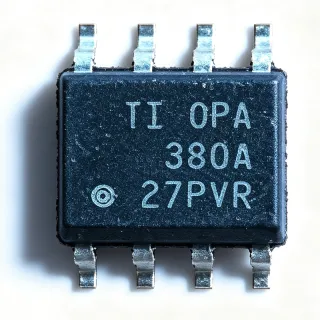
OPA380AID - 90MHz Precision Transimpedance Amplifier | TI
MPN: OPA380AID ✓ Active| Qty | Unit Price | Extended |
|---|---|---|
| 1 | $3.29 | $3.29 |
| 10 | $2.96 | $29.60 |
| 100 | $2.56 | $256.00 |
| 500 | $2.23 | $1,115.00 |
| 1,000 | $1.95 | $1,950.00 |
OPA380AID Overview
A transimpedance amplifier (TIA) is a specialized operational amplifier circuit that converts a sensor current, most commonly from a photodiode, into a proportional output voltage. Within the signal-chain hierarchy, the TIA sits between the optical or current-output sensor and the ADC or comparator, and its bandwidth, input bias current, and offset voltage set the system's dynamic range. The OPA380 belongs to the wider family of precision amplifiers and analog front-end ICs in power management of optical receivers.
Key features include a maximum input bias current of 50pA, a maximum offset voltage of 25uV with only 0.1uV/degC drift, and 4 to 5 decades of dynamic range. These specs allow direct interface with high-impedance photodiodes without external cancellation circuitry.
Architecturally, the OPA380 results from an internal auto-zero amplifier combined with a high-speed amplifier. This composite topology delivers very low 1/f noise and excellent long-term VOS stability while TI's design improves overload recovery and settling time over a traditional discrete composite approach.
Typical applications include high-speed photodiode receivers for optical data links, photodiode-based instrumentation such as spectrophotometers and lab photoreceivers, and barcode or LiDAR-style pulse detection where >1MHz transimpedance bandwidth matters.
Design tip: the feedback resistor and photodiode capacitance set stability - use the datasheet's feedback capacitor guidance, and note the output swings to within millivolts of ground only on a single supply with load returned to a negative rail or virtual ground.
Drop-in alternatives for OPA380AID — same package, pin-to-pin compatible. Different-package parts requiring PCB rework are excluded.
Quick Comparison Tool — Select alternative parts for side-by-side comparison:
OPA380AIDG4
✅ Drop-In📋 Reference alternative (not in catalog)
OPA828IDR
⚡ Same Package✓ In Stock
$1.75 / Unit
View Datasheet →OPA657
⚡ Same Package ⚠️ Specs Unverified📋 Reference alternative (not in catalog)
AD8015ARZ
⚡ Same Package ⚠️ Specs Unverified📋 Reference alternative (not in catalog)
OPA380AID Maximum Ratings & Electrical Characteristics
| Function | Precision High-Speed Transimpedance Amplifier |
| Channels | 1 |
| Gain Bandwidth (GBW) | 90 MHz |
| Transimpedance Bandwidth | > 1 MHz |
| Input Bias Current (max) | 50 pA |
| Offset Voltage (max) | 25 uV |
| Offset Voltage Drift (max) | 0.1 uV/degC |
| Input Current Range | up to 1 mA |
| Dynamic Range | 4 to 5 decades |
| Quiescent Current | 6.5 mA |
| Noise | Very low 1/f noise |
| Operating Temperature | -40C to +125C |
| Package | 8-SOIC (D) |
| Mounting Type | Surface Mount |
| Long-Term VOS Stability | Excellent long-term stability |
OPA380AID Pin Configuration
| Pin 1 | NC — No internal connection |
| Pin 2 | IN- — Inverting input (photodiode node) |
| Pin 3 | IN+ — Non-inverting input (reference/bias voltage) |
| Pin 4 | V- — Negative supply |
| Pin 5 | NC — No internal connection |
| Pin 6 | OUT — Output voltage (transimpedance) |
| Pin 7 | V+ — Positive supply |
| Pin 8 | NC — No internal connection |
Typical Applications
OPA380AID is suitable for 6 applications: High-Speed Photodiode Receivers, Optical Power Metering and Photometry, Laboratory Photoreceivers, Barcode and Pulse Detection, Chemical and Bio-Sensor Photodiode Front Ends, Industrial Optical Sensing.
High-Speed Photodiode Receivers
The OPA380 is ideally suited for high-speed photodiode applications: its 90MHz GBW delivers >1MHz transimpedance bandwidth, while the 50pA maximum bias current preserves sensitivity at low optical power. Placed directly at the photodiode node with a feedback resistor sized per the datasheet stability curves, it converts photocurrent up to 1mA into a voltage with 4 to 5 decades of dynamic range. The auto-zero front end keeps offset error at 25uV maximum, so DC light-level measurements remain accurate without trimming.
Recommended
Optical Power Metering and Photometry
For instrumentation that measures optical power across decades of intensity, the OPA380's 0.1uV/degC maximum offset drift and excellent long-term VOS stability eliminate recalibration drift over time and temperature. The composite auto-zero architecture suppresses 1/f noise, improving accuracy on slow DC measurements, while the 90MHz GBW retains headroom for pulsed sources. A large feedback resistor (e.g., 1M-ohm to 100M-ohm) gives full-scale outputs from nanoamp photocurrents with the 25uV offset contributing negligible error.
Recommended
Laboratory Photoreceivers
Laser optics labs build general-purpose photodiode amplifiers where the OPA380 is frequently chosen over faster parts like the OPA657 because DC precision matters as much as speed. Its 25uV max offset and 50pA bias current allow direct photodiode connection without guard circuitry, and TI's improved overload recovery quickly settles after beam interrupts. With switchable feedback networks, one OPA380 stage covers photocurrents from picoamps to 1mA, suiting beam-alignment and power-monitoring instruments.
Recommended
Barcode and Pulse Detection
Optical barcode scanners and pulse receivers benefit from the OPA380's combination of bandwidth and precision: the >1MHz transimpedance bandwidth resolves fast pulses, while low 1/f noise protects small-signal fidelity in the baseline region. The improved settling and overload recovery over a traditional composite approach keeps recovery time short when a bright reflection saturates the photodiode, allowing rapid return to the quiescent operating point - critical for repeat-read reliability in scanning systems.
Recommended
Chemical and Bio-Sensor Photodiode Front Ends
Absorbance and fluorescence sensors (spectrophotometers, glucose and DNA detection systems) use photodiodes with currents spanning many decades. The OPA380's 4 to 5 decade dynamic range, 25uV max offset, and 0.1uV/degC drift enable a single gain range for quantitative measurement, while the auto-zero topology removes 1/f noise that would otherwise dominate low-frequency readings. Single 5V supply operation simplifies battery-powered portable instruments; drive the reference node with a precision reference for best DC accuracy.
Recommended
Industrial Optical Sensing
Industrial proximity, presence, and break-beam sensors operate from -40C to +125C, exactly matching the OPA380's specified temperature range. The excellent long-term offset stability means field-installed sensors maintain calibration across years of thermal cycling, and 6.5mA quiescent current keeps loop-powered or 24V bus-fed designs within power budgets. Robust overload recovery handles transient exposure to ambient light, and the standard SOIC-8 package supports automated assembly in high-volume sensor modules.
Recommended
Recommended Products Summary
Engineering reference data for OPA380AID — comparison, design guidance, and compliance information.
Selection Guide
Comparison with Alternatives
| Parameter | This Product | OPA380AIDG4 | OPA2380AID | OPA657 |
|---|---|---|---|---|
| Package | 8-SOIC (D) | 8-SOIC (D) - same | MSOP-8 | 8-SOIC (D) - same footprint |
| Brand | Texas Instruments | Texas Instruments | Texas Instruments | Analog Devices |
| Gain Bandwidth | 90 MHz | 90 MHz | 90 MHz (per channel) | 1.6 GHz |
| Channels | 1 | 1 | 2 | 1 |
| Operating Temperature | -40C to +125C | -40C to +125C | -40C to +125C | -40C to +125C |
Key Differentiators
- Composite auto-zero + high-speed architecture (vs OPA657)
- Dual-channel option for multi-beam systems (vs OPA380AIDG4)
- Wide input current range with high dynamic range (vs AD8015ARZ)
Design Notes
TIA stability is set by the feedback resistor (RF) and total input capacitance (photodiode capacitance plus amplifier input capacitance). Size the feedback capacitor using the datasheet transimpedance design guidance: CF must create a pole below the noise-gain zero. Omitting CF is the most common cause of oscillation in photodiode front ends. Follow TI datasheet SBOS193 typical application circuits.
Keep the photodiode as close to pin 2 as possible and use a guard ring or ground plane cutout to minimize leakage currents - with a 50pA max bias current, PCB leakage of just a few pA becomes a measurable error. Place the feedback network with the shortest possible traces, and return the IN+ reference through a clean, low-noise node (ground or precision reference, not a digital rail).
The OPA380 draws 6.5mA quiescent current - budget for this in portable designs. Decouple V+ and V- with 0.1uF ceramics placed within 5mm of the pins plus a 2.2uF bulk capacitor. Output swing near 0V on a single supply requires the load referenced appropriately; if 0V output is needed, use a small negative rail or pull-down resistor per the TI product page guidance.
Compliance Information
Current TI orderable variants (e.g., OPA380AID) are RoHS-compliant and lead-free per TI product listings. REACH and halogen-free status not stated in provided data.