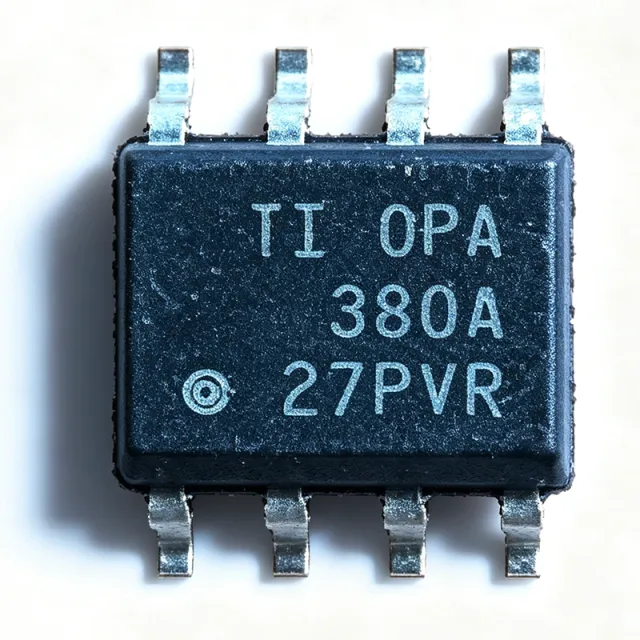
OPA380AID - 90MHz Precision Transimpedance Amplifier | TI
MPN: OPA380AID ✓ Active| Qty | Unit Price | Extended |
|---|---|---|
| 1 | $3.15 | $3.15 |
| 10 | $2.84 | $28.40 |
| 100 | $2.45 | $245.00 |
| 500 | $2.1 | $1,050.00 |
| 1,000 | $1.85 | $1,850.00 |
OPA380AID Overview
A transimpedance amplifier (TIA) is a specialized current-to-voltage converter built on an operational amplifier with a feedback resistor, forming the analog front end of optical receivers, barcode scanners, and photodiode-based instruments. Within the signal-chain hierarchy, the TIA sits between the photodetector and the ADC or comparator, and its noise, bandwidth, and offset set the dynamic range of the whole optical link.
Key features include 50pA maximum input bias current, 25uV maximum offset voltage, and 0.1uV/C maximum drift, giving 4 to 5 decades of dynamic range. The very low 1/f noise and excellent long-term Vos stability result from an internal auto-zero amplifier cascaded with a high-speed amplifier, rather than a traditional composite approach, improving overload recovery and settling time.
The auto-zero plus high-speed composite architecture eliminates the usual precision-versus-speed trade-off: DC accuracy typical of chopper amplifiers is retained while delivering >1MHz transimpedance bandwidth. Quiescent current is 6.5mA per amplifier.
Typical applications include high-speed photodiode receivers for optical communications, laser rangefinders and LiDAR receivers, barcode and medical CT scanner photodiode front ends, and precision optical power meters.
For stable operation, keep the photodiode capacitance and feedback resistor within the datasheet stability region; a small feedback capacitor is usually required, and the output may need a pull-down resistor to include 0V in the output swing.
Drop-in alternatives for OPA380AID — same package, pin-to-pin compatible. Different-package parts requiring PCB rework are excluded.
Quick Comparison Tool — Select alternative parts for side-by-side comparison:
OPA2380AID
📋 Reference alternative (not in catalog)
OPA657ID
📋 Reference alternative (not in catalog)
OPA857ID
📋 Reference alternative (not in catalog)
AD8015ARZ
📋 Reference alternative (not in catalog)
OPA380AID Maximum Ratings & Electrical Characteristics
| Amplifier Type | Transimpedance Amplifier (TIA) |
| Number of Channels | 1 |
| Gain Bandwidth Product | 90 MHz |
| Transimpedance Bandwidth | > 1 MHz |
| Input Bias Current | 50 pA (max) |
| Input Offset Voltage | 25 uV (max) |
| Offset Voltage Drift | 0.1 uV/C (max) |
| Input Current Range | up to 1 mA |
| Dynamic Range | 4 to 5 decades |
| Quiescent Current | 6.5 mA |
| 1/f Noise | Very low (auto-zero architecture) |
| Operating Temperature | -40C to +125C |
| Package | 8-SOIC (D) |
| Mounting Type | Surface Mount |
| Architecture | Auto-zero + high-speed composite |
OPA380AID Pin Configuration
| Pin 1 | OUT — Amplifier output (transimpedance output voltage) |
| Pin 2 | -IN — Inverting input - connects to photodiode cathode/anode node |
| Pin 3 | +IN — Non-inverting input - reference/bias voltage |
| Pin 4 | V- — Negative supply rail |
| Pin 8 | V+ — Positive supply rail |
| Pin 5-7 | N/C or internal nodes — [DATA_NEEDED: exact pin functions 5-7 per datasheet pin configuration] |
Typical Applications
OPA380AID is suitable for 6 applications: High-Speed Photodiode Optical Receiver, Laser Rangefinder and LiDAR Receiver, Precision Optical Power Meter, Barcode Scanner Photodiode Front End, Medical CT Detector Channel, Industrial Optical Sensor and Photogate.
High-Speed Photodiode Optical Receiver
The OPA380 is ideally suited for high-speed photodiode applications: its >1MHz transimpedance bandwidth and 90MHz GBW convert fast photocurrents up to 1mA into voltage with minimal distortion, while the 50pA maximum bias current keeps dark-current offset negligible across 4 to 5 decades of dynamic range. Placed directly at the photodiode with a single feedback resistor and small stabilizing capacitor, the auto-zero architecture adds no switching artifacts and preserves very low 1/f noise, improving detection of weak optical signals in fiber and free-space links.
Recommended
Laser Rangefinder and LiDAR Receiver
LiDAR receivers need to resolve echo amplitudes spanning decades within nanosecond-to-microsecond windows. The OPA380's high-speed composite architecture improves overload recovery and settling time over traditional approaches, letting the TIA recover quickly after the strong transmit leakage or near-field reflection, then accurately amplify weak distant returns. With 25uV maximum offset and 0.1uV/C drift, threshold decisions remain stable over temperature, extending detection range without periodic recalibration in fielded rangefinder and LiDAR modules.
Recommended
Precision Optical Power Meter
Optical power measurement depends on DC precision across wide dynamic range. The OPA380's 4 to 5 decades of dynamic range, 25uV maximum offset, and excellent long-term Vos stability allow a single transimpedance gain setting to cover photocurrents from picoamps to 1mA, simplifying instrumentation design. The very low 1/f noise floor improves reading stability at the lowest light levels, and the SOIC-8 package fits compact handheld meter front ends without the cost of auto-ranging relay or analog-switch gain networks.
Recommended
Barcode Scanner Photodiode Front End
Barcode scanners combine fast modulation with wide amplitude variation as the scan spot crosses labels of differing reflectivity. The OPA380's >1MHz transimpedance bandwidth preserves edge fidelity for high scan rates, while 4 to 5 decades of dynamic range capture both glossy-white and matte-black reflectance in a single gain setting. The auto-zero input stage maintains 50pA bias and low 1/f noise so weak signals from low-contrast labels remain above the noise floor, improving first-pass decode reliability in retail and industrial scanners.
Recommended
Medical CT Detector Channel
CT detector channels place hundreds of photodiode TIAs side by side, making per-channel power and thermal drift critical. The OPA380's 6.5mA quiescent current and 0.1uV/C maximum drift keep heat and offset drift manageable across dense detector arrays, while its excellent long-term Vos stability reduces recalibration frequency. The >1MHz bandwidth supports fast readout of rotating detector elements, and the single SOIC-8 footprint enables compact multi-channel analog boards in medical imaging front ends.
Recommended
Industrial Optical Sensor and Photogate
Industrial optical sensors monitor part presence, position, and speed using photodiode receivers exposed to wide temperature swings and ambient light. The OPA380 operates from -40C to +125C with only 0.1uV/C maximum offset drift, keeping detection thresholds stable on the factory floor. Its 1mA input current range and 4 to 5 decades of dynamic range tolerate both dim reflective sensing and strong direct-beam interruption, while the SOIC-8 package supports compact sensor head designs integrated near the photodiode.
Recommended
Recommended Products Summary
Engineering reference data for OPA380AID — comparison, design guidance, and compliance information.
Selection Guide
Comparison with Alternatives
| Parameter | This Product | OPA2380AID | OPA657ID | AD8015ARZ |
|---|---|---|---|---|
| Brand | Texas Instruments | Texas Instruments | Texas Instruments | Analog Devices |
| Package | 8-SOIC (D) | MSOP-8 (different) | SOIC-8 (same family) | SOIC-8 (pinout differs) |
| Channels | 1 | 2 | 1 | 1 |
| Drop-in Compatible | - | No (dual, MSOP-8) | No - design review required | No - pinout differs |
Key Differentiators
- Precision auto-zero input stage (vs OPA657ID)
- Faster overload recovery than composite TIAs (vs traditional composite TIA designs)
- Single-channel SOIC-8 vs dual MSOP-8 (vs OPA2380AID)
Design Notes
Stability of a TIA depends on the ratio of feedback resistance to photodiode capacitance. With the OPA380's 90MHz GBW, large photodiode capacitance with large feedback resistors can push the loop toward instability - select the feedback capacitor using the datasheet stability region, trading a small bandwidth reduction for robust phase margin. Keep the photodiode-to-inverting-input trace as short as possible to minimize stray capacitance and noise pickup.
The OPA380 draws 6.5mA quiescent current per channel. For battery-powered optical instruments, budget this in total power. On single-supply designs the output cannot reach 0V; per TI documentation, add an external pull-down resistor to -5V (or bias +IN above ground) if the output range must include 0V for low-light measurements.
The OPA380 combines an auto-zero amplifier with a high-speed amplifier. Auto-zero clocks can intermodulate with out-of-band signals, so filter the output bandwidth to the signal of interest. Also, the 1mA maximum input current implies a minimum allowed feedback resistance at full-scale output - verify the full-scale photocurrent times Rf stays within the output swing range over temperature.
Compliance Information
RoHS/lead-free status per standard TI green packaging as listed by distributors. Other compliance fields not stated in provided data.


