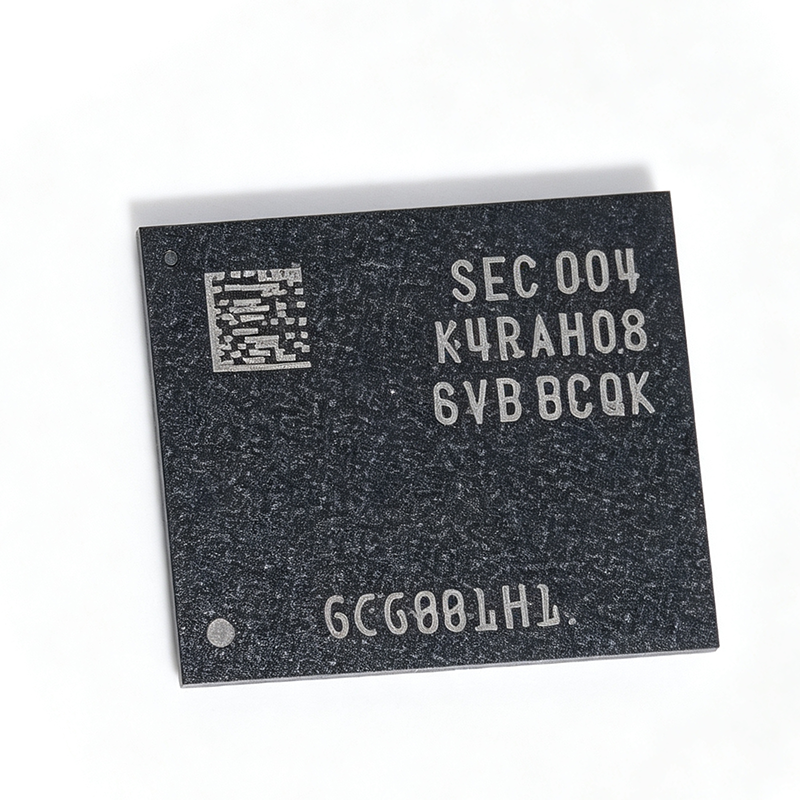
What Is the Samsung K4RAH086VB-BCWM and Why Does It Matter for DDR5 Designs?
The Samsung K4RAH086VB-BCWM is a 16 Gb DDR5 SDRAM organized as 2G x 8, operating at a 5600 Mbps data rate from a single 1.1 V supply in an FBGA-82 surface-mount package. It carries Samsung's BCWM speed bin for the commercial temperature range, integrates on-die ECC, and uses the DDR5 dual independent 32-bit sub-channel architecture with burst length 32 (BL32). It is in active lifecycle status and widely available: XAIPART lists 99,999 units in stock with tiered pricing from $6.20 at qty 1 down to $4.60 at qty 1000 as of 2026-09-12, with an MOQ of 1. Samsung is one of the three leading global DDR5 DRAM suppliers alongside Micron and SK Hynix, making this die a primary qualification target for DDR5-5600 class server, networking, and desktop platforms.
Architecturally, DDR5 moves power management onto the module via a PMIC and splits each die into two independent 32-bit sub-channels, reducing effective command latency on short transfers through the single-data-rate CA bus with dedicated CA training mode. On-die ECC (link ECC at the DQ receiver path) improves reliability without the pin cost of bus ECC. All timing specifications in the Samsung datasheet assume DLL-enabled operation.
What Are the Verified Specifications of the K4RAH086VB-BCWM?
Every specification below is verified from the XAIPART product database against Samsung's DDR5 16Gb B-die component specification (K4RAH0x6VB, Rev 1.0):
| Parameter | Value |
|---|---|
| Memory Type | DDR5 SDRAM |
| Memory Size | 16 Gb |
| Organization | 2G x 8 |
| Data Rate | 5600 Mbps |
| Supply Voltage | 1.1 V |
| Interface | DDR5 (parallel) |
| Package | FBGA-82 |
| Mounting Type | Surface Mount |
| Technology | DRAM (volatile) |
| Speed Grade | BCWM |
| Operating Temperature | Commercial temperature range (per datasheet) |
| ECC | On-die ECC |
| Burst Length | 32 (BL32, DDR5 standard) |
| Sub-channel Architecture | Dual independent 32-bit sub-channels (per DDR5 spec) |
| RoHS Status | Compliant |
| Lifecycle Status | Active |
How Do You Design In the K4RAH086VB-BCWM? A Practical Technical Guide
At 5600 Mbps, signal integrity is the dominant design challenge for this component. DDR5's edge rates demand careful fly-by trace length matching, on-die termination (ODT) tuning, and reference voltage training in the memory controller. Follow this sequence when designing the die into a module or board:
Step 1 — Confirm platform class and QVL. The BCWM bin targets mainstream server, networking, and desktop platforms in the DDR5-5600 class. Confirm the host memory controller's qualified vendor list includes the BCWM speed bin before mass production, since DDR5 training tables are bin-specific.
Step 2 — Plan the power tree. DDR5 moves power management on-module via a PMIC. Provide the 1.1 V VDD rail to the on-module PMIC and decouple per DDR5 guidelines. The 1.1 V core delivers roughly 30% better power efficiency than DDR4's 1.2 V, easing thermal budgets in dense 1U/2U chassis.
Step 3 — Route for 5600 Mbps. Use fly-by routed CA/CK with controlled impedance. Length-match DQ/DQS skews within controller spec windows. Keep DQ/DQS length skew within the 5600 Mbps timing budget and maintain reference-plane continuity on DQ fly-through routing. The Samsung datasheet's CA/CS compliance masks (single-data-rate CA mode) define the voltage/timing limits receivers must meet.
Step 4 — Leverage the dual sub-channel architecture. Each die presents two independent 32-bit sub-channels with BL32 bursts. Map short control-plane accesses to one sub-channel while bulk buffers use the other to improve effective latency on short transfers.
Step 5 — Train and validate. Tune ODT and DFE training in the memory controller. Register the design against the DDR5 PHY vendor's reference layout for first-pass training success. Re-run DDR5 training after any SPD or ODT change to keep eye margins at 5600 Mbps, and validate ODT and drive-strength settings at both temperature extremes.
Step 6 — Choose the right organization. Choose the x8-organized K4RAH086VB-BCWM when your DIMM design needs more ranks per channel and deeper capacity per rank, or when your controller maps better to x8 DQ lanes. x8 parts also pair naturally with bus ECC schemes in server UDIMM/RDIMM designs. Choose x16 dies when maximum density on minimal PCB area matters more than rank count.
Which Temperature Bin Should You Specify: BCWM or an Industrial Variant?
The BCWM suffix indicates Samsung's commercial speed/temperature binning. The extreme-temperature variant within the same family is typically coded with an -I suffix, such as the K4RAH086VB-BIWM. If your application requires -40 °C to +85 °C or wider ambient operation — for example industrial edge enclosures or vibration-prone embedded deployments — specify the industrial-binned sibling rather than the BCWM. Both variants share the identical FBGA-82 footprint, so the substitution requires no PCB change; verify the guaranteed operating range in the ordering information table of the Samsung K4RAH0x6VB datasheet.
What Are the Best Drop-In Alternatives to the K4RAH086VB-BCWM?
Based on the verified cross-reference data in the XAIPART database, the closest substitutes are Samsung family siblings sharing the same 16Gb DDR5 2G x 8 architecture, 5600 Mbps class, and FBGA-82 footprint:
| Parameter | K4RAH086VB-BCWM | K4RAH086VB-BCQK | K4RAH086VB-BIWM | K4RBH046VM-BCWM |
|---|---|---|---|---|
| Memory Size | 16 Gb | 16 Gb | 16 Gb | 16 Gb |
| Organization | 2G x 8 | 2G x 8 | 2G x 8 | 2G x 4 |
| Data Rate | 5600 Mbps | 5600 Mbps | 5600 Mbps | 5600 Mbps |
| Package | FBGA-82 | FBGA-82 | FBGA-82 | FBGA-82 |
| Temperature/Speed Binning | Commercial (BCWM) | [DATA_NEEDED: BCQK bin definition] | Industrial-range classification commonly associated with -I code | Commercial (BCWM) |
| Drop-in compatible with BCWM | — | Yes (same footprint) | Yes (same footprint) | No — requires x4 controller mapping |
| Detailed per-parameter specs | Verified (table above) | [DATA_NEEDED: full product_specs for BCQK] | [DATA_NEEDED: full product_specs for BIWM] | [DATA_NEEDED: full product_specs for K4RBH046VM-BCWM] |
Cross-brand substitution: Micron MT62F1G32D8DR and SK Hynix H5JAG8 memDie-class parts occupy the same 16Gb DDR5 x8 market segment and are mechanically similar in FBGA packages. However, ball map, ZQ calibration, and ODT training parameters can differ between vendors. Treat cross-brand equivalents as second sources, not assumed pin-identical, unless the controller vendor lists them on the same QVL; re-run memory training in your BIOS/memory controller after qualification.
Important incompatibility: The K4RAH086VB is not interchangeable with DDR4 parts such as the K4A8G165WB (a 16Gb DDR4 x16 3200-class component). DDR5 operates at 1.1 V versus DDR4's 1.2 V, uses a different command/address protocol with dual sub-channels and on-die ECC, and is not backward compatible with DDR4 sockets or controllers.
What Applications Is the K4RAH086VB-BCWM Best Suited For?
Enterprise server DIMMs. The die fits DDR5 server RDIMM and LRDIMM designs targeting DDR5-5600 platforms from Intel Xeon and AMD EPYC. Its 16Gb 2G x 8 organization allows eight dies per 8 GB rank with room for rank-dense module topologies, and x8 enables rank-dense RDIMM topologies. Placed behind the RCD and powered by the on-module 12V-to-1.1V PMIC, the die trains at 5600 Mbps with BL32 bursts across dual 32-bit sub-channels.
High-performance desktop memory. Each 16Gb x8 die doubles per-rank density versus 8Gb DDR4 chips, so a single-rank 16GB UDIMM needs only eight components, simplifying layout and reducing BOM cost. Dual 32-bit sub-channels improve effective latency on short BL32 bursts common in gaming workloads.
Networking line cards and switches. The x8 organization pairs well with network ASICs and DPUs whose memory controllers map 64-bit or 72-bit (with ECC) DDR5 buses, while the dual sub-channel structure keeps short control-plane accesses from stalling bulk packet-buffer traffic. The 1.1 V rail eases thermal budgets in dense 1U/2U chassis with limited airflow.
Workstation and AI edge compute modules. On-die ECC plus link-ECC features protect long-running inference jobs against soft errors while 16Gb density raises aggregate capacity without sacrificing 5600 Mbps throughput.
Embedded compute and COM Express. Soldering sixteen 16Gb x8 dies yields 32 GB of on-module memory at 5600 Mbps, eliminating SO-DIMM sockets and their reliability concerns in vibration-prone environments.
Test, measurement, and data acquisition. Multiple x8 dies on a wide DDR5 bus provide acquisition engines tens of GB of continuous-write buffering; the 1.1 V rail reduces internal dissipation, aiding fanless and low-noise instrument designs.
How Much Does the K4RAH086VB-BCWM Cost and Where Can You Buy It?
XAIPART tiered pricing, verified as of 2026-09-12:
| Quantity | Unit Price (USD) |
|---|---|
| 1+ | $6.20 |
| 10+ | $5.80 |
| 100+ | $5.35 |
| 500+ | $4.95 |
| 1000+ | $4.60 |
Stock situation as of 2026-09-04: icDirectory reported 27,700 pcs, Octopart Canada 48,840 pcs (both updated Aug 31, 2026), and Wolfchip 5,420 pcs (updated Aug 26, 2026). XAIPART itself lists 99,999 units with an MOQ of 1. With stock this deep, lead time is typically immediate shipment to a few days for standard quantities; for volumes above published stock, expect 8–12 weeks of factory lead time from Samsung's DRAM allocation cycle. Single units and cut-tape quantities ship immediately from existing stock.
What Is the Lifecycle and Supply Outlook for This Component?
The K4RAH086VB-BCWM carries an active lifecycle status in the XAIPART database. As one of Samsung's current-production 16Gb DDR5 B-die components targeting the mainstream DDR5-5600 server, networking, and desktop segments, it sits in the volume phase of the DDR5 transition that is superseding DDR4. Supply is deep across independent distribution as of late August/early September 2026. [DATA_NEEDED: manufacturer PCN/EOL forecast and contractual lifecycle commitments for long-term supply agreements.]
What Should Buyers Watch Next for DDR5 Component Sourcing?
Watch bin definitions in the ordering table. DDR5 training tables are bin-specific; the BCWM and BIWM suffixes encode speed/temperature binning that must match your platform QVL. Always verify the exact bin definition in the Samsung ordering-information table before substitution in extreme-temperature designs.
Watch training margins as rates rise. 5600 Mbps edges are tighter than 4800 Mbps. Pre-characterize training margins across the full temperature range and re-verify 5600 Mbps eye diagrams after any memory-clock or termination-profile firmware update.
Watch compliance documentation. The part is RoHS compliant and supplied lead-free, consistent with Samsung's current-production DDR5 portfolio, and Samsung DRAM in FBGA packaging is halogen-free per standard Samsung environmental policy. However, because verified web data for this part does not include an explicit compliance certificate, confirm RoHS/REACH declarations via Samsung's product compliance portal for your exact date code before final qualification of RoHS-critical programs.
Watch second-source strategy. Qualify Micron and SK Hynix 16Gb DDR5 x8 dies as validated second sources with re-run memory training — not as assumed pin-identical swaps — to hedge supply without risking field failures.
Watch tiered pricing windows. The step from $6.20 to $4.60 between qty 1 and qty 1000 (as of 2026-09-12) rewards consolidated quarterly buys; aligning module builds to the 500+ and 1000+ tiers cuts unit cost roughly 20% versus single-unit purchases.
For current stock, the full ball map, and volume RFQs, visit the K4RAH086VB-BCWM product page on XAIPART.
Comments
Be the first to comment.
🔐 Please sign in to post a comment.
Don't have an account? Sign up