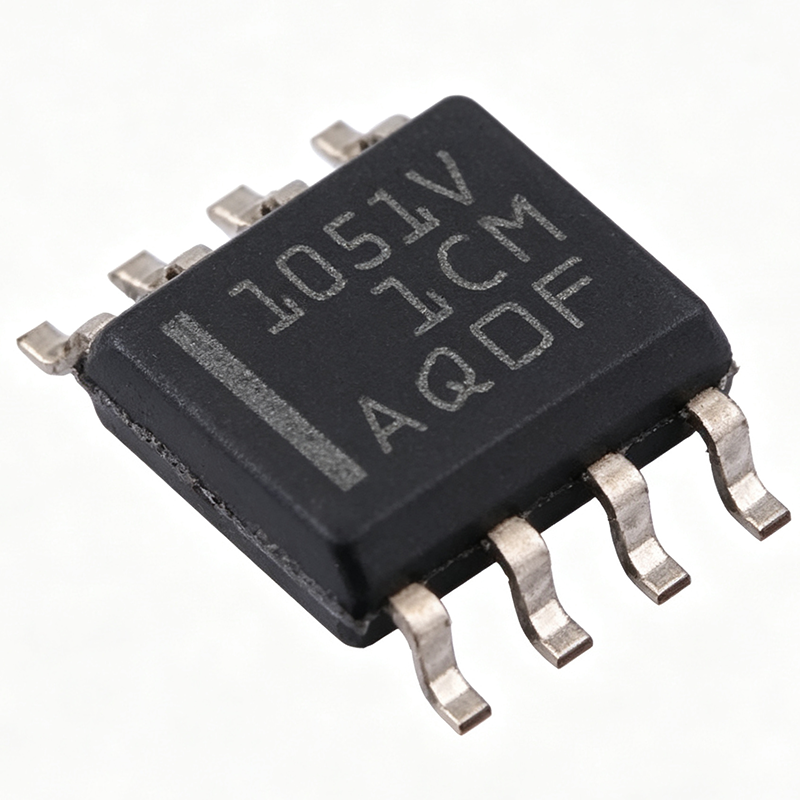
Quick Answers: What Is the TCAN1051HVDQ1 and Why Do Automotive Engineers Specify It?
The Texas Instruments TCAN1051HVDQ1 is an automotive-grade, fault-protected high-speed CAN FD transceiver that delivers data rates up to 2 Mbps from a 4.5 V to 5.5 V supply in an 8-pin SOIC (D) package. It withstands bus faults up to ±58 V on CANH and CANL, operates across the full -55°C to +125°C automotive temperature range, is AEC-Q100 qualified, and complies with ISO 11898-2:2016. As of 2026-09-14, XAIPART lists 99,999 units in stock with MOQ 1 at $1 per unit across all quantity tiers (1, 10, 100, 500, and 1000+ pieces).
The device sits at the physical layer between a CAN protocol controller and the differential bus lines CANH and CANL, converting controller logic signals to differential bus signals and back. Key protections include the ±58 V bus fault tolerance, a silent (listen-only) mode for diagnostics, a TXD dominant timeout that prevents a hung controller from locking up the bus, and integrated thermal shutdown. Typical operating supply current is 45 mA, and the -12 V to +12 V common-mode voltage range plus split termination capability support EMC performance in electrically noisy vehicles. Typical applications include body control modules, gateway modules, battery management systems, ADAS ECUs, electric powertrain controllers, and industrial CANopen nodes.
The lifecycle status is active, and the device is pin-compatible with standard high-speed CAN transceivers, enabling drop-in upgrades to CAN FD and higher fault tolerance in existing designs. You can order directly on the TCAN1051HVDQ1 product page and download the official datasheet PDF from TI.com.
Technical Guide: How Do You Select, Design In, and Use the TCAN1051HVDQ1?
Selection starts with three questions. First, does your network run CAN FD frames? The TCAN1051HVDQ1 supports CAN FD at up to 2 Mbps; if your arbitration or data phase exceeds 2 Mbps, select the same-family TCAN1051GVDRQ1, which supports 5 Mbps. Second, how much bus fault tolerance does the wiring harness require? The HVD variant withstands ±58 V on CANH and CANL — important where harness segments can short to battery voltages, as in door and lamp circuits or near high-voltage contactors. Third, what is your ambient temperature? The -55°C to +125°C rating and AEC-Q100 qualification cover under-hood, engine-bay, and battery-pack locations, with integrated thermal shutdown adding a protection layer in hot enclosures.
On the electrical side, plan the supply carefully. The device operates from a 4.5 V to 5.5 V rail with a typical 45 mA operating current. Per the TI datasheet, decouple VCC locally with a 0.1 µF and 4.7 µF capacitor combination for reliable bus driving and transient immunity. Keep the transceiver physically close to the CAN controller to minimize loop area on TXD and RXD, and provide a solid ground plane for EMC.
Bus termination follows standard high-speed CAN practice: terminate the twisted pair with a 120 Ω resistor at each physical end, matching the cable characteristic impedance. The TCAN1051HVDQ1 also supports split termination, where the 120 Ω termination splits into two 60 Ω resistors with a center capacitor to ground. This improves common-mode noise filtering and radiated EMC performance — a common requirement in vehicle gateways and powertrain networks.
Use the mode pins deliberately. In normal mode, the transceiver drives and receives 2 Mbps CAN FD frames per ISO 11898-2:2016. In silent (listen-only) mode, the device receives bus traffic without driving it — ideal for network management and diagnostic sniffing during calibration, as in ADAS bus monitoring, without injecting frames. The TXD dominant timeout is a safety feature: if the CAN controller faults and holds TXD dominant, the timeout releases the bus so a single node cannot block fault broadcasts — critical in BMS and powertrain architectures where fault messages must get through.
| Parameter | TCAN1051HVDQ1 (Verified Value) |
|---|---|
| Function | High-speed CAN FD transceiver |
| Data Rate | 2 Mbps |
| Bus Fault Protection | ±58 V on CANH and CANL |
| Supply Voltage Range | 4.5 V to 5.5 V |
| Operating Supply Current | 45 mA (typical) |
| Common-Mode Voltage Range | -12 V to +12 V |
| Protocol Standard | ISO 11898-2:2016 |
| Modes | Normal, Silent (listen-only) |
| TXD Dominant Timeout | Yes |
| Thermal Shutdown | Yes |
| Operating Temperature | -55°C to +125°C |
| Package | SOIC-8 (D) |
| Mounting Type | Surface Mount |
| Automotive Qualification | AEC-Q100 |
| RoHS Status | Compliant |
| Lifecycle Status | Active |
Pin assignment on the SOIC-8 (D) package: Pin 1 is TXD (transmit data input from the CAN controller, dominant = low), Pin 2 is GND, Pin 3 is VCC (4.5 V to 5.5 V supply), Pin 4 is RXD (receive data output to the CAN controller), Pin 5 is [DATA_NEEDED: pin function for D-package variant — VIO only on V-suffix parts; may be STB or NC], Pin 6 is CANL (±58 V fault protected), Pin 7 is CANH (±58 V fault protected), and Pin 8 is [DATA_NEEDED: pin 8 name — STB/EN or S] (mode control / standby input). Confirm pin 5 and pin 8 functions against the TI datasheet for your exact suffix before layout signoff.
Alternatives & Comparison: What Are the Drop-In Alternatives to the TCAN1051HVDQ1?
Based on verified alternative data, the strongest drop-in options come from the same TI family in the identical SOIC-8 footprint. The best drop-in alternatives are TCAN1051HQ1 (same family, lower bus fault protection than the ±58 V HV variant), TCAN1051GVDRQ1 (5 Mbps CAN FD), and TCAN1042GVDRQ1 (integrated common-mode choke-compatible, 5 Mbps). All are pin-to-pin compatible CAN FD transceivers; verify the fault protection rating your harness requires before substituting. Cross-brand, the NCV7342 from onsemi is a CAN FD transceiver alternative, but you must check its fault rating against the ±58 V specification of the HVD variant. Full verified spec values for these alternatives are not in the current database — each cell requiring confirmation is marked below.
| Parameter | TCAN1051HVDQ1 | TCAN1051HQ1 | TCAN1051GVDRQ1 | TCAN1042GVDRQ1 | NCV7342 |
|---|---|---|---|---|---|
| Family / Origin | TI, same family | TI, same family | TI, same family | TI, same family | Cross-brand CAN FD transceiver |
| Pin Compatibility (SOIC-8) | Reference | Pin-to-pin compatible | Pin-to-pin compatible | Pin-to-pin compatible | [DATA_NEEDED: pin compatibility verification] |
| Data Rate | 2 Mbps | [DATA_NEEDED: data rate] | 5 Mbps | 5 Mbps | [DATA_NEEDED: data rate] |
| Bus Fault Protection | ±58 V on CANH/CANL | Lower than ±58 V HV variant | [DATA_NEEDED: bus fault protection] | [DATA_NEEDED: bus fault protection] | [DATA_NEEDED: fault rating vs ±58 V] |
| Common-Mode Choke Compatibility | [DATA_NEEDED: choke compatibility] | [DATA_NEEDED] | [DATA_NEEDED] | Integrated common-mode choke-compatible | [DATA_NEEDED] |
Regarding NXP equivalents: the closest family is the TJA1051 (e.g., TJA1051T/3) in SOIC-8, which is pin-compatible in function for standard high-speed CAN but does not match the ±58 V fault protection. CAN FD capability must be checked per variant. Verify pinout and fault ratings before production use — do not treat a non-HV part as a fault-tolerant substitute.
Industry Insight: What Is the Market Position and Supply Situation for the TCAN1051HVDQ1?
The TCAN1051HVDQ1 is an active-lifecycle Texas Instruments product, which means TI continues production and supports new designs. As of 2026-09-14, XAIPART lists 99,999 units in stock with MOQ 1 and unit pricing of $1 at every quantity break (1, 10, 100, 500, and 1000+). Availability is generally good because the device is an active TI automotive product distributed through authorized channels including DigiKey, Mouser, and TI.com direct sales.
[DATA_NEEDED: formal market share ranking, competitor volume data, and TI product-longevity commitment statement for this part number — not present in current database.]
Trends & Outlook: What Should Buyers Watch When Sourcing the TCAN1051HVDQ1?
Three trends anchored to verified specs should shape your sourcing decisions. First, the CAN FD transition: networks are migrating from classic CAN to CAN FD, and the TCAN1051HVDQ1's 2 Mbps ISO 11898-2:2016 compliance makes it a future-proof drop-in for legacy SOIC-8 footprints. However, if your next platform targets data phases above 2 Mbps, plan migration to the same-footprint TCAN1051GVDRQ1 or TCAN1042GVDRQ1 at 5 Mbps now rather than redesigning later.
Second, fault-tolerance requirements are rising as vehicle electrical architectures push higher voltages and longer harness runs near BMS contactors, onboard chargers, and traction inverters. The ±58 V bus fault protection and thermal shutdown of the HVD variant address exactly this exposure; the TCAN1051HQ1 with lower fault protection may not survive the same harness fault events. Match the protection rating to the worst-case wiring fault in your application, not the average case.
Third, dual-source qualification: cross-brand alternatives like the NCV7342 exist, but fault ratings differ and must be verified against ±58 V before approving a second source. Watch tiered pricing at the 1/10/100/1000-unit breaks on distributor listings (typically quoted as of the current month), keep MOQ-1 access for prototyping as XAIPART offers, and monitor the active lifecycle status — any change to that status would be the earliest signal to trigger last-time-buy planning.
Comments
Be the first to comment.
🔐 Please sign in to post a comment.
Don't have an account? Sign up