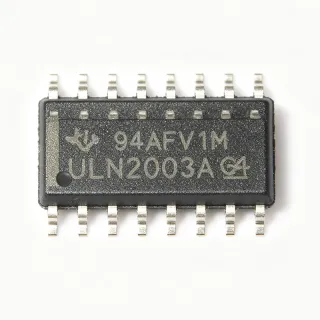
TCAN1051GVDRQ1 - 5Mbps CAN FD Transceiver AEC-Q100 | TI
MPN: TCAN1051GVDRQ1 ✓ Active| Qty | Unit Price | Extended |
|---|---|---|
| 1 | $2.14 | $2.14 |
| 10 | $1.93 | $19.30 |
| 100 | $1.68 | $168.00 |
| 500 | $1.45 | $725.00 |
| 1,000 | $1.28 | $1,280.00 |
TCAN1051GVDRQ1 Overview
A CAN (Controller Area Network) transceiver is a physical-layer interface IC that converts the logic-level TXD and RXD signals of a CAN controller into the differential CANH/CANL bus signals. Within the power-management and interface hierarchy, the transceiver sits between the host microcontroller and the twisted-pair bus, defining bus timing, fault tolerance, and ESD robustness. CAN FD (Flexible Data-rate) extends classical CAN by allowing faster bit rates during the data phase, which this device supports at up to 5 Mbps.
Key features include AEC-Q100 automotive qualification, flexible data-rate operation, integrated fault protection on the CANH/CANL bus pins, and a separate VIO pin that lets the I/O side interface with 3.3 V or 5 V microcontrollers while the transceiver core runs at 5 V. The GV variant designation indicates the VIO-capable version without standby/sleep mode, simplifying designs that do not require low-power bus monitoring.
Technically, the device integrates dominant/short-circuit protection, bus fault detection, and thermal shutdown behavior typical of TI's TCAN1051 family, protecting the transceiver against wiring faults to battery, ground, or other bus lines. The differential receiver architecture maintains receiver timing margins over the full -55C to +125C automotive temperature range, and the SOIC-8 footprint simplifies layout with the standard CAN transceiver pin ordering (TXD, GND, VCC, RXD, VIO, CANL, CANH).
Typical applications include automotive body control modules, gateways, electric powertrain and battery management nodes, and industrial CAN networks where the 5 Mbps CAN FD data phase shortens frame transmission times versus classical 500 kbps CAN.
Design consideration: keep the stub length from transceiver to bus connector short and use a split-termination network (typically two 60-ohm resistors with a capacitor to ground) for best EMC performance; never omit the 100 nF decoupling capacitor close to VCC.
This page synthesizes distributor pricing from DigiKey, Mouser, LCSC and Octopart, same-package drop-in alternatives, and practical design notes not consolidated in the manufacturer datasheet.
Drop-in alternatives for TCAN1051GVDRQ1 — same package, pin-to-pin compatible. Different-package parts requiring PCB rework are excluded.
Variants in this series
Same-series models that are drop-in compatible with TCAN1051GVDRQ1 (same form factor and footprint) — differing in Product Type, Data Rate, Package, Fault Protection, Packaging.
Quick Comparison Tool — Select alternative parts for side-by-side comparison:
TCAN1051HVDRQ1
✅ Drop-In📋 Reference alternative (not in catalog)
TCAN1051HGDRQ1
✅ Drop-In📋 Reference alternative (not in catalog)
TCAN1051GDRQ1
✅ Drop-In📋 Reference alternative (not in catalog)
TCAN1051VDRQ1
✅ Drop-In✓ In Stock
$0.31 / Unit
View Datasheet →TCAN1042HGVDR
✅ Drop-In📋 Reference alternative (not in catalog)
TCAN1043GDRQ1
✅ Drop-In📋 Reference alternative (not in catalog)
TCAN1051GVDRQ1 Specifications
| Product Type | Automotive fault-protected CAN FD transceiver |
| Data Rate | Up to 5 Mbps (CAN FD) |
| Supply Voltage (VCC) | 4.5 V to 5.5 V |
| I/O Supply (VIO) | 3.3 V to 5 V (VIO-capable variant) |
| Protocol | CAN 2.0A/B and CAN FD |
| Number of Drivers | 1 |
| Number of Receivers | 1 |
| Duplex | Half duplex |
| Mounting Style | SMD/SMT |
| Package | SOIC-8 (D), 3.90 mm width |
| Operating Temperature | -55C to +125C |
| Automotive Qualification | AEC-Q100 |
| Fault Protection | CANH/CANL bus fault protection (G version) |
| Standby / Sleep Mode | No (GV variant, no standby) |
| RoHS Status | Compliant |
TCAN1051GVDRQ1 Pin Configuration
| Pin 1 | TXD — Transmit data input from CAN controller (referenced to VIO) |
| Pin 2 | GND — Ground reference |
| Pin 3 | VCC — Transceiver supply, 4.5 V to 5.5 V |
| Pin 4 | RXD — Receive data output to CAN controller (referenced to VIO) |
| Pin 5 | VIO — I/O level supply for TXD/RXD, 3.3 V or 5 V |
| Pin 6 | CANL — CAN low bus line (fault protected) |
| Pin 7 | CANH — CAN high bus line (fault protected) |
| Pin 8 | NC — No connect (GV variant has no standby/mode pin) |
Typical Applications
TCAN1051GVDRQ1 is suitable for 6 applications: Automotive Body Control Modules, Electric Powertrain and Battery Management, Vehicle Gateways and Domain Controllers, Industrial CAN Networks and Automation, Telematics and Fleet Tracking Units, Medical Equipment Control Buses.
Automotive Body Control Modules
The TCAN1051GVDRQ1 fits body control modules (BCM) because its AEC-Q100 qualification and -55C to +125C rating cover the under-hood and cabin thermal environments where lighting, door, and seat control nodes operate. Its integrated CANH/CANL fault protection survives wiring-harness shorts to battery or ground - a common failure mode in vehicles - without destroying the transceiver. With VIO support, a 3.3 V BCM microcontroller connects directly to TXD/RXD without level shifters. Used in normal-mode CAN FD operation at the vehicle's network speed (up to 5 Mbps data phase), it shortens diagnostic and firmware-update frames; the standard SOIC-8 footprint keeps the layout identical across platform derivatives.
Recommended
Electric Powertrain and Battery Management
In EV powertrain and battery management systems, the TCAN1051GVDRQ1 provides the fault-tolerant CAN FD physical layer needed for cell-voltage and temperature reporting between battery modules and the vehicle gateway. The 5 Mbps flexible data-rate capability reduces frame latency for time-critical charge-control messages compared with 500 kbps classical CAN, and the fault protection tolerates the high-voltage isolation faults characteristic of pack environments. Placing the transceiver near the connector with a split-termination network (two 60-ohm resistors plus capacitor to ground) minimizes emissions; the -55C to +125C AEC-Q100 rating covers pack exterior temperature extremes during fast charge and cold-crank conditions.
Recommended
Vehicle Gateways and Domain Controllers
Gateway ECUs bridging multiple CAN FD and LIN channels benefit from the TCAN1051GVDRQ1's deterministic 5 Mbps data-phase support and robust fault behavior. Gateways often translate high-traffic powertrain and chassis buses, so short frame times at 5 Mbps lower arbitration backlog; the transceiver's receiver timing maintains margins across the full automotive temperature range. Its VIO pin interfaces with 3.3 V SoC or MCU I/O banks directly, simplifying mixed-voltage gateway boards that also host Ethernet and LVDS. The SOIC-8 package allows eight or more CAN channels to be placed densely along one board edge adjacent to the bus connectors with short stubs.
Recommended
Industrial CAN Networks and Automation
Industrial machinery, motor-drive networks, and CANopen/CAN FD fieldbus nodes adopt the TCAN1051GVDRQ1 even outside automotive because its fault-protected bus pins withstand industrial wiring abuse - accidental shorts to 24 V rails or ground during panel maintenance. The 5 Mbps data phase shortens cyclic synchronization frames on time-sensitive networks (TSN-style CAN FD deployments), and the -55C to +125C rating exceeds typical industrial -40C to +85C requirements with margin. VIO lets modern 3.3 V PLC microcontrollers connect without translation. Place 100 nF of ceramic decoupling directly at VCC and route CANH/CANL as a 120-ohm differential pair away from switching-power nodes.
Recommended
Telematics and Fleet Tracking Units
Telematics black boxes tap the vehicle CAN bus to capture speed, mileage, and fault frames; the TCAN1051GVDRQ1 provides a listen-protected receive path whose fault protection prevents harness miswiring during field installation from damaging the tracker. Because telematics units must function from cold soak in parked vehicles to cabin heat, the -55C to +125C AEC-Q100 rating covers the entire deployment envelope. The device's CAN FD support future-proofs trackers against next-generation 5 Mbps bus networks, while VIO adapts its TXD/RXD to the 3.3 V cellular modem or GNSS module's MCU domain without additional level-shifting components.
Recommended
Medical Equipment Control Buses
Diagnostic and imaging equipment increasingly use CAN FD internally for module-to-module communication where EMC and cable reliability matter. The TCAN1051GVDRQ1's fault-protected bus pins tolerate cable disconnects and partial shorts on heavily flexed internal harnesses, while its wide -55C to +125C margin ensures reliability in equipment qualified beyond commercial grades. The 5 Mbps data phase reduces latency for real-time control loops between the main controller and motion or detector modules, and the VIO pin directly interfaces 3.3 V controller logic. Keep the bus differential pair impedance-controlled at 120 ohms and decouple VCC with 100 nF local ceramic capacitance.
Recommended
Recommended Products Summary
Engineering reference data for TCAN1051GVDRQ1 — comparison, design guidance, and compliance information.
Selection Guide
Comparison with Alternatives
| Parameter | This Product | TCAN1051HVDRQ1 | TCAN1051HGDRQ1 | TCAN1051GDRQ1 | TCAN1042HGVDR |
|---|---|---|---|---|---|
| Package | SOIC-8 (D) | SOIC-8 (D) - same | SOIC-8 (D) - same | SOIC-8 (D) - same | SOIC-8 (D) - same |
| Brand | Texas Instruments | Texas Instruments | Texas Instruments | Texas Instruments | Texas Instruments |
| CAN FD Data Rate | Up to 5 Mbps | Up to 5 Mbps | Up to 5 Mbps | Up to 5 Mbps | Up to 5 Mbps |
| VIO I/O Level Pin | Yes (3.3 V / 5 V) | Yes (H variant) | No | No | Yes (VIO variant) |
| Fault Protection Level | Enhanced fault protection (G family) | Enhanced (same family) | Enhanced (same family) | Enhanced (same family) | Basic bus fault protection |
| Operating Temperature | -55C to +125C | -55C to +125C | -55C to +125C | -55C to +125C | -55C to +125C |
| Automotive Qualification | AEC-Q100 (Q1) | AEC-Q100 (Q1) | AEC-Q100 (Q1) | AEC-Q100 (Q1) | AEC-Q100 (Q1) |
Key Differentiators
- VIO pin for direct 3.3 V controller interfacing (vs TCAN1051GDRQ1)
- Enhanced fault protection and diagnostics (vs TCAN1042HGVDR)
- No standby mode simplifies always-on designs (vs TCAN1051HVDRQ1)
- Identical SOIC-8 footprint across family (vs TCAN1051HGDRQ1)
Design Notes
Place the TCAN1051GVDRQ1 within a few millimeters of the bus connector and route CANH/CANL as a tightly coupled differential pair with approximately 120-ohm differential impedance. Keep the transceiver-to-connector stub as short as possible; long stubs cause reflections that erode CAN FD data-phase timing margin at 5 Mbps. Decouple VCC with a 100 nF ceramic capacitor placed directly at pin 3, plus a 1 uF bulk capacitor nearby. Connect VIO (pin 5) with its own 100 nF decoupling capacitor, especially when VIO is powered from a different rail than VCC.
Do not leave VIO floating - the GV variant's TXD/RXD thresholds reference VIO, so a floating pin produces undefined I/O levels and intermittent communication. The GV suffix has no standby or sleep mode, so if the design requires low-power bus monitoring or wake-up, select a sleep-capable family member (TCAN1051-Q1 series) instead. Also verify the bus termination: use a single 120-ohm terminator at each physical bus end (60 ohms effective at any node) or a split-termination network for better EMC; unterminated stub networks will fail at 5 Mbps even though the transceiver meets datasheet timing.
For EMC-sensitive platforms, implement a split termination: two 60-ohm resistors in series across CANH/CANL with their midpoint connected to a 4.7 nF to 10 nF capacitor tied to chassis ground. This attenuates common-mode emissions without distorting differential signaling. Keep the TXD trace short and away from switching regulator nodes to prevent false dominant glitches during transients. TI's TCAN family application literature and reference designs demonstrate bus-side common-mode choke placement adjacent to the connector, which typically improves radiated emissions margins by several dB in the 30-200 MHz band.
Estimated: the TCAN1051GVDRQ1 dissipates only tens of milliwatts in normal operation (5 V supply, dominant-drive current through the 60-ohm effective bus termination implies roughly 100-150 mA per CANH/CANL pin pair only during dominant bits). The SOIC-8 package handles this without a heatsink; ensure standard copper pours on pins 2 (GND) for heat spreading. No special thermal design is required, but verify worst-case dissipation in a dominant-clamped fault condition per the manufacturer datasheet thermal derating information.
Compliance Information
RoHS compliance and AEC-Q100 (Q1) automotive grade indicated by TI product page and distributor listings. REACH, halogen-free, and conflict-minerals status not stated in provided data.